
Evidence-Based Creativity: The New Hard Skill for Marketers in the AI Era
A learn article on 'evidence-based creativity' as a new marketing skill in the AI era, drawing on a Contentful and Atlantic Insights survey of 425 marketing decision-makers. It covers data analysis outranking pure creativity, the rise of full-stack marketers, and the gap between AI investment and results.
A few days ago, an old friend of mine who works in marketing invited me out for tea.
The first thing he said as we sat down was: "Honestly, how many more years do you think I can keep doing this job?"
His company recently rolled out AI. Writing copy, creating images, editing videos — AI can take a pass at all of it. The whole team is on edge, and the whisper going around is: AI is here, and marketers are finished.
I told him: don't panic just yet. I happen to have a report on hand that speaks directly to that anxiety.
Last September, Contentful (a company that builds a digital experience platform) partnered with market research firm Atlantic Insights to release a survey. 425 marketing decision-makers filled out questionnaires, spanning different industries, company sizes, and regions. They also had a group of marketers spend ten days immersed in real work with AI tools, recording their screens and narrating their thinking as they went.
The conclusion is counterintuitive.
AI isn't here to take your job. It's here to reshuffle the deck.
There's a new card on the table now. It's called "evidence-based creativity."
What Is Evidence-Based Creativity?
So what exactly is evidence-based creativity?
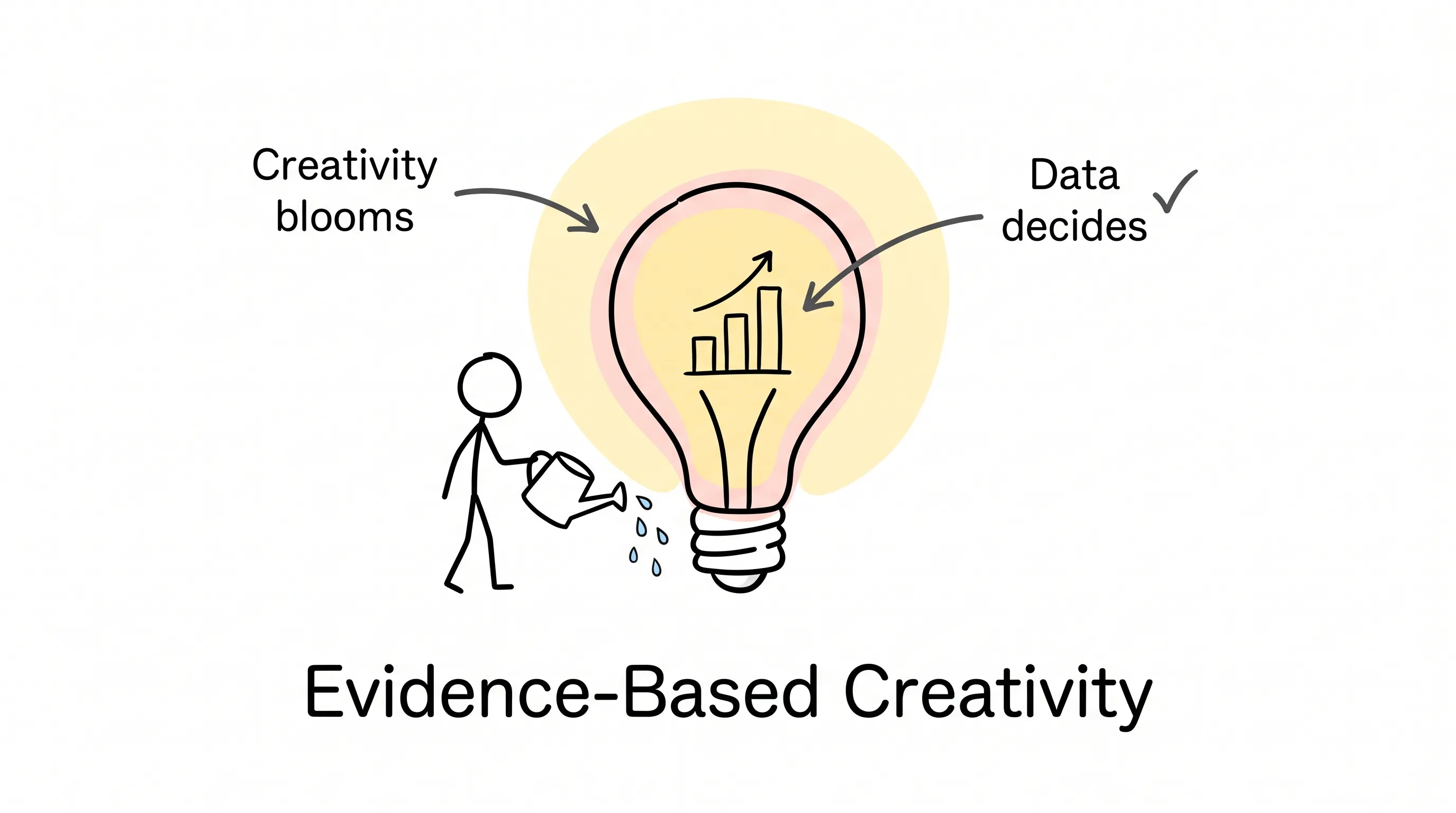
In one phrase: creativity blooms, data decides.
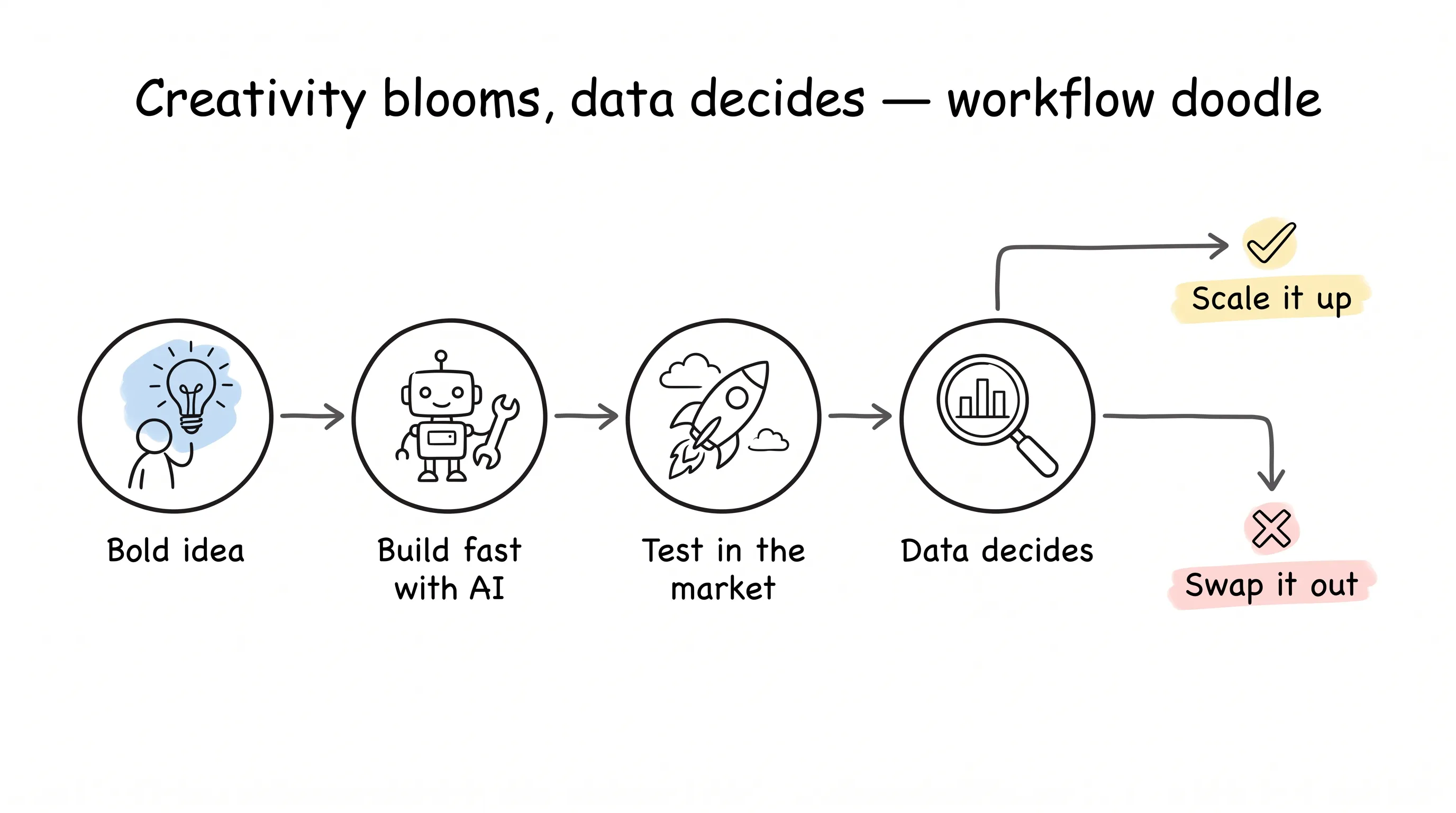
You dream up a bold idea, use AI to build it fast, then throw it into the market to test. If the data says it works, scale it up. If the data says no, swap it out.
In the past, marketers competed on "coming up with one good idea." Now, they compete on "coming up with a fistful of ideas — and proving which one is best."
This isn't just my hunch. The data says so.
The survey included this question: in marketing today, which skill matters most? Guess what came in first.
Not creativity. It was data analysis and interpretation — 46% of respondents ranked it number one.
Second place: digital experience design, at 40%. After that, personalization strategy and writing prompts for AI, tied at 37% each; campaign testing and optimization, at 33%.
Take a good look at that list. More than half of it has to do with data, testing, and optimization. Pure creativity — the skill we thought was our meal ticket — didn't even crack the top three.
The report offers another judgment I couldn't agree with more: tomorrow's top marketers won't split into two camps, "creative types" and "analytical types." They'll be both at once.
Organizations have figured this out too. 45% of companies have already started providing AI training for their teams. This isn't trend-chasing — it's catching up on lessons they skipped.
A New Breed of "Full-Stack Marketers" Is Emerging
There's one more observation in the report that, to me, paints a more vivid picture than the term "evidence-based creativity" ever could.
A breed of "full-stack marketers" is taking shape.
What is a full-stack marketer? Someone who can plug AI into the entire workflow.
They know how to write prompts, how to build AI workflows, how to pick the handful of tools that suit them from a pile of options, and then embed those tools into their daily work. Like an engineer assembling parts, they assemble their own marketing toolkit.
This isn't future tense. It's present continuous.
49% of marketers are already using AI copilots inside their office software; 48% are using generative tools to create content.
Right? Odds are it looks the same around you. Writing a weekly report? Let AI draft it. Making a poster? Have AI produce three versions. Before a meeting? Let AI tidy up the minutes.
The tools have already climbed onto everyone's desk. Only one question remains: are you the person using the tools, or the person being outdone by them?
Signed Up for the Gym, Never Worked Out
But every coin has a flip side.
The most gut-punching part of this report is a set of "temperature gap" numbers (the gap between money spent and results delivered).
74% of marketing teams are putting money into AI. Of those, 34% plan to invest at least $500,000 over the next one to three years.
The money is real, hard cash.
And then?
Two-thirds say: our current marketing tech stack isn't helping us get the work done faster or better.
89% of teams are already using AI tools. Yet only 18% admit that after adopting AI, their dependence on development teams and data teams has truly gone down.
The report calls this the "optimism-execution gap."
What does it mean? The money has been spent, the tools are in use, and the returns are nowhere in sight. It's like signing up for a gym membership and showing up three times a year.
Why does this happen?
From what I've observed, many teams treat "buying tools" as "using AI." The tools got bought, but the workflow never changed. People keep working the old way, and AI ends up as one more ornament sitting on the desk.
The tools aren't what's missing. What's missing is the pair of hands that embeds those tools into the process.
Two Sides of the Atlantic, Two Playbooks
The report also contains a fascinating finding: with the very same AI, the two sides of the Atlantic have played two different games.
Europe: steady. 58% of marketers there test AI tools selectively, under a clear plan. Nearly a third are drilling their governance skills: brand voice, compliance, quality standards — nothing left loose.
America: fast. 37% of marketers there put their energy into campaign testing and optimization, versus 26% in Europe. When measuring success, US teams look at content quality (45%) and agility (39%), while their European counterparts care more about operational stability and speed (43%).
One plays like Go — set up the board first, then place each stone. The other plays like basketball — start running first, figure the rest out as you go.
Which is better? I don't know. But behind both playbooks lies the same underlying logic: fit data with brakes and a steering wheel before creativity takes off.
Back to That Cup of Tea
Back to my friend.
He asked me how many more years he could keep doing this work. I didn't answer directly. Instead, I asked him: that person on your team who's best at using AI — is he worried?
He thought for a moment and said: actually, no. He's now the busiest of anyone there — he can't keep up with all the work coming his way.
You see, anxiety doesn't come from AI. It comes from standing still. The report carries a reminder to this effect: AI just sits there; it won't do your work for you. The people who use it strategically are the ones who take the dividends.
As he was leaving, I asked a side question: did you ever get a refund on that gym membership?
He laughed.
And to you, my wish for the AI era: may your creativity never run dry, may your data never run dry — and may your job never run dry either.
Continue reading
Related articles

Cross-Border Business: Time to Upgrade Your AI Toolbox
A learn article explaining how AI tools help cross-border e-commerce sellers clear five hurdles: language, regulation, logistics, payments, and fraud. It outlines a five-compartment toolbox, a five-step adoption path, and metrics such as conversion rate and CLV, while cautioning against over-reliance on AI.

AI Is Taking Over the Dirty Work of Social Media Marketing, One Task at a Time
This learn article outlines four social media marketing tasks AI can handle — audience analytics, content drafting and design, ad targeting and creative testing, and spam moderation — and cautions that taste, judgment, and data security remain human responsibilities.

AI Is Already This Good — Why Is Your Social Media Marketing Still Pure Manpower?
An overview of 18 AI tools for social media marketing, organized into six categories covering audience research, content creation, scheduling, comment and DM handling, ad management, and visual production, plus notes on personalization, prediction, and emerging trends.