
Everyone's Using AI. So Why Would You Be the One Who Wins?
A bilingual learn article argues that as AI makes marketing execution cheap and widely accessible, the real advantage lies in organizational context — documented customer knowledge, decision reasoning, and cross-team experience turned into reusable marketing workflows.
A few days ago, I had dinner with an old friend who runs marketing. He's been owning growth for over three years, a seasoned operator — yet that night he looked troubled.
I asked what was wrong. Hadn't they just rolled out a suite of AI tools?
He said the tools were good tools. A proposal that used to take a week now comes out as ten versions in a single day! But no more leads, no lift in conversions. And now the boss is starting to wonder: is this money actually well spent?
I put down my chopsticks, and we talked for the rest of the evening. What follows is that conversation, written for you.
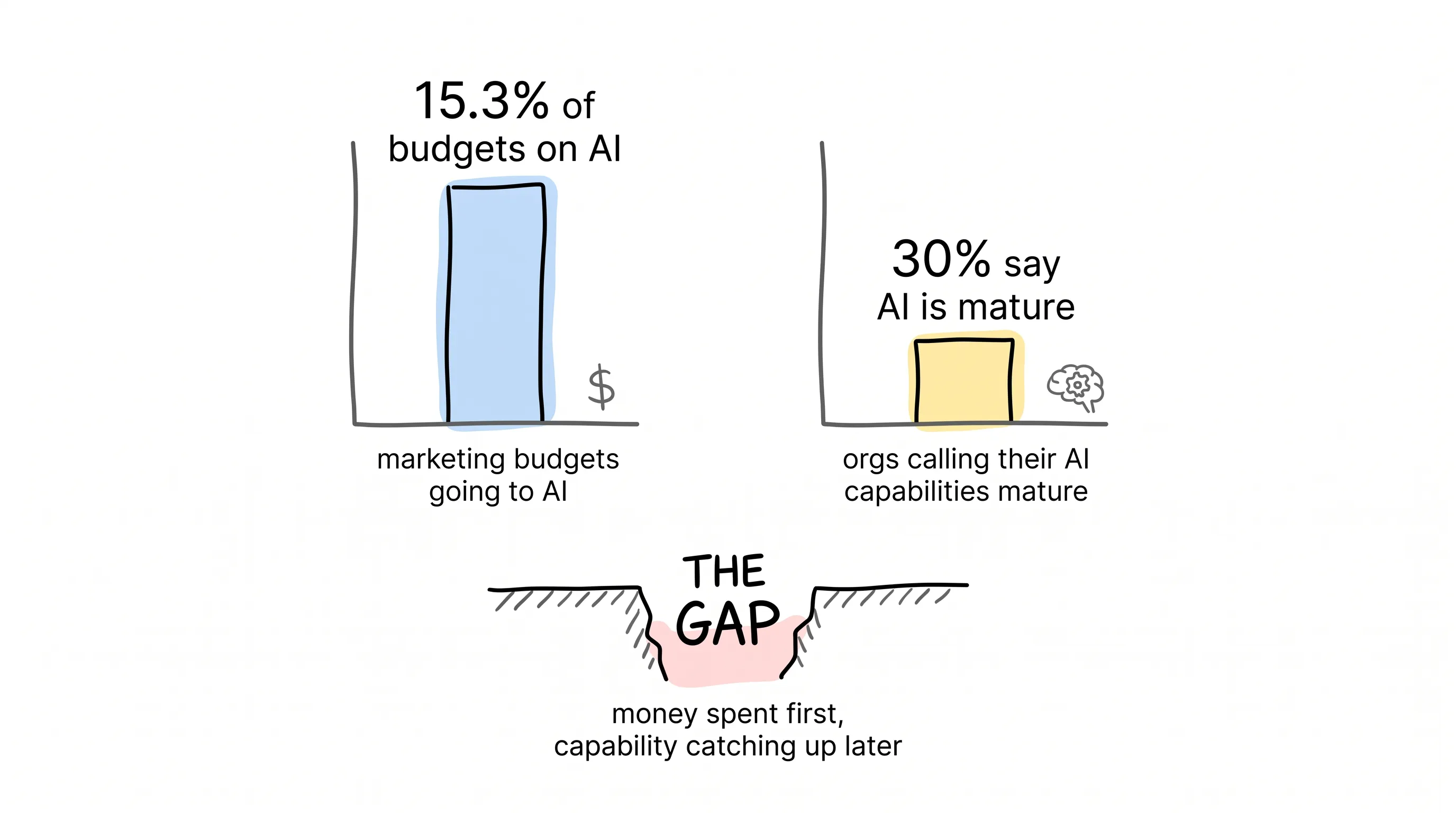
This year's Gartner CMO survey has one number: 15.3% of marketing budgets is already going to AI. Impressive, right?
The same survey holds another number: only 30% of marketing organizations consider their company's AI capabilities mature.
The money went out first; the capability hasn't caught up. That gap in between is the thing most worth puzzling over this year.
Why do I say that? Think about it. AI has torn down the barrier to execution. Writing copy, producing assets, building journeys, running campaigns — anyone can do all of it, and faster and faster. When everyone runs at the same speed, the race is no longer about legs. It's about direction.
An August report from Forrester says 88% of B2B marketing organizations are already using AI tools — some are even building their own. Yet at the same time, marketing leaders keep reciting the same litany of complaints: the strategy isn't clear, the results can't be measured, the data foundation is thin, and they don't know where to apply it.
So you see — the tool was never the missing piece.
What's missing is what you feed the tools. AI has made "getting things done" cheap. It has not made "getting them right" cheap.
What Is Context?
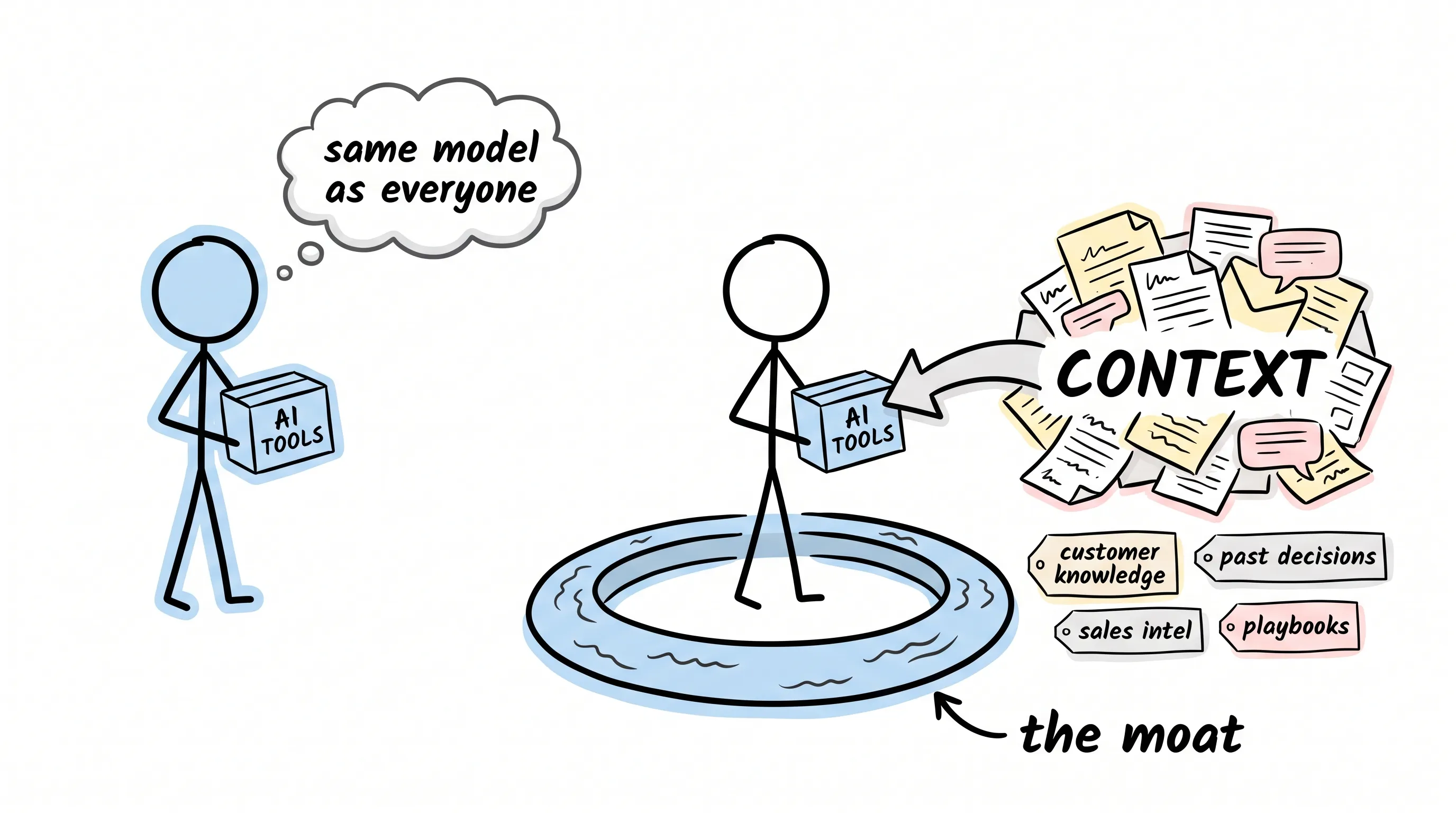
Every prompt you send is only the final sentence of a very long conversation. What actually determines the quality of the answer is everything accumulated before that sentence: the thousands of conversations you've had with customers, the objections buyers raised, the campaigns you won and the ones you lost, your understanding of the industry, your familiarity with competitors' plays, and the judgment to see at a glance when an answer is technically correct but strategically all wrong.
Same model, two marketers, nearly identical questions — both come back with answers that pass. So why does one turn into good marketing and the other into something mediocre?
Because the winner knows which answer deserves one more probing question, what information is still missing, and whether this answer actually matters to the buyer.
All of that is context.
Concretely, it includes:
What your company knows about its customers. Why each past decision was settled the way it was. The complaints sales hears every single day. The exact point where customers get stuck. Which tactics were tried, and which once-confident assumptions reality later proved wrong.
Nearly every company has this stock of knowledge — and has plenty of it.
But where does it all sit? In veteran employees' heads. In meeting minutes. In customer-service call recordings. In hundreds of chat groups. In old decks from five years ago.
Knowledge you can't put to work might as well not exist.
Unload the Knowledge from People's Heads
So what do you do?
The answer is process: unload the knowledge carried in people's heads and turn it into organizational memory.
How? At the close of every project, answer five questions honestly:
- What did we expect to happen at the time?
- Which buyer signal supported that judgment?
- What actually happened?
- What changed along the way?
- What did we learn, and what will we change next time?
Don't brush it off as a chore. Once those five questions are answered, experience stops being "something only the old hands know" and becomes words on a page — there for anyone to look up, there for anyone to use. People can leave. The experience stays.
There's a saying I like: every marketing campaign should produce two things. One is the campaign itself. The other is what the campaign taught you.
Pile up this memory and it can flow across departments. What the merchant side has learned about customers' temperaments can feed into the design of online journeys. Sales knows best which objections come up again and again — those questions are ready-made content topics. And the verbatim words from hundreds of customer interviews are the most authentic buyer language there is.
Product, sales, service, marketing — each used to keep its knowledge locked in its own cabinet. Now there's a chance to string it all together.
There's a term for this: experience arbitrage. The experience already exists. What technology does is carry it to more places where it can create value.
But everything has a flip side.
Technology amplifies good assumptions and bad ones alike — no favorites. Get an audience assumption wrong, and in the past the damage topped out at one bad poster. Now? Before anyone even thinks to question it, it has already become dozens of assets, hundreds of "personalized" variants, plastered across an entire channel.
And you can be wrong just as fast.
So keep the reasoning behind your decisions. The day an assumption goes wrong again, that record is your brake.
Context Is the Moat
Now look a step further out.
IDC predicts that by 2028, 62% of traditional demand generation will be driven by AI. From then on, marketers will use AI to find customers — and customers will use AI to size up companies. Machines will sit on both sides of the table.
What your AI says, and how it says it, depends on the context you feed it. The quality of that context grows directly into the customer experience.
Meanwhile, users are already getting fed up. A Gartner survey found that 49% of U.S. consumers believe generative AI has made content on the internet worse. Among Gen Z and millennials, that figure is 57%.
In other words: the cheaper content gets, the less it's worth.
When everyone can mass-produce content, "producing a lot" is no longer an advantage. What keeps growing more valuable are the things that can't be copied away: what you know about your customers, the pits you've fallen into, what your product can actually do, documented evidence you can point to, and that point of view of yours people recognize at a glance.
So for marketing technology leaders, the real exam question has become this: how do you rebuild the tech stack into a system that remembers and learns? Concretely, four things:
- Store the conversations you have with customers.
- Keep the reasoning behind every decision.
- Pipe in the intelligence from sales, service, and product, so credible third-party evidence is always within reach.
- Build reusable processes, so what the last campaign taught flows into the playbook of the next.
Back to That Dinner
At the end of the meal, I told my friend: the question you're asking can be asked a different way.
For all these years, we've been asking: what can technology do for marketing?
The question worth asking now is: what has your marketing taught technology?
Because the tools will keep getting cheaper and more alike. Everyone runs on the same models.
Context is the part that's yours.
Here's to an AI that knows more than everyone else's.
Continue reading
Related articles

Cross-Border Business: Time to Upgrade Your AI Toolbox
A learn article explaining how AI tools help cross-border e-commerce sellers clear five hurdles: language, regulation, logistics, payments, and fraud. It outlines a five-compartment toolbox, a five-step adoption path, and metrics such as conversion rate and CLV, while cautioning against over-reliance on AI.

AI Is Taking Over the Dirty Work of Social Media Marketing, One Task at a Time
This learn article outlines four social media marketing tasks AI can handle — audience analytics, content drafting and design, ad targeting and creative testing, and spam moderation — and cautions that taste, judgment, and data security remain human responsibilities.

AI Is Already This Good — Why Is Your Social Media Marketing Still Pure Manpower?
An overview of 18 AI tools for social media marketing, organized into six categories covering audience research, content creation, scheduling, comment and DM handling, ad management, and visual production, plus notes on personalization, prediction, and emerging trends.