
Everyone's Asking AI Now — Why Should It Pick Your Content?
An explainer on GEO (Generative Engine Optimization): how AI search selects and cites sources, why SEO fundamentals still matter, and five practical steps — from crawler access to quotable writing and topical coverage — plus measurement and common pitfalls.
A while back, a friend who runs a B2B software company invited me out for tea. He sat down and opened with a single question: "Run, tell me honestly — does the money I keep pouring into SEO still mean anything? Six out of ten of my customers, the moment they hit a problem, go ask ChatGPT first. Who still pages through blue links one page at a time?"
That question is about as typical as it gets.
I'd guess nearly everyone in marketing has watched the same doubt circle in their head.
Today I'll lay out my view for you, broken down piece by piece. The keyword here is GEO — Generative Engine Optimization.
1. What Is GEO, Exactly?
So what is GEO?
First, think back to traditional SEO. You researched keywords, optimized pages, traded backlinks — all for one thing: when a user searched, you wanted your page to rank in the top ten, ideally top three. Only when the user clicked through did you get a chance.
GEO plays in a different arena entirely.
Today's user doesn't scroll through ten results anymore. They hand a whole question straight to the AI: "How should a B2B software company pick an SEO provider?" The AI turns around, walks into the "library", pulls out a stack of material, compares it, digests it, and then writes an answer in its own words. At the end, it attaches a few source links.
Your website has gone from "a link waiting to be clicked" to "a source waiting to be cited."
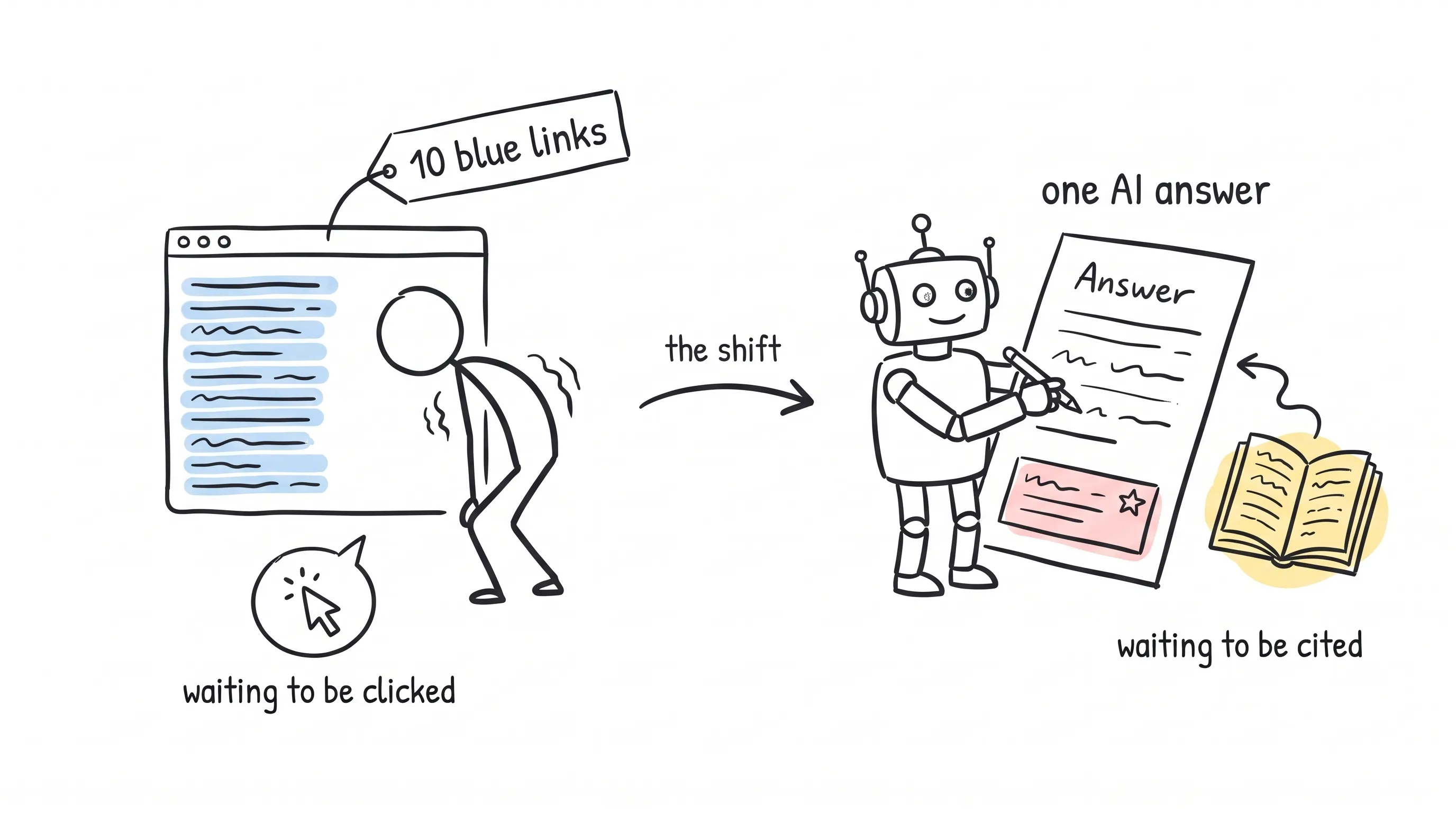
That's GEO: making your content easier for AI to find, understand, and trust — so it ends up written into that answer.
Is the difference big? Let me give you a metaphor.
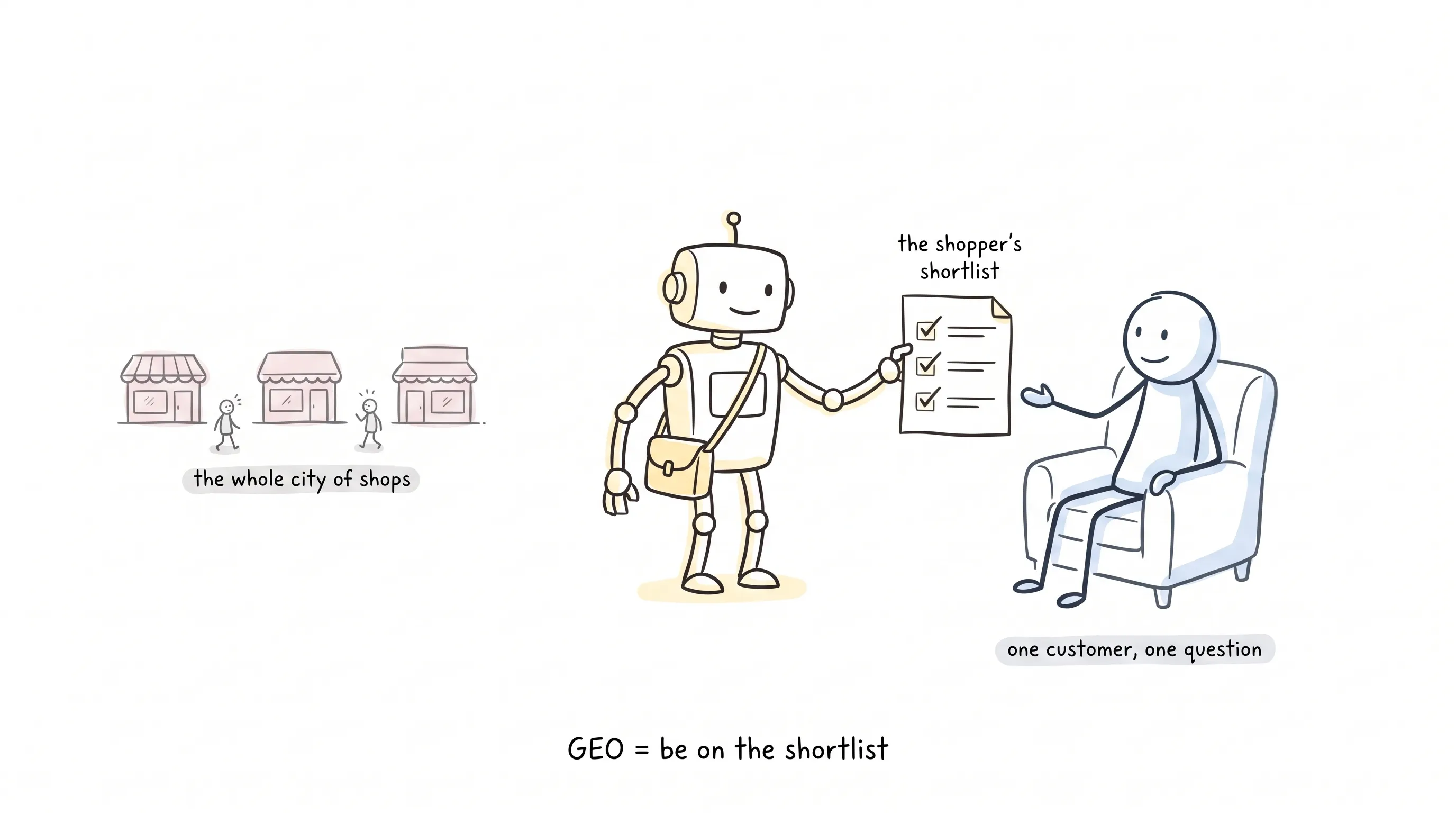
Traditional SEO is like opening a shop at the busiest corner in town, fighting for prime storefront space — the more foot traffic, the better.
GEO is like customers giving up on browsing and hiring a professional personal shopper instead. The shopper combs the whole city for them, comes back, and says just one line: "These three shops are worth a look." What you're competing for is a place on that shopper's shortlist.
A perfect storefront means nothing if the shopper never walks in.
2. How Does AI "Pick the Goods"?
Many people assume AI search is just ranking in a new location. It isn't. What happens under the hood is more complicated than you imagine, and more reasonable than you imagine.
Google's own documentation is clear about this: its AI search relies on two key technologies. One is RAG (Retrieval-Augmented Generation); the other is query fan-out.
The names sound intimidating, but the idea is simple.
Ask the AI, "How should a SaaS company approach SEO when entering the US market?" It won't just feed that one sentence into a search. It breaks the question apart: How does SEO work for SaaS? What are the specifics of international SEO? How do American users search? Who are the competitors? ... Out comes a string of smaller questions. It looks into each one, then pulls everything together into a single answer.
It's like an assistant who takes everything seriously. You toss off a casual question; he tears through thirty books in the library, comes back with a one-page summary, and even attaches the citations, all properly listed.
And note this: that page of "references" is the new battleground.
3. The Most Counterintuitive Fact
Before we go further, let me pour a bucket of cold water on this first.
Many people hear "AI search" and their first reaction is: SEO is dead, time to go all in on the new game.
It's exactly the opposite.
Google has said it in plain black and white: SEO best practices continue to apply to its generative AI search experiences. The logic isn't complicated. AI search pulls its answers out of the search index — ranking, quality, credibility: it's still the same old system laying the groundwork.
The foundation is still SEO; GEO is the extra floor you build on top of it.
A shaky foundation holds up nothing. If your site can't be crawled, can't get indexed, or the pages are poor quality, the AI won't spare you a glance. The fundamentals all still count: make the site crawlable, get pages indexed, keep the structure clear, make the content useful, load fast, and write titles that say exactly what the page is.
4. What to Actually Do: Five Things
Where do you start? I've boiled it down to five things.
1. Open the door first. Don't keep the guest outside
This one is the most basic — and the easiest to overlook.
ChatGPT has a search crawler called OAI-SearchBot. If you want your website to be found and cited by ChatGPT, the prerequisite is that robots.txt doesn't lock it out. Plenty of technical teams have no idea they've turned a guest away at the door. And remember: Google being able to crawl your site doesn't mean the door is open for every other AI.
One more thing while we're here: referral traffic from ChatGPT arrives with utm_source=chatgpt.com tagged onto the link, visible in your analytics tools. That's a new line on your books — worth tracking.
2. Bring exclusive substance
What AI never lacks is ten near-identical articles.
If your content is just copied-and-reworked versions of what's already online, then to the AI, you're one copy in an ocean of copies. Google's official advice is blunt: offer unique perspective, original information, real experience.
Here's an approach I particularly like: don't write "10 SEO Tips"; write "We audited 100 small-business websites and found 12 problems that kept coming up." The first is recitation; the second is evidence. If they genuinely help, charts, screenshots, and videos all count as exclusive goods too. Experience is the one thing AI cannot copy.
3. Write so you can be quoted
When the AI writes its answer, it is essentially doing massive quotation and compression. If you write in fog, it can't quote you.
Compare these two sentences:
"In today's rapidly evolving digital marketing landscape, organizations may consider a range of combined strategies to improve visibility..." That says nothing at all.
"GEO is optimizing your content so that generative AI can discover it, understand it, and cite it in its answers." One glance, and it can go straight into an answer.
How to write? Short definitions. Direct answers. Clear subheadings. Use lists and tables whenever they help. Don't pile up adjectives; pile up facts.
4. Make clear who you are
The AI doesn't just need to read your article — it also has to judge: is the person behind it credible?
This is called entity optimization. It sounds mystical, but the work is plain: what your company does, where it is, whom it serves, how to reach it. This information must stay consistent across your official site, social profiles, industry directories, and author bios. If the story differs everywhere, your digital identity is a muddled mess — and the AI naturally won't dare trust you.
5. Build a topical forest, not a lone tree
One hit article cannot hold up a competitive field.
Around your core topic, build a ring of supporting content: What is GEO, GEO vs. SEO, how to optimize for ChatGPT, how to track AI citations... Then link them together with internal links. When the AI searches, what it sees is not one lonely page, but a forest — substantial and structured.
A forest is easier to remember than a lone tree.
5. How Do You Do the Math?
In marketing, ignoring the data is malpractice. For GEO, the ledger works differently now.
In the past you only asked: Where do I rank for this keyword?
Now you need to ask several more:
- Did the AI's answer cite my content?
- Is the AI platform sending traffic to my website?
- When users ask related questions, is my brand mentioned?
- Do visitors coming from AI eventually become customers?
The good news: this math is getting easier to do. Starting August 31, 2026, Google launched a "Generative AI performance report" in Search Console worldwide — you can directly see the impressions that AI Overviews and AI Mode bring. Microsoft Bing, for its part, rolled out an AI performance report in Bing Webmaster Tools, so you can see where your content is being cited in AI answers.
For the first time, AI search visibility has first-party data. No more guessing with third-party tools.
6. Four Pitfalls to Avoid While You're at It
First, don't believe in magic spells. "Add a hidden tag and the AI will recommend you" — "Repeat your company name fifty times and you'll rank" — don't trust a single punctuation mark of this; no official evidence backs any of it. Let me also clear up a rumor: in 2026 Google stated plainly that llms.txt neither helps nor hurts in Google Search, so don't bother fussing over it. Same for structured data: mark things up accurately and leave it there; it's not a ranking cheat code.
Second, don't write only for the AI. The first reader of content is always a human. Content written only for machines is content humans won't read — and sooner or later, the machine stops recommending it too.
Third, don't stuff keywords. "GEO company, GEO services, the best GEO agency" — stringing that pattern on and on isn't optimization, it's self-sabotage.
Fourth, don't pad with fluff. Don't mass-produce cookie-cutter articles and assume sheer volume wins. However big the volume, without exclusive information and real experience, the "shopper" sees the same item displayed ten thousand times over.
7. Back to That Cup of Tea
As he was leaving, I asked my friend: "Do you know how to answer your own question now?"
He thought for a moment and said: "The SEO money wasn't wasted — the foundation is still there. But I need to build on top of it, a layer the AI can see."
Exactly. That's the right understanding.
In the era of traditional search, you competed to get customers to see you first. In the era of AI search, you compete to get the AI to repeat you and recommend you. Rankings go stale; citations don't. The moment one of your sentences is written into an AI answer, you are standing in the room where the customer is deciding.
As for how to get there? Open the door, bring exclusive substance, write to be quoted, say clearly who you are, plant the forest. Five things — start today.
Here's to making that shortlist soon.
Continue reading
Related articles

Cross-Border Business: Time to Upgrade Your AI Toolbox
A learn article explaining how AI tools help cross-border e-commerce sellers clear five hurdles: language, regulation, logistics, payments, and fraud. It outlines a five-compartment toolbox, a five-step adoption path, and metrics such as conversion rate and CLV, while cautioning against over-reliance on AI.

AI Is Taking Over the Dirty Work of Social Media Marketing, One Task at a Time
This learn article outlines four social media marketing tasks AI can handle — audience analytics, content drafting and design, ad targeting and creative testing, and spam moderation — and cautions that taste, judgment, and data security remain human responsibilities.

AI Is Already This Good — Why Is Your Social Media Marketing Still Pure Manpower?
An overview of 18 AI tools for social media marketing, organized into six categories covering audience research, content creation, scheduling, comment and DM handling, ad management, and visual production, plus notes on personalization, prediction, and emerging trends.