
Everyone Is Using AI — So Why Is No One Winning With It?
Explores why heavy AI spending in marketing often yields no winners: generative AI is a general-purpose technology still mid-diffusion, and tools alone create competitive parity. Covers four marketing use areas, four adoption barriers, and why human-AI collaboration plus governance form the real moat.
A few days ago, I met an old friend who works in marketing for dinner.
We weren't even halfway through the meal when the venting started.
Over the past two years, his company hasn't been shy about spending on AI: copywriting tools, image generators, video editors, automated customer support — tools bought round after round. Sure, output got faster, and the images piled up. But when the year-end tally came in: revenue hadn't grown, profit hadn't grown. The only thing that grew was the software bill.
He asked me: this AI thing — has it been overhyped?
I said that's not a question you can answer with a gut call. I've been chewing on it lately, and I've worked a few things out. Sit tight, and I'll walk you through them.
First, Get Clear: What Kind of Technology Is AI?
What is a general-purpose technology?
It's the kind of technology you can't confine to a single point of use. Electricity is one. The steam engine is one. The internet is one. It's not a tool that improves one step of one process — it's something that seeps into every industry and every link of the chain. Economics has a dedicated category for exactly this. As for whether generative AI qualifies, academics are still arguing to this day; in 2025, the OECD published an entire working paper devoted to the question.
Now guess where the crux of that debate really lies?
Not in how powerful AI is.
In how, exactly, it turns into money.
The Real Battleground Is Diffusion, Not Invention
A general-purpose technology's life cycle runs roughly in three steps: first it's invented, then it's adopted, finally it diffuses.
The first two steps are the noisy ones.
The third step is where results actually get decided.
Because the true power of a general-purpose technology has never lived in the moment it's born in a lab. It shows up at the moment it becomes real products and applications and seeps into the capillaries of the entire economy.
Think about electricity.
When the light bulb was first invented, it was a novelty, a curiosity people came to gawk at. Electricity only began changing the world decades later, when factories wired it into their production lines and the whole shop floor — layout, workflows, division of labor — was re-arranged around it. From invention to diffusion: roughly half a century.
So where is generative AI right now?
Tools are everywhere, adoption rates keep climbing. But diffusion — truly becoming productivity, becoming the thing you can't function without — is still halfway there.
So what's jammed between adoption and diffusion?
Where Can AI Actually Move the Needle in Marketing?
Let's finish the good news first.
Marketing is a field with roughly four patches of ground where AI can spread fertilizer.
The first patch: brand and communications. Copy, images, video — work that used to keep a creative team grinding for a week now comes out in ten versions in a few hours. Some companies simply let AI handle brand design from start to finish; Tailor Brands, for one, can generate an entire logo suite in one click.
The second patch: customer experience and service. AI customer service is online 24 hours a day and never calls in sick.
The third patch: innovation and strategic analysis. Have AI chew through dozens of industry reports and consumer studies, fish out the insights scattered inside them, and hand you a few draft proposals.
The fourth patch: operations. Ad creatives mass-produced, data reports auto-generated — the grunt work gets outsourced to machines by the batch.
Across all four, AI gives you the same class of thing: faster, cheaper, bigger scale, plus a degree of personalization that simply wasn't possible before.
Sounds like all good news, right?
But there's always a flip side.
Standing in the Way: Four Walls
Let's start with the first wall: the technology itself isn't stable yet.
AI will spout nonsense with a perfectly straight face — the industry calls it hallucination.
It's not a one-off. In 2024, people dug up the fact that OpenAI's speech-to-text tool, when used in medical settings, would fabricate things doctors and patients had never actually said.
More famous still is the Air Canada case. In early 2024, the chatbot on its website assured a passenger, in no uncertain terms, that he could book the bereavement fare (a discounted fare offered in the event of a death in the family) now and claim the refund afterward. The passenger did exactly that. When he later filed for the refund, the company disowned it — that was the bot talking. The dispute went to court, and the court's opinion was blunt: what the bot says, your company says. Pay up.
An AI misspeaking used to be a joke.
Now, it's a lawsuit.
Second wall: people don't dare trust it.
There's a finding here that runs completely against human nature.
Starting in 2015, researchers ran a string of experiments: an algorithm and a human made the same predictions, and the algorithm was clearly more accurate. Yet the moment users saw it make a single mistake, they turned and walked.
Later research twisted the knife: the more uncertain the decision, the harder people avoid the algorithm.
Think about it — marketing is precisely a high-uncertainty trade. Today's viral-hit logic may not hold tomorrow. So if marketers can only half-trust AI, don't blame yourselves for being conservative — that's just human nature.
And there's another layer, worse still. A 2024 consumer study found that the same piece of social media content — the moment users were told "this was written by AI," their ratings of the brand's "authenticity" dropped immediately.
In other words, the harder your AI works, the faker your brand may look.
Third wall: the rules aren't settled yet.
A group of well-known writers jointly sued OpenAI, claiming it trained its models on their books and violated their copyright. Lawsuits like this are still dragging on, with no definitive answer in sight.
Who owns the copyright to what AI generates? If a model was fed on other people's work, does its output count as infringement? Regulation is still on its way. Where no line has been drawn, the risk is still there — just nobody's covering your downside.
Fourth wall: the math doesn't add up.
This is the wall that stings the most.
In 2024, a survey by Boston Consulting Group (BCG) found that 74% of companies admitted they hadn't yet cleared the hurdle of landing AI's value and scaling it.
In 2025, NANDA, a research project at MIT, took a ground-level look at enterprise generative AI use, and its conclusion hit like a bucket of cold water: 95% of enterprise pilots failed to leave any visible return on the P&L.
95%. Good God.
A Gartner survey from the same year was even more interesting: the CEOs themselves admitted that their executives don't know enough about AI.
So why don't the books balance? Because many companies treat "using AI" as the goal itself — before the business strategy has figured out what problem AI is supposed to solve, the tools are already rolled out. That's not transformation. That's using AI for the sake of using AI.
When Everyone Can Do It, No One Can Win
Now, back to my friend's question: the money was spent — why no win?
The answer hides in two words: competitive parity.
What is competitive parity?
It's this: whatever you have, your competitor has tomorrow. You use AI to cut your copywriting costs in half; next month he cuts his in half too. Your images come out fast; his come out faster.
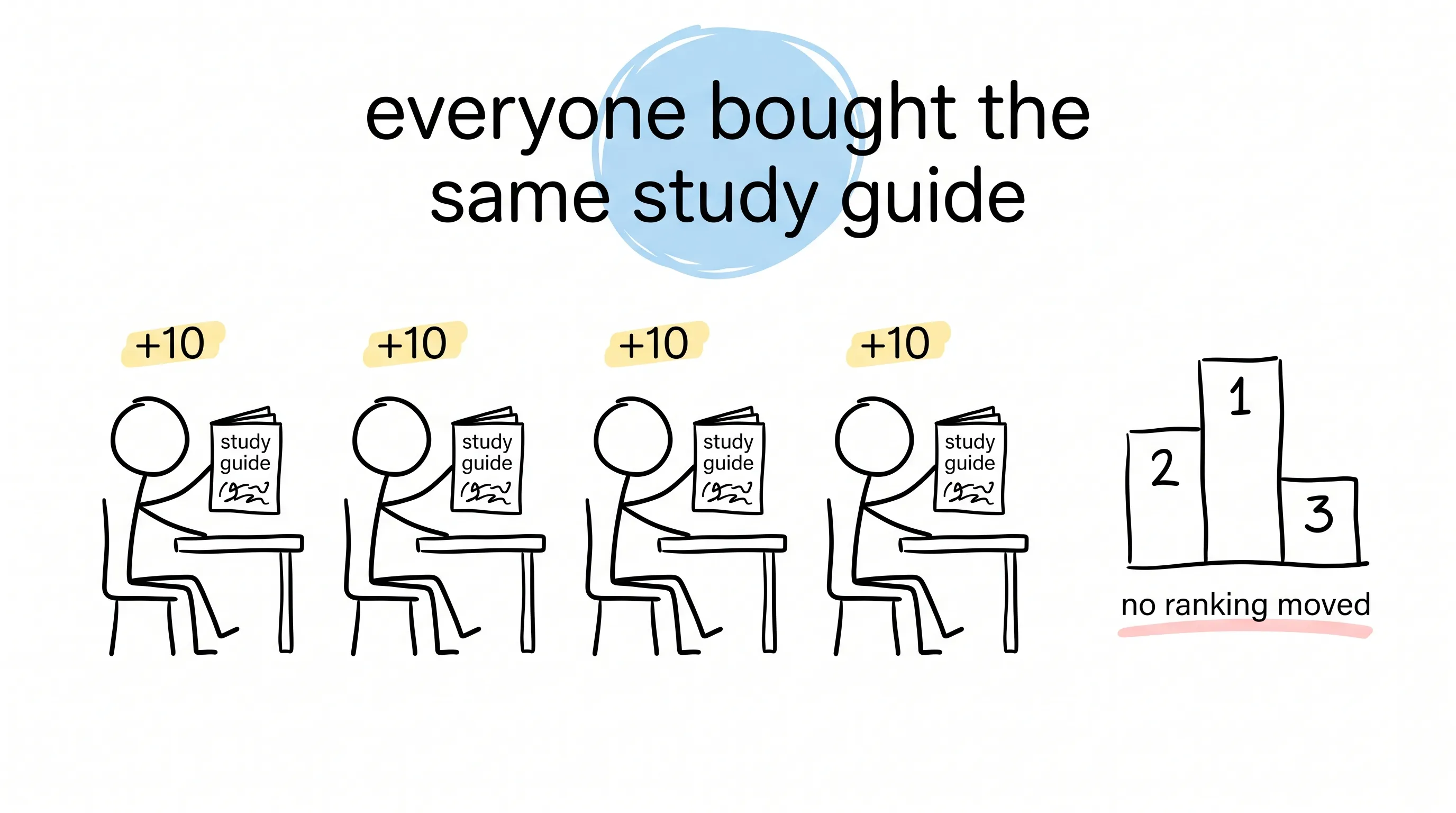
The whole class bought the same study guide. Everyone's score went up 10 points, and not a single ranking moved.
So what was that money for?
Tools are level. What you can learn in three days, your rival can learn in three days too. Strategy has long had a saying: operational effectiveness is not strategy. Efficiency gains that everyone is making will never underwrite above-average profits.
So where does AI's long-term value actually lie?
Over the past two years, the credible research has converged on the same answer: human-AI collaboration, plus a governance framework with real teeth.
"Governance framework" sounds mystical, but stripped down it's just four questions: Who signs off on — and answers for — AI's output? Where does the training data come from, and can it even be used? What content can be published directly, and what must pass through a human first? When something goes wrong, how fast can you detect it and pull it back?
Not sexy at all. But the moat is buried in those questions.
AI won't give you a moat. The people and institutions that use it — that's the moat.
A Final Word
At the end of that dinner, I told my friend: you've got nothing to be discouraged about. Your problem wasn't buying the wrong tools — it was expecting tools to win for you. Tools don't owe you that.
Generative AI is a turbocharger, not an engine. The engine is still that human brain of yours: judgment, taste, an understanding of what makes people tick. What the turbocharger does is squeeze more horsepower out of that engine.
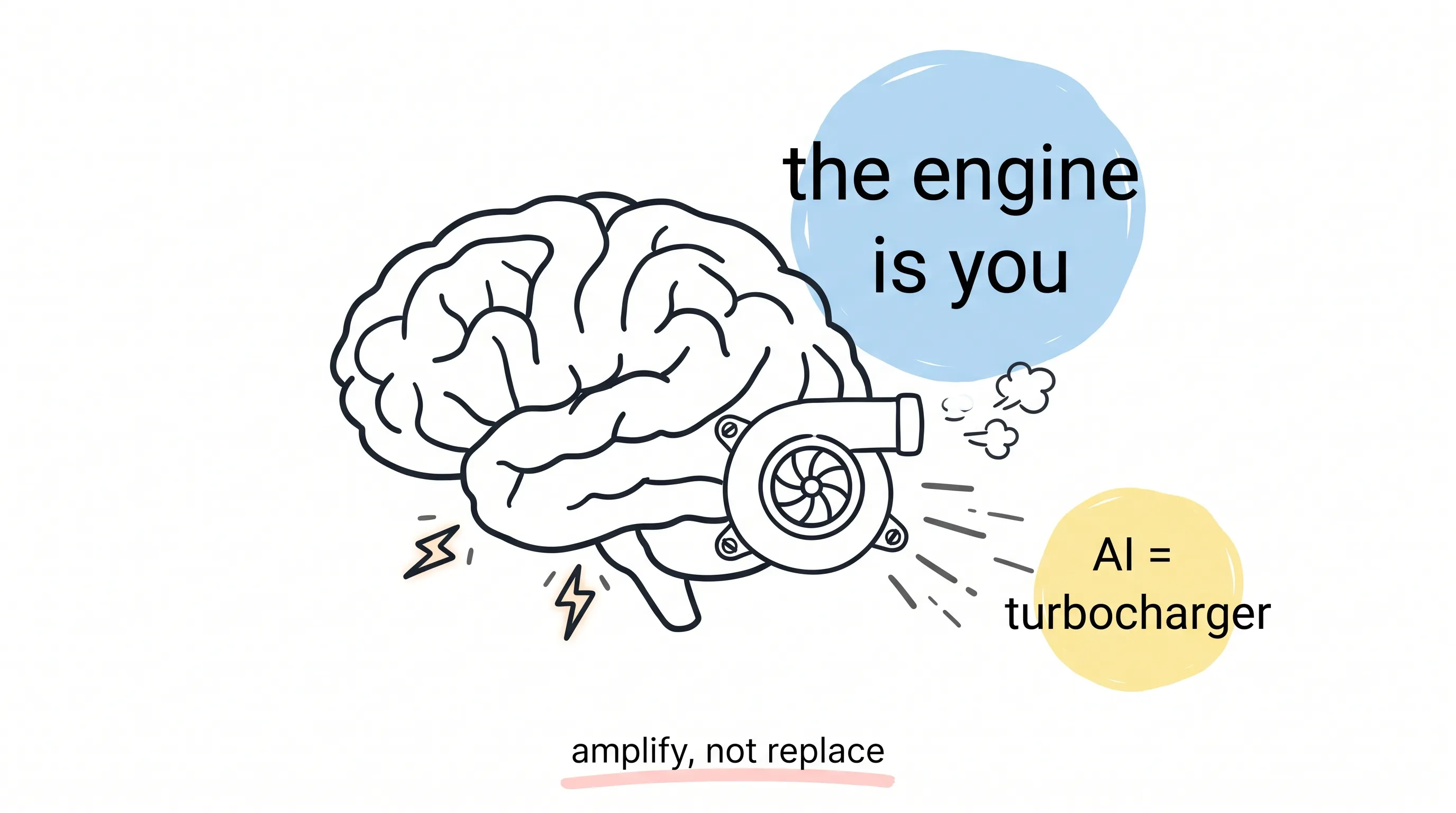
Used right, it amplifies you.
Used wrong, it replaces you — then settles into mediocrity right alongside you.
May you be the one who figures this out first.
Continue reading
Related articles

Cross-Border Business: Time to Upgrade Your AI Toolbox
A learn article explaining how AI tools help cross-border e-commerce sellers clear five hurdles: language, regulation, logistics, payments, and fraud. It outlines a five-compartment toolbox, a five-step adoption path, and metrics such as conversion rate and CLV, while cautioning against over-reliance on AI.

AI Is Taking Over the Dirty Work of Social Media Marketing, One Task at a Time
This learn article outlines four social media marketing tasks AI can handle — audience analytics, content drafting and design, ad targeting and creative testing, and spam moderation — and cautions that taste, judgment, and data security remain human responsibilities.

AI Is Already This Good — Why Is Your Social Media Marketing Still Pure Manpower?
An overview of 18 AI tools for social media marketing, organized into six categories covering audience research, content creation, scheduling, comment and DM handling, ad management, and visual production, plus notes on personalization, prediction, and emerging trends.