
DSA Is Retiring, AI Max Is Taking Over: Do Advertisers Get Google's Play?
An explainer on Google's retirement of Dynamic Search Ads and the transition to AI Max, covering its three features, advertiser controls, and the upgrade timeline. It advises advertisers to upgrade proactively rather than wait for the automatic migration.
A few days ago, an old friend who has spent ten years running Google Ads campaigns messaged me on WeChat at midnight.
"The dashboard threw up an upgrade notice saying my Dynamic Search Ads will sooner or later turn into AI Max. I sat there staring at the screen, stunned. What on earth is AI Max?"
I told him: it's a good thing. Don't panic — go ahead and upgrade yourself first.
After we got off WeChat, I walked through the whole thing from start to finish. The more I turned it over, the clearer it became: this is no ordinary product update. Google is swapping out the engine of search advertising.
Today, in plain language, I'll break this whole thing down for you.
First, What Exactly Is DSA?
Anyone who has done search advertising knows that keywords are the fundamentals. You guess what users will search for, then hang your ads on the matching keywords.
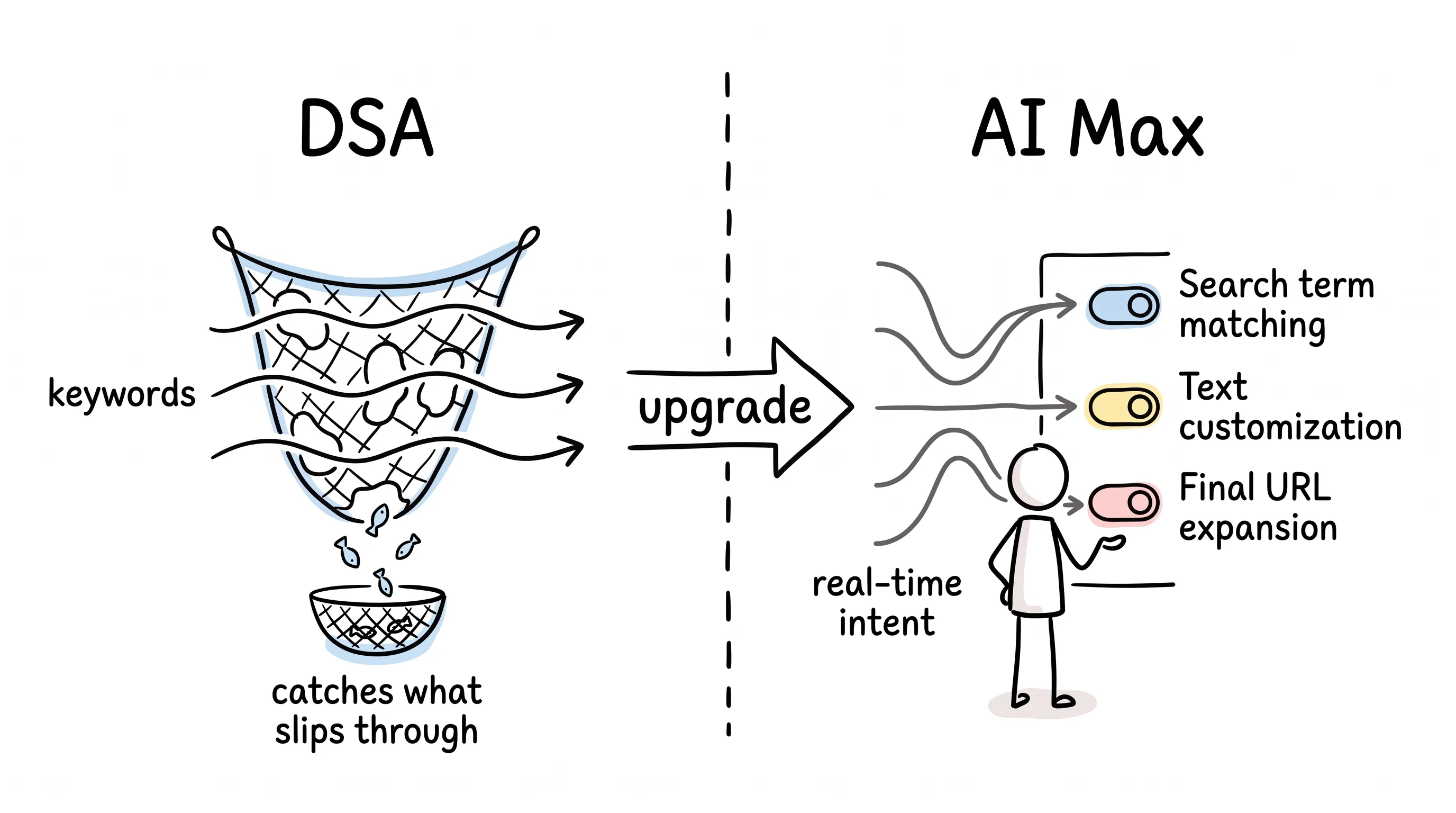
But guessing always misses. User search queries are wild and varied — no matter how long your keyword list is, some fish slip through the net.
So years ago, Google offered a fallback tool called Dynamic Search Ads, or DSA for short. Instead of relying on your guesses, it crawls your website, reads what's actually on your pages, automatically generates ad headlines for you, and matches searches to landing pages.
Put simply, it's the catch-all mesh at the bottom of the fishing net. Keywords catch the big fish; DSA scoops up whatever slips through below.
Does it work? It does. Which is why advertisers have used it for years — countless accounts still have a few DSA campaigns sitting inside.
But.
But the Times Have Changed
Over the past few years, the way people search has changed a lot.
People used to search "running shoes." Now they search "I'm a junior in college, weigh 80 kilos, have flat feet, and run 5K three times a week — what running shoes should I buy?" A query like that reads like a conversation: long, specific, and changing all the time.
Think about it: by doing nothing more than crawling the pages you wrote three months ago, can you really tell what a user wants at this very moment?
Pages are dead. Search is alive.
A user's need hides in the instant a search happens — not on the pages you prepared in advance.
Google figured one thing out: rather than relying only on your website's data, it's better to put broader, more real-time intent signals to work. That's the whole starting point of AI Max.
So What Is AI Max?
In one sentence: AI Max is the next generation of DSA.
Everything DSA can do, it can do. Plus one more layer of genuine AI: it blends the information you provide — your ad content, your website content — with more real-time signals, hunting down search terms you've never covered while keeping your ads glued to user intent.
In April this year, Google officially announced that AI Max was out of testing and fully graduated. Hundreds of thousands of advertisers worldwide are already running search campaigns with it.
Break it apart, and it's three features.
- Search term matching. AI matches your ads to more real search queries, filling the gaps your keywords can't reach.
- Text customization. Headlines and descriptions adjust themselves to the search context, so your ad reads more like the very sentence the user wanted to see.
- Final URL expansion. When a user asks something very specific, it can bypass your default landing page and send them straight to the page that fits best.
One finds the people. One rewrites the words. One swaps the door. The division of labor is crystal clear.
That 7% Is Worth Doing the Math On
Concepts only get you so far. Let's run the numbers.
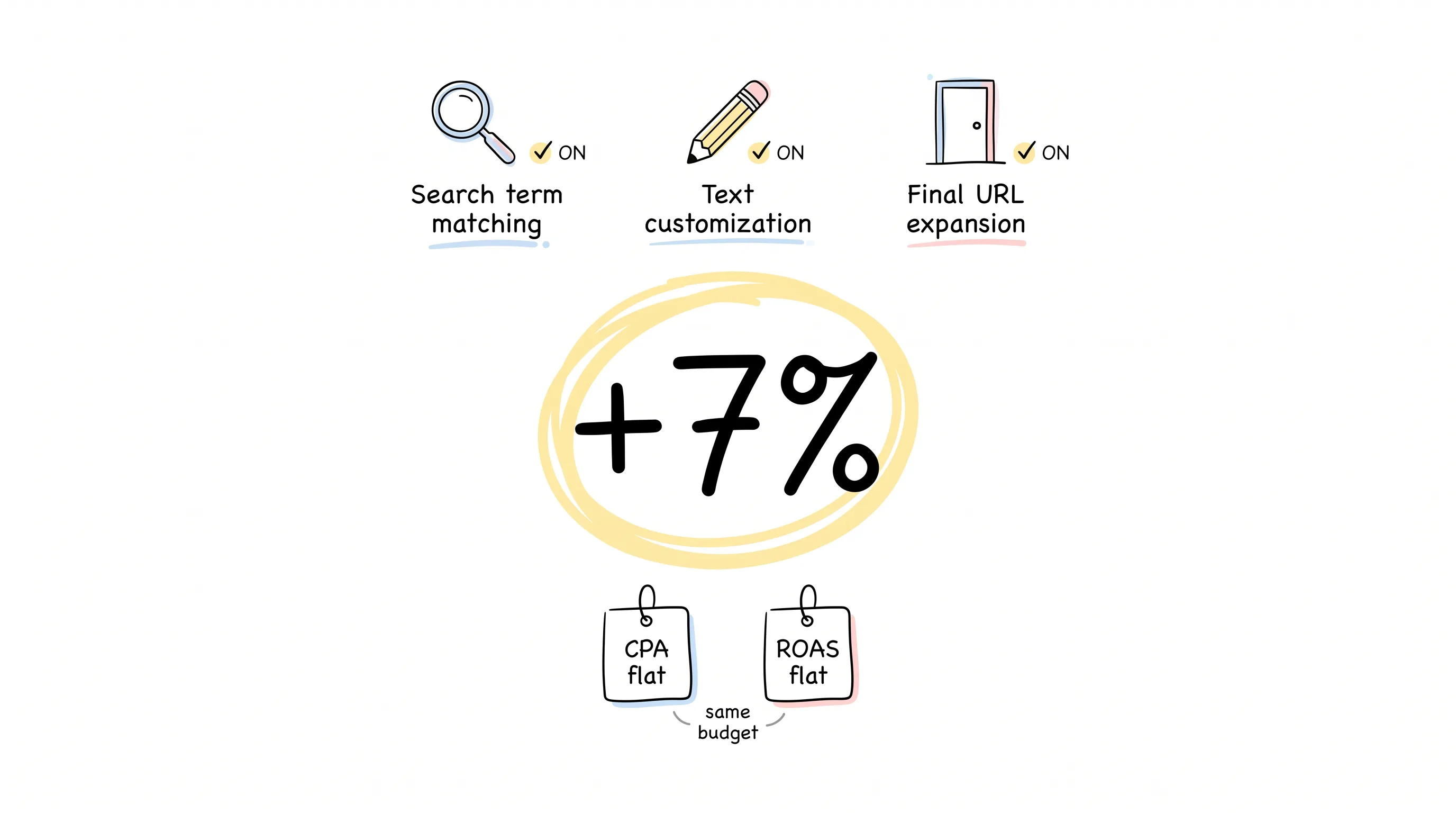
Google released a set of internal data from 2026, covering non-retail advertisers: with all three features turned on, versus search term matching alone, advertisers saw on average 7% more conversions or conversion value, while CPA (cost per acquisition) and ROAS (return on ad spend) stayed roughly flat.
7%? You might think that's not much.
Anyone who runs paid campaigns thinks differently. Paid-media profit is scraped together a few percentage points at a time. Same budget, same acquisition cost, yet 7% more orders out of thin air — that's a solid lift in efficiency for the entire account.
The key: that 7% costs not one extra cent of budget. It's picked up by AI from the places you weren't watching.
Money like that is free money — you'd be a fool to leave it sitting on the table.
Afraid of Losing Control? The Reins Are in Your Hands
The moment people hear "AI decides automatically," their first reaction is: will it run wild? Random matches, copy rewritten at will, landing pages swapped on a whim — money pouring down the drain.
Google ships a set of controls built precisely to cure that worry.
Brand controls: which brand terms are off-limits — you name them. Location controls: where ads run and where they don't — you decide. Text specifications: your ad copy has to follow your rules — banned words and required phrasing, written down in advance.
AI does the running; the reins stay in your hands.
And here's a detail most people don't know: when the automatic upgrade happens, AI Max's settings are carried over from your original configuration — the URL controls you set up before are preserved exactly as they were.
An upgrade doesn't mean tearing everything down. Your old settings move right into the new house.
The Timeline, Untangled for You
The timeline for all this changed once along the way, and a lot of people haven't kept up. Let me straighten it out.
In April this year, Google announced: starting in September, any campaign still using DSA, Automatically Created Assets (ACA), or campaign-level broad match would be automatically upgraded to AI Max.
In June this year, a wave of advertisers pushed back: transitions take time, and business results have to come first. Google listened, and pushed the DSA deprecation and auto-upgrade back to February 2027.
Note: only DSA got the extension. ACA and campaign-level broad match still auto-upgrade in September — not up for discussion.
So what actually happens on auto-upgrade day? Dynamic ad groups become standard ad groups, historical settings and data move into AI Max together, all three features switch on, and the old URL controls carry over. ACA accounts get search term matching and text customization on by default; broad-match accounts get search term matching on by default.
And one more thing to burn into memory: once DSA deprecation begins in February 2027, you won't be able to create new DSA campaigns. The dashboard, Google Ads Editor, and the API — all three doors close at once.
My Advice: Don't Wait
The upgrade tool is live now. DSA users can use it to migrate their historical settings and data straight into new standard ad groups; ACA and broad-match users will see an upgrade banner in the dashboard — one click and it's done.
My advice is clear: rather than let the system pick your moving day, pick it yourself.
Upgrade on your own, and your settings fit your business from day one instead of being moved on the system's best guess. Upgrade early and you still have months of buffer to get familiar with the new controls — if something goes wrong, there's time to fix it.
The safest route: first run a one-click experiment inside Google Ads to see how AI Max performs in your own account, let the data speak, then decide how to configure it. And when you do configure it, turn all three features on. The math above already made the case: with all three on — that's how you get to that average 7%.
Back to That Midnight WeChat Friend
In the end, he didn't wait for the automatic upgrade. He did it himself, tuned the settings to his own business, and ran an experiment.
The next day he messaged me: conversions up, costs flat. Then two words: "I'm sold."
Tools retire; experience doesn't. In every big platform migration, the ones who understand it first act first — and the ones who act first collect the dividend.
May every cent of your budget go toward new opportunities.
Continue reading
Related articles

Cross-Border Business: Time to Upgrade Your AI Toolbox
A learn article explaining how AI tools help cross-border e-commerce sellers clear five hurdles: language, regulation, logistics, payments, and fraud. It outlines a five-compartment toolbox, a five-step adoption path, and metrics such as conversion rate and CLV, while cautioning against over-reliance on AI.

AI Is Taking Over the Dirty Work of Social Media Marketing, One Task at a Time
This learn article outlines four social media marketing tasks AI can handle — audience analytics, content drafting and design, ad targeting and creative testing, and spam moderation — and cautions that taste, judgment, and data security remain human responsibilities.

AI Is Already This Good — Why Is Your Social Media Marketing Still Pure Manpower?
An overview of 18 AI tools for social media marketing, organized into six categories covering audience research, content creation, scheduling, comment and DM handling, ad management, and visual production, plus notes on personalization, prediction, and emerging trends.