
Don't Turn Your Strategist into a Typist
A learn article on using AI as a content strategist rather than a typist, covering topic gap analysis, refreshing back-catalog articles, brand voice, personalization, distribution, and data review.
A while back, an old friend who had spent more than a decade in content asked me out for tea.
He runs content for a cross-border e-commerce business, with a fairly big team. Before he'd even taken a sip, he said: "I can't keep this up much longer."
What happened?
He told me that a while back, his team had rolled out five AI tools and could now produce eight articles a day — three times the old output. But reads didn't move. Leads didn't move. His boss's face, though, grew visibly darker by the day.
When he finished, I opened with a compliment: "Impressive."
Eight articles a day — a few years ago, that kind of capacity was unthinkable.
Then I asked him one question: of those eight articles, before any of them went out, had anyone stopped to ask "why are we writing this one?"
He froze.
Here's what I told him: your problem isn't AI. It's that you've been using your strategist as a typist.
AI's Greatest Talent Isn't Writing
What is AI content marketing, exactly?
Many people assume it means "letting AI write articles."
Wrong.
Today, getting AI to produce a fluent article is no longer worth anything. Everyone can do it. You can, and so can your competitors.
The real dividing line is what you treat AI as.
Treat it as a typewriter, and you get articles off an assembly line; treat it as a strategist, and you get a team that carries its own judgment.
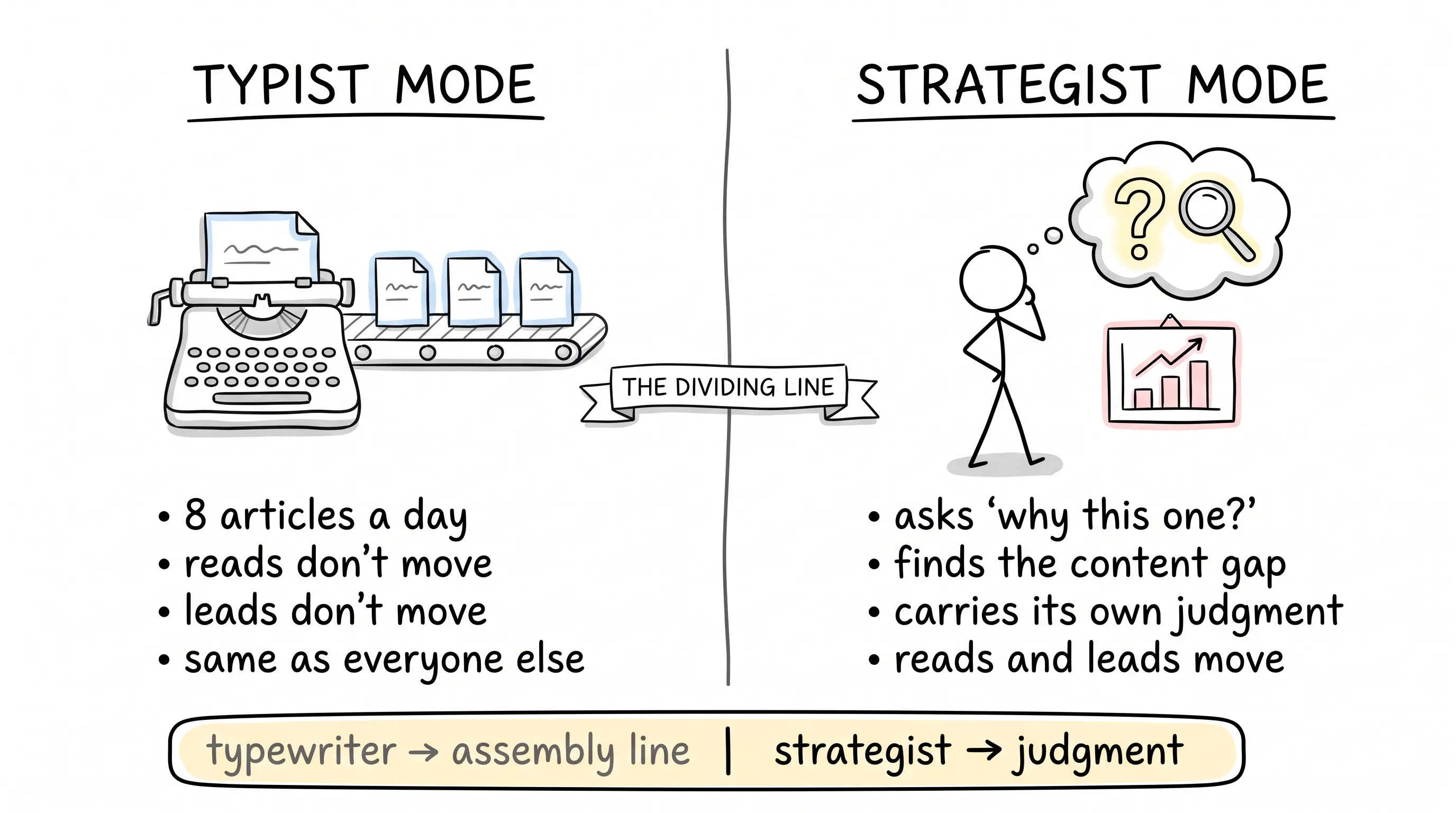
Same tools. Some people come away calmer the more they use them; others, more anxious. The difference has never been the tool — it's how you use it.
That day, I took the playbook I've tested again and again over the years, broke it into eight moves, and walked him through it. Today, I'll walk you through it too.
First, Get Clear on What to Write
The problem with most teams is that they write whatever comes to mind.
What does it mean to use AI for content strategy?
It means letting the machine look at the data first and then set the topics: what your readers are searching for, what your competitors are publishing, and which questions a crowd of people are asking that nobody has answered properly.
That's the "content gap." And a gap is an opportunity.
How do you actually do it? Three steps.
Step one: have AI gather your industry's keywords into "clusters," and flag the clusters you still haven't touched. Step two: feed it the questions customers have actually asked in your CRM, and let search data and sales data finally meet. Step three: run your whole inventory of old articles through it, and see which ones are duplicated labor and which gems are gathering dust.
William, the AI assistant from StoryChief, works exactly this way: it hooks up to real-time data from Google Search Console, reads your brand, studies your competitors, and then tells you straight out what your next article should be.
A content audit used to take a team a full week of grinding. Now? One afternoon.
What you save isn't just hours — it's the cost of trial and error.
Don't Rush to Dig New Wells; the Old Wells Still Have Water
I asked him again: after all these years, how many articles have you accumulated?
More than six hundred.
And how many are still bringing you traffic?
He took out his phone, scrolled for a while: "Maybe a few dozen."
And there it is. The other five hundred-plus articles are just lying there.
Most content teams are desperately digging new wells, forgetting that the old wells clearly still have water.
AI has a wonderfully practical use here: as an auditor. Run your whole stock of articles through it — which ones are declining and need updating; which can be split into video scripts or woven into a newsletter. William does this automatically: it watches the articles whose performance is sliding, suggests paths for updating and revamping them, and distributes them for you while it's at it.
A good article, in a different format, gets one more chance to be seen — at a fraction of what it costs to write a new one.
New content is principal; your back catalog is compound interest. A team that only draws down the principal and never collects the interest is forever paying off debt.
The Machine Builds the Skeleton, the Human Puts in the Soul
So what about the writing itself?
Writing is exactly where you go "semi-automatic."
AI builds the skeleton: drafts the outline, sets the structure, and tunes the tone for each channel.
You supply what no machine can: your point of view, your stories.
And here's a move many teams skip: build a "brand voice library."
Feed the AI your articles, your talks, and the way you speak every day, and teach it "how you talk." Otherwise whatever it writes will forever be "generic internet voice." It could be anyone. It just isn't you.
I find William's design here quite clever: it first learns your tone, your audience, and your habitual phrasing — then drafts in your voice. But remember: the last step of the process must be a human.
Why?
Because what readers respond to has never been "fluent." It's "you."
No matter how fast AI writes, the judgment calls are still yours to make.
One Article, Saying Different Things to Different People
Have you ever wondered: why does the same article make one reader send an inquiry and another scroll away?
Because the words never landed where that reader lives.
What is personalization?
It means segmenting your audience by intent, industry, and level of engagement — then saying to each segment the words only that segment can hear. You can't serve the same pot of soup to a customer in Guangdong and one in Sichuan.
Why couldn't this be done before? Not enough hands. Ten segments would need ten versions — who could keep up?
Now a machine can.
Let AI swap the examples and adjust the phrasing for each segment, then use predictive analytics to tell you which topics convert which people best. William can also push all those versions to every one of your channels — no more copy-pasting ten times.
Scale and "understanding every individual" used to be an either-or. Now you can have both.
Don't Let Content Be Text Alone
The human eye is caught by images first.
AI stopped being just a writer a long time ago. Illustrations, covers, short-video scripts, design templates — all can be generated.
One prerequisite, though: feed it your brand guidelines in black and white. Colors, fonts, tone — teach them one by one.
Otherwise it hands you a cold minimalist look one day and loud reds and purples the next — and the mix looks like the work of several different companies.
Hitting Publish Is Where the Work Begins
Many people think that clicking "Publish" finishes the job.
Quite the opposite. Publishing is the birth; distribution is how it's raised.
What is distribution?
It's the same piece of content: a straight-faced industry breakdown on LinkedIn, a thirty-second hook in short video, and the voice of an old friend in your newsletter.
AI can handle all of this adaptation automatically: rework the headlines, adjust the length, match the tags, then funnel every channel's performance into a single dashboard. The message stays the same; every tone slides into its proper place.
The value of content lies not in the moment it's finished, but in the moment the right person sees it.
Let the Machine Watch the Data for You
And after it's out?
Watch the data. But please — don't just watch traffic.
Traffic is a vanity metric. If you watch anything, watch which pieces of content actually brought in leads and conversions.
What does it mean to use AI for analysis? Connect it to GA4 (Google Analytics 4) and ask it two questions: why did this article work? Why did that one flop?
Was it the topic choice that won, or did the title do the heavy lifting? Readers bail en masse in the third paragraph — is it pacing, or substance? It follows the data trail and hands you the answers; you apply them to the next piece.
By the way, AI can also turn search from "guessing" into "calculating": organize keywords into pillar pages with cluster pages around them (a pillar page covers a broad topic, with cluster pages drilling into its subtopics), so search engines conclude you're an authority on the subject. If rankings slip, it flags them, and you go fix them.
Data isn't there to be looked at. It's there to fix the next piece.
Smell It Before Your Competitors Do
Most of the moves above look backward.
AI has one more talent: looking forward.
It continuously scans search data and social chatter, telling you which topic is heating up and which format is on the rise. Get your word in before the crowd catches on, and the microphone is yours.
Once everyone has seen it, it's no longer called a trend.
It's called a red ocean.
At the End of the Day, It's Two Sentences
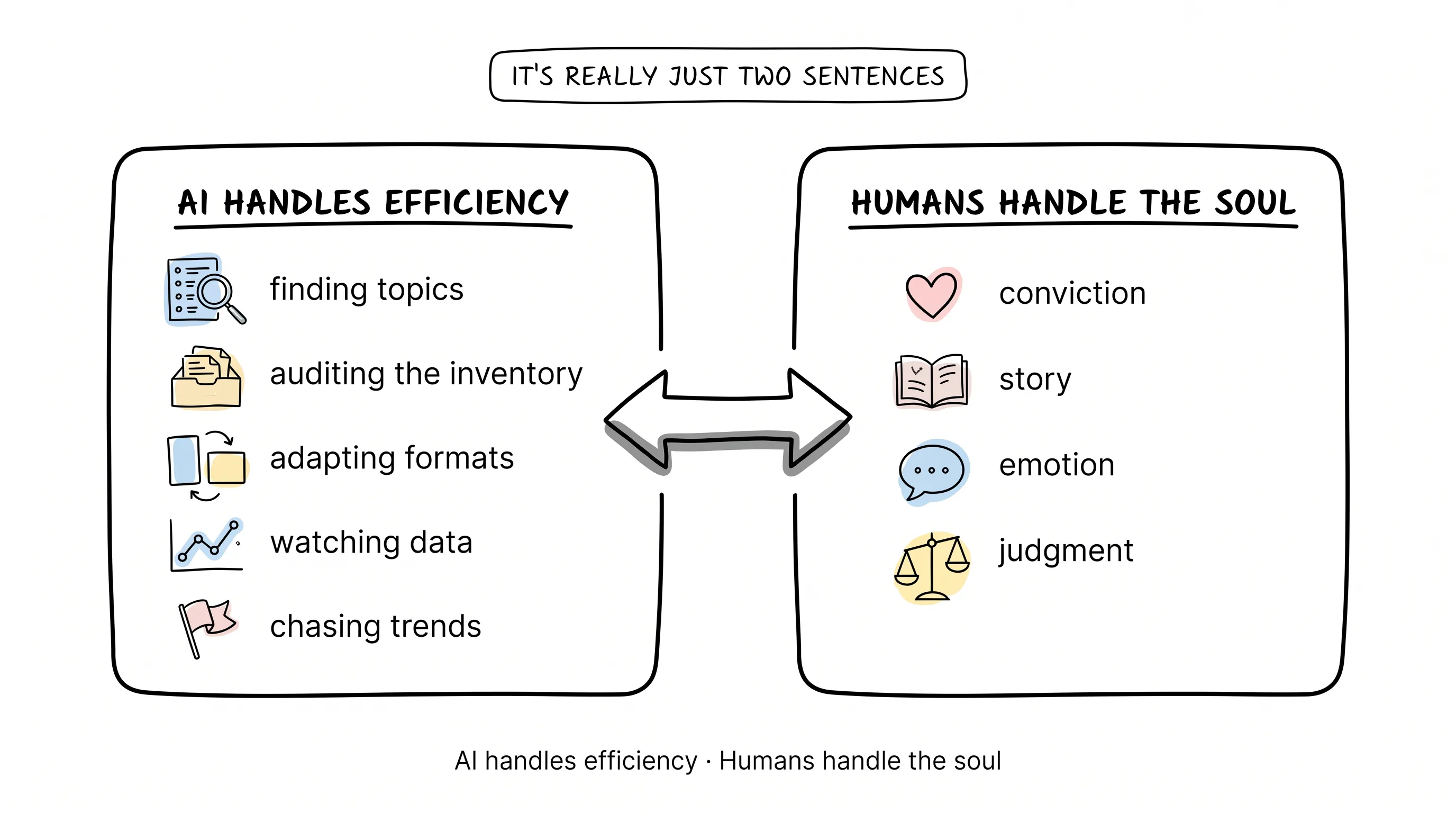
Lay out the eight moves, step back, and look: it's really just two sentences.
AI handles efficiency: finding topics, auditing the inventory, adapting formats, watching data, chasing trends.
Humans handle the soul: conviction, story, emotion, judgment.
That day, we drank the tea down to its last infusion. My friend said: "Got it. First thing I do when I'm back, I'm moving AI out of the typist's seat and into the strategist's tent."
I said: "Right. The strategist keeps you off the wrong roads."
The road is still yours to choose.
And here's wishing you a strategist of your own soon — one who shows up the moment you call and never once complains of being tired.
Continue reading
Related articles

Cross-Border Business: Time to Upgrade Your AI Toolbox
A learn article explaining how AI tools help cross-border e-commerce sellers clear five hurdles: language, regulation, logistics, payments, and fraud. It outlines a five-compartment toolbox, a five-step adoption path, and metrics such as conversion rate and CLV, while cautioning against over-reliance on AI.

AI Is Taking Over the Dirty Work of Social Media Marketing, One Task at a Time
This learn article outlines four social media marketing tasks AI can handle — audience analytics, content drafting and design, ad targeting and creative testing, and spam moderation — and cautions that taste, judgment, and data security remain human responsibilities.

AI Is Already This Good — Why Is Your Social Media Marketing Still Pure Manpower?
An overview of 18 AI tools for social media marketing, organized into six categories covering audience research, content creation, scheduling, comment and DM handling, ad management, and visual production, plus notes on personalization, prediction, and emerging trends.