
Don't Rush to Put AI to Work — Turn Your Work Into a Tool First
A commentary on Andy Crestodina's upcoming MAICON 2026 talk: instead of using AI to speed up tasks, turn a marketing job into a tool by writing, testing, and refining prompts into reliable assistants. It also argues the person who does the work best should build the tool.
The other day, I came across the announcement of an upcoming talk. The title alone was enough for me to save it to my bookmarks.
The speaker is Andy Crestodina, co-founder and CMO of Orbit Media, a man who has spent twenty-five years in the marketing business. He's about to give a session at MAICON 2026 (the Marketing AI Conference), a fairly well-known gathering in the AI marketing world. The gist of his topic: how a marketing job, step by step, becomes a marketing tool.
My god, that framing is spot-on.
Because lately, you must have heard it a thousand times in some form: Use AI. Write faster, publish more, automate the busywork. And so everyone on the team is straining to get AI to do their own work faster.
And yes, that is what most people are doing.
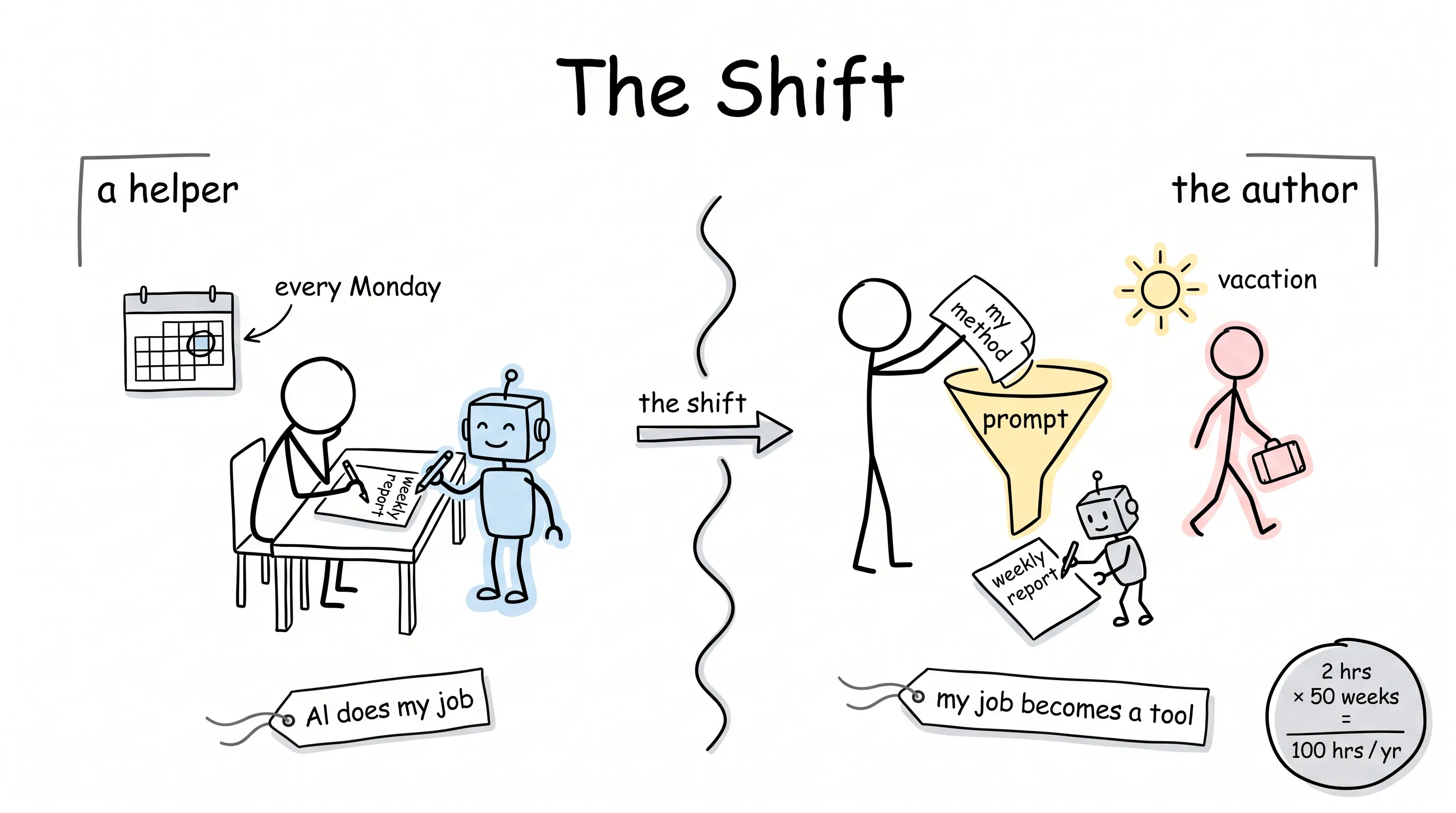
But Crestodina poses a harder question: when you use AI to do your work, at best you've found a helper for your job. The real opportunity is to turn the job itself into a tool.
What does it mean to turn a job into a tool?
Here's an example. Every Monday morning, you write a weekly report — once this week, again next week, year after year. No matter how good your reports get, the craft lives only in your hands. Take a vacation, and the weekly report stops. Change jobs, and the craft goes with you.
Don't underestimate this. Say a weekly report takes two hours to write. Fifty weeks a year, that's 100 hours. Do it for ten years, and it's over a thousand hours. Those thousand-plus hours of your career, drained away week after week on repeating the same thing.
But suppose you write down your method for the weekly report as a prompt, and then nurture it into an assistant. The craft starts working for you. When you're not writing, it's writing.
That's the shift: from working with tools to becoming the author of a tool.
How Does a Craft Become a Tool?
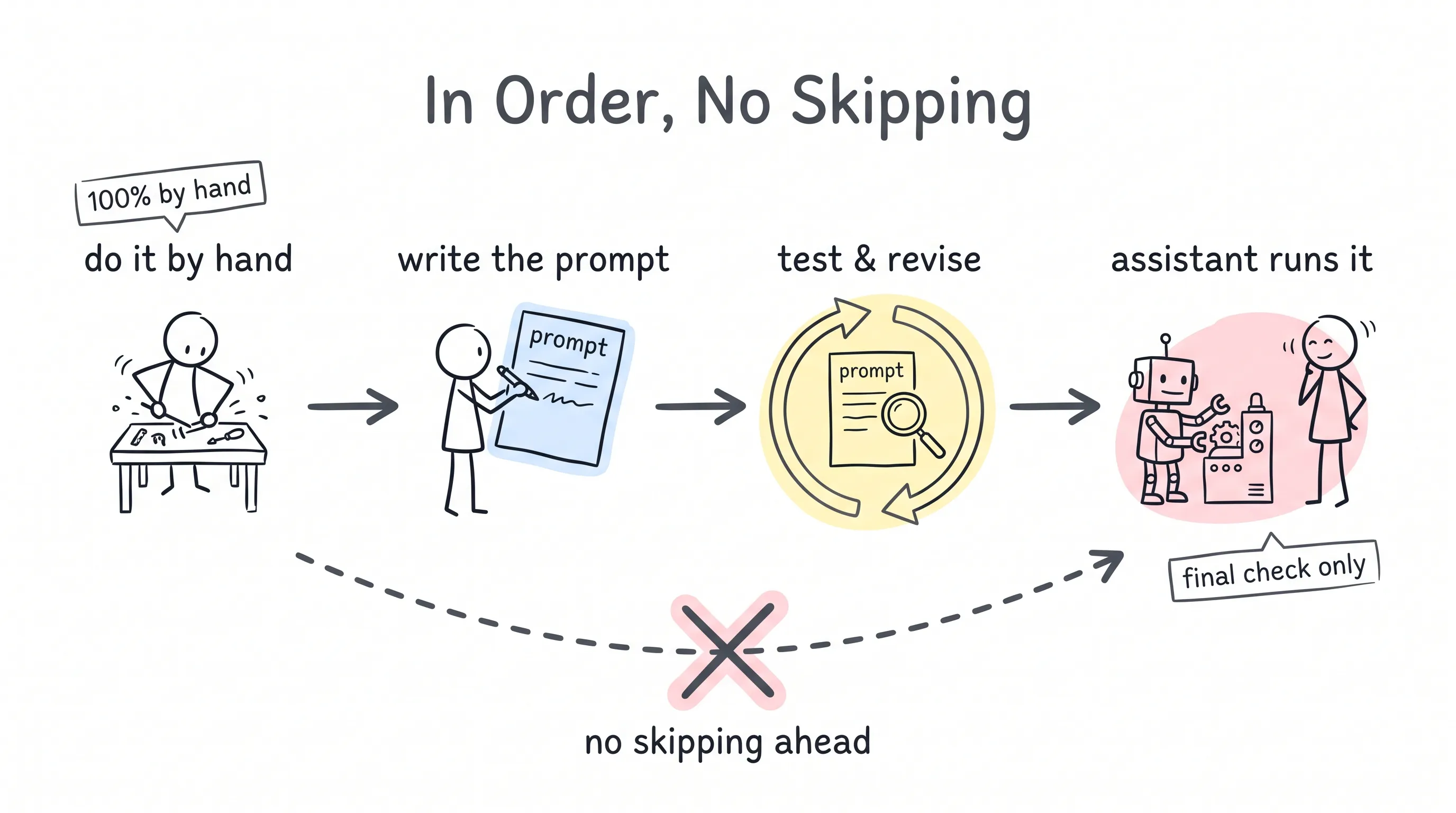
Crestodina says the modern marketing workflow evolves along a fixed route: from 100% done by hand to 100% handed to AI assistants, with humans doing just a final check.
Note that this road has an order to it — no skipping ahead.
If you've never done this work with your own hands, don't rush to automate it.
If you never put your ideas into the original prompt, you won't be able to make the prompt better.
If you haven't tested your prompts again and again, don't expect to build a reliable assistant with them.
Why can't you skip ahead?
Think about it. If someone has never cooked a dish themselves, how can they judge whether the apprentice's dish is fit to be served?
They can't judge. They can't even taste whether it's properly salted.
So if you want to build tools, you first have to be someone who has done the work. Not only done it — you have to take every step apart and chew it over: wondered why it's done this way, tried how to do it better. All that thinking and trial and error eventually settles into the lines of a prompt.
Crestodina's own most capable AI assistants evolved exactly this way, bit by bit. I love his exact words: "I don't believe anyone can build a great AI employee on the first try."
Great assistants are raised. Like a master stock, kept going pot after pot — only then does the flavor grow rich.
Why Do the Experts Get to Build the Tools?
This part was, in my view, the most valuable content of the entire talk.
Most teams pour their AI anxiety into "which tool to pick." But Crestodina believes the biggest waste isn't there at all — it's in something else: letting people who can't do the work build the tool that does it.
His yardstick is almost brutally simple: the person who does this work best is the person most deserving of building the tool for it.
Why? Because the core ability in tool-building isn't writing code. It's judgment.
Whether what the AI spits out is good, whether it's right, whether it's usable — someone who has actually done this work can tell at a glance. Amateurs judge whether it looks the part; experts judge whether it is right.
So Crestodina offers a particularly beautiful formulation: AI is the most powerful "craft transfer" tool in the world.
Masters use it to pour their own craft into the tool, so that people on the team with less skill can still produce seventy or eighty percent of the work. Craft, transferred just like that.
For the first time, a master's strength can be lent directly to the apprentice.
Prompts Are Your Code
So what do you actually do?
Crestodina quotes a line from OpenAI co-founder Andrej Karpathy: "The hottest new programming language is English."
What does that mean? Every prompt you write is, in essence, code. It's a function. It's a tool. It's meant to be called again and again.
So don't treat it like a question asked offhandedly. Take it seriously: find new inputs to feed it, look carefully at what it spits out, test it, revise it, test it again.
And when a prompt can genuinely do the work, don't let it lie idle in your own chat window. Share it. Put it in the team's shared space, piece it together with your colleagues' prompts, and build complete workflows around them.
One person's craft becomes a team's craft.
Finally, That Line Is for You Too
Of everything in Crestodina's talk, what left the deepest impression on me was the most brutal line he closed with:
Stop looking for a tool. Build one of your own. The only limit is your imagination.
The tools in the tool store are made for everyone, which is why everyone finds them slightly off. A tool that grows out of your own work comes into the world already fitting your frame.
That talk I bookmarked the other day — I'd bet someone in that room sat up and thought: damn, that's it.
And may you, too, soon turn the work you've done for years into a tool that keeps doing it even when you're not there.
Continue reading
Related articles

Cross-Border Business: Time to Upgrade Your AI Toolbox
A learn article explaining how AI tools help cross-border e-commerce sellers clear five hurdles: language, regulation, logistics, payments, and fraud. It outlines a five-compartment toolbox, a five-step adoption path, and metrics such as conversion rate and CLV, while cautioning against over-reliance on AI.

AI Is Taking Over the Dirty Work of Social Media Marketing, One Task at a Time
This learn article outlines four social media marketing tasks AI can handle — audience analytics, content drafting and design, ad targeting and creative testing, and spam moderation — and cautions that taste, judgment, and data security remain human responsibilities.

AI Is Already This Good — Why Is Your Social Media Marketing Still Pure Manpower?
An overview of 18 AI tools for social media marketing, organized into six categories covering audience research, content creation, scheduling, comment and DM handling, ad management, and visual production, plus notes on personalization, prediction, and emerging trends.