
Don't Rush into B2B Marketing Automation — Clear These Four Hurdles First
An explainer on B2B marketing automation covering four adoption hurdles: system integration, data quality, scalable personalization, and marketing-sales alignment, plus platform categories and privacy compliance considerations.
A while back, a friend who had spent eight years in B2B marketing took me out to dinner. The dishes were barely on the table before he started pouring out his troubles: meetings, copy reviews, and running events all day, then back home at night to manually import contact lists, segment them, and send emails. Once, halfway through a mass send, his email provider blocked the send outright.
He asked me: do you think I should hire a couple more people?
I told him: what you lack isn't people. More people would only mean doing more of the repetitive work.
What does the work of B2B marketing actually look like? Pull in leads, nurture leads, drive conversion — one task after another, each one needing a human to watch it. As leads move through different stages, they need different content pushed to them; whether a prospect has looked, clicked, or walked away — in theory, every step deserves a response.
In theory.
No human can watch all of it. That's why, in recent years, marketing automation platforms have become nearly standard equipment for B2B companies. And it's no small market: enterprise marketing automation software is projected to exceed $11 billion by 2031.
So what is marketing automation? Plainly put, it's software taking over the marketing actions where the rules are clear and the motions repeat. Who segments, who sends, who follows up, who keeps the records — hand it all to the machine. It runs by the rules you set: fast, steady, no mood swings, no days off.
Machines run the rhythm; humans make the judgment.
Sounds wonderful, right? But the mistake my friend nearly made is one many people are making: the moment they hear automation is good, the wallet comes out.
Hold on. I've seen plenty of teams buy the system, clear not a single hurdle, and end up where automation just makes the scrambling automatic.
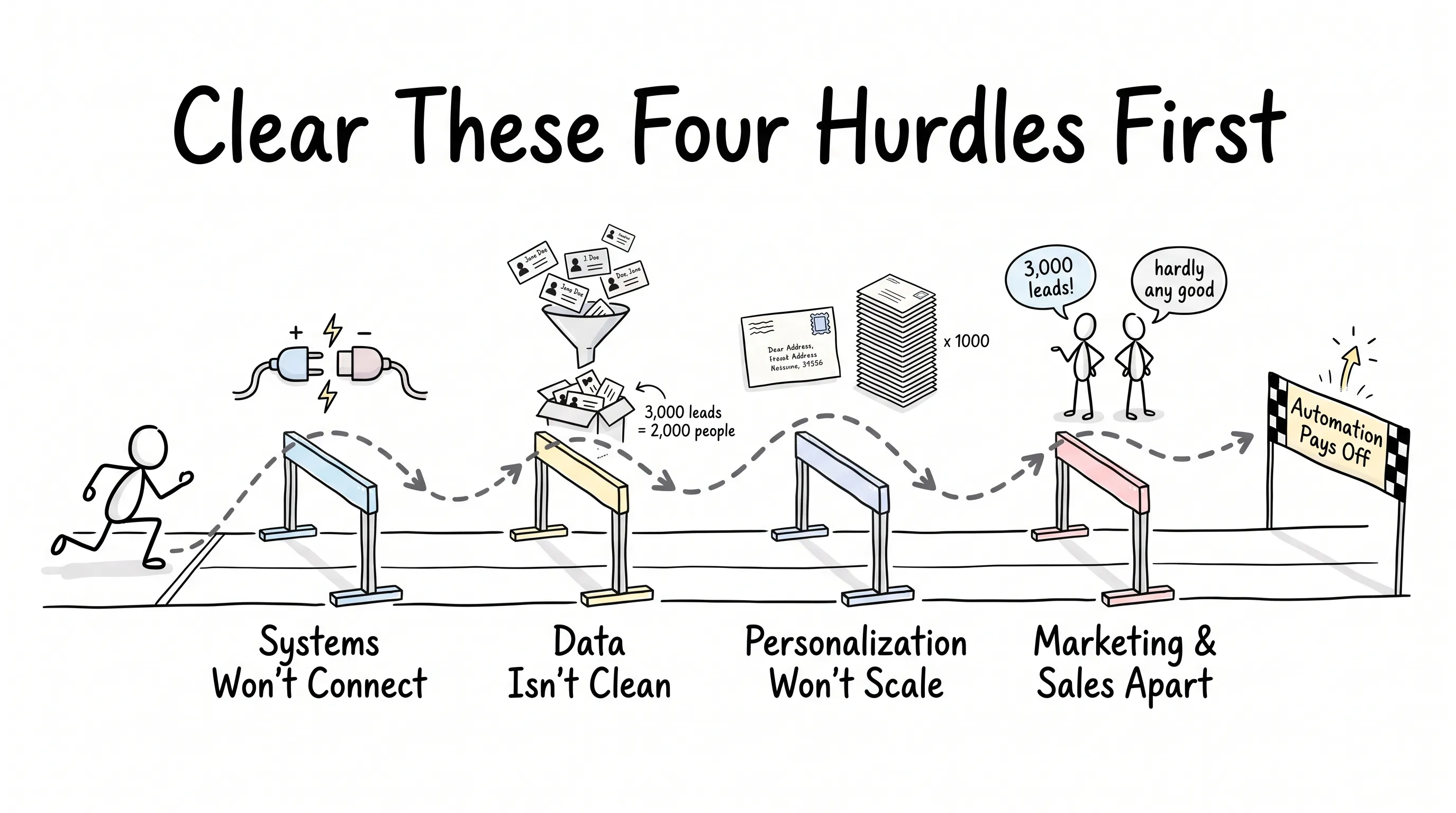
The First Hurdle: The Systems Won't Connect
Think about the tech stack of a typical B2B company: customers live in the CRM, orders run through the ERP, an inventory system tracks the goods, and there may be a pile of legacy systems connecting with partners. Legacy systems have their own protocols, new platforms have their own clouds, and every data standard speaks its own language.
It's like locking a roomful of people who speak different dialects into one conference room — and not providing a translator.
So when choosing a platform, ask first: can it connect to what I already have? Whether it integrates smoothly with the CRM matters most of all. Where leads come from, what prospects have looked at, how far sales has followed up — if that data can't flow, every bit of automation built on top is a castle in the air.
The Second Hurdle: The Data Isn't Clean
Some teams find integration a hassle, so they import a spreadsheet and make do. Make do long enough, and the problems start.
The same customer shows up once in the CRM, once in a web form, once again on an event list — the phone number is off by a digit, the job title is a rank apart. The system says three thousand leads; in reality there may be only two thousand people.
Feed dirty data in, and garbage actions come out — at the speed of automation. A human slip of the hand mislabels a few dozen records a day; a misconfigured rule can send thousands of emails to the wrong people overnight. Wrong recipients waste money; the deeper trouble is that the customer changed companies long ago, and your email keeps chasing their old title. That's harassment.
So before launch, put in the unglamorous work and clean the data first. This step can't be skipped, and it can't be rushed.
The Third Hurdle: Personalization That Won't Scale
B2B buyers do respond to personalization. Their purchases go through a process, and at every stage of their homework, you have to hand them the right thing.
But here comes the problem. With a dozen customers, you can still serve them by hand; at hundreds or thousands, personalization for every customer collapses into one message for everyone. Content has to be produced piece by piece, audiences segmented layer by layer — the bigger the audience, the harder it is to sustain.
How do you clear this hurdle? Half of it depends on the platform's content production and segmentation capabilities; the other half depends on planning ahead: which steps can be templated, and which must stay human. If you haven't thought it through in advance, the day you scale is the day it collapses.
The Fourth Hurdle: Marketing and Sales, Worlds Apart
This is the hardest hurdle, because it doesn't live in the systems. It lives in people's heads.
Marketing's KPI is lead volume and impressions; sales' KPI is closed deals and collections. So Marketing says: I handed you three thousand leads! And Sales says: out of those three thousand, barely a handful were worth calling!
Both are right. Both feel wronged.
What falls through the cracks is the customer. Marketing sent materials just last week; sales cold-calls today. The same prospect gets pinged by both sides at different tempos, the journey shatters into fragments, and the conversion rate naturally turns ugly.
There's only one antidote: both sides looking at the same data. Where the customer has reached, what marketing has done, what sales has said — all visible in one platform. That's exactly why automation platforms with native CRM integration have been in such hot demand these past few years.
Once the Hurdles Are Cleared, Automation Finally Pays Off
Once all four hurdles are cleared, what can automation do for you?
I can compress it into one sentence: orchestrate the customer journey around goals.
What does orchestrating around goals mean? The system tracks where every person is in their journey and, at the moment they're ready to be caught, automatically hands them the right thing. When behavior changes, the journey changes with it; when the data comes back, the strategy adjusts on the spot.
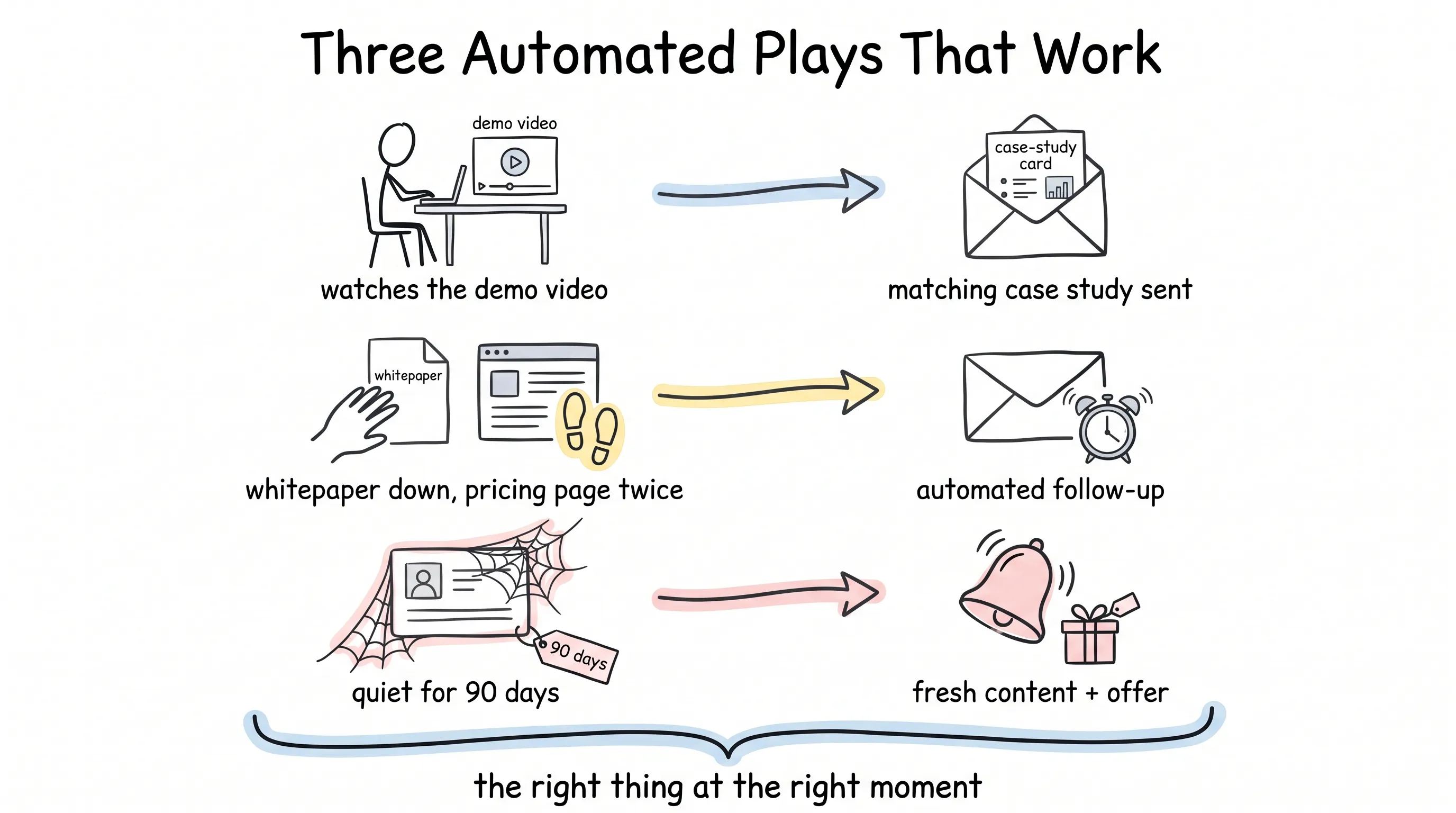
Let me walk you through three plays I've seen work.
First, moves that follow behavior. A lead has just finished watching your demo video; the system recognizes which feature they care about and sends the matching case study straight to their inbox. Before they've said a word, the message you wanted to deliver has already arrived.
Second, event triggers. Someone downloads a whitepaper, or goes back to the pricing page twice. The action itself is the signal: an automated follow-up email goes out with more detailed material, or an invitation to chat. Strike while the iron is hot — that's the key.
Third, waking the dormant. A batch of leads has gone quiet for ninety days; left alone, they're pure waste. The system automatically filters them out and pushes a wave of fresh content, or a special offer. Every lead you wake up is a win.
Notice: every one of these three is about saying the right thing at the right moment. That's what automation should look like.
The Platforms on the Market, Roughly Six Types
When it comes to categories, don't memorize names — look at what problem each type solves.
CRM-integrated platforms put marketing and sales to work in one pool — that fourth hurdle above is the one they handle. Enterprise multi-channel platforms orchestrate email, social media, mobile, and web together, built for large organizations whose touchpoints are scattered everywhere. Mobile-first platforms build everything around the phone: real-time push, in-app messaging, personalized offers — the moment user behavior shifts, they respond. AI-driven platforms are the hottest of the past two years, using algorithms to chew through customer data and predict behavior, taking personalization to the point where it knows what you want before you say it. Then there's the CDP — the customer data platform — the unification approach: paint one unified portrait of each customer, merging data from every channel into one place; segmentation and performance attribution are all built on that portrait.
The sixth category is special. Calling it a platform type is a stretch — it's really the pass line every platform must clear: privacy compliance.
Since regulations like GDPR and CCPA took effect, customer data is no longer yours to use just because you want to. Consent has to be obtainable, traceable, and governable; when customers want to view, correct, or delete their data, you have to provide the way for them to do it. So with any platform, ask one more question: on privacy, is it patching holes after the fact, or was it built in from day one?
That one question will filter out a whole batch.
A Case in Point: HCL Unica
After all this theory, let's look at something concrete. HCL Unica earned recognition in the marketing automation category in the Q4 2023 Spark Matrix report (an industry evaluation report). Let me take it apart so you can see what an enterprise-grade platform looks like.
Precision segmentation at scale. It slices a vast audience into clear segments, giving personalized messages somewhere to land.
Real-time personalization. Delivering the right content at the exact moment a customer needs it — do that often enough, and stickiness and loyalty grow naturally.
Planning plus budgeting. Where the marketing money goes and whether it's worth it — it runs the numbers for you, aiming every cent of budget at ROI.
Goal-based journey management. This is where the real craftsmanship shows: journeys aren't pieced together touchpoint by touchpoint — they grow out of the goals you set.
Built-in data layer and behavioral analytics. The CDP capability lives inside the platform, translating customer behavior directly into marketing decisions — no more stitching things together from separate pieces.
Notice how it answers the four hurdles and the three plays point by point. I'm not pitching it here — good platforms look much alike; bad platforms each fail in their own way.
Finally, Back to My Friend
In the end, he didn't hire anyone. He rolled out an automation platform, connected the CRM first, got the data properly cleaned, then configured those three plays one by one.
Last month he told me: these days, after nine at night, his phone stays quiet.
Same budget, same headcount — a completely different rhythm.
Tools take over the repetition; what they can't replace is judgment. Hand the repetition to the machine, and only then do you free your hands for the things machines can't do.
May your next email always land at exactly the right moment.
Continue reading
Related articles

Cross-Border Business: Time to Upgrade Your AI Toolbox
A learn article explaining how AI tools help cross-border e-commerce sellers clear five hurdles: language, regulation, logistics, payments, and fraud. It outlines a five-compartment toolbox, a five-step adoption path, and metrics such as conversion rate and CLV, while cautioning against over-reliance on AI.

AI Is Taking Over the Dirty Work of Social Media Marketing, One Task at a Time
This learn article outlines four social media marketing tasks AI can handle — audience analytics, content drafting and design, ad targeting and creative testing, and spam moderation — and cautions that taste, judgment, and data security remain human responsibilities.

AI Is Already This Good — Why Is Your Social Media Marketing Still Pure Manpower?
An overview of 18 AI tools for social media marketing, organized into six categories covering audience research, content creation, scheduling, comment and DM handling, ad management, and visual production, plus notes on personalization, prediction, and emerging trends.