
Does AI Marketing Actually Make Money? I Went Through Every Number I Had
An analysis of AI marketing ROI drawing on industry research: returns vary widely, with only about a quarter of companies moving AI projects past the pilot stage, while clear KPIs and workflow redesign are linked to higher returns.
A while back I had dinner with a friend who runs an e-commerce business. Last year he spent just shy of a million on an AI marketing system.
I asked him: is it running?
He shoveled in another bite of rice and said: the model is running, the money isn't showing up. And his team keeps telling him this is a "long-term investment."
I told him: don't rush to cut it, and don't rush to believe it either. Let me walk you through a few numbers, and you can judge for yourself.
What Does "AI Marketing ROI" Even Mean?
First, let's define the term.
The return on AI marketing — the ROI — is simply this: for every dollar you spend on machine learning, how much more comes back from your marketing results.
That's it. No mysticism, no jargon — just an arithmetic problem.
So what's the answer? I went through the research from several major institutions and found something genuinely interesting: the answer is "it depends on who's doing the using."
The Ones Who Use It Well Really Do Make Money
Start with the winners.
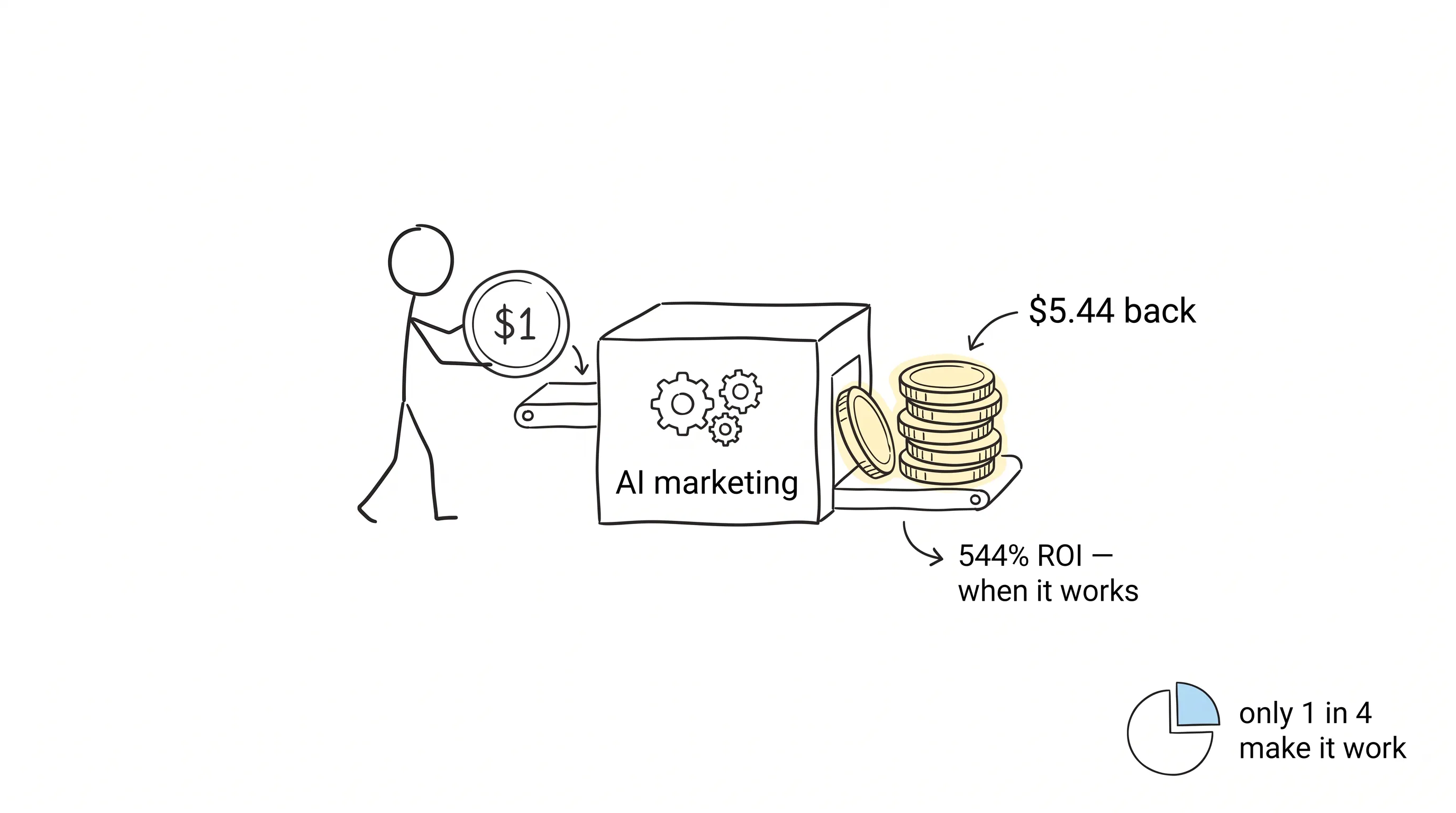
The marketing automation category has a documented ROI of 544% in industry research.
You read that right. Put a dollar in, get five dollars and forty cents back.
Forrester ran a Total Economic Impact study (an independent cost-benefit analysis framework) on e-commerce companies using Bloomreach's AI marketing automation: 251% ROI over one year. McKinsey's global survey found that companies with deep AI deployments can lift sales ROI by 10% to 20%.
Good grief, these numbers feel almost too good to be true, don't they?
That was my first reaction too. So I kept digging, looking for "the other side."
Why Do Most People Fail to Make Money?
That digging turned up something more important.
Stitch several institutions' surveys together and the conclusion stings: only about a quarter of companies manage to get their AI projects out of the pilot stage and into real value.
What about the rest? Their data is scattered, their systems are silos, and they don't even have a decent metric to measure success. The money gets spent, and the reports show nothing.
So what did that quarter do right?
One consultancy tracked over a thousand companies and found a pattern: among companies adopting AI, those that set clear KPIs and rebuilt their workflows along the way earned 2.7 times the returns of those that didn't.
Sit with that for a second.
Same tools. The difference is that one group shoved AI into their old processes, while the other went so far as to change how they themselves work, just so AI could actually deliver.
This is what I always say: AI isn't about adding furniture to an old house — it's a full renovation.
There's also the time problem. Plenty of companies take a good year or two before they see any sign of savings. That's not failure — that's the normal rhythm. Data, models, processes: every one of them needs nurturing. Impatience is the most expensive cost of all.
Early vs. Late: The Gap Is Compounding
Now for a number that sent a chill down my spine.
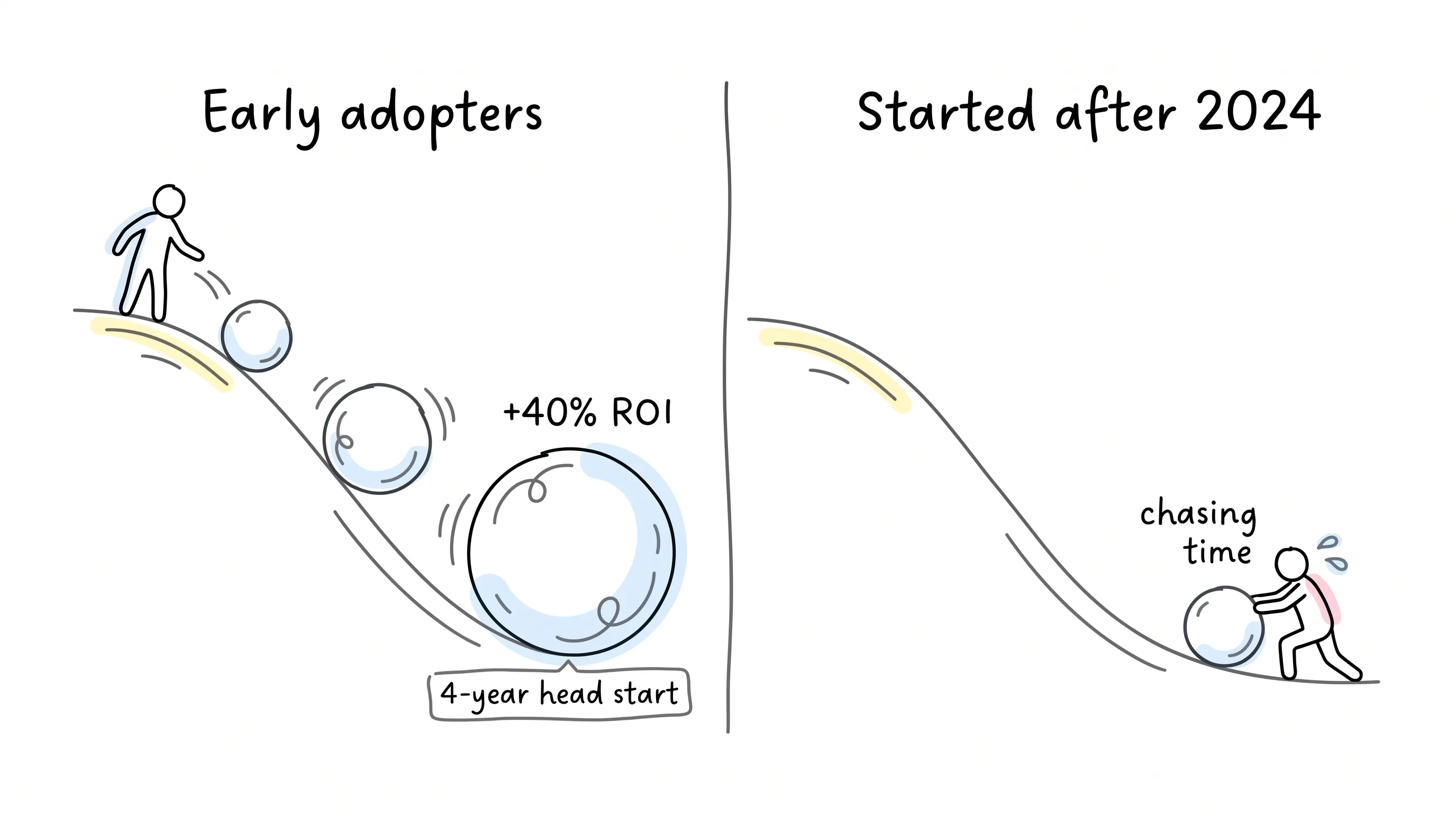
Stanford's AI Index Report tracked a group of companies and split them into "early AI adopters" versus those who only started "after 2024."
The result: the early crowd's marketing ROI ran more than 40 percent higher on average. And their data assets keep snowballing — the first-mover advantage in model training works out to a lead of more than 4 years.
What does that mean?
It means latecomers aren't just chasing the technology — they're chasing time. And time is the one thing no amount of money can buy back.
Move first, and your advantage compounds on its own.
How Much Room Is Left in This Market?
Someone will ask: is it too late to get in now?
Look at two numbers. Per IDC, about 35% of companies worldwide are using AI analytics — nowhere near the ceiling. And in McKinsey's 2026 survey, 66% of marketing and sales teams said generative AI has already brought real, spendable revenue growth.
The market itself is still compounding at a compound annual growth rate (CAGR) of 34.8%, with Statista's projections running all the way to 2030.
So the room is still spacious — but the door is closing.
Back to My Friend
Before dinner ended, I gave him one piece of advice: stop asking how much AI cost, and ask whether your KPIs were ever changed for it, whether your workflows were ever rearranged for it.
If the answer is no on both counts, the problem isn't AI.
The data won't let down anyone who does the math honestly.
Here's to you being one of that quarter.
Continue reading
Related articles

Cross-Border Business: Time to Upgrade Your AI Toolbox
A learn article explaining how AI tools help cross-border e-commerce sellers clear five hurdles: language, regulation, logistics, payments, and fraud. It outlines a five-compartment toolbox, a five-step adoption path, and metrics such as conversion rate and CLV, while cautioning against over-reliance on AI.

AI Is Taking Over the Dirty Work of Social Media Marketing, One Task at a Time
This learn article outlines four social media marketing tasks AI can handle — audience analytics, content drafting and design, ad targeting and creative testing, and spam moderation — and cautions that taste, judgment, and data security remain human responsibilities.

AI Is Already This Good — Why Is Your Social Media Marketing Still Pure Manpower?
An overview of 18 AI tools for social media marketing, organized into six categories covering audience research, content creation, scheduling, comment and DM handling, ad management, and visual production, plus notes on personalization, prediction, and emerging trends.