
Customers Don't Follow the Map You Drew
Why customers experience your brand as one company no matter how many systems you run behind the scenes — and how journey analytics, identity resolution, AI-powered real-time monitoring, and journey maps stitch scattered data into one seamless customer journey, with a six-step implementation plan.
A while back, it took me four devices and five days to buy one coffee machine.
Someone in my WeChat Moments (WeChat's social feed) posted a photo of their latte art, and I was tempted. I went to an e-commerce site and dug through reviews for over forty minutes, until I found "Third time buying — customer service was very patient," and I relaxed a little. The next day on my commute, I compared prices across three platforms in the app and added it to my cart. Didn't buy. Friday night, scrolling on my tablet, I noticed a price drop and saved it to my favorites. Saturday morning, sitting down at my computer, I placed the order.
One smooth sweep, start to finish. And nothing about it felt off — not even to me.
Then, on Monday, I got a text message: "Exclusive for new customers — ¥50 off your first order."
Me — a returning customer who had spent over a thousand yuan just the day before — getting a text urging me to claim a "new customer discount."
Does this company actually know me?
You might say: what's the big deal? Their systems just aren't connected.
The problem is, customers don't see it that way.
In a customer's eyes, there's no such thing as your systems, your departments, your KPIs. All they know is: the cart I filled on my phone should still be there when I switch to a computer; if I abandon a half-filled online form and call instead, customer service should know where I left off; and once I've bought the thing, I shouldn't keep getting "buy it" ads.
They don't care whether you run on one system behind the scenes or eighteen. What they want is for your company to know them.
What Does "Seamless" Actually Mean?
What is a seamless experience?
Put simply: wherever the customer goes, the company's memory follows. No re-introducing yourself, no explaining your situation twice, and certainly no wondering "do they even know I've already bought this?"
This kind of experience is how trust gets built. A smooth checkout, an instant reply from support, an easy onboarding — every smooth moment is a deposit into the "this company is reliable" account.
But it takes only one withdrawal to empty it. A navigation that leads you in circles, repeated rounds of verification, ads pushed after the purchase — once is enough.
Trust is built up slowly, and collapses in a single moment.
The math works out directly: less friction, higher conversion; customers who feel understood stay longer; a clearer process means fewer people calling support. Every one of these is money.
First, Put One Person Back Together
So how does a company come to "know" its customers? That's where journey analytics comes in.
What is journey analytics? It's taking the traces a customer leaves in all these different places and stitching them into one complete line.
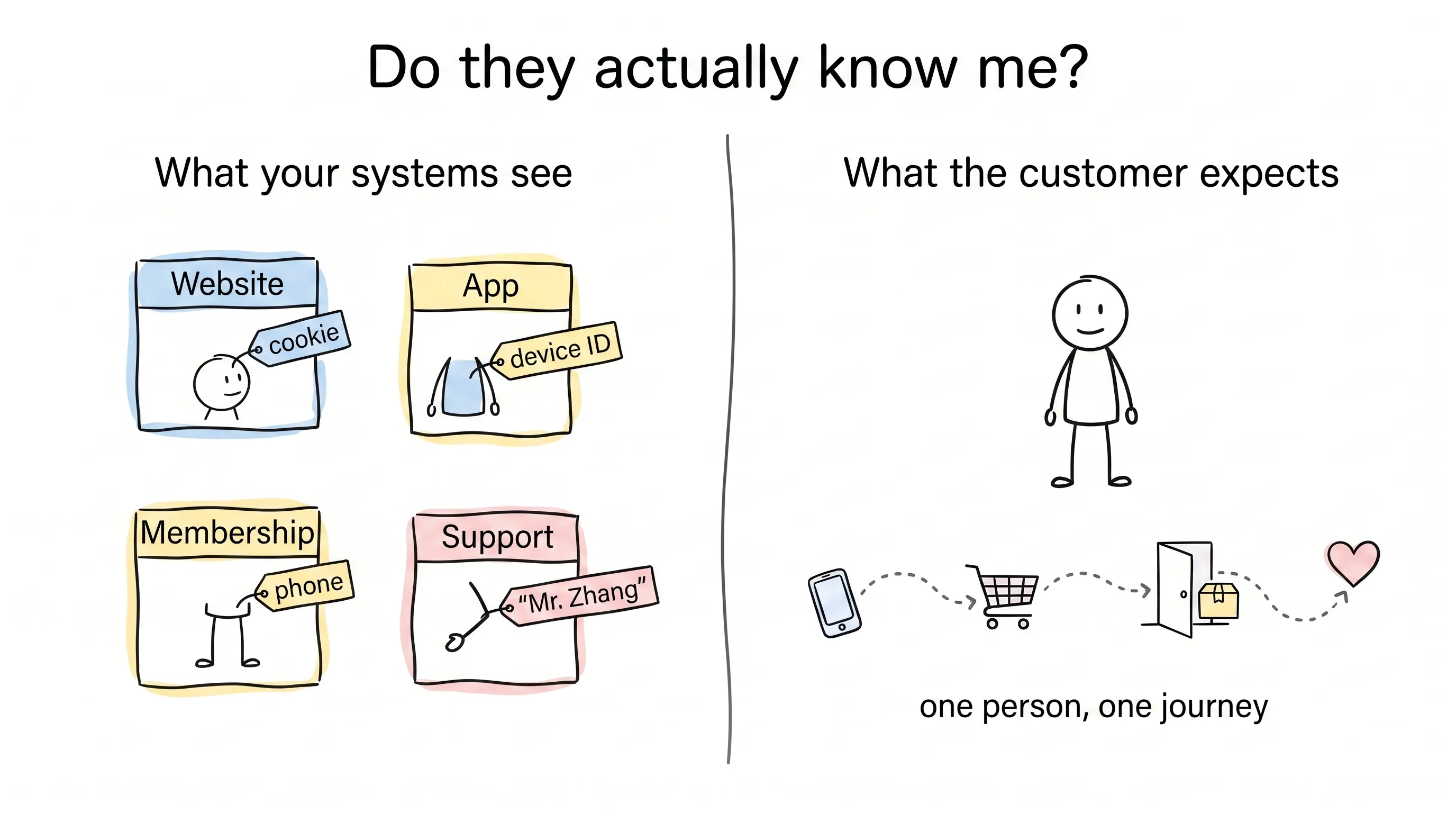
The hard part is that the data all exists — it's just scattered. One copy sits in the marketing platform, one in the e-commerce system, one in the CRM (customer relationship management) system, one in the support-ticket queue. Like the blind men and the elephant: each is holding one leg, and no one has ever seen the whole animal.
What's more, the same person looks different in every system: on the website, they are a cookie string; in the app, a device ID; in the membership system, a phone number; in the customer service records, "Mr. Zhang."
And the systems don't know these are all the same person.
The first thing journey analytics does is reunite those fragments under one real human being — the industry calls it "identity resolution." Only after the pieces are stitched together do you see, for the first time, a complete line: where this person came from, where they hesitated, where they turned back, and where they finally made the purchase.
Only when the line is connected are you in a position to answer the questions that really matter: at what moment do customers reliably give up? Which touchpoint drives conversion? Where is the fork in the road between satisfied and unsatisfied customers? Which kind of intervention works best?
You'll also discover an uncomfortable truth: the holes you dig up front tend to blow up down the road. Design a checkout that leaves people dizzy, and a few weeks later the support calls multiply. Do a sloppy job on onboarding, and a few months later that whole cohort stops logging in.
If every team reads its own data separately, these chains of cause and effect never connect.
Reports Are Autopsy Reports. AI Is a Thermometer.
At this point you might ask: haven't reports been doing this all along?
Yes — all along. Weekly and monthly reports, conversion funnels, churn rates — quite beautifully done, too.
But reports have a built-in flaw: they only look at the past. They tell you last week's conversion rate dropped two points — but by the time that number crawls into the weekly meeting, the customers who were going to leave have long since left.
Reports are autopsy reports. AI is a thermometer.
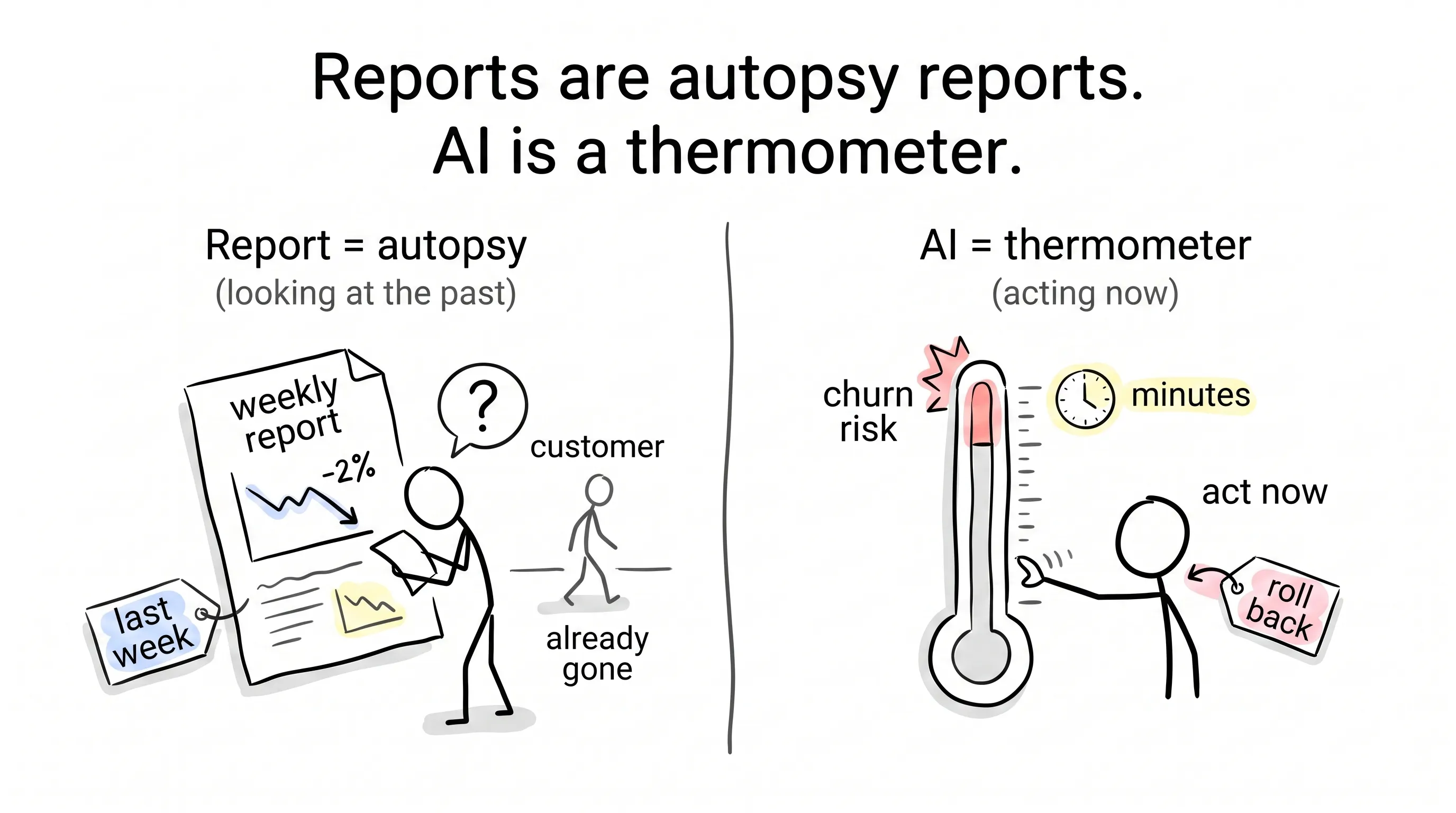
A thermometer means: catch your fever on the spot, deal with it on the spot.
The first thing AI does is real-time. Every click, every swipe, every line of the support chat — it's watching all of it. An anomaly that used to take a person weeks of digging to spot now triggers an alarm within minutes: a page that has never had problems suddenly has a big wave of visitors turning around and leaving. Nine times out of ten, some change that shipped today is to blame. Find it early, roll it back early, and the loss stays small.
The second thing is prediction. It's a bit like how a veteran shopkeeper reads people: one glance, and they can tell whether you're just browsing or buying today. AI turned that kind of intuition into math. Logins dropping, core features untouched, repeated trips to the troubleshooting page — churn risk flashes red, time to make the win-back call. The other way around: constant price comparisons, repeated looks at the spec sheet — purchase intent flashes green, and a coupon offered at exactly that moment lands perfectly.
And one more thing I think is seriously underrated: AI can actually read text. Support chat logs, ticket notes, the long complaints in surveys, reviews collected through QR-code scans... These are customers speaking their minds in plain, everyday language, and in the past nobody had the energy to read them one by one. AI can read them. Out of a few thousand "here's why I'm leaving," it can fish out the real reason that keeps reappearing.
By the way: AI no longer segments people in coarse strokes like "25 to 35 years old, tier-1 and tier-2 cities." It looks at behavior: how you use the product, what content you love, which feature is a genuine necessity for you. Then, at the right time, it hands you the right thing.
Data Says "What." Maps Say "Why."
But data alone is not enough.
Data tells you the customer bailed at step three. But why did they bail? Data often can't answer.
This is when you need a tool that looks dumber: the journey map. Draw a typical customer, from start to finish, on a single sheet of paper: who they are, what they want, which step they're at, which touchpoints they pass through, what they're hoping for, what they're cursing, where they're stuck.
This map has a magical side effect: it's a surefire cure for internal squabbling.
What marketing promised the customer, product never delivered; whatever sales said on the phone, support has no idea about; billing, product, after-sales — three systems, three versions of the truth.
Customers don't understand any of this. All they feel is being jolted back and forth between your departments.
Hang the map on the wall, and the arguing stops. Everyone can see it now.
So How Do You Actually Do It? Six Steps.
- First, twist the scattered data into a single rope. Connect the customer data spread across systems, so that every team sees the same "person."
- Pick the most critical journeys first. Don't be greedy. Onboarding, after-sales handling — start with the two that have the most friction and the most value.
- Let AI find the friction. When humans look at data, they see averages; AI can see where behavior clusters. Where it clusters is usually where the opportunity is.
- Be restrained with personalization. Hand people things when they need them; don't bombard them when they don't. Be a help, not an interruption.
- One map and one set of metrics for the whole company. Marketing, product, customer service — each owning a segment is fine, but in the customer's eyes, you are "this one company" from beginning to end.
- Keep testing, keep changing. Run A/B tests, iterate in small, fast steps, and let the data speak.
Looking Ahead, a Few Things Are Pretty Much Certain
AI agents will increasingly do the work by themselves: without waiting for a human nod, they just get the job done.
The logic of service will flip. Before, the customer discovered the problem and came to you; from now on, you discover the problem first, and it's already solved before the customer even notices. Like the 4S dealership (China's one-stop auto dealership combining sales, service, and parts) calling before your tire has even gone flat: "Sir, your front-right tire is worn down to the safety line — shall we book a time for the replacement?"
Tools will keep getting simpler — operations people who can't code will be able to build workflows and tune the messaging themselves. And capabilities like prediction, generation, conversation, and analysis will keep snapping together until they grow into a single platform.
And the rope of privacy will keep tightening. Data you can freely grab will keep getting scarcer. Whoever is better at using the signals customers hand over voluntarily will be out in front.
Back to That Text Message
Remember that "¥50 off for new customers" text at the beginning?
The company that sent it doesn't lack data, doesn't lack technology, and doesn't lack budget. What it lacks is the thread that stitches its data into one complete journey.
With the thread stitched, customers feel "you know me"; without it, customers feel "you just want to make money off me."
Seamless is not about how beautiful an interface is. It is an entire company revolving around one single person.
Here's hoping your next new customer never receives a "first-order discount" text the day after they order.
Continue reading
Related articles

Cross-Border Business: Time to Upgrade Your AI Toolbox
A learn article explaining how AI tools help cross-border e-commerce sellers clear five hurdles: language, regulation, logistics, payments, and fraud. It outlines a five-compartment toolbox, a five-step adoption path, and metrics such as conversion rate and CLV, while cautioning against over-reliance on AI.

AI Is Taking Over the Dirty Work of Social Media Marketing, One Task at a Time
This learn article outlines four social media marketing tasks AI can handle — audience analytics, content drafting and design, ad targeting and creative testing, and spam moderation — and cautions that taste, judgment, and data security remain human responsibilities.

AI Is Already This Good — Why Is Your Social Media Marketing Still Pure Manpower?
An overview of 18 AI tools for social media marketing, organized into six categories covering audience research, content creation, scheduling, comment and DM handling, ad management, and visual production, plus notes on personalization, prediction, and emerging trends.