
Customer Journey Maps: Time to Let AI Redraw Them
This learn article explains how AI redraws customer journey maps by stitching omnichannel data, reading emotions in reviews and chats, and flagging funnel drop-offs in real time, then covers personalization, AI customer service with human handoff, GDPR/CCPA data trust, and adoption steps.
A few days ago, I had tea with an old friend who runs an e-commerce business.
He sighed the moment he sat down. His team had just spent two days in back-to-back meetings, covering a whiteboard with sticky notes, redrawing the customer journey from start to finish.
I asked: and once you'd finished drawing it?
He said: then it hangs on the wall, waiting to go stale.
I laughed. It sounds like a joke, but he was telling the plain truth.
What is a customer journey? It's every step a person takes from the first time they see you, to paying you, to using your product, to recommending you to friends. Seeing an ad is a point. Clicking into your online store is a point. Asking customer service a question is a point. Placing an order, receiving the package, writing a review — all points. Connect the points, and you have a journey.
So why does the map go stale?
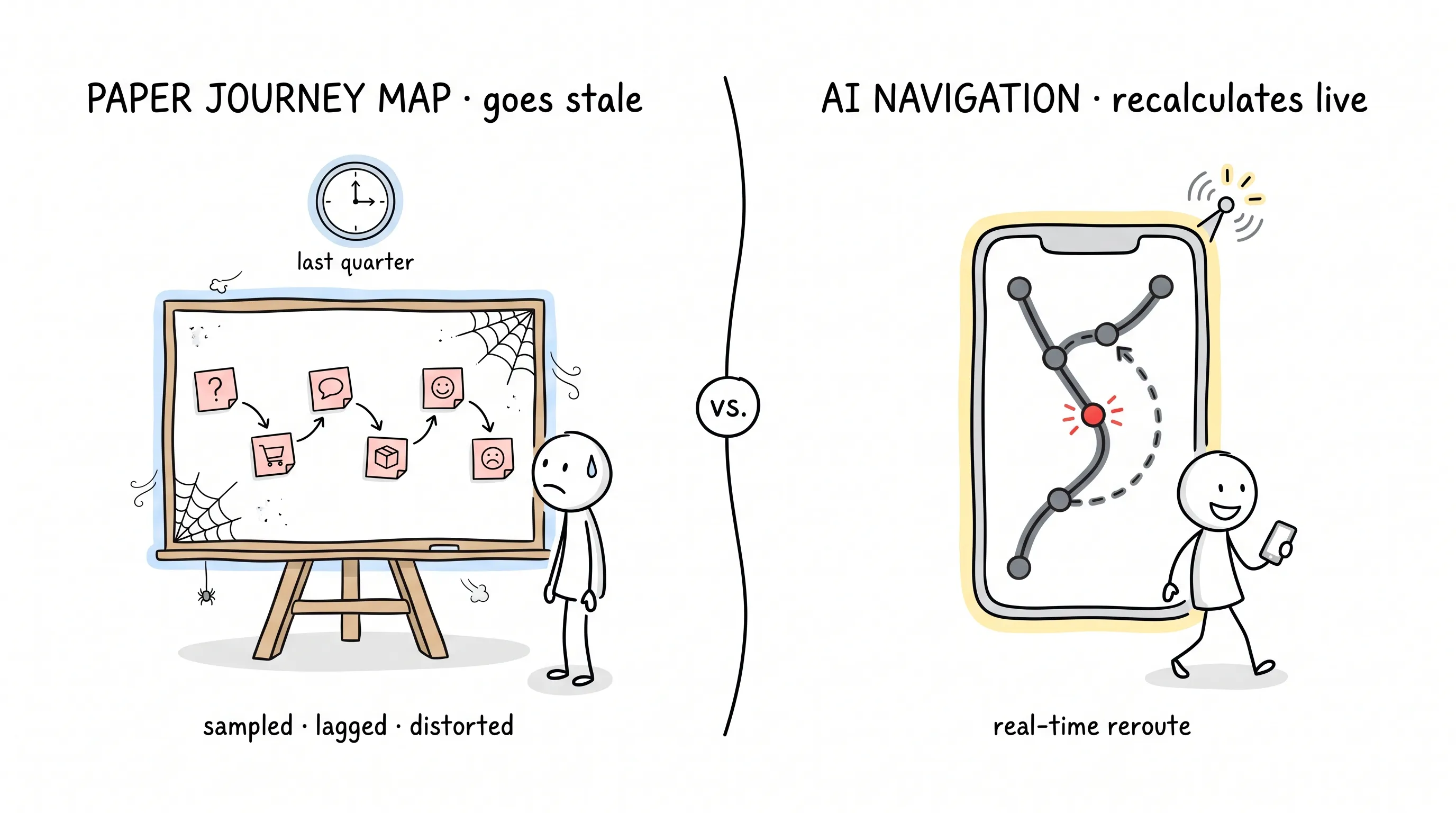
Because you draw it from interviews, surveys, and the recollections of a few employees sitting in a conference room. Sampled. Lagged. Distorted. Meanwhile, your customers change every single day.
The old customer journey map was like checking a paper map before a road trip. However finely you draw the route, one traffic jam ruins it. Only after AI entered the picture did this become navigation for the first time: hit a jam, and the route recalculates automatically.
The Three Things AI Does
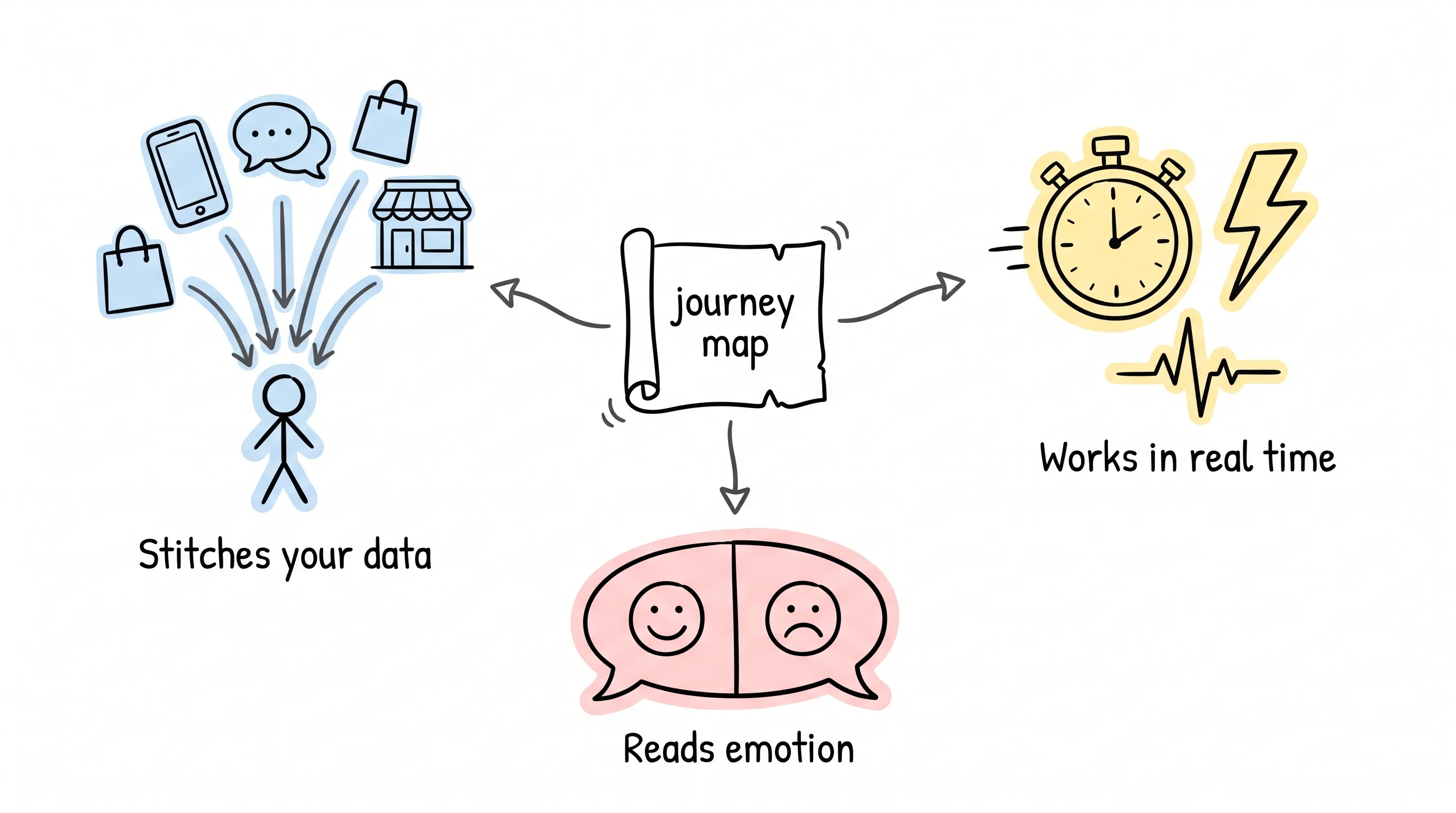
First, it stitches the data together.
Website, app, social accounts, customer service chats, physical stores — customer behavior is scattered across every corner. AI pieces this omnichannel data onto a single picture, and for the first time you see one complete human being instead of a pile of fragments.
Second, it works in real time.
The algorithm processes while you act. The moment you get stuck on the payment page, the system has already seen it. No waiting for next quarter's report.
Third, it understands emotion.
Using natural language processing to read reviews and chat logs, it can tell whether the feeling behind a sentence is happiness, disappointment, or anger.
This one, I think, matters most of all. The customer who says "it was fine" out loud and the one thinking "I'm never coming back" are often the exact same words.
A Map Alone Is Useless. You Need to Know Where It Hurts
Think about it. Say you run an online store. Ten thousand customers enter the purchase flow, and eight thousand pay.
Where did the remaining two thousand drop off — at which step?
The human eye can't see it. AI can.
It watches the conversion data at every step, and the moment drop-off at any step suddenly spikes, it raises the alarm. If the bounce rate on the payment page doubles overnight, you know that day — not at the month-end retrospective.
It also spreads out tens of thousands of reviews and service records and automatically sorts the complaints: slow shipping, damaged packaging, painful returns. The pain points line up in a row, and the order of improvements follows.
By the way: once the pain points are listed, the opportunities come out with them.
Segment customers by behavior and preference, and you may find a group that only orders at midnight and only buys sale items. Is that group worth its own dedicated campaign?
That's the doorway to personalization.
What Is Personalization? Plainly Put: Making Fewer Choices on the Customer's Behalf
You open a shopping app, and somehow everything recommended on the front page is something you want to buy. What's behind that?
Three common approaches.
The first is collaborative filtering: people with taste similar to yours bought something, so it gets recommended to you. A crowd of "neighbors" trialing things on your behalf.
The second is content-based filtering: whatever you like, you get more of. One example stuck with me: a customer glanced at a mortgage product on a bank's website, didn't apply, and left. The next time he logged in, the front page was showing mortgage offers. The system remembered him.
The third uses both together, then factors in context. Coffee in the early morning. Food delivery on a rainy day.
The current mainstream play is deep learning that reads both text and images. You see a sofa you love in someone's home, snap a photo, and it finds you the same one.
Impressive.
Personalization also comes in two rhythms.
One is real-time: you just tap on running shoes, and the front page instantly becomes a running-shoe feature. Fast.
One is predictive: the system reads your past records and judges that your car is due for service, that your membership is due for renewal — and reminds you before you even think of it.
The industry calls this whole apparatus "Customer Journey Orchestration": making what the customer feels at every touchpoint part of one continuous performance.
There's another term: "Next Best Action." On the service agent's screen, AI suggests: with this particular customer, right now, what's the best thing to do?
AI even searches for the optimal path on its own: whichever route takes customers most smoothly from discovery to purchase, that's the route you pave; then A/B testing validates all along the way, you keep fixing, and the map keeps updating.
And when personalization is done well, the savings aren't just about experience. Predict which product is about to sell out, and stock up early. Predict which day customer service will queue up, and staff up early. Everything saved is real money.
Machines Handle Efficiency. Humans Handle Emotion.
When AI customer service comes up, many people's first reaction is: the bot doesn't understand the question, and it's infuriating.
True. I've been infuriated too.
But have you had the other experience? It's midnight, you want to change an order, you can't find a human, and you wait until nine the next morning.
The bot's greatest advantage is one thing: it is always online. And it can take ten thousand conversations at once without getting tired. Refunds, address changes, shipping inquiries — done in three seconds, no waiting for the human shift to start.
Better still, it understands context, its answers are backed by a knowledge base, and it gets smarter with every conversation.
But.
Complex problems, emotionally charged problems, still need a human.
The one thing you must nail is the seamless handoff: the bot packages the conversation context and the customer's history and hands it to the human, so the customer never has to say "my order number is..." for the third time.
After the handoff, AI keeps helping, pushing the relevant materials in front of the agent. And when the agent is done, they teach the AI in return: next time a question like this comes up, answer it this way.
Machines handle the 80% of questions that are routine; humans handle the remaining 20%. And that 20% decides whether the customer stays or walks.
There's Only One Prerequisite: The Customer Has to Trust You
At this point you may be tempted: I should get on this right away.
Not so fast. If you skip this one thing, everything above is wasted.
Every piece of customer data in your hands is borrowed from the customer. And when you borrow, you should act like a borrower.
Regulations like the EU's GDPR and California's CCPA have long been on the books: how data is collected and used must be explained to customers in plain terms; if customers want to inspect, correct, or delete their data, you must comply. Anonymization and encryption are the floor, not the ceiling.
One more thing gets overlooked: algorithms can be biased. If a model consistently gives one group of customers worse prices or slower service, it has crossed a technical boundary and become a fairness problem.
Plainly put: you trade data for experience, and the customer trades their trust for you.
Trust takes years to accumulate. It takes one breach to collapse.
Want a Seat at the Table? Where Do You Start?
I've seen two kinds of companies.
One kind spends big money first on a pile of AI tools, then figures out what to do with them. The tools gather dust in a warehouse.
The other kind runs in reverse. First, get clear on the problem: what exactly am I solving? Customers waiting too long? Recommendations that miss? Service staff stretched thin? Once the goal is set, take inventory: is my data clean, or scattered? Then pick one or two scenarios and pilot small; once the pilot works, wire it into your CRM and daily workflow, and roll out little by little. And even after rollout, don't let go: keep watching, feed customer feedback back in, keep refining the model.
Along the way, a handful of numbers is enough to watch: CSAT, NPS, first response time, conversion rate, and customer lifetime value (CLV).
Especially the last one. Don't only count the headcount you saved.
Saving headcount is saving small money. A rising customer lifetime value is making big money.
Looking Ahead: What's Already Happening?
Conversational AI will understand people better, and chatting with it will feel less and less like "talking to a machine."
Personalization will get finer — so fine that the same page, opened by a thousand people, shows a thousand versions.
AR and VR will bring "trying on" online. You've spent ages picking a dress on screen; put on the headset, and the dress is already on you. Turn around, and you can check the back.
Emotion AI will read your expressions and tone of voice and tune the warmth of service to just the right temperature. And there's visual search — snap a photo, find the same item — plus voice interaction that keeps getting smoother.
None of this waits for some distant future. It's becoming reality, item by item.
Don't be anxious about chasing every new technology. What matters is that the organization keeps up: keep one pair of eyes on what's new, validate with small pilots, build up the team's ability to work with data, and set the rules for how data gets used.
Coda
That day over tea, as he saw me off, my friend said he was keeping the whiteboard — but next month he planned to swap the sticky notes for a real-time data screen, where any step that jams turns red on the spot.
I said: now that's right.
Maps go stale. Understanding people doesn't.
Whoever lets AI understand their customers first will be first to serve them right where it counts.
And may you, too, draw a map that never goes stale.
Continue reading
Related articles

Cross-Border Business: Time to Upgrade Your AI Toolbox
A learn article explaining how AI tools help cross-border e-commerce sellers clear five hurdles: language, regulation, logistics, payments, and fraud. It outlines a five-compartment toolbox, a five-step adoption path, and metrics such as conversion rate and CLV, while cautioning against over-reliance on AI.

AI Is Taking Over the Dirty Work of Social Media Marketing, One Task at a Time
This learn article outlines four social media marketing tasks AI can handle — audience analytics, content drafting and design, ad targeting and creative testing, and spam moderation — and cautions that taste, judgment, and data security remain human responsibilities.

AI Is Already This Good — Why Is Your Social Media Marketing Still Pure Manpower?
An overview of 18 AI tools for social media marketing, organized into six categories covering audience research, content creation, scheduling, comment and DM handling, ad management, and visual production, plus notes on personalization, prediction, and emerging trends.