
Content Keeps Getting Cheaper, and Buyers Are Harder to Fool: B2B Content Needs a New Way to Earn Its Keep
A learn article arguing that AI has made B2B content cheap, so volume is no longer a moat; teams should invest in reusable reference assets—calculators, benchmarks, templates, playbooks—chosen by recurring need, stakes, unique contribution, and maintenance, citing industry research and vendor cases.
A few days ago, a friend who works in B2B marketing came to me to vent. He said that with AI writing drafts now, one afternoon produces what used to take a week. His team's efficiency is frighteningly high, yet he feels less and less sure of himself: nobody seems to actually use the things they write.
I asked him: you've published all this stuff — what do buyers actually do with it?
He froze. He had no answer.
That inability to answer is the biggest problem in B2B content marketing today.
First, a Few Numbers That Sting
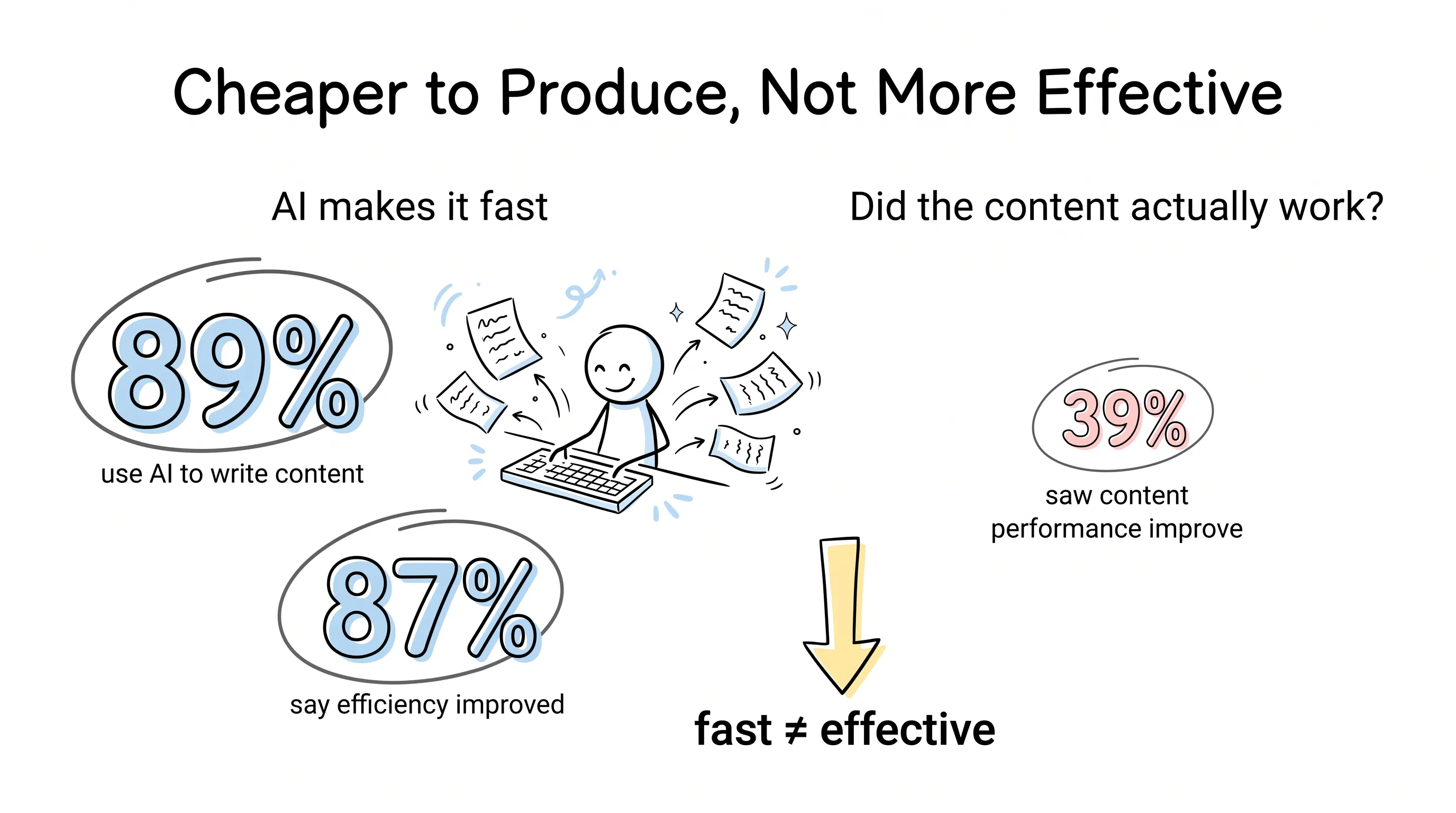
In CMI's 2026 B2B research, among marketers who use AI, 89% use it to write content, and 87% say it has genuinely improved their efficiency.
Sounds great, right?
But only 39% say their content performance has actually improved as a result.
What does that mean? It means you're producing content faster, but the share of content that actually works has barely moved.
Let me give you an analogy. Printing used to be expensive, and publishing a book was hard — anyone who could put out a book had to have something. Then printing got cheap, everyone could publish a book, and books stopped being worth much. What became valuable instead was that small handful of books people actually read to pieces.
Content is the same. AI has driven down the cost of content — and, along with it, the value of content.
Volume is no longer a moat. Judgment is. The more you produce, the more you need to be clear about: which things deserve to exist? Which things deserve continued investment after you hit publish?
Time to Hit Pause on the Old Rhythm
What's the rhythm every B2B content team knows by heart?
Find a topic, write the piece, publish, push it out, glance at the data, then — next round.
The calendar is packed, the team always has something to do, and everyone looks industrious.
But there's a trap buried in it: every piece of content is treated as disposable.
Publish day is its peak, and after that nobody touches it again. For news-jacking posts and campaign collateral, that's fine — they were consumables from birth. The problem is that some content was never meant to be treated this way — the things that help buyers solve problems again and again are being run down the same assembly line.
There's another number in that CMI study: among the marketers who consider their content effective, 65% attribute success to "relevance" and "quality." Notice: not quantity.
So the question worth asking has changed. It's no longer "which topics did we cover this month," but:
After you hit publish, which things are worth continuing to feed?
Buyers Don't Want Information. They Want Momentum.
To answer that question, you first have to understand what buyers are actually doing.
You think they're "reading materials." In fact, they're running a complicated internal project: figuring out what the problem is, comparing vendors, defining requirements, getting colleagues aligned, explaining to leadership why the purchase makes sense, and finally making the call.
And he's not doing any of it alone.
Demand Gen Report's survey found that roughly 56% of B2B buyers are already drowning in too much content. At the same time, 72% forward content to the relevant people on their team.
Put those two numbers side by side and something interesting emerges.
Buyers don't need more to read. They need a weapon that helps them win other people over.
The reason they found your content may be to use it themselves — but more likely they're taking it to finance to explain the budget, to IT to explain compliance, or to their boss to argue the case for the purchase. In 6sense's 2025 buyer experience report, buyers don't speak to sales until they're about 61% of the way through the buying process; and among vendors buyers already like before that first conversation, roughly 80% go on to win the deal outright.
Forrester's 2026 enterprise buying research shows that a single B2B purchase involves an average of 13 internal stakeholders and 9 external participants. Gartner also found that 74% of B2B buying teams experience harmful internal conflict during the decision process.
Picture the scene: a room full of people, at each other's throats, drowning in information, nobody able to persuade anybody.
What can an ordinary explainer article do in that moment? Nothing. It just adds a little more noise on top of the noise.
But something that helps him frame the problem clearly, lay out the options plainly, and broker internal consensus — that's a lifeline.
The easier information becomes to produce, the more valuable clarity becomes. I've been turning this over in my head lately, and the more I think about it, the truer it feels.
So What Counts as a "Reference Asset"?
Alright — what kind of content deserves the words "continued investment"?
I call it reference assets. Note: it's not a format.
It can be a calculator, benchmark data, a template, a checklist, even an article. There's only one test: do people have a reason to come back to it, share it, and use it to make decisions?
That's a full order of magnitude above the standard of "is this post good enough to publish."
One example and you'll get it. A 50-page white paper takes real investment — but if people put it down after one read, its lifespan is over. Compare that to a scrappy little calculator that a buyer might open a dozen times across the entire decision process.
The difference in lifespan isn't length. It's what the thing helps people get done.
Broadly, there are three ways to live:
- Help people understand hard things — industry benchmarks, regulatory requirements, complex market data;
- Help people make decisions — comparison frameworks, ROI calculators, scoring sheets;
- Help people do the work — templates, implementation guides, checklists, playbooks.
Now let me tell you a few real cases. When I first saw these, my reaction was: oh — so that's how you play this game.
Four Cases, Four Ways to Live
First: solve a small annoyance that keeps recurring.
Procore makes construction software. It has an asphalt calculator that helps contractors estimate how much material a paving job needs, and a daily construction report template that helps project teams log each day's site conditions, resources, delays, and safety issues.
Are these two things sophisticated? Not remotely.
And that's exactly the beauty of it. On a job site, estimating material and writing the daily log are things you face every single day. Procore never asked "what article should we write about asphalt?" It asked: what do the people in this trade actually have to get done, every day?
Second: turn your own proprietary data into other people's decision tool.
Carta holds data on roughly 20,000 equity financings by US startups. It turned that data into a benchmark tool: founders can filter by funding stage, industry, region, and time period, and compare round sizes, valuations, and dilution.
Sure, a founder could read an article about "what Series A valuations usually look like." But this tool answers a question on another level: what do companies like mine look like right now?
Anyone can write the article. Only Carta has this data. That's the thing AI can't replicate in five minutes.
Third: turn knowledge into action.
Atlassian's Team Playbook assembles a full set of "plays" for common scenarios: retrospectives, project kickoffs, role assignment, decision-making, ways-of-working agreements. Take its 4Ls retrospective — from how to prepare and how long to run the meeting, to how to turn observations into actions, it walks you through running a retrospective step by step.
Reading an article, you can "understand" what a retrospective is. Open the playbook in the actual meeting, and you can actually "run" one.
Between understanding and using lies a whole ocean.
Fourth: help people find their bearings in a high-stakes, complex decision.
Trilliant Health, a healthcare data company, published a practical guide to healthcare strategy that breaks big questions — market share, physician strategy, pricing, capital allocation — into questions you can actually work through. It also has a tool that finds the 50 hospitals that are statistically most similar to yours, then compares them item by item on quality, finances, competitiveness, and price.
The question that tool answers is very concrete: who are my true peers? And how do I actually measure up?
Four cases, wildly different formats. But the core is identical: they gave people a reason to come back.
Not Every Topic Deserves This Kind of Investment
At this point, you might be fired up, ready to go back and upgrade every topic on your list.
Hold on.
Reference assets are expensive. They take time, expertise, and ongoing maintenance. Your team is already stretched thin; if you treat everything this way, you'll spread yourselves across the board and end up doing nothing well.
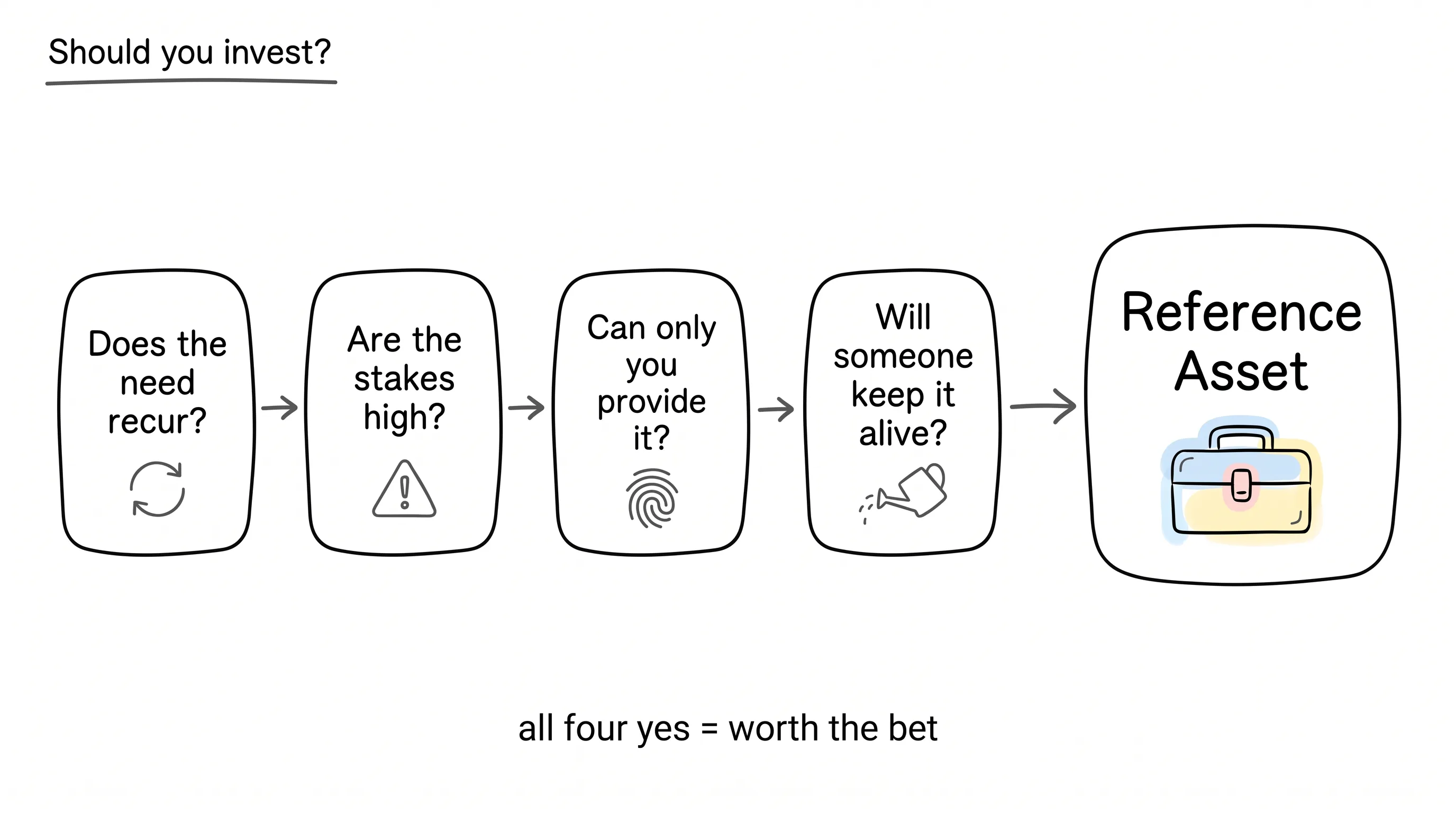
So how do you choose? In my summary, ask yourself four questions.
First: does the need recur?
Gartner describes B2B buying as a series of jobs buyers need to complete, not a tidy funnel. "Learn about CRM" carries no real information; "evaluate which CRM meets our requirements" points at a concrete decision. Then push one layer deeper: is that decision one-and-done, or will it come around again in six months? Only the recurring ones are worth betting big on.
Second: are the stakes high?
Vendor selection, budget, compliance, implementation, benchmarking, internal approvals — if these go wrong, someone answers for it. Where the cost of failure is high, content that helps people make the right call is worth a lot. And look at the whole buying group while you're at it: can someone take this asset into a conversation with finance, IT, procurement, or leadership? If yes, it's more than a lead magnet.
Third: what can we contribute that nobody else can?
In the AI era, this question can't be dodged anymore: what can your company provide that no other company — or any AI system — could replicate in five minutes?
It doesn't have to be proprietary data. Implementation experience, industry depth, a methodology, real customer feedback, an understanding of the regulatory landscape — even just the ability to piece scattered fragments of information into one coherent whole — all of it counts.
Fourth: after you publish, is someone responsible for keeping it alive?
If buyers start depending on this asset, someone has to own its accuracy. Data needs updating, guidance goes stale, templates start to look dated, and feedback from sales and customers will create new demands. Without that patience and headcount, don't start.
A recurring, genuine need, plus something only you have, plus the willingness to nurture it long-term — only when all three come together is it an opportunity.
The Best Next Asset Might Already Be Sitting in Your Library
There's a cheaper way to think about this, too.
Before adding anything new to the calendar, look backward first: what's already being used?
An article published months ago that keeps bringing people back; sales reps who carry the same single document into every client meeting; a page that keeps earning backlinks long after publication; customers who bring it up in conversation unprompted.
These aren't just nice metrics. They're your audience telling you: this is where it's worth digging deeper.
Here's an example. Say you have a piece called "10 Questions to Ask Before Choosing a CRM" — decent traffic, and sales loves using it.
What's the reflex? Another piece: "12 Questions to Ask Before Choosing a CRM."
Stop. The better question is: what could the original one grow into?
It could become a self-serve vendor scoring sheet; it could add a set of questions tailored to what finance, IT, and procurement each care about; it could level up into a weighted evaluation framework; it could even become an internal business-case template you can carry straight into the meeting room.
Not every hit deserves this treatment. But when people keep using something, keep sharing it, keep coming back to it — don't look away.
Sometimes the right next step isn't to build something new from scratch. It's to take what your audience has already endorsed, and keep deepening it.
The Cadence and the Metrics Have to Change With It
Once you start building reference assets, there's a chain reaction you can't escape: the rhythm of your entire content operation has to change.
The old rhythm was: build, publish, check the first month's numbers, move on.
The reference-asset rhythm is: build, distribute, observe, maintain, iterate.
What does that mean in practice? Experts watch the market and spot a guideline that needs revising; sales hears new questions the resource doesn't answer; customer success sees customers using it in ways you never imagined; product has new technical documentation to fold in; the benchmark data is due for a refresh, and the template is starting to age.
How people use the asset is itself intelligence. If everyone keeps re-reading one section and skipping another, or keeps asking for a tool to help them take the next step, those behaviors are handing you a to-do list.
Gradually, this asset stops being a "publish and run" product of the content team and becomes something the whole company operates on an ongoing basis. You're not investing in its launch. You're investing in the rest of its life.
The metrics have to change too.
Auditing something designed to live a year or two on its first 30 days of data is absurd. What you want to know is: are people coming back? Is sales still sharing it? Are target customers using it? Are backlinks still growing? Is it supporting pipeline and serving existing customers?
These signals are things launch traffic will never give you. You don't need to invent an entirely new attribution model — you just need to stretch your time horizon: if you plan for it to live a year, then evaluate it with a full year's eyes.
Finally, Back to That Question
So stop asking "what else can we write?"
Ask: what question do you want to become the answer to?
It might be a hassle buyers keep having to solve, a decision that never quite gets settled, the one document sales can grab in a pinch, or a field where you genuinely have the expertise and other people genuinely need a hand.
AI keeps making content easier to produce. Which means, precisely, that the judgment to decide where to invest has never been worth more.
Some topics only need a timely article. Some ideas deserve a thought-leadership piece. Campaign collateral still needs to exist. Not every topic earns a calculator, a set of benchmark data, or a playbook you'll maintain for years.
But when something can repeatedly help people solve problems, support a major decision, or get real work done — that's worth a big bet.
The goal of content was never to make the library fuller.
It's to make something so useful that buyers can't get around you when they research and when they decide.
That's the kind of value that holds up over time.
Continue reading
Related articles

Cross-Border Business: Time to Upgrade Your AI Toolbox
A learn article explaining how AI tools help cross-border e-commerce sellers clear five hurdles: language, regulation, logistics, payments, and fraud. It outlines a five-compartment toolbox, a five-step adoption path, and metrics such as conversion rate and CLV, while cautioning against over-reliance on AI.

AI Is Taking Over the Dirty Work of Social Media Marketing, One Task at a Time
This learn article outlines four social media marketing tasks AI can handle — audience analytics, content drafting and design, ad targeting and creative testing, and spam moderation — and cautions that taste, judgment, and data security remain human responsibilities.

AI Is Already This Good — Why Is Your Social Media Marketing Still Pure Manpower?
An overview of 18 AI tools for social media marketing, organized into six categories covering audience research, content creation, scheduling, comment and DM handling, ad management, and visual production, plus notes on personalization, prediction, and emerging trends.