
Content Is the Shelf: Retail Is Switching Playbooks
A learn article exploring how social commerce turns content into the retail shelf, with generative AI, 5G, logistics, and sustainability trends shaping cross-border e-commerce.
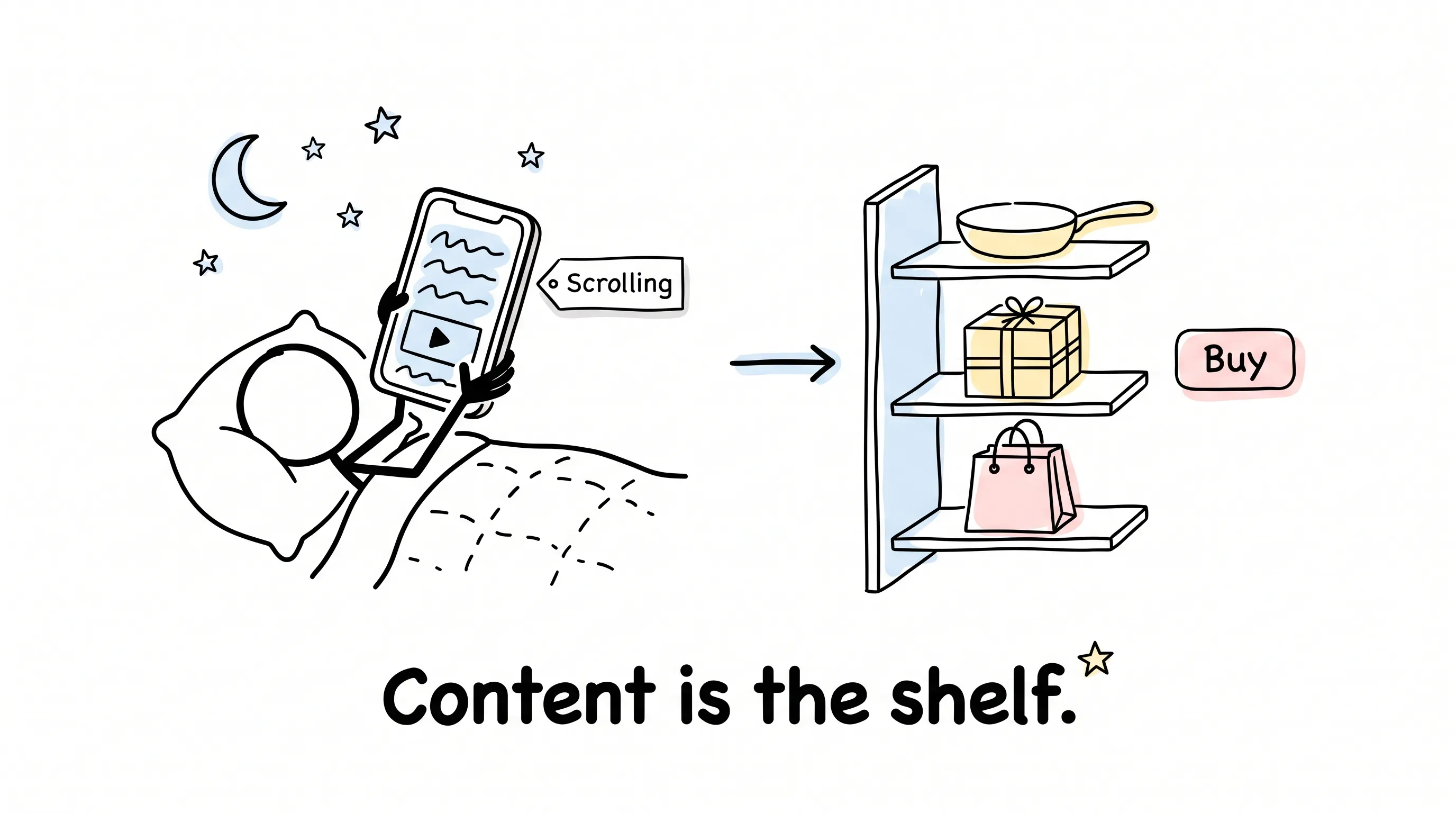
A few nights ago, lying in bed past midnight, I was scrolling my phone. A short video came up — a host going on about a wok for roughly forty seconds — and before I knew it, I had tapped "Buy."
The next morning, a shipping notification jogged my memory.
I froze for a few seconds: when exactly did I decide to buy this wok?
Once I worked it out, I felt a slight chill down my spine. Because behind this little episode hides an entire logic that is quietly rewriting retail. That's what I want to walk you through today.
First, a Report
A while back, a trends research outfit called Exploding Topics released its "Nine Business Trends for 2026" report. They track millions of data points continuously, trying to answer one question: what will genuinely change business next?
The number-one trend: generative AI.
One figure in the report surprised me: consumer spending driven by generative AI applications in 2026 alone is projected to exceed $10 billion.
What does it mean for generative AI to "make money"? Not the sell-software-collect-subscriptions kind. It means AI has quietly slipped into every step of how you buy things: it powers your search, it powers your recommendations, it powers your customer service — and the copy on that product page may well have been written by it too.
Some e-commerce platforms already let AI auto-generate product descriptions and ad creative. A human operator used to max out at ten-odd pieces of copy a day. Now? A machine turns out thousands in one go, and people just pick.
That's the cost side of the ledger. The experience side is just as big: smart search, virtual try-on — your shopping path gets cut down dramatically. Shopping used to be something you browsed; now it's something you ask.
What Is Social Commerce?
Back to my midnight wok.
Did I need that wok? Honestly, no. Then why did I buy it?
Because in those forty seconds, I wasn't "shopping" at all. I was watching content. Buying was just the incidental part.
That is social commerce. Platforms like TikTok Shop and Instagram are stitching content and transactions together, so that as you scroll, the shelf simply shows up in front of you.
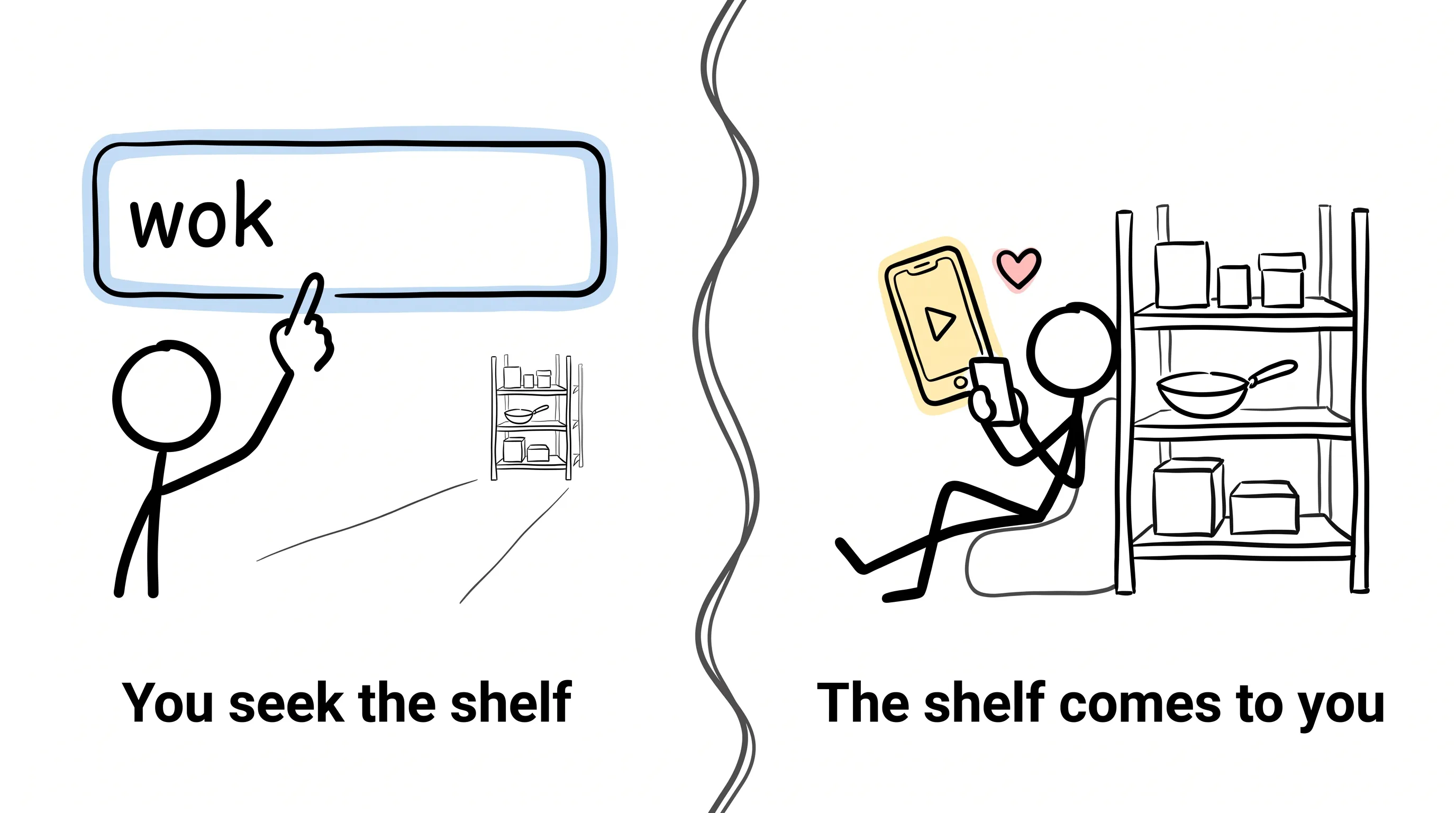
The traditional e-commerce shelf is one consumers seek out with a clear purpose. When you type "wok" into search, you're completing a task.
The social commerce shelf is the content itself. You had no intention of buying — the content planted the desire.
So purchases in social commerce are far more impulsive, far more social. Consumers happily complete a transaction inside a content community — and walk away feeling they got the better end of the deal.
It's the same as wandering a shopping mall. Be honest: most trips to the mall aren't made with a shopping list. You go "to look around," and somehow walk out with three bags.
Content is the shelf. Those four words may be the most important repositioning in retail in years.
5G Plus AI: How Potent Is the Combo?
There's another shift hiding in network speed.
Since 5G rolled out over the past couple of years, mobile shopping has become utterly smooth. Video-driven, interactive shopping content is now the dominant format.
Think about it: in the 4G era you looked at pictures on your phone. In the 5G era, you stroll inside your phone.
Faster networks look like a small thing, but paired with AI they turn fierce: AI runs on data, and 5G gives data collection and application a whole new playbook — and out of that, real-time retail has emerged. Where you lingered for a few seconds, which frame made you swipe away — those signals feed back into the system in real time, and the next piece of content pushed to you is different.
A shopping mall can't do that. All a mall can do is arrange its shelves and wait for people to show up.
Markets Are Not on the Same Starting Line
These trends exist everywhere, but every market plays them differently.
Consumers in North America and Europe put more faith in AI-personalized experiences, and are more willing to pay for sustainable products. In Western markets, being green is no longer a bonus point — it's the passing grade.
Asian markets lead the world in social commerce and livestream shopping. My midnight wok would surprise no one in Asia; what would be surprising is meeting someone who has never shopped that way.
The Middle East and Latin America are playing catch-up on e-commerce infrastructure, and logistics innovation is their make-or-break battleground.
And Africa? Digital retail penetration is still low, but the spread of mobile payments and social platforms gives it a chance to leapfrog some intermediate stages and grow a new form of e-commerce directly — the way some regions skipped the landline era and went straight to phones in every pocket.
For anyone doing cross-border business, this all compresses into one sentence: don't expect one playbook to work everywhere on Earth. Localization isn't an elective. It's a required course.
The Last Mile Is Really the Final Meter of Experience
What is the last mile?
It's the stretch between the distribution hub and your front door.
Don't underestimate that stretch. Global e-commerce exploded in 2020 after the pandemic hit, then settled into a plateau. Once growth slowed, everything that was fought over earlier — price, traffic, content — ends up resting on the same final act: does the parcel reach your hands fast, and in good shape?
Whether delivery is fast, whether it's cheap, directly decides whether a cross-border seller has any competitive edge at all. The last-mile experience directly shapes satisfaction and repeat purchase rates. However elegant the first ninety-nine miles, if the last mile drops the ball, the one thing the customer remembers is that drop.
In the future, this stretch will only get fiercer. Logistics will keep automating and smartening up; drones and autonomous delivery may first get rolling and reach real scale in certain local markets.
Sustainability: From Slogan to Hard Constraint
One more trend that's easy to overlook: sustainability.
A few years ago, "eco-friendly" was mostly a word in brand marketing — printed on posters, said in ads.
Not anymore. Consumers, especially in Europe and America, now genuinely use it as a standard for choosing brands. Willing to pay for sustainable products? Willing.
Looking ahead, sustainability will harden from a marketing slogan into a hard constraint along the supply chain. What packaging you use, how your supply chain is organized — all of it will be examined under a magnifying glass.
For brands, this is no longer a question of "should we take a stance?" It's a question of re-examining your supply chain and packaging strategy. Trust is earned slowly and collapses fast.
Looking One Step Further Out
Zoom the lens out a little further, and the real change comes into focus: AI will move from the tool layer to the core of the business model.
What does that mean?
Today, AI writes your copy and answers your customer tickets. That's a "tool." Tomorrow, AI joins demand forecasting and dynamic pricing, joins the core decisions of your business. That's "operations."
Retail decisions — from forecasting demand to setting prices — will all be reshuffled by AI.
Social commerce will fuse content and transactions even more deeply; sustainability will become a hard gate on the supply chain; and though e-commerce growth has slowed, cross-border and social channels still hold enormous room.
For retail companies worldwide, adapting to these changes is no longer "a growth opportunity." It's the price of staying alive.
Finally, Back to That Wok
The wok has seen plenty of use already. Fried an egg in it — quite good, nothing sticks.
I still occasionally wonder: how exactly did I decide to buy it?
Maybe the answer is: in a world where content and transactions are seamless, the very word "decide" has changed. There are no carefully weighed decisions anymore — only a gentle nudge from content, followed by a tap that felt effortless.
That's neither good nor bad. It's just the new logic of shopping.
Whoever reads this logic first gets to sell their goods into the next era first.
May you, in this new world, buy with delight and sell with clarity.
Continue reading
Related articles

Cross-Border Business: Time to Upgrade Your AI Toolbox
A learn article explaining how AI tools help cross-border e-commerce sellers clear five hurdles: language, regulation, logistics, payments, and fraud. It outlines a five-compartment toolbox, a five-step adoption path, and metrics such as conversion rate and CLV, while cautioning against over-reliance on AI.

AI Is Taking Over the Dirty Work of Social Media Marketing, One Task at a Time
This learn article outlines four social media marketing tasks AI can handle — audience analytics, content drafting and design, ad targeting and creative testing, and spam moderation — and cautions that taste, judgment, and data security remain human responsibilities.

AI Is Already This Good — Why Is Your Social Media Marketing Still Pure Manpower?
An overview of 18 AI tools for social media marketing, organized into six categories covering audience research, content creation, scheduling, comment and DM handling, ad management, and visual production, plus notes on personalization, prediction, and emerging trends.