
Choosing a GEO Agency? Start With Whether It Dares to Talk Revenue
A guide to evaluating GEO agencies, arguing that brand recommendations in AI answers—not visibility scores—drive revenue, and covering agency selection, GEO-vs-SEO fundamentals, pricing, and in-house vs. outsourced decisions.
A few days ago, a friend of mine who runs a B2B SaaS company came to me clutching three proposals from GEO agencies.
He pointed at a page and asked me: this line says the AI visibility score jumped 400% — does that count as great results?
I told him: don't reach for your wallet just yet. That number is an input, not an outcome.
He paused. That afternoon, we went through all three proposals from top to bottom. The further we got, the clearer it became that in this trade, barely two or three years old, the water runs deeper than he'd imagined.
Today I'm walking you through that process. Whether you plan to hire an agency or build the capability yourself, these yardsticks will serve you well.
What Is a GEO Agency?
First, the vocabulary.
GEO stands for Generative Engine Optimization. Some people call it AEO, or AI SEO. They're all essentially describing the same thing.
So what is a GEO agency?
It's an agency that helps your brand get mentioned, recommended, and cited when AI engines answer questions. When a buyer asks ChatGPT, Perplexity, Gemini, or Google's AI Overviews "what are the best tools in this space," is your name in the answer? That's what GEO does.
One thing to note: the foundation underneath it all is still SEO. More on that later.
The First Yardstick: Recommendation, or Citation?
This is the distinction that's easiest to fudge.
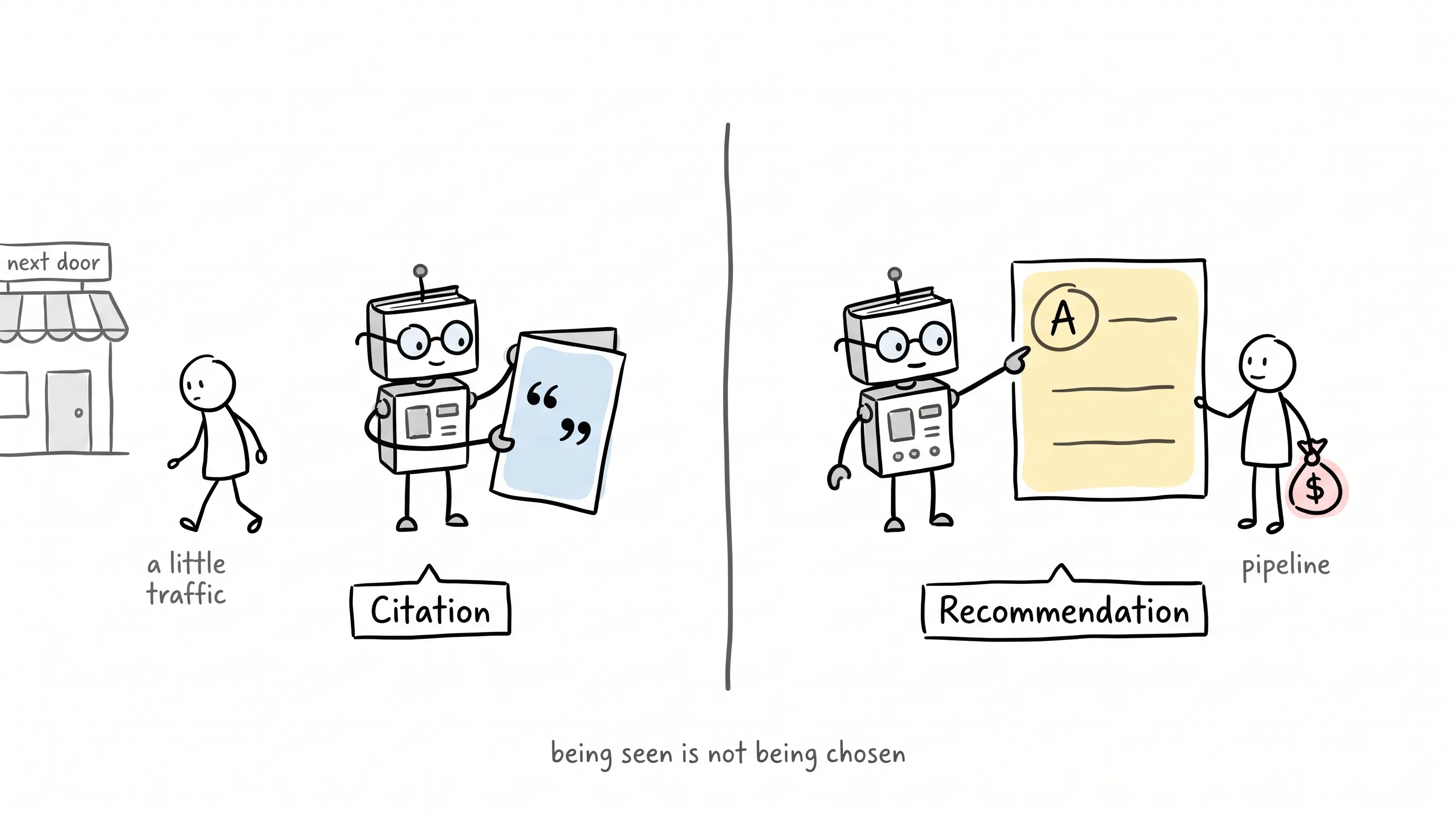
Here's an analogy. AI is like a store assistant who loves reading: it can quote your product manual at length, sound absolutely convincing, and then turn around and walk the customer straight to the shop next door.
Sit with that image for a second: your content gets cited, and the business goes next door.
Citations bring a little traffic. Recommendations bring pipeline. Because when a buyer asks "what's the best tool," and AI names you — "go with A" — A lands directly on their shortlist.
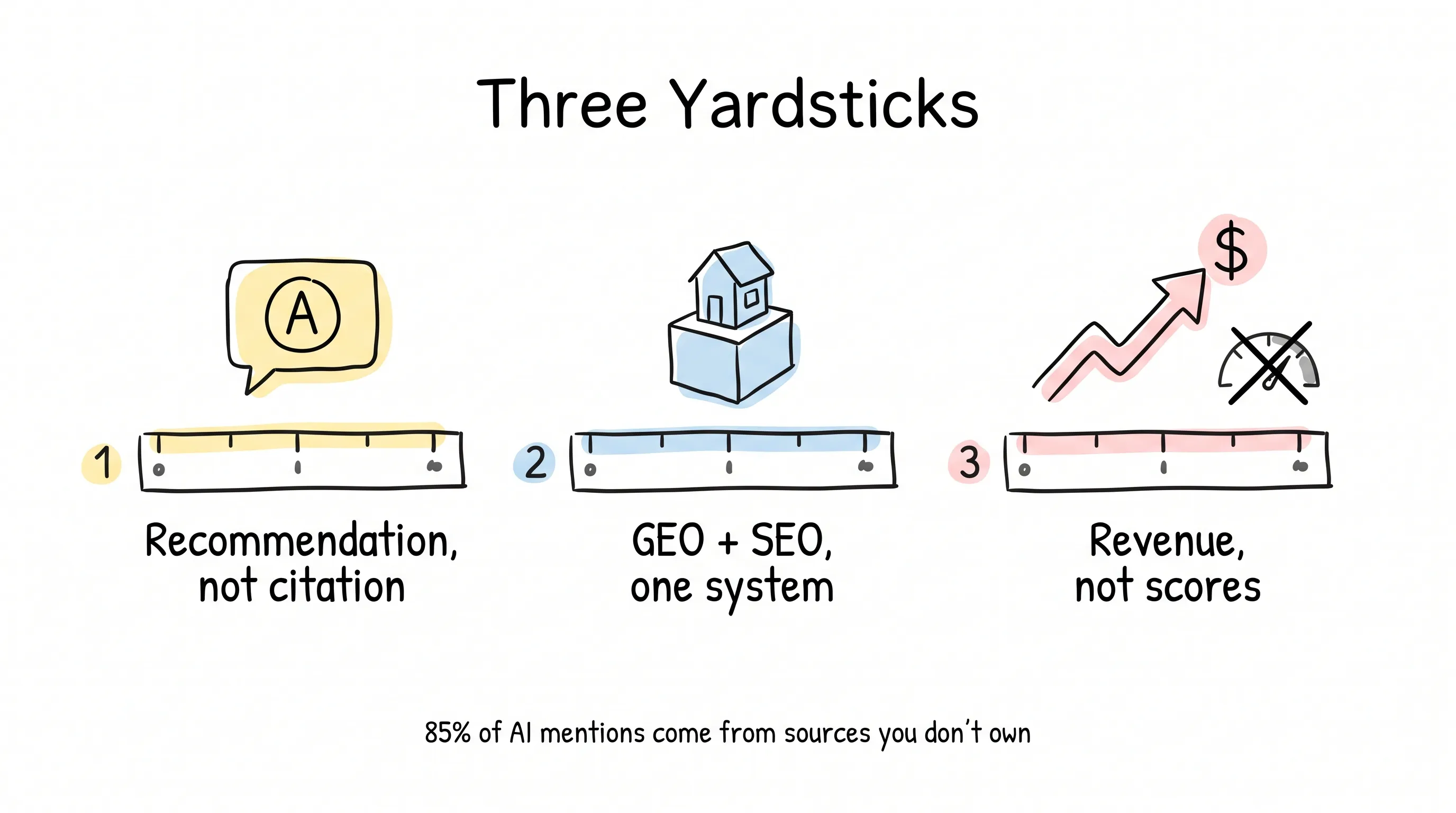
So the first yardstick: make the agency show evidence of brands recommended by name, not a dashboard of visibility scores. The score rose 400%. Then what? How many more demos? Did revenue move?
Being seen and being chosen are two different things.
The Second Yardstick: GEO and SEO — One System, or Sold Separately?
Google's own position is clear: optimizing for generative AI search is optimizing for the search experience, so it's still SEO. In August 2025, Google's Danny Sullivan put it even more bluntly at WordCamp US: good SEO is good GEO.
But don't oversimplify that into "GEO is just SEO." It isn't.
Same foundation, two different playbooks on top — with different levers.
One playbook gets your brand remembered and recommended by AI. The work: content gaps, entity disambiguation, consistent messaging.
The other playbook gets your content cited by AI. The work: content structure, structured markup, and covering the long tail of phrasing variants buyers might actually ask.
So where's the problem? Plenty of vendors sell the two blended into one offering; some repackage GEO as a standalone product; the worse ones tell you outright: "SEO is dead."
Don't believe any of it. SEO is the foundation; AEO is the building on top of it. If someone tells you the building matters and the foundation can be skipped, keep your guard up.
The Third Yardstick: Talk Revenue, Not Scores
An "AI visibility score" can sit quite happily on the same dashboard as a pipeline that hasn't moved an inch.
Why? Because being seen by AI engines and being chosen by buyers are recorded in different columns.
Here's another number worth memorizing: 85% of brand mentions in AI answers come from sources the brand doesn't own. Which means an agency that only circles your website is solving a fraction of the problem.
So the third yardstick: look at public case studies. Look for cases that tie results to revenue, signups, and SQLs (sales-qualified leads). If they can't produce one, no matter how lively the pitch, they're selling buzzwords.
While we're at it, why do these three yardsticks matter so much?
Because this business is genuinely new. GEO as a category is, being generous, only two or three years old. What's the fastest way to "add GEO"? Change SEO to GEO on your website — one afternoon is enough. Meanwhile, Conductor's 2026 State of AEO/GEO report says 94% of CMOs plan to increase AEO and GEO investment. The demand is sitting right there, and the silt comes rushing in with it.
With These Three Yardsticks, I Went Through Seven Agencies
First, a plain truth.
Search "best GEO agencies" and the listicles you find were, nine times out of ten, written by one of the agencies on the list — which always ranks itself first.
So for the seven below, I'm not ranking them; I'm introducing each by its specialty. I went through all the public material, and for each agency I cover four things: who they serve, how they charge, what their edge is, and where they fall short.
Optimist: The One With the Hardest Evidence
Start with the one with the hardest evidence.
Optimist, an AEO/SEO consultancy serving B2B tech and SaaS companies, is one of the few in the field that puts revenue-level case studies out in public. Three numbers to give you a feel:
In 14 months, one B2B tech client's revenue from LLM referral traffic grew 49x, and the referral traffic itself grew 26x. In 8 months, a fintech company's LLM conversions grew 8x. And one retail brand's LLM-driven revenue grew 13x year over year.
Yes — 49x. What makes these three numbers worth their weight: they all point at money, not at scores.
Its methodology is called the CORE framework (Complete Organic Revenue Engine). In plain English: pull every topic buyers care about into one unified dataset and roadmap, then run two lenses at once — a search lens and an AI lens.
The two playbooks described above grew out of this framework.
The bread-and-butter SEO hasn't been neglected either. Stampli's inbound pipeline grew 5x and MQLs (marketing-qualified leads) grew 400%; Glide grew product signups 14x in one year; Kubera grew 43x in 15 months; HelloSign grew on this inbound engine and was eventually acquired by Dropbox for $230 million. The client list also includes Semrush, ZoomInfo, and Superhuman. In a public review on Clutch, Stampli's head of growth specifically praised their nose for how AI search is shifting.
Pricing is transparent too: it starts with a free analysis; a one-time roadmap from $7,500; monthly engagements from $3,000/month (advisory) or $4,000/month (fully managed).
The weaknesses have to be said too. Small team, all senior practitioners — if you want big-firm service with hundreds of people and layers of account managers, you won't find it here. Deepest experience is in B2B tech; the fit is weaker for consumer brands and non-tech industries. Heavy on strategy and execution; doesn't take on high-volume content production.
iPullRank: The One That Digs Deepest
Optimist wins on evidence; iPullRank wins on depth.
Mike King founded the company in 2014, with a methodology called Relevance Engineering. How deep does the work go? Embeddings, passage retrieval, query fan-out. They've published research on how AI systems expand and rewrite user queries — required reading in this trade.
The client list matches that depth: American Express, Citi, SAP, HSBC, Nordstrom.
Who is it for? Large enterprises with sprawling site architecture and in-house SEO teams, where technical debt is dragging down AI retrieval.
Weaknesses: pricing isn't public, and mid-range budgets mostly can't reach it. Also, if your problem is mainly a gap in content, buying iPullRank is overkill.
Siege Media: The One With the Strongest Reputation
Founded by Ross Hudgens in 2012, now 100-plus people. Its path into GEO runs through the asset it's best at: original data content, plus the media coverage that content earns.
A 4.9 rating with 46 reviews on Clutch — the only independently verified, large-volume client reputation among the seven. Clients include Zendesk, The Zebra, and Zapier. Pricing starts at $11,000/month.
Where does it fall short? Its case-study scoreboard leans mainly on traffic value and backlink counts estimated by third-party tools (like Ahrefs). Those are leading indicators, not pipeline. A CMO who wants AI revenue attribution has to build that layer outside the engagement. And enterprise-level pricing puts it out of reach for early-stage companies.
Animalz: The One With the Finest Editorial Craft
Founded in 2015, a distributed team with a large network of writers and editors. It made its name on content that digs deep into a subject, with expert interviews feeding the depth — a playbook it calls Movement Marketing. AEO and GEO are now woven in, along with research white papers and LinkedIn thought leadership.
The client list is dazzling: Google, Intercom, GoDaddy, Zendesk, Amplitude, Airtable.
The pricing figures come from third-party sources: roughly $8,000/month for research-driven content, and around $10,000/month for advanced thought-leadership content that includes AEO/GEO. Note: there's no official price list, so don't take these numbers as official word.
Weaknesses: it's content- and editorial-driven, not technical-SEO-driven, and certainly not revenue-attribution-driven. Public results are content metrics — the 360Learning blog reached 75,877 monthly views in two years, and SupportLogic grew organic traffic 500% in one year. Good numbers, all of them. None of them revenue.
Oh, and it has a 3.0 rating on Glassdoor. That's employees rating their employer — don't mistake it for client word of mouth.
Omniscient Digital: The One That Came to GEO From Editorial Craft
Most of these seven walked into GEO from technical SEO. Omniscient Digital didn't — it walked in from editorial craft.
Founded in 2019, a distributed team of 30-plus, producing content that reads like industry reporting, not SEO filler. Clients include SAP, Adobe, Loom, and Asana. GEO is now a formal service line, and it has built a partnership with Peec AI, an AI visibility tracking tool. Pricing is custom — reportedly starting at $10,000/month.
The weakness is blunt: public results are all content- and SEO-attributed. To date, it hasn't published a single AI revenue-level case study.
First Page Sage: The One That Entered Earliest
Most agencies added GEO after the category got hot. First Page Sage didn't. In May 2023, it launched a dedicated GEO service. Back then, the category didn't even have an agreed-upon name.
Its model is called Thought Leadership SEO, betting on one thing: AI engines most love to draw from expert content. Clients include Salesforce, Verizon, Logitech, and NerdWallet. On Clutch, its listed pricing starts above $10,000/month.
Weaknesses: no per-client, AI-attributed revenue case studies. For an agency selling AI search expertise, that missing piece is a very real shortcoming. It also has no verified Clutch client rating. And it takes every industry — tech, construction, real estate alike. Spread that wide, and the depth in any single industry gets a question mark.
Skale: The One That Specializes in Off-Site Mentions
The last one is Skale, out of London, B2B SaaS only, with every engagement designed around revenue metrics. One of its service lines, AI Citation Outreach, does exactly one thing: go off-site and win third-party mentions and citations.
Clients include Perkbox, Personio, and MoonPay. Official pricing runs $8,000 to $20,000/month.
Weaknesses: non-SaaS need not apply. Among the specialist boutiques (not counting enterprise-scale firms), its entry price is the highest. Independent verification is thin, too — the 4.9 Clutch rating circulating in third-party listicles can't be verified directly. Even its founding history doesn't line up across sources.
Hire an Agency, or Build In-House?
Start with a number.
G2's 2026 Answer Economy report found that 51% of B2B software buyers now make an AI chat the first stop when their research begins — already more often than they turn to Google. In April 2025, that number was only 29%.
Here's the part that stings: 69% of buyers will drop the vendor they'd planned to buy based on an AI chat's suggestion.
Where buyers ask their first question has already moved. So this capability — do you buy it, or build it?
My take: for most B2B teams, buy first, build later.
Why? The discipline is too new and changes too fast. A new in-house hire takes two quarters to get up to speed. During those two quarters, your competitors are being recommended by AI by name, and you're not. An agency, meanwhile, has already run the plays on several other clients.
Here's how the math works: bring the agency in first, to build the engine and prove the model. Once the system is stable, hire a coordinator to run day-to-day operations.
The agency builds; your people maintain.
One more money-saving detail. If you have an in-house content team that can ship directly against the agency's roadmap and briefs, that's the most cost-effective way to work with an agency. If even the content production has to be fully covered by the agency, that's another price entirely — think it through before you negotiate.
How Much? Let's Run the Numbers
GEO agency pricing runs from around $5,000/month at the low end to above $20,000/month at the high end; B2B SaaS monthly fees mostly land somewhere in the middle.
Why such a wide range? Because scope varies enormously. A pure-content project is one end; the full bundle of technical plus content plus digital PR is the other.
There's a lesson hidden in that range: talk scope before you talk price. Let me run the numbers for you.
An agency at $6,000/month that gets your brand recommended is far cheaper than one at $4,000/month that only gets you a rising score.
Price by outcomes, not by invoices.
Four Red Flags
Finally, the four easiest traps to step on.
One: the GEO on their website only showed up recently, yet they can't produce a single respectable AI result behind it. Anyone can repaint the sign, and repainting takes one afternoon.
Two: "AI visibility score" in every other sentence, but vagueness the moment you ask about revenue. Scores are inputs. Push once more: revenue, signups, demos — did they move? Then watch whether the answer comes with specifics or with smoke and mirrors.
Three: selling GEO as a standalone product, or telling you SEO is already useless. That's a misreading of how the engines work — covered earlier.
Four: vague scope, deliverables that can't be pinned down. A proposal where everything is "custom" is the easiest place for an engagement to bloat. A solid agency either gives you a clear model or honestly tells you: quoted per project.
Finally, Back to My Friend
When we finished talking that day, my advice to him came down to one sentence.
Don't let the agency pitch you scores. Make them tell you a story: how a certain client got recommended by name when a buyer asked an AI, and then real money landed in the pipeline. If they can tell it, then talk price. If they can't, however cheap, it's still expensive.
Scores are for reporting. Recommendations are for buyers. Only the latter becomes your revenue.
And here's wishing that the next time you ask an AI "what's the best tool in this space," the name it calls is yours.
Continue reading
Related articles

Cross-Border Business: Time to Upgrade Your AI Toolbox
A learn article explaining how AI tools help cross-border e-commerce sellers clear five hurdles: language, regulation, logistics, payments, and fraud. It outlines a five-compartment toolbox, a five-step adoption path, and metrics such as conversion rate and CLV, while cautioning against over-reliance on AI.

AI Is Taking Over the Dirty Work of Social Media Marketing, One Task at a Time
This learn article outlines four social media marketing tasks AI can handle — audience analytics, content drafting and design, ad targeting and creative testing, and spam moderation — and cautions that taste, judgment, and data security remain human responsibilities.

AI Is Already This Good — Why Is Your Social Media Marketing Still Pure Manpower?
An overview of 18 AI tools for social media marketing, organized into six categories covering audience research, content creation, scheduling, comment and DM handling, ad management, and visual production, plus notes on personalization, prediction, and emerging trends.