
Choosing a B2B Marketing Automation Platform? First Answer the Question No Vendor Will Touch
A learn article arguing that switching B2B marketing automation platforms rarely fixes marketing-sales reporting conflicts, reviewing ten mainstream platforms and their limits, and explaining how a GTM context layer aligns scattered CRM and marketing records for attribution and AI agents.
A friend who works in B2B marketing came to me recently to vent.
His company runs on HubSpot, and the monthly review meeting was humming along. Until the CRO (chief revenue officer) cut in with one line: of these MQLs (marketing qualified leads), which ones turned into money?
The room went quiet.
HubSpot's report said it was these emails, these campaigns. But on the Salesforce side, half of the opportunities the sales team built themselves weren't attached to any campaign at all. Both reports were "right" — they just never said hello to each other.
I told him: no marketing automation platform you switch to will fix this. Whichever one you buy, it's the same.
Why? Today let's take the B2B marketing automation market apart piece by piece. By the end, you'll understand what this category is actually selling — and where the real wall is.
What Is a Marketing Automation Platform?
First, let's line up the concepts.
A marketing automation platform, to put it plainly, is marketing's "launch system": sending emails, making forms, building landing pages, scoring leads, nurturing by the rules. HubSpot, Marketo, Eloqua, Pardot — they all do this.
It's diligent. But it's only diligent within its own walled garden.
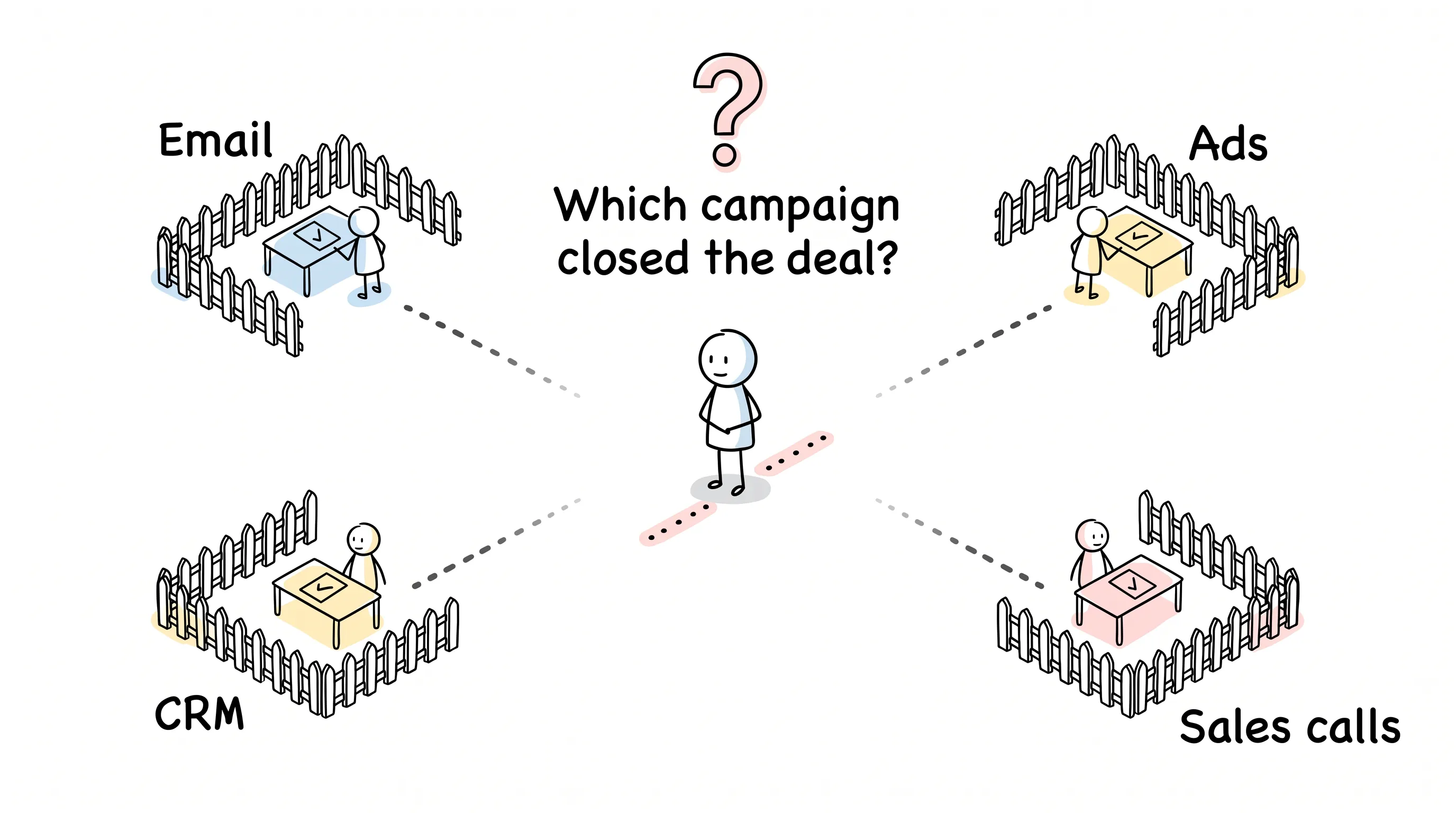
When HubSpot sends an email, HubSpot remembers it in perfect detail. When Marketo runs a program, Marketo's report spells it out clearly. Each platform's report covers only the touchpoints it touched with its own hands.
So here's the question: which campaign, way back at the start, brought in the customer who eventually closed — who remembers that?
No platform remembers. Because that campaign may have run on Google, the lead landed on the website, the contact changed email addresses once inside Salesforce, and the opportunity was created by hand after a sales rep made a phone call.
One customer's information sits scattered across four or five desks. On each desk sits a report that is "correct" — internally.
This is the root of every conflict.
Something Counterintuitive Happened in This Market
Logically, as tools get better and better, people should be more willing to switch tools, right?
Exactly the opposite.
The MarTech Replacement Survey, published in March 2026 (fielded in 2025, with 207 respondents), gave two numbers: the replacement rate for marketing automation platforms fell from 31% a year earlier to 19%; the replacement rate for CRM fell from 22% to 10%.
People stopped switching platforms.
Why? Think about it. Many teams, after going around in circles, found that switching the sending platform doesn't cure a data disease. Your records were scattered, dirty, and mismatched to begin with; move them to a new platform, and they stay scattered, dirty, and mismatched. The disease isn't rooted in the sending layer.
Interestingly, with users staying put, the vendors have gotten even more restless.
Salesforce announced Marketing Cloud Next in June 2025, and since then nearly all new features have piled up on the Agentforce Marketing side. Old Pardot's entire Summer '26 release contained a single consent-management update — and even that was designed to make your migration easier.
At its Summit in April 2026, Adobe folded Marketo into the new Adobe CX Enterprise framework and stacked a new layer on top of it.
Oracle simply decommissioned Eloqua's native connector to Salesforce in November 2025, forcing every customer to migrate to a new integration app.
Act-On changed owners.
Platform decisions made in 2023 now come with a migration question bolted on automatically.
Ten Mainstream Platforms, and Where Each One Hits a Ceiling
Where to start? I'll walk you through them the way B2B teams most commonly pair them up. For each, just two things: where it's strong, and where it stops.
HubSpot Marketing Hub. The one-stop choice for small and mid-size teams. CRM, email, forms, and reporting all sit on one contact record — no integration project needed. Published pricing: Professional is $800 a month including 3 seats, plus a $3,000 onboarding fee; Enterprise is $3,600 a month. In April 2026, two Breeze agents also moved to outcome-based pricing: 50 cents per customer session resolved. Impressive. But past 50,000 contacts the fees climb fast; and its attribution reports see HubSpot itself clearly, and everything outside as one blur. Your outbound actions running inside Salesforce — it can't see them.
Adobe Marketo Engage. The enterprise benchmark for demand generation; its lead scoring and nurture are battle-tested at volumes others can't reach. But it needs a dedicated Marketo administrator, and often a consulting firm besides. Reports only go down to the program level. As for how much revenue one program actually contributed, you have to wait for the CRM to pass the data back cleanly. The CRM rarely does.
Salesforce's Account Engagement — the old Pardot. Its biggest advantage fits in one sentence: it is Salesforce. Scoring and nurturing act directly on Lead and Contact objects, sales sees marketing's moves right on the record, and you even skip the security review. But as noted above, the new investment is all going to Marketing Cloud Next. Before you buy it, ask yourself clearly which roadmap you're buying.
Oracle Eloqua. The choice for large, heavily regulated companies that don't want to be locked in to any single CRM. Oracle is still investing continuously: the 26B release in May 2026 added AI features and started refreshing the Redwood interface. But the native Salesforce connector is gone, implementation cycles run long, and the partner ecosystem is small.
Microsoft's Dynamics 365 Customer Insights - Journeys. For companies whose sales team lives in Dynamics 365, look no further. The first-half-2026 release wave 1 added Copilot-built journeys and lead creation straight from behavioral signals. Outside Microsoft's orbit, you can mostly skip it.
Act-On. The value pick for small-to-mid-market teams that don't want an enterprise-size contract; it connects to Salesforce, Dynamics, SugarCRM, or NetSuite. It was acquired by Banzai for $53.2 million in January 2025 — before signing a multi-year contract, ask the new owner about the roadmap first.
ActiveCampaign. For small teams. Email automation plus a built-in CRM, and it even wrote a "results guarantee" into a public commitment — rare in this category. But it's lead-centric; teams running account-based plays who want revenue-grade reporting will hit the ceiling fast.
Brevo. Formerly Sendinblue, it bundles email, SMS, and WhatsApp at SMB-level prices. In December 2025 it raised over €500 million and became a unicorn, with ARR past €200 million, and announced a €100 million push into the US market. Ambitious. But the depth of its lead scoring and account-based capability still trails HubSpot and Marketo.
Zoho Marketing Automation. Companies already inside the Zoho suite can pick it with their eyes closed — cheap and good enough. Outside Zoho, there's not much of a case.
Customer.io. The most unusual of the ten: it doesn't run on campaigns, it runs on events. A user activates a feature, goes quiet, crosses a threshold — a journey fires. For product-driven PLG SaaS companies whose data sits in a data warehouse, it's a handy tool. For traditional demand generation, it isn't built for that.
That's all ten. Did you notice something?
Not one of these ten can tell you: which campaign created the pipeline that eventually closed.
Two More Layers — Don't Mix Them Up
Beyond the ten, two more names often come up in the same breath: 6sense and Demandbase.
They aren't sending platforms either. They're a layer above: identifying which accounts are in-market and buying, then coordinating ads, email, and sales motions against those accounts. In 2026 both are accelerating: 6sense opened up its MCP Server in July, letting agents inside Claude, ChatGPT, and Agentforce query its account intelligence directly; Demandbase added an MCP gateway in April.
They answer "who to target." Sending platforms answer "how to send."
Then — "of everything sent out, how much revenue did it actually buy" — who answers that?
Two True Stories
Let me tell you two companies' true stories, both told by the companies themselves at customer briefings.
One company selling call-center AI launched automated outbound outreach, pouring 500 to 2,000 records a week into the system. The marketing automation platform accepted everything wholesale, counting it all as leads, as MQLs. A later audit found: more than 400 MQLs that not a single person had ever touched.
Good grief. The MQLs shining bright on the report — more than half were assembly-line junk.
A healthcare software company went one step further. Campaigns in Salesforce number in the tens of thousands; more than nine in ten Google and LinkedIn ad clicks lose attribution the moment they land on the website, so in Salesforce "everything shows up as website." By their own account, they've been cleaning it up for years, and it will never be perfect.
Are these two companies' problems sending-platform problems?
They didn't pick the wrong platform. The records scattered across all those desks were simply never pieced together.
What Is a GTM Context Layer?
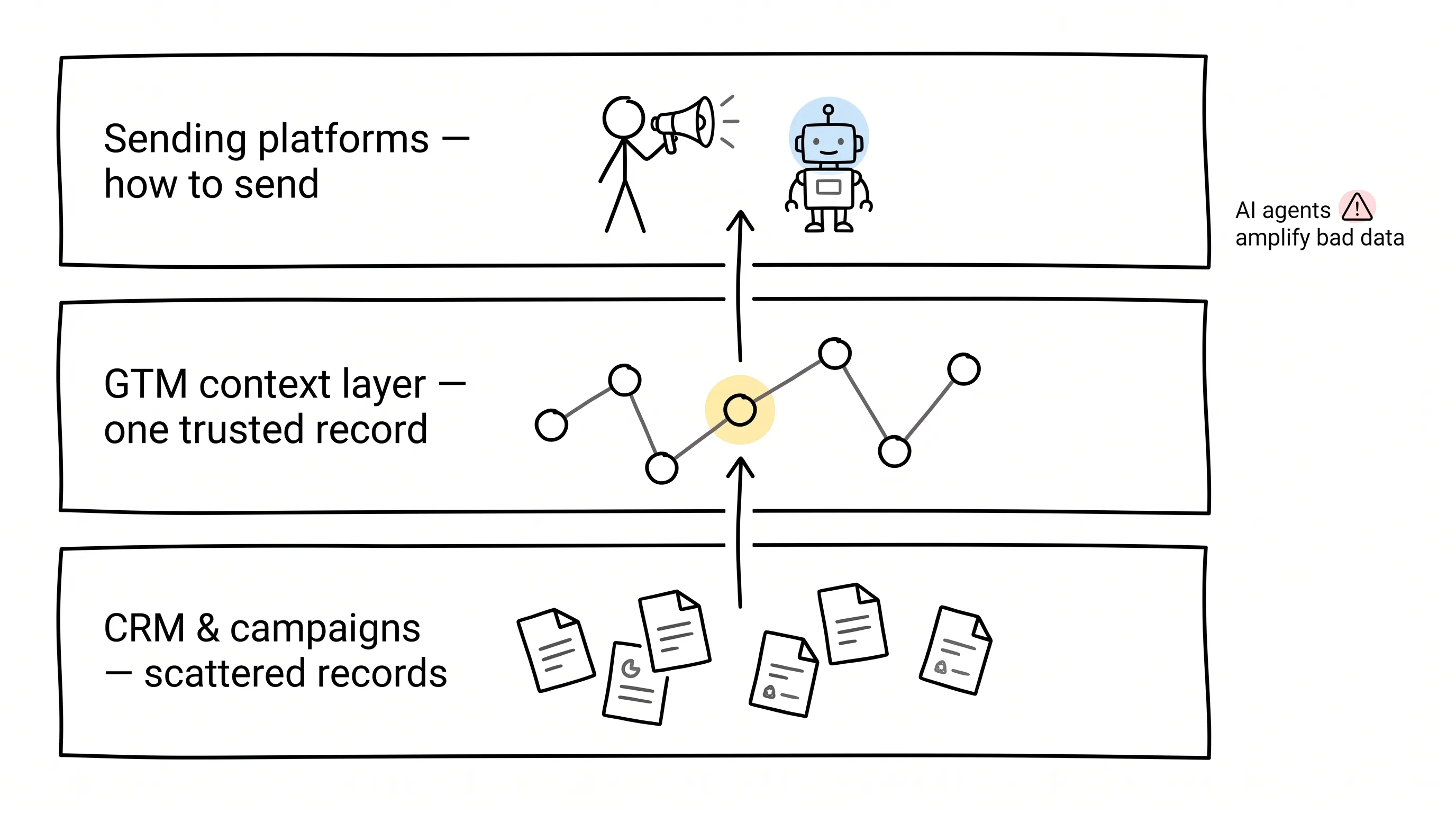
This is one of the new answers that has emerged in recent years — RevSure is the example here. It doesn't send emails, build forms, or run nurture, and you shouldn't use it to replace any of the vendors above. It does something else: it sits beneath the marketing automation platform and the CRM, parsing, aligning, and merging scattered records — campaign, contact, account, opportunity — into one unified graph, then runs attribution and forecasting on that graph.
RevSure calls this graph the Full Funnel Data Graph. The name doesn't matter; what matters is that single, aligned record.
Why has this suddenly become critical now?
Because AI agents have arrived. You can now put agents on top of your GTM data: run attribution, build forecasts, push leads to sales. But think about it — an agent facing an uncleaned CRM, with duplicate contacts, lost campaigns, misattached opportunities, will amplify those mistakes ten thousandfold, at machine speed.
A human reading bad data errs once a day. An agent reading bad data errs ten thousand times a second.
So the order has changed: only with a trustworthy, unified record does an agent earn the right to step in. The sending platform's job is getting the message out; the context layer's job is making the data trustworthy. Two layers — you can't do without either.
What's interesting is the way it gets validated. New customers of this vendor often don't start with a demo — they start by pulling six months of Salesforce reports to reconcile the numbers, trying their best to break its figures. Only when the marketing report and the sales report actually match can you say both were built on the same record. As one marketing leader put it: in review meetings now, a sales AE who wants to pick at the marketing numbers thinks twice first.
How to Choose?
After all that, here's the order I'd act in.
- Start with your CRM. A marketing automation platform spends its whole life syncing with the CRM, so pick the one native to your CRM — unless you have a strong reason not to.
- Then your playbook. If you run account-based, you'll need a layer above the sending platform — 6sense or Demandbase.
- Finally, ask the question no vendor will volunteer: when the CRO slams the table and says "the marketing pipeline numbers are wrong," what in your system can prove him wrong?
If your answer is "a dashboard inside the marketing automation platform," you've already lost. It's not that the dashboard is bad — it's that the CRO doesn't believe it.
Why doesn't he believe it? Because the numbers on that dashboard have never once matched the numbers in sales' hands.
Back to that friend from the opening. In the end, he didn't switch platforms. What he did first was piece the records from the two systems together, so both sides' reports started speaking the same language.
When the CRO asks again "which ones turned into money," his report and the report on the sales side are still describing the same reality.
Platforms will change; agents will multiply.
But one record everyone trusts — there's no such thing as too much of that.
Here's to never being caught in the middle between your own two reports in a review meeting.
Continue reading
Related articles

Cross-Border Business: Time to Upgrade Your AI Toolbox
A learn article explaining how AI tools help cross-border e-commerce sellers clear five hurdles: language, regulation, logistics, payments, and fraud. It outlines a five-compartment toolbox, a five-step adoption path, and metrics such as conversion rate and CLV, while cautioning against over-reliance on AI.

AI Is Taking Over the Dirty Work of Social Media Marketing, One Task at a Time
This learn article outlines four social media marketing tasks AI can handle — audience analytics, content drafting and design, ad targeting and creative testing, and spam moderation — and cautions that taste, judgment, and data security remain human responsibilities.

AI Is Already This Good — Why Is Your Social Media Marketing Still Pure Manpower?
An overview of 18 AI tools for social media marketing, organized into six categories covering audience research, content creation, scheduling, comment and DM handling, ad management, and visual production, plus notes on personalization, prediction, and emerging trends.