
ChatGPT's Ads Have Started Following You Out the Door
An independent researcher's finding that OpenAI is testing cross-site tracking via the __obi cookie placed alongside ChatGPT ads, covering how conversion attribution works, consent concerns around its 'analytics' classification, and what marketers should verify before relying on such measurement.
A message crossed my feed the other day, and I sat there frozen for a good while.
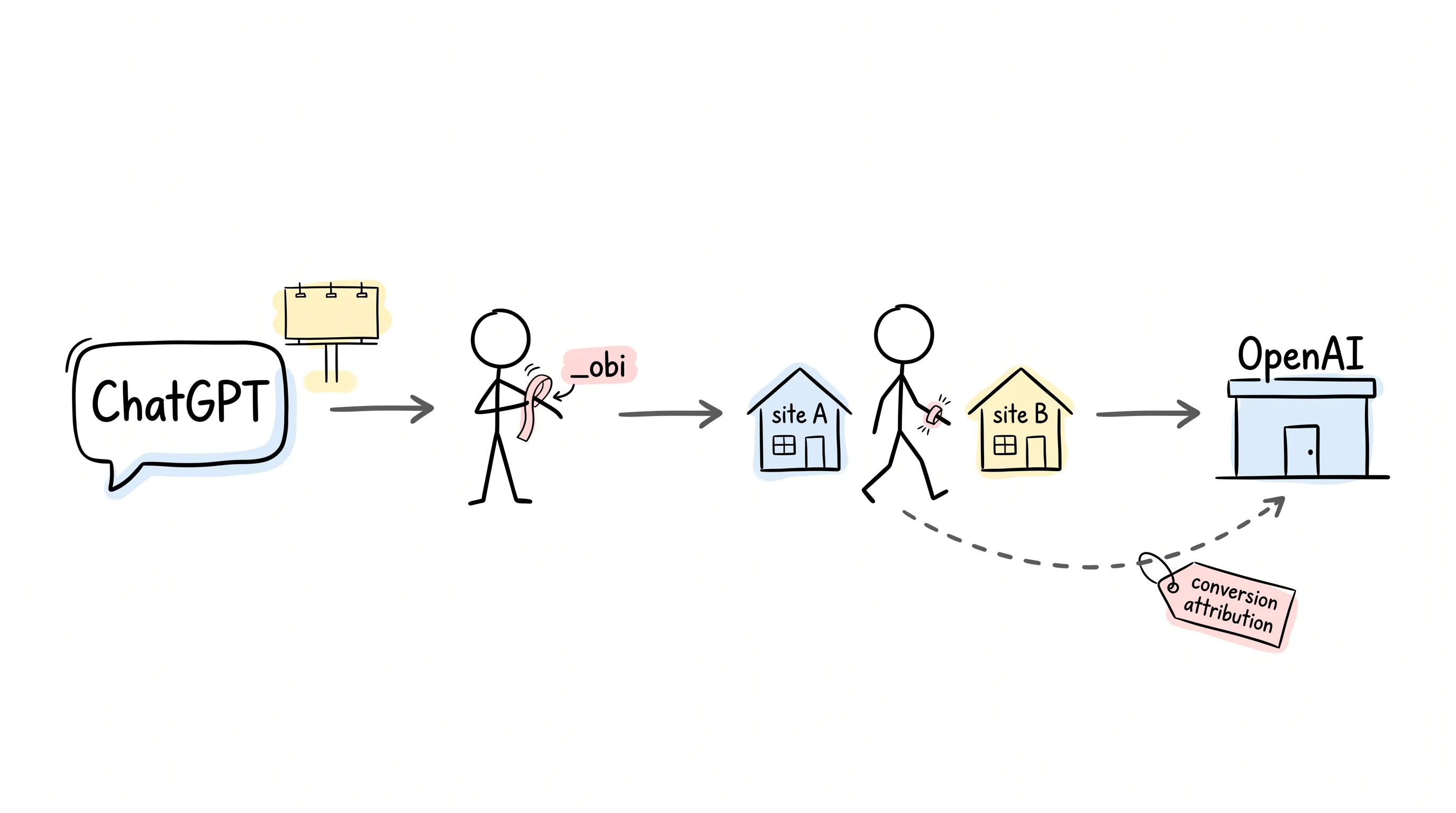
An independent researcher — writing under the pseudonym Buchodi — has found that OpenAI is testing a form of cross-site tracking. You see an ad while using ChatGPT; then you close the page and go wandering off to other websites, and the "mark" that ad left behind goes wandering off with you.
Wait. How did it follow you?
First, a quick explainer. What is a cookie?
Every time you walk into a big shopping mall, the front desk hands you a visitor's wristband. Which stores you entered, how long you lingered, where you finally checked out and paid — the wristband remembers all of it. You roam the entire mall wearing it, and every store recognizes the very same wristband.
A cookie is that wristband. The difference is you never have to hand it back — it quietly stays in your browser.
The wristband inside ChatGPT has a name: __obi.
Here's how the game is played. You see an ad in ChatGPT, and at the same moment __obi is placed in your browser. This cookie is a hard one to kill: it can stick around for up to a year. A year — 365 days.
Then one day you visit a website that carries OpenAI's ad pixel — a small snippet of tracking code embedded in a web page. When your browser reports back to OpenAI, __obi goes along for the ride, carrying a few notes on what you did on that page: what you looked at, whether you placed an order.
And just like that, two events click together: "you saw this ad in ChatGPT" and "you later bought it somewhere else."
To the people buying ads, this is called conversion attribution. To the ordinary user, it's called being tracked.
Same event. Two names. Two very different feelings.
To be fair, hold the outrage for a moment. The researcher did not observe the final step. What does that mean? The step where your behavior on that website gets matched back to the ChatGPT account — the one with your name and your chat history — that step has not been seen. So a conclusion like "OpenAI is building a secret dossier on everyone" is, for now, premature.
What can be confirmed is this: one and the same identifier sets out from ChatGPT, follows you to the websites you visit, and lands back in OpenAI's hands. The chain is live. The last mile isn't hooked up yet.
But honestly, my verdict fits in four words: old technology, new setting.
Strip away the novelty and this is just a traditional third-party cookie. The ad industry was doing this twenty years ago, and search engines and social platforms long ago turned it into a fine art.
So why does the very same trick make your skin crawl the moment ChatGPT does it?
Because the setting has changed.
Think about what you hand over, day to day. To a search engine: a few keywords. To a social platform: likes and reposts. To ChatGPT?
What's weighing on you.
Sitting awake in the middle of the night, would you type your troubles into a search box? Probably not. But you might tell ChatGPT. The longer you talk, the more it knows. And now people have discovered that the wristband handed out by the one place that understands you best can follow you out the door.
The more a platform knows about you, the more its cookie can unnerve you.
Here's a detail worth chewing on.
OpenAI classifies __obi as an 'analytics cookie.'
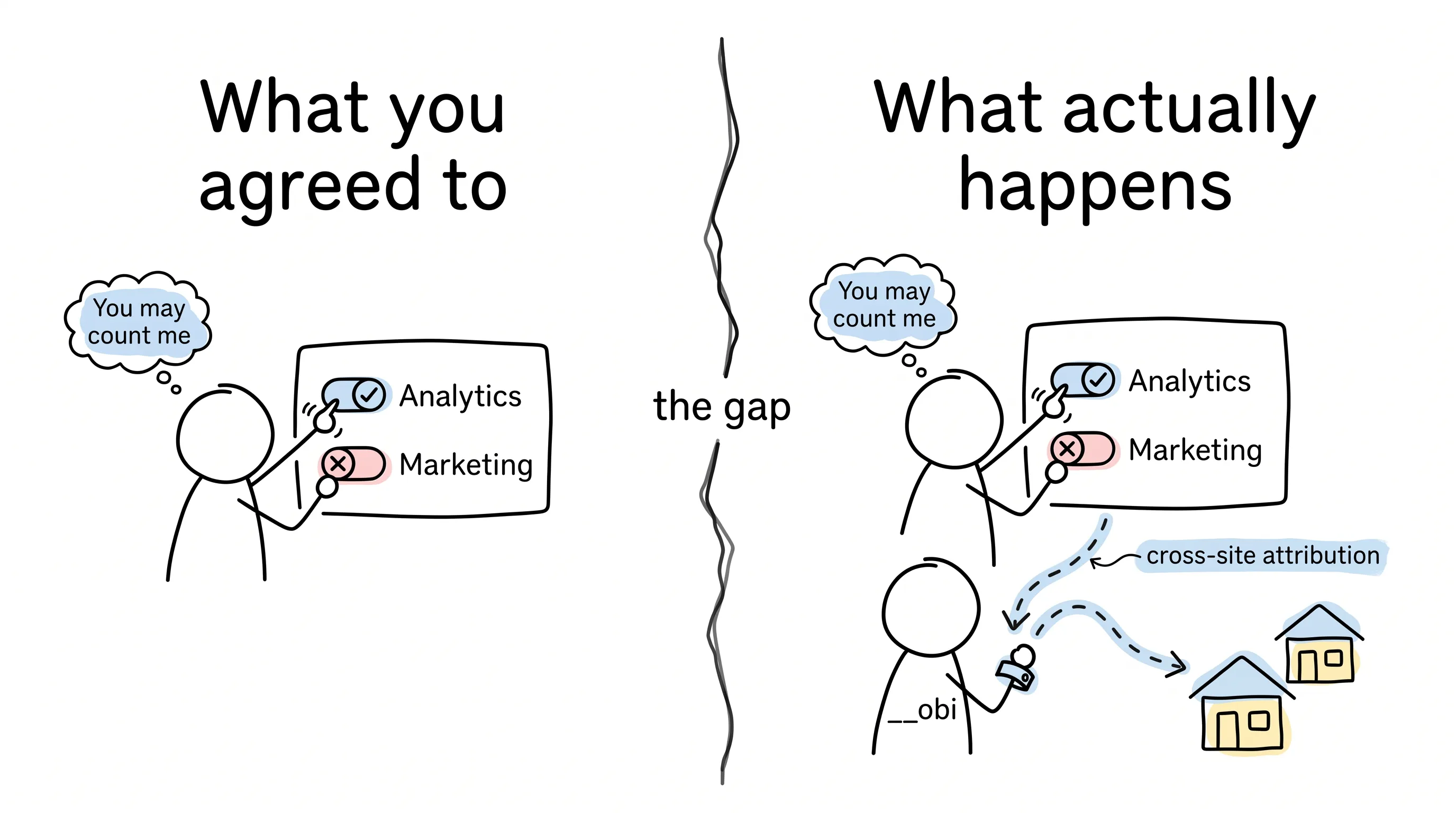
Analytics — sounds utterly harmless, right? Count how many people use which features, make the product a little nicer to use. In users' minds, 'analytics' and 'marketing' are two different animals: analytics is there to help you, marketing is out to target you.
But this researcher found that as long as you consent to 'analytics' — even if you explicitly refuse 'marketing' — __obi may still end up in your browser all the same.
Sit with that gap for a moment. Users thought they were saying, "You may count me." What was heard instead was, "You may take this ID and find me across the web."
The label says 'analytics'; the deed is cross-site attribution. The gap between those two is the gap between what users understand and what the platform actually does.
At the time the research was published, OpenAI had not yet responded publicly: Why this classification? Does consenting to 'analytics' alone authorize all of this?
Having written this far, I want to say a couple of things to my friends in marketing.
Seeing the news that "ChatGPT ads can now measure conversions," many people's first reaction is delight. This is, after all, a new channel with a pitifully small set of metrics to watch — and now, at last, you can work out whether an ad actually brought anyone in.
Before you celebrate, do two things.
First, get the consent design straight. On the platform where you run your ads, what authorization is it relying on to use people's data? Is the line of fine print users see the same thing as what the platform actually does?
Second, do your vendor due diligence. Don't just ask "how accurate is the attribution" — ask "what data is it computed from."
"How much the platform can measure" and "what customers know and accept about being measured" are two different things. When either one goes wrong, it will come looking for you in the end.
Finally, one possible twist.
If ChatGPT is going to do business worldwide, it has to face the personal-data laws of every region. How data may be collected, transferred, and used differs from place to place — each jurisdiction keeps its own rulebook.
OpenAI has been urging governments to set rules for AI, and I believe the kind of rules it wants are the kind that shield innovation.
But the kind of regulation that cookie business attracts is probably not the kind it has in mind.
That wristband named __obi may, at this very moment, be lying in your browser and mine. At most, it can stay another year.
And here's wishing that every private thing you've ever told ChatGPT stays, forever, between the two of you.
Continue reading
Related articles

Cross-Border Business: Time to Upgrade Your AI Toolbox
A learn article explaining how AI tools help cross-border e-commerce sellers clear five hurdles: language, regulation, logistics, payments, and fraud. It outlines a five-compartment toolbox, a five-step adoption path, and metrics such as conversion rate and CLV, while cautioning against over-reliance on AI.

AI Is Taking Over the Dirty Work of Social Media Marketing, One Task at a Time
This learn article outlines four social media marketing tasks AI can handle — audience analytics, content drafting and design, ad targeting and creative testing, and spam moderation — and cautions that taste, judgment, and data security remain human responsibilities.

AI Is Already This Good — Why Is Your Social Media Marketing Still Pure Manpower?
An overview of 18 AI tools for social media marketing, organized into six categories covering audience research, content creation, scheduling, comment and DM handling, ad management, and visual production, plus notes on personalization, prediction, and emerging trends.