
ChatGPT's Ad Business Hits $1 Billion a Year: AI Advertising, Time to Settle the Books
An industry roundup on ChatGPT's ad business milestone, AI advertising's shift to conversational entry points, retail media, GEO trade-offs, and reshuffled roles at agencies and AI labs.
A few days ago, a headline stopped me mid-scroll.
ChatGPT's advertising business has crossed $1 billion in annualized revenue.
What is annualized revenue? It means taking the pace money has come in at over the past month, multiplying by twelve, and calling that "a year's worth." It isn't cash already in the bag — it's what the machine would run up if it keeps going at this speed.
A billion dollars — what does that mean? In any industry, that's a serious business. And this one grew out of a chat box, of all places. For OpenAI, the weight of this line of business is rising fast enough to see with the naked eye.
Whoa.
But don't start envying just yet. Right after that, another item scrolled past: the honeymoon between AI and advertisers is ending.
What's the honeymoon period? It's when everyone has just met, all they see is each other's good side, and nobody looks at the ledger. What's a reality check? The ledger just arrived in the mail.
Brands, agencies, and AI labs now have to face a few unromantic questions together: Does it actually perform? Who holds the controls? When the system breaks, who takes the blame?
The past two or three weeks have been unusually dense with news along the AI-advertising line. Let me pick three clusters and walk you through them.
1. The Giants' Fate, Hanging in Mid-Air
Start with Google. It came within a hair of being broken up.
In the antitrust case, one voice argued it should sell off its ad exchange and its publisher-facing ad server — split into several companies. The ruling came down in early September: no breakup. The court chose a different path — behavioral remedies.
What is a behavioral remedy? The court doesn't tear down your restaurant, but your menu and your supplier prices all have to be visible to the place next door — and learnable by it.
The moment the verdict landed, the industry split in two. One side let out a long breath: we live to see another day. The other side shook their heads: all rule-tweaking and no knife — will competition really find its way back?
My take: a breakup is the quick blade, remediation the slow cure. The quick blade draws blood and it's over. The slow cure depends on whether the patient takes the medicine willingly.
Now look at Nvidia. That same week, the chip giant announced it would pay nearly $13 billion to buy Hugging Face — the second-largest acquisition in its history.
Why buy? A bet on open-source AI. What Nvidia is wagering: the way people use AI in the future will grow out of open-source soil.
And here's some quick math while we're at it: $13 billion is roughly what ChatGPT's ad business would take thirteen years to run up. The billion that made us go "Whoa" at the top of this piece looks like pocket change next to this deal.
2. Business, Growing Into the Conversation
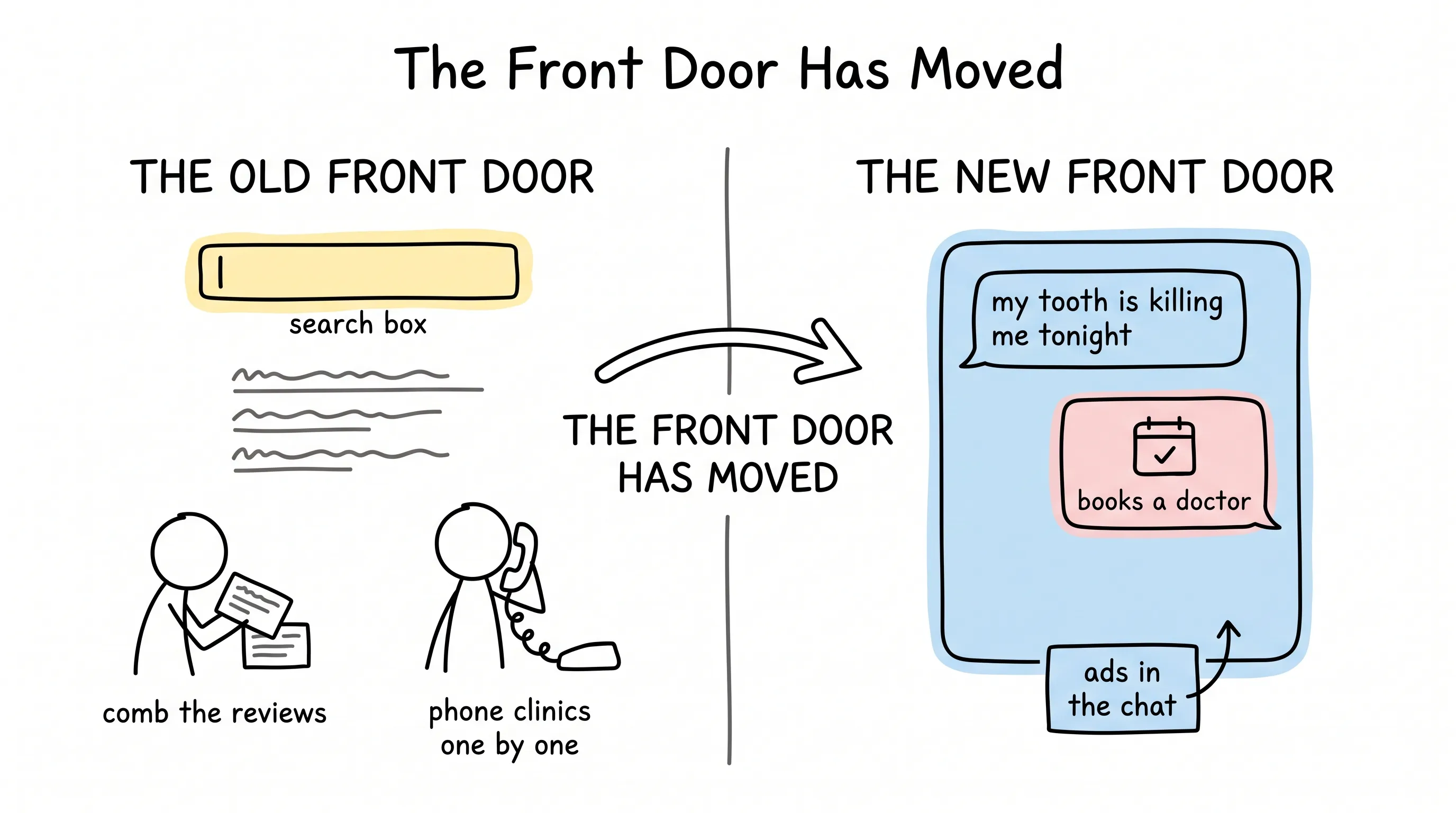
The second cluster of news is about a new front door.
Zocdoc has struck a partnership with Gemini. Here's the picture: you tell a Gemini chat window that your tooth is killing you tonight and you need a clinic that can take urgent cases — and it books you a doctor on Zocdoc directly. No opening a search page and combing through reviews, no phoning clinics one by one.
You see it — the front door has moved. The entry point used to be the search box. Now it's the conversation.
Retail is livelier still. After a long stretch of dithering, Home Depot has finally appointed a head of retail media. Ad slots inside stores are multiplying. Dollar General is binding itself ever tighter to DoorDash. Amazon has pulled a whole lineup of brands into its back-to-school campaign.
What is retail media? In plain terms: the shelf itself is an ad slot. Walk into a supermarket — what sits at the end of the aisle, what gets squeezed in beside the register. That used to rest on a channel manager's say-so; now it rests on the system's scales.
But people have already stumbled into potholes on this road. The play everyone's talking about lately is called GEO (Generative Engine Optimization — getting your brand mentioned more often inside AI answers). One practitioner threw cold water on it directly: chasing visibility alone can come back around and wreck the experience on your own website. If you rewrite your content until even your users can't read it, just to get cited by an AI — is that worth it?
Penny wise, pound foolish.
3. Where the People Fit, Being Reshuffled
The third cluster of news is about people.
Omnicom, one of the world's heavyweight advertising groups, has spent years pitching its in-house AI platform as the future. Yet the news in late August was that it transferred several hundred of the engineers and product people who originally built that platform — wholesale — to the outsourcing firm Endava.
On one hand, the platform is the future; on the other, the people who built that future are shown the door. Contradictory? The financial statements see no contradiction. People are heavy assets; platforms run best light.
Anthropic is more interesting still. Across the industry, every AI company has been busy signing content licensing deals with publishers, paying for peace. Anthropic hasn't signed a single one. Stranger yet: not one publisher has sued it. Publishers are baffled — no cooperation, no open war either. What exactly is this company's game plan?
Hightouch is poaching talent too. The data company just closed its Series D at a $2.75 billion valuation, then turned around and lured a veteran of the agency game away from Google. Why? The keys to advertisers' biggest budgets are clutched in the agencies' hands.
On the brand side, two quotes stuck with me.
Alison Payne, chief marketing officer (CMO) of Heineken's US business, said: our fans' friends have more reach than we do. Brands have to chase how consumers change — just don't lose your own positioning in the chase.
Rob Master of Edgewell put it even more bluntly: knowing the new technology certainly matters, but there is no technology that can replace your understanding of your audience.
Some call this the "hybrid CMO": half the speed AI hands you, half the bruises experience does.
Scars are assets too.
Back to That $1 Billion
Money is a good thing — it votes on your behalf. ChatGPT earning a billion dollars inside a chat box tells you conversation really has become the new front door.
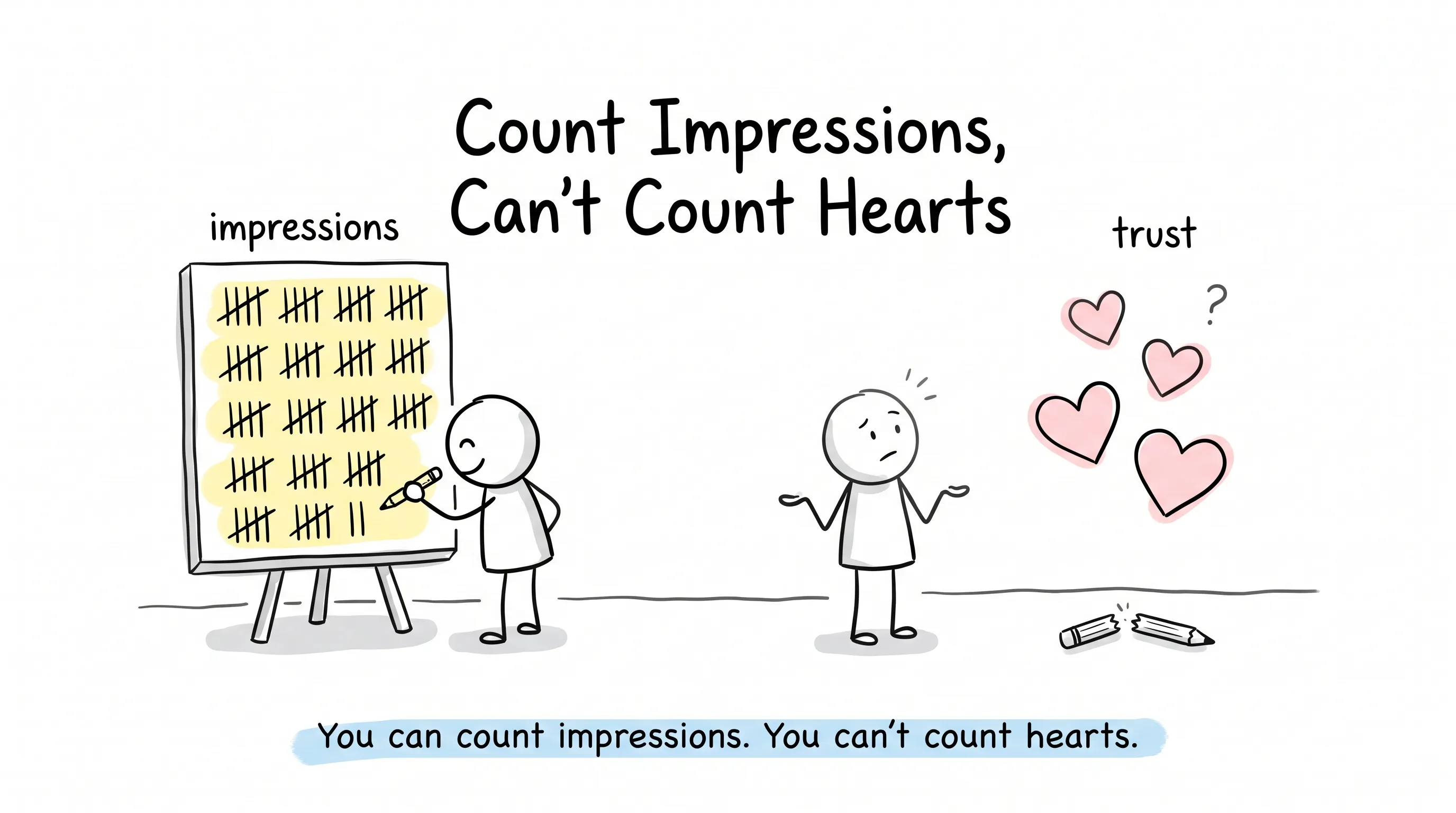
But after looping through this whole run of news, the more I think about it, the clearer it gets: the hard part was never counting the impressions. It's stacking up the trust.
You can count impressions. You can't count hearts.
Maybe someday you'll book tonight's dentist inside a Gemini chat window, and get served the sneakers you searched for last week at the foot of a mall escalator.
When that day comes, may you remember: what made you place your first order might have been a conversation. What keeps you coming back will always be a person.
Continue reading
Related articles

Cross-Border Business: Time to Upgrade Your AI Toolbox
A learn article explaining how AI tools help cross-border e-commerce sellers clear five hurdles: language, regulation, logistics, payments, and fraud. It outlines a five-compartment toolbox, a five-step adoption path, and metrics such as conversion rate and CLV, while cautioning against over-reliance on AI.

AI Is Taking Over the Dirty Work of Social Media Marketing, One Task at a Time
This learn article outlines four social media marketing tasks AI can handle — audience analytics, content drafting and design, ad targeting and creative testing, and spam moderation — and cautions that taste, judgment, and data security remain human responsibilities.

AI Is Already This Good — Why Is Your Social Media Marketing Still Pure Manpower?
An overview of 18 AI tools for social media marketing, organized into six categories covering audience research, content creation, scheduling, comment and DM handling, ad management, and visual production, plus notes on personalization, prediction, and emerging trends.