
Can AI Actually Help Companies Sell More? Someone Ran 7 Real Experiments
A learn article recounts seven randomized controlled experiments in which a cross-border e-commerce platform applied generative AI to real processes like pre-sales customer service, search, product descriptions, and ad headlines, summarizing reported sales effects and which users benefited most.
A while back, I came across an economics paper. When I finished it, I sat there applauding it in my head for a long time.
In May 2024, NVIDIA's CEO Jensen Huang said something uplifting: the next industrial revolution has already begun, and AI will bring significant productivity gains to nearly every industry.
The investors in the audience applauded — but inside, they were all wondering: productivity gains, fine, I get it. But where's the money? When do those tens of billions of dollars invested turn into revenue?
For the past two years, the debate about AI has been one long argument about "employees using AI to work more efficiently." In the coding experiments, engineers finished tasks 55.8% faster. In customer service research, agents handled about 15% more issues per hour.
Have you noticed? All of these stories are about cutting costs.
Cutting costs means spending less. But the real test of a business is: can AI directly help you make more money?
Selling more. More revenue. Revenue you can stand behind, in broad daylight.
Few big platforms have dared to answer this question with hard evidence. Because the answer can't come from surveys or interviews — only from an experiment: split real users randomly into two groups, one using AI, one using the old way, change nothing else, and see who sells more.
And one cross-border e-commerce platform actually did it.
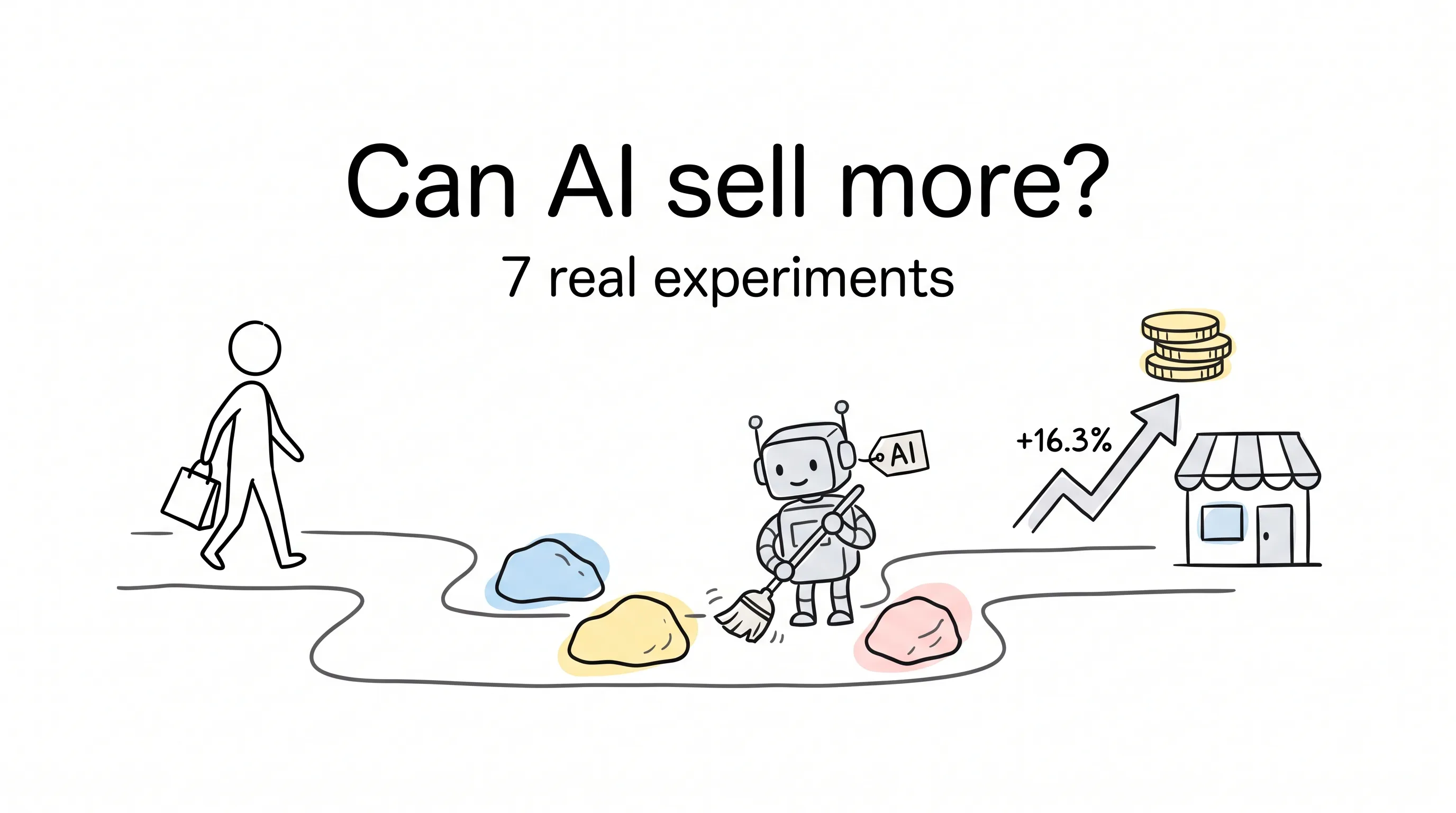
An Experiment Involving Millions of People
First, a word about this platform. It lets consumers worldwide bypass middlemen and buy directly from manufacturers at low prices. Hundreds of thousands of sellers, hundreds of millions of buyers, business in over 100 countries and regions, with roughly 20 service languages alone.
From September 2023 to June 2024, the platform did something very few in the industry had done: it plugged generative AI into 7 real business processes, and paired each one with a randomized controlled experiment.
What's a randomized controlled experiment? It's like flipping a coin — split users randomly into two groups. One gets the new AI-powered process; the other keeps walking the old path. Prices unchanged, products unchanged, everything else unchanged. The only difference is AI.
That way, whatever gap opens up between the two groups' sales results can be cleanly attributed to AI.
Seven experiments. The smallest involved 30,000 people; the largest, 13 million. Together: nearly 20 million instances of real consumer behavior.
And the results?
In one sentence: AI really can sell more — but the effects were wildly different. One process rose 16.3%; another barely moved at all.
Where was the difference? Let's look at them one by one.
The Biggest Rise: The Process Nobody Was Minding
The biggest effect came from pre-sales customer service.
Before, this platform's first-party products offered no real-time customer service for pre-sale questions. Had a question before paying? The system automatically sent back a pre-written line: customer service is temporarily unavailable. The platform's limited human resources were all reserved for after-sales; pre-sale questions just weren't that urgent.
Third-party small sellers? Even less so. How can a small shop afford a multilingual customer service team?
In other words, the pre-sales inquiry stage had been leaking for years.
Starting September 2023, the platform ran an experiment on 44,000 users who had initiated pre-sale inquiries: one group kept being ignored, the other was handed to AI customer service. Around the clock, in every language, every question answered.
Two months later, the data: the AI customer service group's sales rose 16.3%, and their purchase rate rose 21.7%.
Some will ask: did the control group users get so fed up with being ignored that they stopped buying, which made the AI look better?
The researchers wondered too. They ran follow-up tests: AI customer service alone already delivered service quality close to human agents; AI with human backup (escalating to humans when stumped) lifted sales 25% versus "completely ignored"; and here's the kicker — compared to a purely human-staffed group, the AI-plus-human combination got users to spend 11.5% more.
In other words, 16.3% may well be a conservative number.
The Others: Small Wins, Bigger Stakes, and One Flop
Search optimization: up 2.9%.
This platform's search used to translate whatever the user typed, word by word, into English, then match products. Word-by-word translation understands words, not people. Users searching in Arabic, Japanese, or Polish had long been "making do." After AI came in, it first understood what you wanted to buy, then rewrote the search query to be accurate and clear. Three experiments, nearly 2 million users, sales up 2.9%.
You will say: only 2.9%?
For a mature platform with hundreds of millions of users, search is the entrance nearly every user walks through every day. 2.9% spread across a base that size is serious money.
Product descriptions: up 2.1%.
There's a particularly interesting detail here. Most of this platform's first-party goods are sourced from Chinese suppliers, and the habit of Chinese suppliers is to make product introductions as images, with the characters baked into the image. Domestic shoppers are used to that; what overseas shoppers want is the kind of text selling points laid out line by line, like on an Amazon product page.
The result: nearly half of the first-party products had almost no text description.
After AI arrived, it batch-wrote multilingual structured descriptions for products. An experiment with 4.8 million users, sales up 2.1%.
Even better, look at it in layers: products that originally had almost no description saw sales rise 6.5% after AI descriptions were added; products whose descriptions were already complete barely changed when AI descriptions were added on top.
You see — AI's value hides where information is poorest. Sending coal in a snowstorm works instantly; adding flowers to brocade changes nothing.
Marketing push: up 1.6%, but statistically uncertain.
Writing push messages used to depend on one or two employees spending a few hours a month writing a few dozen. Across the platform's hundreds of millions of users, everyone received one of those few dozen. After AI came on, a single experiment generated 2.7 million distinct message versions.
Clicks rose 3.1%, orders rose 2.8%. But the rise in sales showed no certain effect statistically. Two reasons: first, the baseline purchase rate in this scenario was too low — only 0.16% — so the noise was huge; second, for risk control, only 40% of users in the experiment group actually received the AI messages. This number is very likely just a lower bound.
Then, the flop.
Google ad headlines: the effect was negative.
The platform put 1.2 million products into Google Shopping ads and let AI optimize the ad headlines. Sounds perfectly sensible, right? The result: sales fell instead of rising, though not statistically significant.
Why?
Because the model used this time was a general-purpose model with no fine-tuning for e-commerce advertising. Ad headline writing is a craft: it demands weaving in the keywords users will search for and the selling-point words that hook people into ordering, exactly right. A general model doesn't speak that trade's language; the pile of headlines it generated dropped the key selling-point words instead. Ad quality scores fell, and the auction win rate followed downward.
The value of this experiment lies precisely in how clearly it failed: take a general-purpose large model straight to a specialist's job, and it may not even match the old master.
For the last two processes, the platform didn't release detailed data, but the direction is very clear.
Chargeback defense. In cross-border business, buyers ask their bank to reverse the payment, and the seller must write appeal materials. This work is tedious, and it tests language ability and familiarity with each country's rules; for more than half of chargeback disputes, the sellers simply gave up, leaving it to a handful of outsourced staff processing with templates. After AI agents took over, the appeal success rate rose 15%.
Customer service translation. A large share of the platform's customer service staff are Filipino employees, serving global users in English, because hiring native-speaking agents for every market costs three times as much. After AI two-way real-time translation was plugged in, consumer satisfaction rose 5.2%.
Let's Run the Numbers
The four processes with positive effects, added together: per average consumer, AI contributed an extra $4.6 to $5.2 per year.
How big is that? From 2023 to 2024, of the growth in global per-capita annual e-commerce spending, roughly 6% was contributed by these few AI processes.
And this is only the beginning. In 2023, this platform used AI in only a few processes; by 2024, more than 40; by 2025, more than 60. The platform's AI-related API call volume was still just over 50 million a day in mid-2024; one year later it exceeded 1 billion a day.
One year. Twenty-fold.
What Did AI Actually Change?
Break it down, and things get interesting.
Of the 7 experiments, every process that had an effect saw purchase rates rise, with increases from 1% to 22%. But average order value barely moved at all.
Put simply, AI didn't make people spend more per order. It made people who weren't going to buy, buy.
Why? Because what AI does is, essentially, remove friction: what couldn't be searched can now be searched; what couldn't be understood can now be understood; what nobody answered now has someone answering. The stones along the shopping road got cleared away, one by one.
So the new question: would AI, to sell more, exaggerate and deceive people into ordering?
The data says: no.
Return rates did not get worse. The product description process: return rate actually fell 3.9%; the marketing push process: down 11.4%. Ratings didn't fall either — the pre-sales AI customer service process saw ratings rise 4.5%.
More goods were sold — but no more buyers regretting afterward.
Who Gains the Most?
Newcomers.
The researchers stratified users by experience: those who bought less, logged in less, registered later drew significantly bigger benefits from AI. And the shopping veterans felt almost nothing.
The logic isn't complicated. Veterans lack nothing: they know how to search, compare, ask. What newcomers lack is exactly information and skills; their friction is the biggest. So as soon as AI cleared away the stones, they were the first to start walking.
The seller side shows a similar shape: small sellers' and new sellers' gains also look bigger in the data, only the sample isn't large enough to say it with certainty.
AI levels the field for the disadvantaged; it doesn't widen it. Whoever is furthest from "smooth" gains the most.
This finding is in the same key as previous research: AI customer service tools improved the most junior customer service employees the most. Technology, all along, has been quietly passing ladders to those starting at the bottom.
Back to the Original Question
Can AI help companies sell more?
Yes. But it isn't magic — it's a patch.
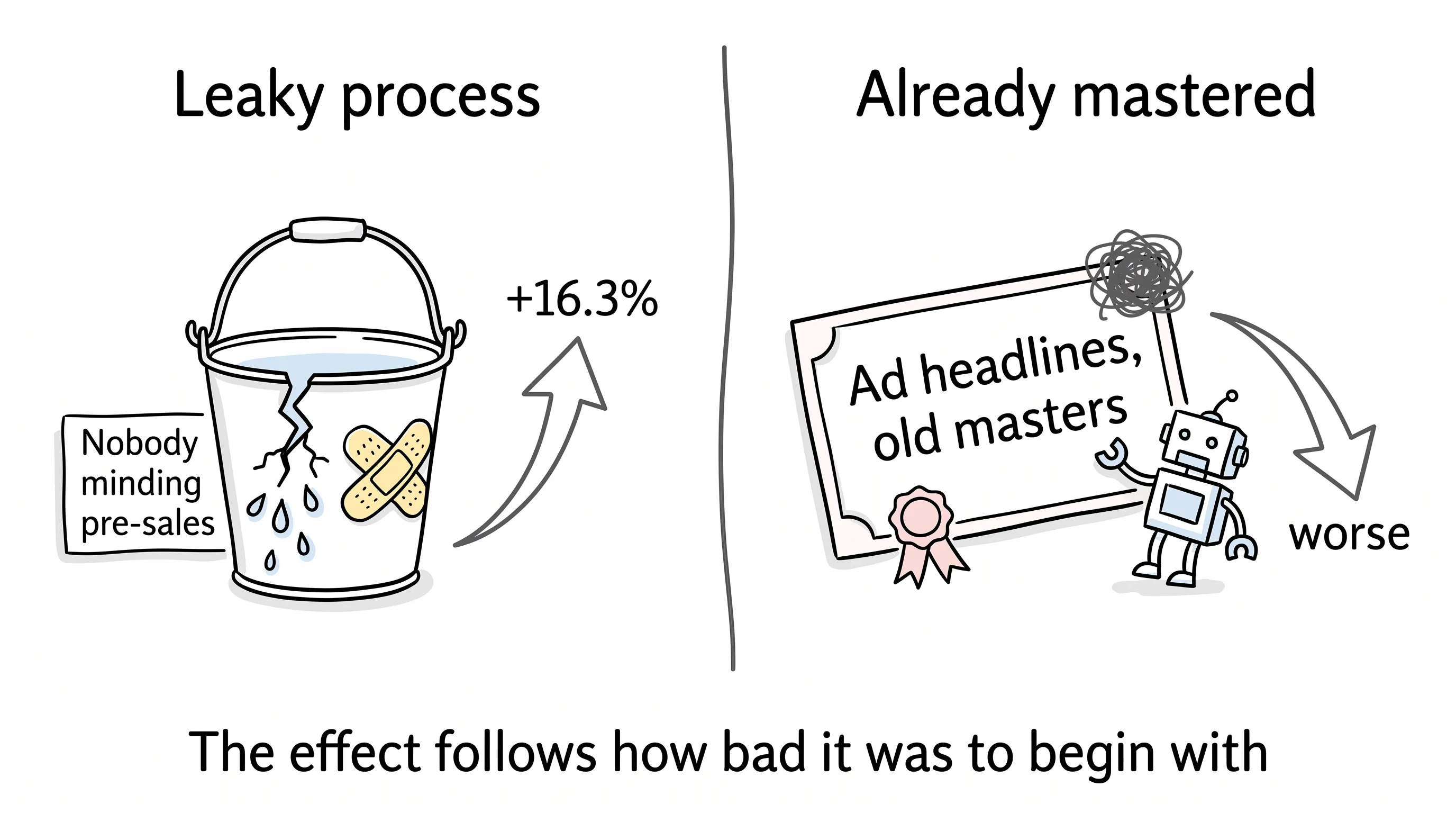
Where pre-sales had nobody minding it, patching in AI is worth 16.3%. Where ad headlines were already written well by old masters, an outsider AI butting in only makes things worse. The effect doesn't follow the "AI" label — it follows "how bad it was to begin with."
Jensen Huang's productivity revolution is real. But it won't fall from the sky in one whole piece; it grows, slice by slice, inside specific processes.
So don't just stare at the question "should our company adopt AI." Go look first: in your business, which process is still left "unanswered"?
There, your 16.3% may be hiding.
Here's to finding yours, soon.
Continue reading
Related articles

Cross-Border Business: Time to Upgrade Your AI Toolbox
A learn article explaining how AI tools help cross-border e-commerce sellers clear five hurdles: language, regulation, logistics, payments, and fraud. It outlines a five-compartment toolbox, a five-step adoption path, and metrics such as conversion rate and CLV, while cautioning against over-reliance on AI.

AI Is Taking Over the Dirty Work of Social Media Marketing, One Task at a Time
This learn article outlines four social media marketing tasks AI can handle — audience analytics, content drafting and design, ad targeting and creative testing, and spam moderation — and cautions that taste, judgment, and data security remain human responsibilities.

AI Is Already This Good — Why Is Your Social Media Marketing Still Pure Manpower?
An overview of 18 AI tools for social media marketing, organized into six categories covering audience research, content creation, scheduling, comment and DM handling, ad management, and visual production, plus notes on personalization, prediction, and emerging trends.