
Buying AI Isn't the Same as Using AI
A learn article on the gap between installing AI tools and actually changing how marketing teams work, presenting Pam Boiros' five building blocks — skills, workflows, guardrails, measurement, and culture — with culture as the most underestimated.
A few nights ago, I had dinner with some friends who work in marketing. When the conversation turned to AI, heads nodded all around the table: the tools were bought ages ago, everyone has an account, and training has rolled out more than once.
Then I couldn't help butting in with a question: has the way you actually work changed?
The table went quiet for a few seconds.
After some thought, one person said that proposals still get written the way they always did, and spreadsheets still get built the same. AI? Every now and then they use it to come up with a headline.
And there it is — the thing I want to talk about today. Most marketing teams have AI "installed," but very few have actually changed how they work because of it. Between installed and actually using it lies a gulf, and plenty of teams are standing at the edge of it, convinced they've already crossed.
Recently I came across someone who has studied this gulf in depth. Her name is Pam Boiros, an AI strategist who currently serves as fractional CMO at Bridge Marketing Advisors. What's a fractional CMO? A chief marketing officer who works for a fraction of the time, serving more than one company at once. She previously led the marketing organizations at Skillsoft and meQuilibrium, and co-founded Women Applying AI, a global community that helps women build real, hands-on AI skills. For the past three years she has been training marketers and teams.
Soon she'll be giving a talk at MAICON 2026 on a topic that boils down to this: AI adaptation — the human side of scaling. In other words, that gulf between installing and actually using.
Whether AI is being used well isn't about whether the tools are installed. It's about whether the way we work has changed.
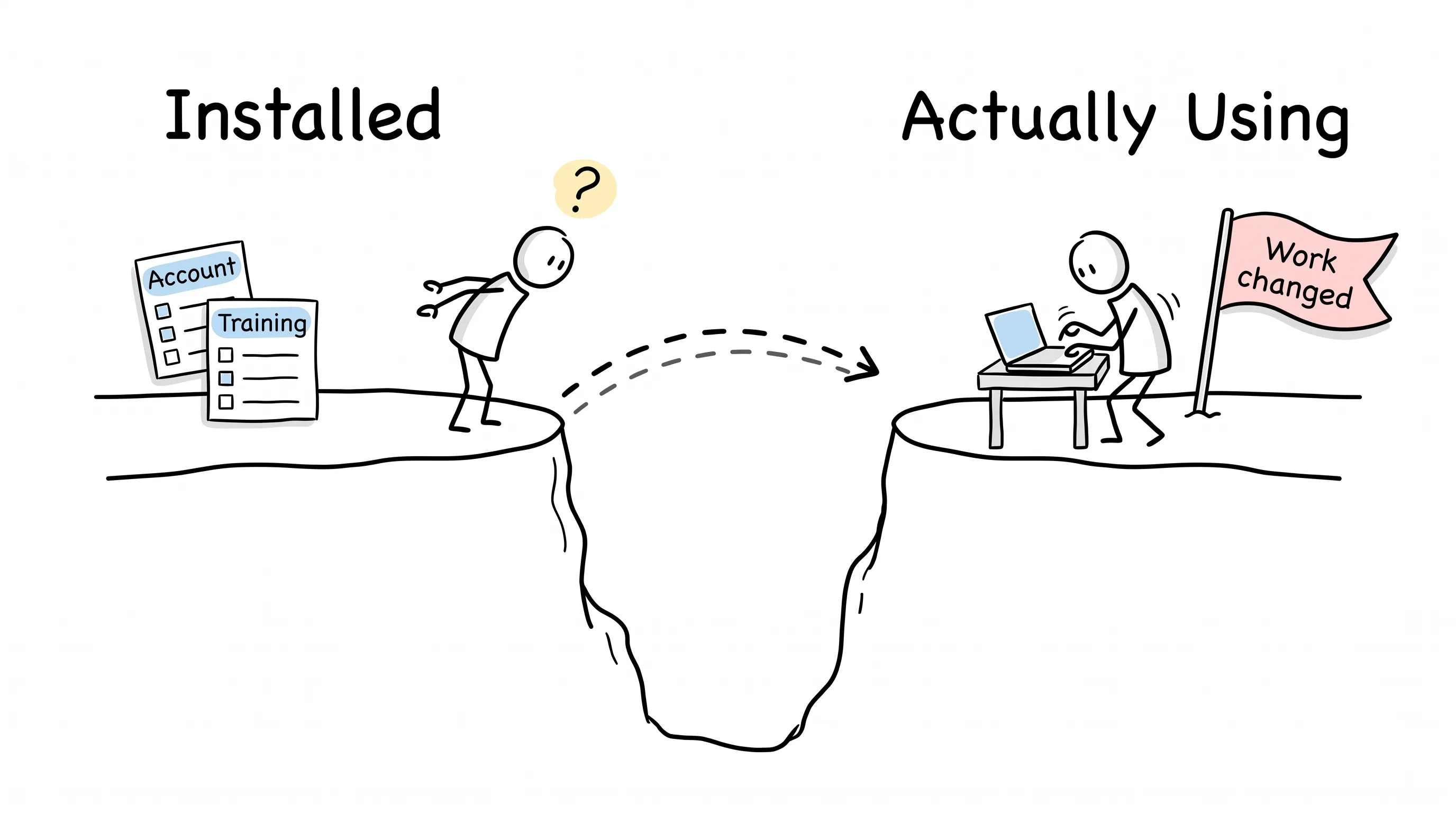
Take "installed" first. Everyone has an account, training has rolled out more than once, and personal use cases are starting to pop up in the team. All of that is visible, and all of it counts. But it's only "go-live."
So what does "actually using it" mean? Pam's litmus test is elegant: when AI stops being a project of its own and starts changing how the work itself gets done, you've crossed from go-live to hands-on.
What does that look like specifically?
The work gets redivided. Which tasks are people best at, and which does AI do fastest — the team rearranges its workflows around those answers. Managers start coaching people on working with AI, and quality is held to a new standard. And everyone else? They've grown bold enough to try things, bold enough to tell the AI "this passage won't do, run it again," and they know where the guardrails are — no more guessing day after day whether something is actually allowed.
Measurement changes too. The old question was "has everyone started using AI?" The questions that came after it got sharper: Is what we produce actually better? Are colleagues spending more of their time on the things machines can't replace — judgment, creativity, dealing with people? Will the playbook we've built up survive the next tool swap, the next model upgrade?
Teams that can ask these questions are already standing on the other side of the gulf.
Five Building Blocks — and the Most Underestimated One Comes Last
Pam breaks "actually using AI" into five building blocks: skills, workflows, guardrails, measurement, culture.
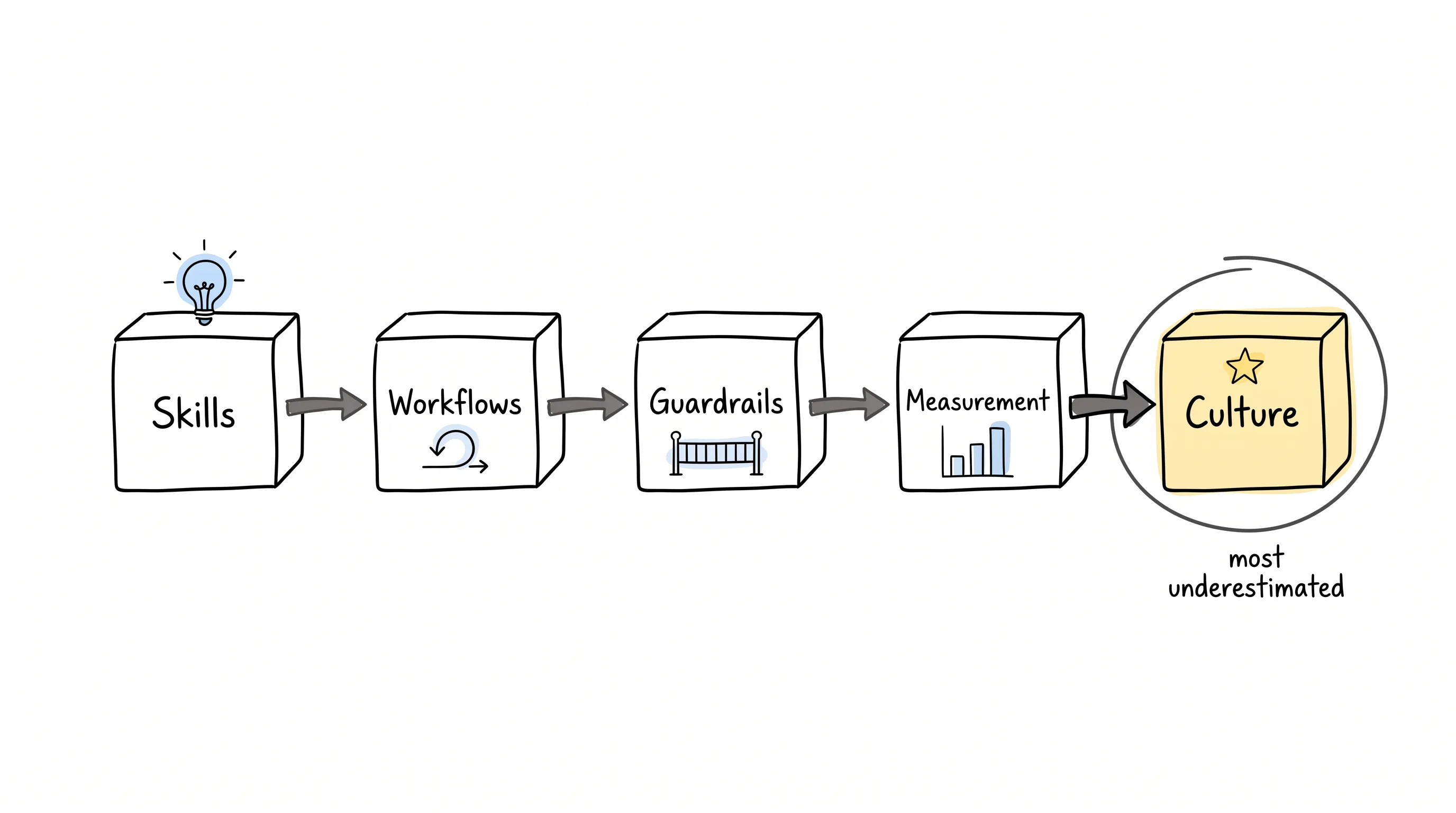
You'd think the hard part comes first? Her observation is exactly the opposite: what the vast majority of teams underestimate is the last block of all — culture.
What is culture? Skip the abstract stuff. Culture shows up in what people "actually dare to do" every day.
Think about it. Using AI means learning in new ways, reaching for things you're not yet good at, sometimes admitting "I really don't know how to do this," and rethinking work you've done for years. Now, if a company rewards only confident answers and polished presentations, which way will people choose?
They choose caution.
Some won't touch it at all. Some experiment in secret, and when they find something that works, they don't breathe a word — they quietly keep it for themselves.
The teams that move fastest do exactly the opposite: curiosity is encouraged, hands-on experimentation is expected, and sharing "I messed this up" is welcomed just as warmly as sharing "I nailed it." Leaders use AI themselves and say so publicly — "I stepped in a pitfall with it just recently." Once that signal goes out, AI stops being anyone's private pet tool and slowly grows into a capability the whole team owns.
Resistance Isn't What You Think It Is
In three years of training teams, Pam has seen every kind of resistance. The root, she says, is almost always the same: fear.
Fear rarely says its own name out loud. It shows up in costume.
"I don't have time to learn another new tool."
"This doesn't really have anything to do with my job, does it?"
"I tried it once. Didn't do much for me."
They sound like someone grumbling about hassle. Unpacked, they're really other questions: Is my place on this team still secure? Does my career still have a future? If I start now, is there still time?
That's why Pam keeps saying that adding more training alone gets you nowhere. What actually works is carving out a space where people can learn without feeling like they're secretly moonlighting at a second job. Think about it: your daytime work is already maxed out. Would you sign yourself up for an "AI night class" after hours? Would you?
How does she do it? Start from the work people already have to do — no separate track spun up from scratch. Protect a stretch of time meant purely for experimenting. Make learning a group thing, where colleagues can see how one another uses AI, and asking questions is nothing to be embarrassed about. And don't put your faith in grand transformation blueprints — small wins are enough. Once someone genuinely uses AI to smooth out an old process and delivers a better result, the conversation in the team changes on its own: from "why am I being made to use this?" to "where else could we use this?"
Back at the Dinner Table
If next time I ask "has the way you work changed?" and the table goes quiet again, I'll probably think of Pam's five building blocks — especially the one most easily skipped: culture.
Tools are bought. Ways of working are grown.
Buying takes money. Growing takes soil.
Maybe your team already has an AI account for everyone. What I wish for you goes beyond accounts: that everyone dares to try, is allowed to get it wrong, and can talk openly about what they've learned.
That's when you've truly put it to work.
Continue reading
Related articles

Cross-Border Business: Time to Upgrade Your AI Toolbox
A learn article explaining how AI tools help cross-border e-commerce sellers clear five hurdles: language, regulation, logistics, payments, and fraud. It outlines a five-compartment toolbox, a five-step adoption path, and metrics such as conversion rate and CLV, while cautioning against over-reliance on AI.

AI Is Taking Over the Dirty Work of Social Media Marketing, One Task at a Time
This learn article outlines four social media marketing tasks AI can handle — audience analytics, content drafting and design, ad targeting and creative testing, and spam moderation — and cautions that taste, judgment, and data security remain human responsibilities.

AI Is Already This Good — Why Is Your Social Media Marketing Still Pure Manpower?
An overview of 18 AI tools for social media marketing, organized into six categories covering audience research, content creation, scheduling, comment and DM handling, ad management, and visual production, plus notes on personalization, prediction, and emerging trends.