
Buyers Are Asking AI Now — Is Your Brand in the Answer?
A while back, an old friend of mine who works in B2B software sales vented to me about how rough things had gotten.
A while back, an old friend of mine who works in B2B software sales vented to me about how rough things had gotten.
Rough how? He said that in the old days, before a customer ever reached out, they would at least open the company's website, flip through a few product pages, talk pricing. Now? The first words out of a prospect's mouth are: "I already asked AI about this — why does it recommend your competitor?"
I told him I knew — and that the reality was worse than what he'd been feeling.
Here are the numbers: 58% of consumers now use generative AI instead of traditional search for recommendations; 48% of B2B buyers rely on AI tools to discover vendors.
Think about what that means.
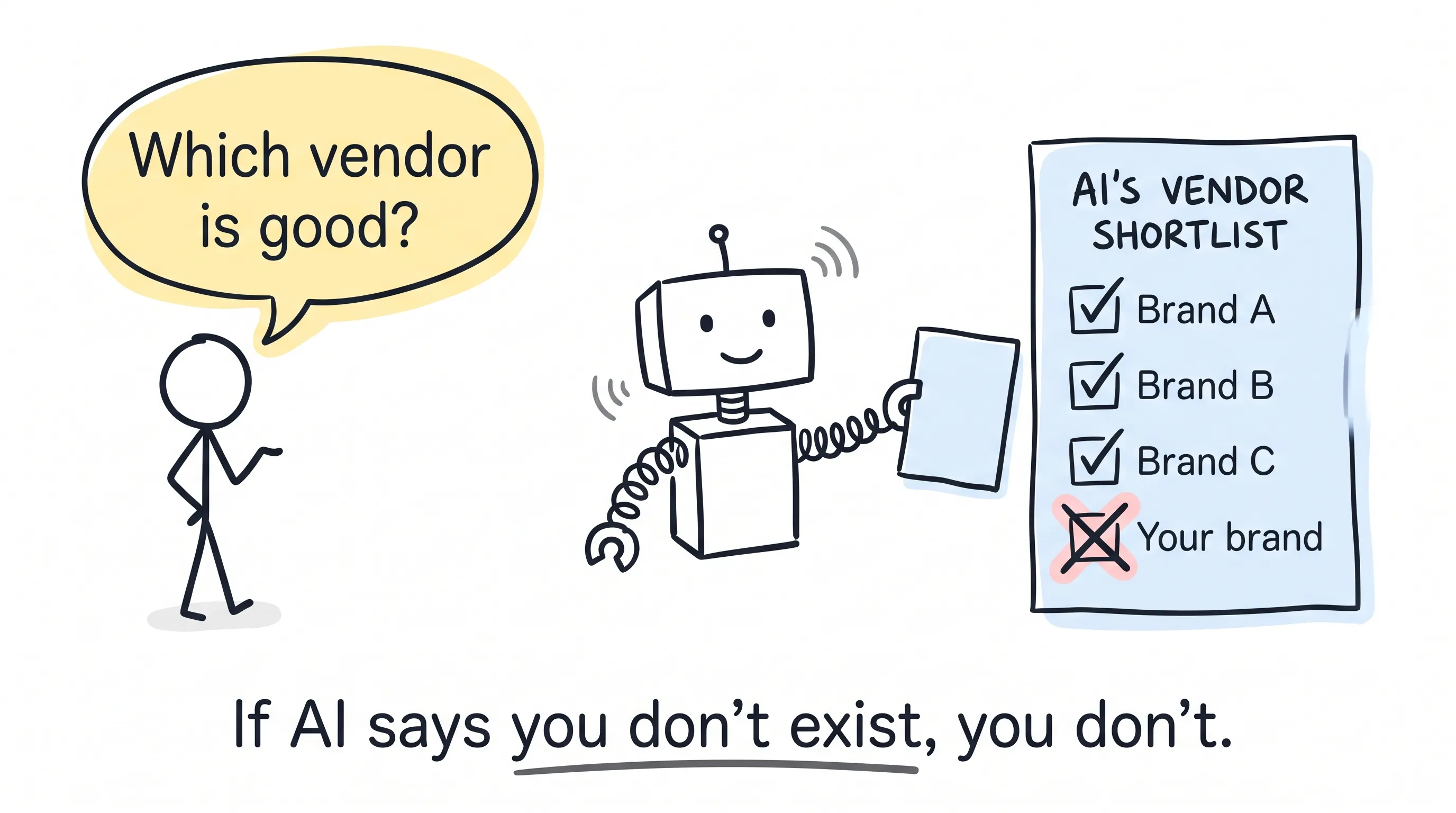
It means buyers may never visit your website at all. They open ChatGPT, Gemini, or Perplexity and ask, "In this space, which vendor is good?" The AI spits out a list. If you're on it, you're still at the table. If you're not, the deal was lost before the conversation even started.
If AI says you don't exist, you don't.
What Is GEO?
Sounds arcane. Truth is, it's dead simple.
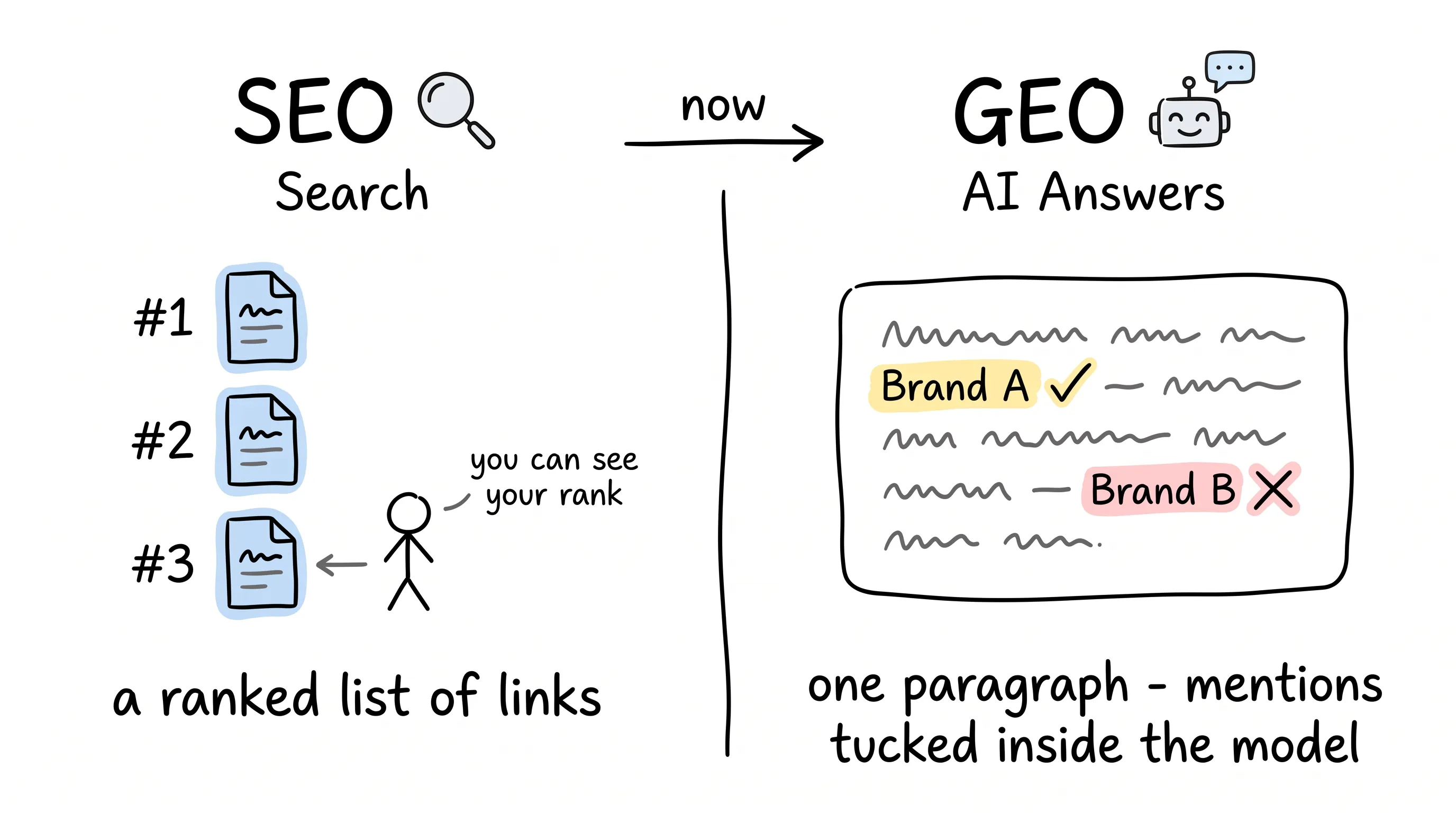
In the past, businesses pulled out all the stops to push their web pages to the top of search results. That craft is called SEO.
Now, businesses are pulling out all the stops to get their brands into AI's answers. This new craft is called GEO — Generative Engine Optimization.
The two run on completely different logic. Search results are a ranked list of links; you can see at a glance where you place. An AI answer is a paragraph — who it mentions, who it skips, how it frames you, all tucked away inside the model.
So a new tool category has popped up: GEO tools. They watch what AI actually says about you, help you squeeze onto that list, and can even help you correct what AI gets wrong about you.
In 2026, this space is already crowded — more tools than you can count on two hands, prices from $29 a month to enterprise quotes with no ceiling, and quality all over the map.
How do you choose? Start with three yardsticks.
Three Yardsticks for Picking a Tool
Every landing page promises "a complete boost to your AI visibility." But the gap between tools is wider than the gap in price.
Yardstick one: how many engines does it watch?
Where do your buyers ask their questions? Some use ChatGPT, some Perplexity, some Gemini — plus Grok and Claude. A credible GEO tool covers all of the mainstream engines, and ideally also keeps an eye on the AI Overviews sitting at the top of Google Search.
Watching just one engine is flying blind. Your most valuable questions may be happening precisely on the engine you're not watching.
Yardstick two: data, or action?
By 2026, tracking "does AI mention you at all" is the passing grade. The real dividing line comes after that: does the tool hand you a score and call it a day, or does it tell you why the score is what it is — and which task your content team and your PR team should go do this week?
A dashboard that only shows scores gets boring after two glances. The tool that tells you what to do next — that's productivity.
Yardstick three: does it fit your team's shape?
A startup content marketer doing the work of three people wants simple, cheap, and fast to start. A Fortune 500 global PR team wants depth, governance, and full workflows. Agencies are another story: juggling a dozen client brands, they need bulk management — and reports that can carry their own logo.
Price follows shape. Entry-level, think Otterly at $29 a month. Enterprise, think Profound or BrightEdge — that's a different budget entirely.
And one blunt truth: the best tool is the one your team actually opens every week. However powerful it is, if nobody uses it, it's worth zero.
11 Tools, Sorted by How You'd Use Them
I've been through all 11 mainstream tools. I'm not ranking them one through eleven, because teams come in different shapes, and someone else's #1 might be a waste of your money. Instead I've grouped them by "who you are" — find your seat.
Want the Full Lifecycle in One Platform? Look at Brandi
Brandi packs four things into one platform: analysis and insights on AI visibility, market and competitive intelligence, direction for content optimization (it calls this the Content Compass), plus a layer of technical optimization. It watches ChatGPT, Gemini, Perplexity, Grok, and Claude — all of them. More impressive still, it digs out the specific questions, pain points, and emotional triggers that sway buyer decisions, then tells you what to change. By its own account, clients typically see real movement in AI visibility within four to six weeks. In 2025 it also won an Intellyx Digital Innovator award. CMOs, content, PR, and digital marketing teams who want a complete map: start here.
Agencies Juggling Many Brands? Look at Geoptie
Its killer feature is flat-rate pricing. From $49 a month, all four engines included — Claude too, which is rare at this price point. Unlimited audit reports and content generation, and reports can carry your own logo. The $99 Professional tier manages 10 brand workspaces. For a small team wrangling a pile of brands, it's hard not to be tempted.
Deep-Pocketed Enterprises? Look at Profound and Evertune
Profound is the technical benchmark of the enterprise tier: 10-plus engines watched, deep dives into AI crawler behavior, and an Agent Analytics feature that shows you how large models actually read and interpret your content. The costs are just as obvious: expensive, complex to implement — small teams, stay away.
Evertune's founding team came from the ad-tech company The Trade Desk. Beyond enterprise-grade monitoring, it has an AI Brand Index that specifically measures "unaided awareness": you don't prompt the AI with your brand — you see whether it thinks of you on its own. Strong. It has also rolled out Shopping Intelligence, which tracks product exposure in ChatGPT shopping results. Big brands in retail, FMCG, and automotive should take a close look — it even watches Meta AI.
Want AI-Native? Look at Goodie AI
Plenty of GEO tools on the market are old SEO tools retrofitted for AI. Goodie isn't: it was designed for AI search from day one, with monitoring and on-page optimization advice sitting in the same workspace. In-house marketing teams that want one-stop coverage without the enterprise price tag: this one.
Tight Budget, Just Starting Out? Look at Otterly and HubSpot AI Search Grader
Otterly starts at $29 a month and gets running fast — good for a first read on where you stand. But its analytical depth is limited; once GEO grows into a real program, you'll likely switch.
HubSpot's AI Search Grader is even simpler: free, and within a few minutes it hands you a baseline snapshot — visibility, share of voice, sentiment. It's not a management platform; as a health check, it's great.
Your Team Already Lives in Semrush? Use Semrush's AI Features
The veteran SEO suite, now with AI Overview monitoring and question tracking added. Your subscription is already there anyway — flip the switch and it's good value. But note: its AI visibility coverage leans toward the Google ecosystem; it doesn't count as true multi-engine tracking.
Big, Structured Content Library? Look at BrightEdge
Enterprise-grade. Its strengths are entity optimization and knowledge-graph alignment, and it has a solid reputation for how accurately large models recognize entities. Companies with many product lines and mountains of content assets will get real use out of it.
Tech-Geek Teams? Look at AthenaHQ
The founding team came out of Google Search and DeepMind. Beyond monitoring, the emphasis is on actionable recommendations. Teams with an engineering pedigree recognize that temperament.
Managing Brand Reputation? Look at Scrunch
Enterprise-grade. Its strengths: sentiment analysis, GA4 integration (you can see how much referral traffic AI sends to your site), and SOC 2 compliance. It also has one genuinely forward-thinking idea: serving optimized content to AI crawlers directly at the CDN layer. That said, it leans heavily toward monitoring, with relatively light execution — a fit for PR and brand teams doing narrative and reputation management.
How to Choose: Four Filters
Tools listed. Here's a decision order.
Filter one: know who you are. A one-person marketing team, a Fortune 500 PR department, an agency handling ten clients — three shapes, three answers. Don't buy what someone else bought.
Filter two: match the engines. If your buyers are asking questions in ChatGPT and Perplexity, and the tool you bought only watches Google's AI Overviews — that's flying blind with your eyes wide open. Global brands, add one more question: is language and region coverage enough.
Filter three: weigh data against action. A tool that only tells you "you scored 62" is a spreadsheet. A tool that tells you "you lost points in these three places — fix this one first this week" is a system.
Filter four: back to that line — the right tool is the one your team really opens every week.
One Last Thing
Looking across this whole sweep, one pattern jumps out: platforms built natively for GEO beat the SEO transplants on nearly every front. Not because the latter aren't trying — search rankings and AI answers are simply two different crafts. It's like bolting an engine onto a horse-drawn carriage: it'll run, but it's still carriage-maker thinking.
SEO and GEO share DNA, but they've become two separate disciplines.
Back to that sales friend from the opening. Last month he told me his company had started doing GEO. Now when he meets clients, his opener has changed to one line: "Have you asked AI about us?"
The times really have changed.
You used to fear the search engine wouldn't find you. Now you fear AI's answer won't include you.
Here's hoping you're already in the answer.
Continue reading
Related articles

Cross-Border Business: Time to Upgrade Your AI Toolbox
A learn article explaining how AI tools help cross-border e-commerce sellers clear five hurdles: language, regulation, logistics, payments, and fraud. It outlines a five-compartment toolbox, a five-step adoption path, and metrics such as conversion rate and CLV, while cautioning against over-reliance on AI.

AI Is Taking Over the Dirty Work of Social Media Marketing, One Task at a Time
This learn article outlines four social media marketing tasks AI can handle — audience analytics, content drafting and design, ad targeting and creative testing, and spam moderation — and cautions that taste, judgment, and data security remain human responsibilities.

AI Is Already This Good — Why Is Your Social Media Marketing Still Pure Manpower?
An overview of 18 AI tools for social media marketing, organized into six categories covering audience research, content creation, scheduling, comment and DM handling, ad management, and visual production, plus notes on personalization, prediction, and emerging trends.