
Buyers Are Asking AI Now — Are You on AI's List?
A learn article on how buyers now ask AI for supplier recommendations and how Answer Engine Optimization (AEO) differs from SEO. It outlines three steps: checking AI brand visibility, following a prioritized content checklist, and tying AEO results to CRM revenue, citing HubSpot's AEO tool as an example.
A while back, a founder friend took me out to dinner. His company had been running five years, with steady clients and a solid product. By all rights, he should have been sleeping well.
But then he told me something that made me put down my chopsticks.
A few days earlier, to save himself some legwork, he'd asked an AI assistant directly: "In our industry, which suppliers would you recommend?"
The AI rattled off five companies.
His wasn't one of them.
He panicked and came to me: "Is this actually a problem? How serious is it?"
I told him: it's more serious than you think.
Today's buyers are treating "asking AI" like asking a friend. Before making a purchase, they used to search, flip through a few pages of results, and pick for themselves. Now they just ask AI: "Who's reliable in this space?" AI answers in seconds with a shortlist — reasons included.
In other words, before buyers make a decision, they sit through a briefing about your industry — one where AI is the only voice.
Did it mention you?
If not, they'll act like they've never heard of you.
What Is AEO?
AEO — Answer Engine Optimization.
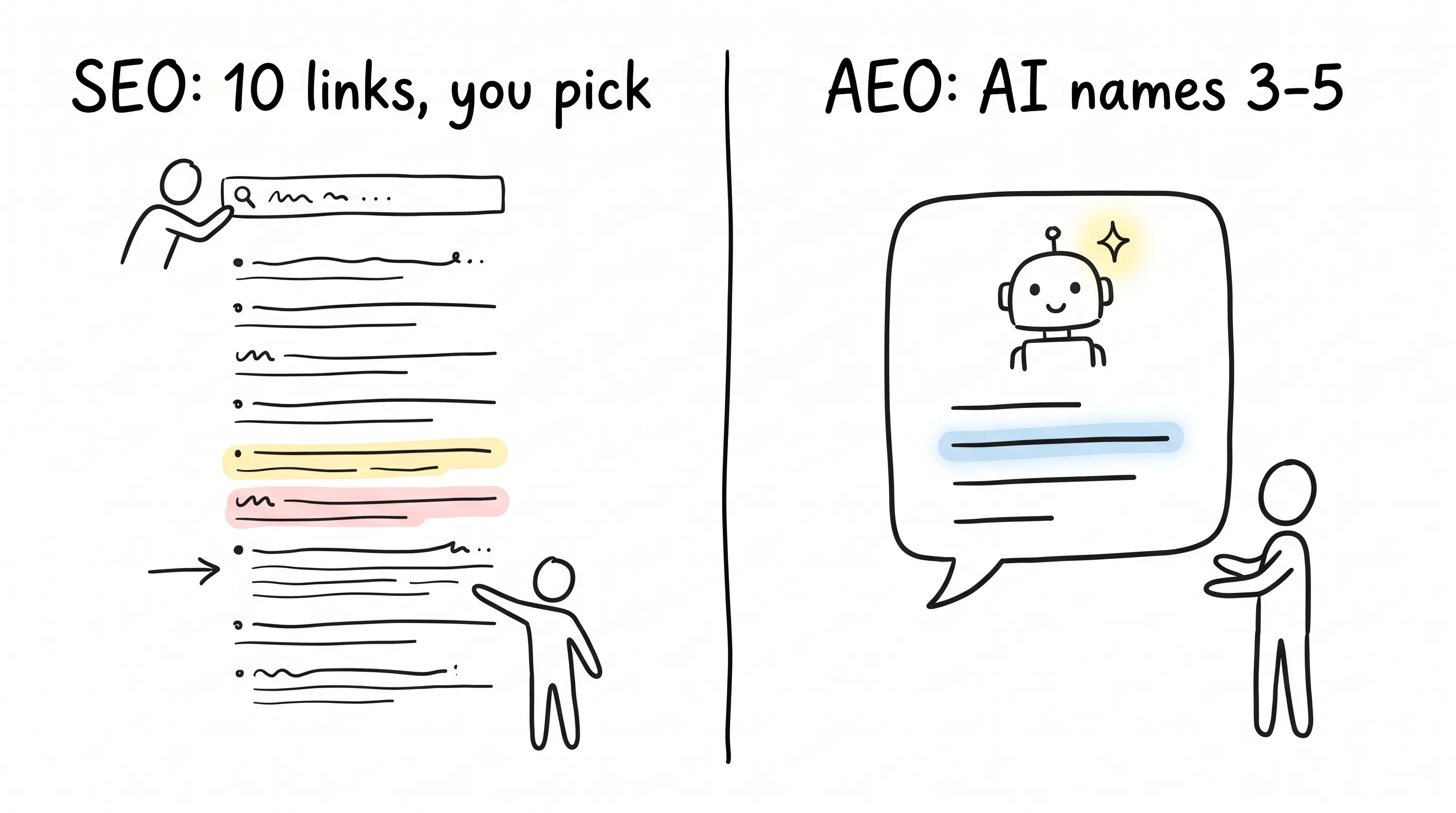
SEO is about getting search engines to rank your pages higher.
AEO is about getting AI to mention you when it answers questions.
Sound similar? The difference is huge.
A search engine hands you a list of links and you choose. AI hands you the answer — you don't even get the chance to pick. A search engine shows ten options; AI names three to five. And here's the crucial part: the two draw on different sources of information. Ranking high in search doesn't mean AI knows you exist.
So the line "our search rankings are pretty good" carries no weight with AI.
So what do you do? Three moves.
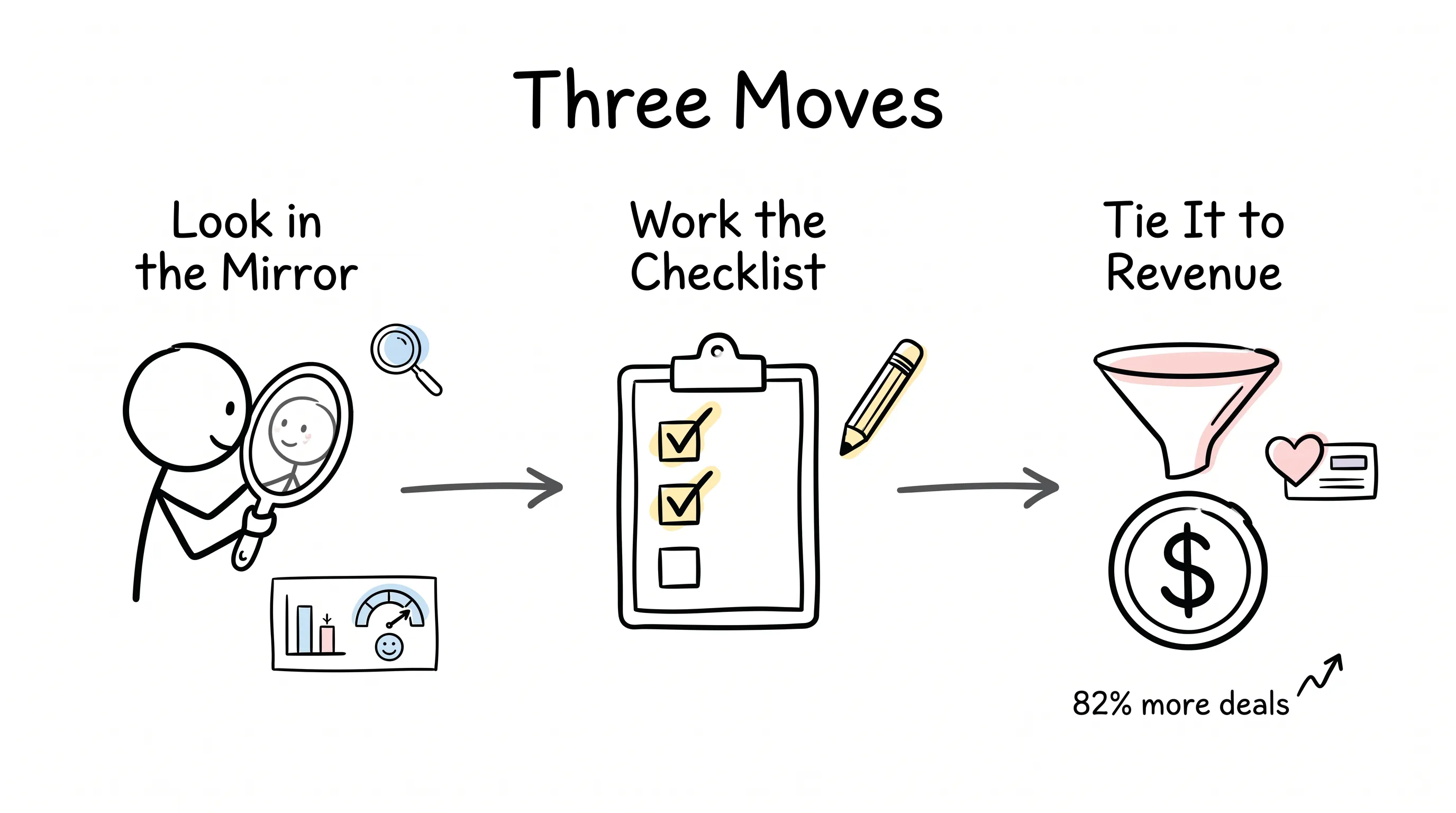
First, Look in the Mirror
What does looking in the mirror mean? Finding out who AI actually names when it talks about your industry.
If you don't even know whether buyers are seeing your name, your competitors' names, or nothing at all, you can't even judge whether this is worth your time.
Take HubSpot's AEO tool, for example. You open it and there's a brand visibility dashboard: AI visibility score, share of voice, who's citing you, what they're citing you for, and which competitors rank ahead of you in AI answers. You don't need to be an SEO expert — it makes sense the moment you open it.
Oh, and one more number. HubSpot's internal data shows that customers using AEO close 82% more deals than those who don't.
82%. Nearly doubled.
Second, Work the Checklist
Where do most people get stuck? At "I know I need to change something, but I don't know what."
AI visibility used to be the exclusive turf of SEO teams and consulting firms. As a founder, you can't exactly hire someone just for this.
The key is a prioritized checklist: what content to create, which pages to update, which sources to get yourself into. Work through it item by item in priority order — do it yourself, or hand it to a writer. No strategy meetings required in between.
Third, Tie It to Revenue
This is the one I most wanted to say.
AEO isn't a branding exercise. It's a customer acquisition channel. There's only one way to measure it: has it turned into contacts, conversations, and deals in your CRM?
If you track AEO in one spreadsheet and your business in another, you'll never be able to answer the question: was the time spent on AEO actually worth it?
So my advice is to connect the tool to your CRM. HubSpot's AEO plugs into Smart CRM, so every recommendation it gives you — what to write, what to update, what to go after — grows out of your real customer data, not a generic industry template.
When recommendations track the business, your moves hit the mark.
Back to My Friend
What did he do? He opened the dashboard, checked his AI visibility, and started filling in content item by item, following the checklist.
He said that looking back, the problem was never AI. His product docs, customer stories, industry content — there was nothing there for AI to cite in the first place.
If you ignore what AI says about you, you're essentially betting on one thing: that your competitors are ignoring it too.
That bet used to be cheap — not enough buyers were asking AI yet.
Now, the stakes keep rising.
Here's to you being on AI's list.
Continue reading
Related articles

Cross-Border Business: Time to Upgrade Your AI Toolbox
A learn article explaining how AI tools help cross-border e-commerce sellers clear five hurdles: language, regulation, logistics, payments, and fraud. It outlines a five-compartment toolbox, a five-step adoption path, and metrics such as conversion rate and CLV, while cautioning against over-reliance on AI.

AI Is Taking Over the Dirty Work of Social Media Marketing, One Task at a Time
This learn article outlines four social media marketing tasks AI can handle — audience analytics, content drafting and design, ad targeting and creative testing, and spam moderation — and cautions that taste, judgment, and data security remain human responsibilities.

AI Is Already This Good — Why Is Your Social Media Marketing Still Pure Manpower?
An overview of 18 AI tools for social media marketing, organized into six categories covering audience research, content creation, scheduling, comment and DM handling, ad management, and visual production, plus notes on personalization, prediction, and emerging trends.