
Buy or Build? Now It's the CMO's Turn to Answer the AI Question
A learn article arguing that AI shifts marketing technology strategy from procurement to product decisions: CMOs must define buy-versus-build criteria, route generic work to platforms, and create a governance path for promoting internal AI agents into core operations.
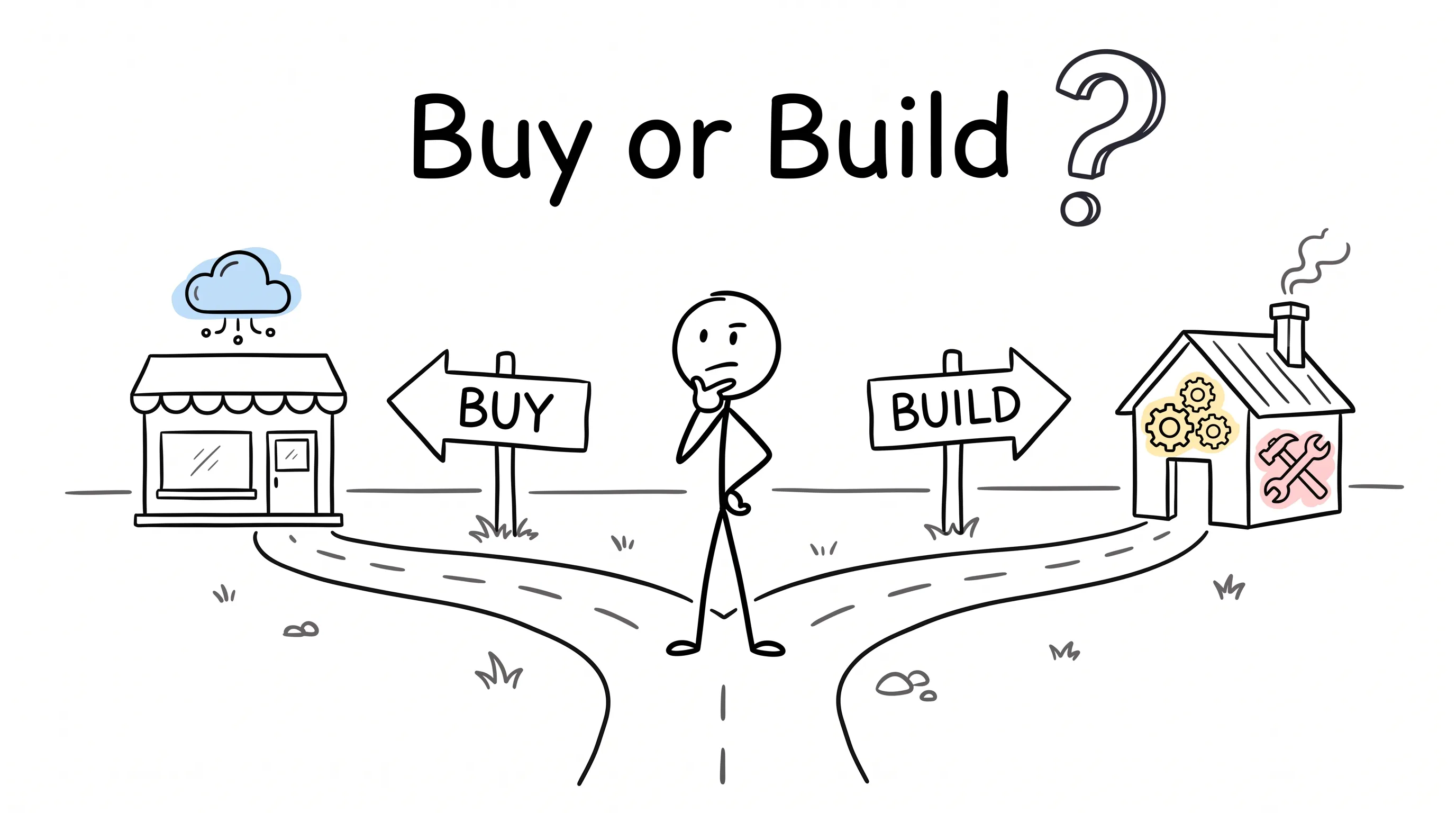
A few days ago, I spent an entire afternoon over coffee with a friend who runs marketing at a consumer goods company.
She had just sat through a string of AI demos from the major vendors. In her own words: huge productions, a thrilling show — and she came out more dazed than ever.
She asked me: every vendor's capabilities look about the same. Who am I supposed to pick?
I said: you may have been answering the wrong question from the very start.
She froze for a second. What do you mean?
Don't rush. Let me walk you through it, one layer at a time.
First, Look at the Shift
Not long ago, an enterprise technology strategy boiled down to one thing: buy.
Whenever marketing wanted a tool, the routine was: evaluate software, negotiate contracts, do the integrations, and wire platforms into the system one by one. The technology leader was, in effect, a procurement leader.
And now? AI has rewritten the exam question.
Vendors are pulling the "generic work" that marketers do into their platforms, one piece at a time. Salesforce is demoing agents that can write a brief (the creative playbook for a campaign) on their own, manage leads, and run ad campaigns. Adobe is showing AI coworkers embedded across the entire customer experience journey. Oracle is talking up role-based agents built into its large enterprise applications.
Every session is brilliant. Honestly, with production values like that, it's hard not to be impressed.
But put several demos side by side, and you discover an uncomfortable truth: they look more and more alike. What you have, they have; what they have, the others have too.
And so a new question is being forced onto the CMO's desk: which capabilities can simply be bought? Which ones must be built and nurtured in-house?
Before, this was a procurement question.
Now it's a product question. Technology strategy is turning from a procurement question into a product question.
Cross Out the Wrong Question First
Where do you begin? Begin by crossing out one wrong answer.
Right now, nine out of ten discussions about marketing AI are answering the same question: which platform to pick?
A year ago, that may have been the right way to ask. Now, it isn't.
Why? Let me run the numbers for you.
Audience segmentation, campaign summaries, first-draft content, workflow orchestration, lead routing, data management... these jobs are done in roughly the same way at every company. For vendors, this is the easiest business there is: one feature costs billions to develop, but the cost gets spread across thousands of customers, so each pays only a sliver.
And if you rebuild it yourself? Billions — all on your own tab.
You don't need me to teach you that math.
So: whatever the platforms are already doing, and doing well, don't touch. The question truly worth asking is: compared with everyone else, where are you actually different?
The truth is, most marketing leaders already carry the answer inside. It isn't in segmenting audiences, and it isn't in building workflows. It lives in the details of "how your company specifically runs": the compliance requirements unique to your industry, the approval processes shaped by your organization's history, the service experience accumulated over years of dealing with customers.
Not one of these words ever comes up on a demo stage.
Yet competitive advantage lives precisely here.
Three Small Scenes
That's the theory. Now let me give you three small scenes, and you can feel it for yourself.
A few weeks after the demos end, here's how the mood inside the company typically looks.
First, the web team. They say: commercial tools only understand "generic best practices"; they can't read our internal SEO standards. Fine, we'll build our own content-validation workflow.
Second, the content team. They say: approved templates still hide accessibility problems, and the platform is no help — it's giving them a real headache.
Third, campaign operations. They say: several teams are working the same batch of customer accounts at the same time, and the overlaps are so tangled that no platform can sort them out, so a human has to go through them one by one.
Three sentences, and every one of them stings. Because you won't find a single word about any of it on the vendors' roadmaps.
Why? Too specific. Specific to the way your company, and only your company, grew up. These hard problems are buried deep in a company's marketing operations (MOps), layered over years of accumulated processes, decisions, customer expectations, and organizational memory.
Think about it: what AI vendors do best is solve the problems where "everyone is the same." And what makes you truly valuable is exactly where "you are different from others."
So, one team after another starts building its own agents. The playbook tends to look the same: spot a repetitive task, wire up a few data sources, assemble a small workflow, and see results fast. It saves time, lowers risk, and you never have to wait for the vendor's schedule.
Up to here, the story is all rosy.
But Everything Has a Flip Side
Once an agent works well, the trouble is just beginning.
First, your own team can't do without it. Then the team next door hears about it and starts using it too. New scenarios keep popping up, and the dependencies grow heavier. Before you know it, one experiment is affecting the daily operations of several departments.
That's when the real question surfaces: should it be promoted into the company's core operating system?
What is the core operating system? It's the part of the company where, when something goes wrong, someone answers for it; where data follows standards; where processes run with discipline.
And the status quo? In most large enterprises, buying software goes through procurement, connecting platforms goes through integration review, and launching enterprise applications goes through governance. Only internally built AI capabilities are handed almost none of the corresponding set. The result: a pile of useful but isolated agents, stuck halfway — suspended in the no-man's-land between "pilot" and "production."
That no-man's-land cannot hold for long.
What to do? Build a promotion path for in-house capabilities. Three steps.
Step one, prove the value. It has to solve a real problem and show measurable results.
Step two, validate. Reliability, performance, adoption — put them to the test over time. Only what survives the run can stand.
Step three, governance review. Who owns the data? How is security managed? What about compliance? Who is responsible when something goes wrong? Clear each item, one by one. Only when everything passes does it graduate. That's right — the same "probation-to-full-time" logic a purchased piece of software goes through.
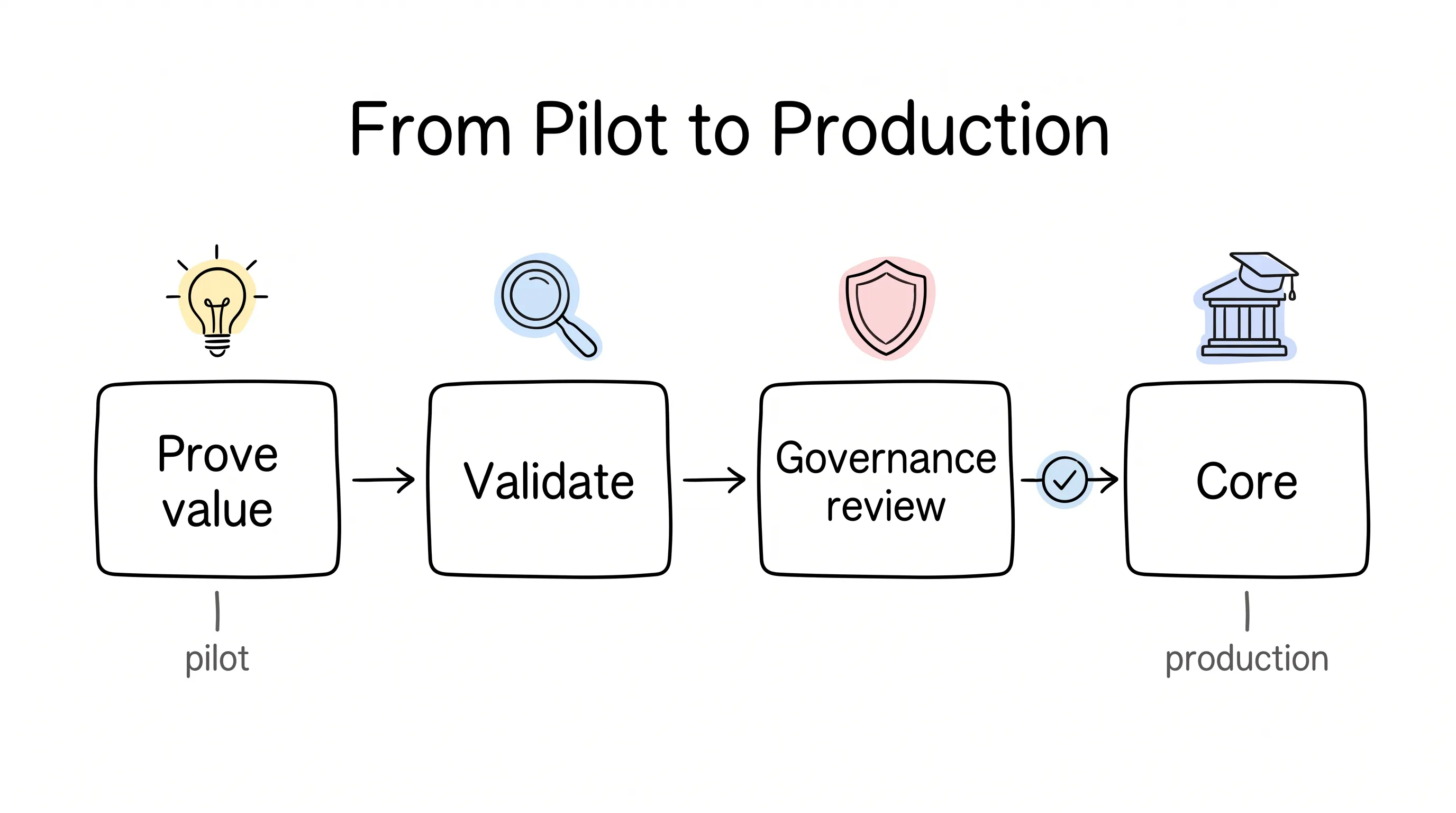
After graduation? It is no longer some team's "private side project." It enters the formal processes, gets to touch trusted data, and is held to exactly the same standards as other critical business systems.
Put plainly: the long-term value of AI isn't measured by how many agents you build, but by how many agents actually grow into the skeleton of the organization.
Governance Isn't the Brake. It's the Accelerator.
The moment people hear the word "governance," the reflex is: here comes the drag again.
My view is the exact opposite.
Every organization, sooner or later, runs headlong into that one moment that exposes, in perfect clarity, the gap between "running experiments" and "running real operations." For instance: a campaign is already booked and scheduled — and only then does the agent surface a problem; the customer records turn out to be stale; compliance risks come to light late. No great catastrophe, but a string of questions that someone must answer:
The outcomes — who is accountable?
The recommendations — built on which data?
The controls — what are they?
The performance — how is it measured?
Sit with those four questions for a moment. Not one of them is a technical question. Every one of them is an operating-model question.
Here's the interesting part: the earlier an organization gets these straight, the faster it runs later. Because once data standards are clear, accountability is easy to divide, and security and compliance review shifts from "firefighting after the incident" to "doing things by the rules." When the road is paved smooth, the car dares to drive fast.
Conversely, organizations that get stuck landing AI are rarely stuck on the technology. Most are stuck on three things they can't articulate: who makes the decisions, who bears responsibility, and why anyone should trust it.
So governance is not the enemy of innovation. Once you think it through, it is the paving stone of innovation.
This Quarter, the Most Important Meeting Isn't a Vendor Selection Meeting
For a CMO, the meeting that truly matters this quarter may not be any vendor selection meeting at all.
It's the meeting where marketing, operations, IT, security, and finance — five parties at one table — settle once and for all the criteria for deciding "buy or build."
From then on, every candidate capability goes through the same set of questions:
Is this a generic problem the vendors are already solving?
Is this opportunity unique enough to be worth your own investment?
What data does it need? What governance standards must it meet? And when an experiment wants to graduate into a core capability — against what criteria, and who gets the final say?
Honestly, none of these conversations is the least bit sexy.
But foundations have never been sexy.
The real function of these meetings is to move the focus from "picking the technology" to "designing the organization." The winning move of this round of AI competition hides exactly here.
When You Hand In Your Answers to the Board
At the end of the quarter, when you report to the board, the story you tell should not be "we've started using some AI tool again."
It should be: we already have a clear set of rules. What to buy, what to build, what to fold into the core.
Why do I say this? Because the trend of vendors absorbing generic work will not stop; it will only accelerate. That leaves you exactly one opportunity: find the workflows, decisions, and experience that belong only to you, one by one, and judge which ones are worth consolidating into organizational assets.
The winners of the next stage won't necessarily be the ones with the deepest pockets, nor the ones with the flashiest agent tricks. They have simply figured out one thing: the real decision stopped being "which software to buy" long ago — it's how you design the operating model. Which capabilities go to the platform. Which capabilities stay with you. And how to build the road that lets successful experiments flow, without interruption, into the organization's core architecture.
That is far harder than picking a vendor.
But it is also the only hard question that, after demo after demo fades to black, is still truly worth anything.
Back to that friend from the beginning, the one over coffee. As she was leaving, I gave her one line: don't rush to answer "whom to buy." First answer "who am I."
Hand the generic work to the platforms with confidence. Guard your own family silver, inch by inch.
And better still — may you be the one who figures it out first.
Continue reading
Related articles

Cross-Border Business: Time to Upgrade Your AI Toolbox
A learn article explaining how AI tools help cross-border e-commerce sellers clear five hurdles: language, regulation, logistics, payments, and fraud. It outlines a five-compartment toolbox, a five-step adoption path, and metrics such as conversion rate and CLV, while cautioning against over-reliance on AI.

AI Is Taking Over the Dirty Work of Social Media Marketing, One Task at a Time
This learn article outlines four social media marketing tasks AI can handle — audience analytics, content drafting and design, ad targeting and creative testing, and spam moderation — and cautions that taste, judgment, and data security remain human responsibilities.

AI Is Already This Good — Why Is Your Social Media Marketing Still Pure Manpower?
An overview of 18 AI tools for social media marketing, organized into six categories covering audience research, content creation, scheduling, comment and DM handling, ad management, and visual production, plus notes on personalization, prediction, and emerging trends.