
Brands Don't Die of Collapse. They Die of Drift.
A learn article arguing that brands fail gradually through drift rather than sudden collapse, and recommending annual brand health checkups with continuous fine-tuning instead of decade-scale rebrands. It also covers how AI-generated answers reshape findability, retention, and memorability.
Let me start with a true story.
You may remember a blunder by the American restaurant chain Cracker Barrel: it took a logo it had used for decades — a nostalgic old-uncle figure — and swapped it overnight for a minimalist design. The direction was easy to guess: go younger, reel in younger customers.
The result? Longtime customers erupted, and public opinion turned on it. Within days, the old logo was sheepishly brought back.
Hitting the brakes that fast — call it quick reflexes. But what I really want to talk about is a different question: who made that call, and on what basis?
Very possibly, it happened in some conference room on a Thursday afternoon. Someone had a passing whim: "Shouldn't we go a bit younger, too?" And just like that, it was settled.
This kind of decision has a vivid name: drunk-driving marketing.
What is drunk-driving marketing? It's a marketing call made with no diagnosis and no research, based on nothing but "that thing is hot, so we're doing it too." You see a competitor playing the short-video game, you get envious, you play too. You see another brand roll out a younger look, you get itchy, you switch too. But here's the thing: something being hot and something being right for you are two different matters.
Without regular diagnosis, management will almost inevitably slide into drunk driving: deciding on impulse, coveting the competitor's moves, mistaking someone's momentary excitement in an afternoon meeting for strategy.
But drunk driving is only the symptom. Dig toward the root and you find a subtler, more lethal disease.
There's a term that captures it precisely: brand drift.
What Is Brand Drift?
You surely know someone like this: one morning while getting dressed, they suddenly find the buttons won't close, and they panic — how did I get fat?
Nothing sudden about it, really. It built up day by day: the extra two bites at every meal, the stretch of road they couldn't be bothered to walk.
Brands are the same. Brands rarely collapse; mostly, they drift.
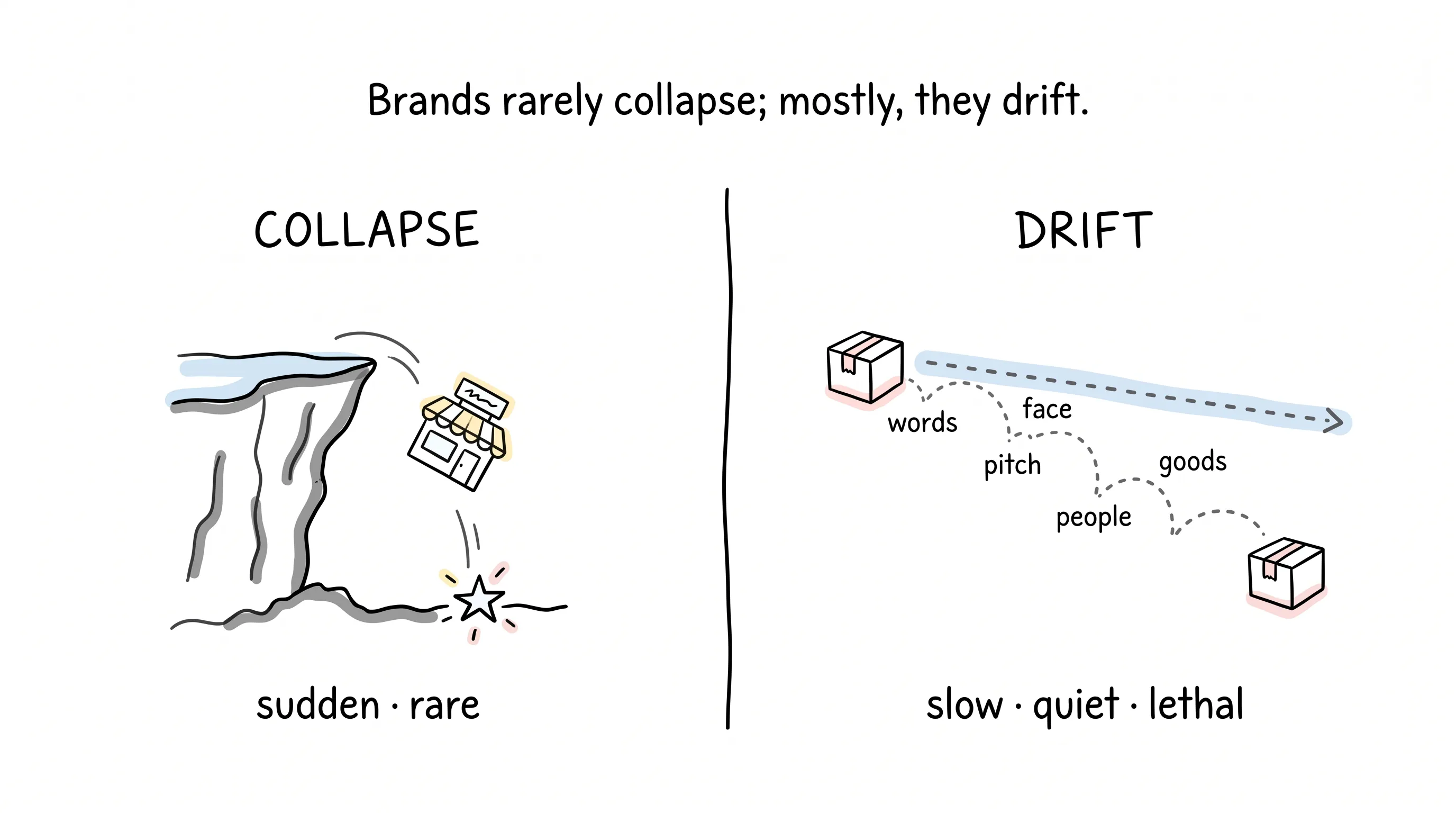
Sometimes the words drift: the thing you set out to say gets more scattered with every telling. Sometimes the face drifts: the visuals grow more muddled with every change. Sometimes the pitch drifts: the marketing moves have little to do with the brand. Sometimes the people drift: you're still shouting at the customers of ten years ago. Sometimes the goods drift: what you sell stopped being your foundation long ago.
The nastiest thing about drift is its slowness — so slow that every small deviation seems too minor to call a meeting over. By the time you notice, it's usually an acute condition: profits down, customers gone, and when you look up, a new rival is standing at your door.
Starbucks is the textbook case.
What was it once? A warm coffeehouse with a neighborhood feel, the kind of place you'd happily sit in all afternoon. And now? What's the first picture in your head when you think of it? Order on your phone, arrive, pick up, leave. At many locations the seats are gone, and even the restrooms are no longer open to customers.
Convenient — genuinely convenient. But that pot of "community coffeehouse" soup: is the stove still on?
Maybe this was a deliberate choice on their part. But the likelier story is that when the drift happened, not one person truly registered it. The scale inside customers' heads had quietly changed its reading long ago.
Retail is especially sensitive to this disease, because retail sits closest to the market's smallest shifts — and drifts fastest of all.
Victoria's Secret drifted for years and has only now recovered — its newly reported quarter showed revenue up 15%. Gap spent years standing at the center of fashion, then lost focus, and is still slowly finding its form again. Old Navy is the sadder story: it had a die-hard following and a razor-sharp positioning, then one day suddenly announced "we're going all sizes, serving everyone." Sounds generous-hearted, right? The moment a brand gives away "distinctive" with its own hands, it's already in danger.
Patch It Up, or Tear It Down and Start Over?
So you've spotted the drift. Now what?
Many people's first reaction: change everything! New logo, new slogan, new colors — demolish the whole visual identity and rebuild, go big.
Stop.
First, separate the two moves.
What is tearing it down and starting over (a rebrand)? Its subtext: the previous version was either wrong or written off — reset to zero, begin again. That's major surgery.
What is continuous fine-tuning? The subtext is completely different: the brand is alive, the foundation intact — you've simply grown up, and the old clothes no longer fit. Get clothes that fit; you don't swap out the whole person.
A rebrand is a career change. Fine-tuning is a promotion.
Mind you, fine-tuning isn't makeup, either. A fresh coat of paint on the logo, a trendy new palette — that's not fine-tuning, that's lipstick on a patient. Real fine-tuning means finding where you've drifted and setting it straight.
Why is this especially lethal today?
In February 2026, Gartner published a prediction: by 2027, 40% of CMOs pushing for bigger brand budgets will lose their voice in the executive suite because they can't prove the returns.
Sit with that for a moment. A rebrand is a huge expense, and the returns on that kind of spending are almost destined to be unexplainable. Fine-tuning? It costs little, it fixes exactly the part that drifted, and every line item maps to the business.
Gartner even has a name for the state where the harder you struggle, the deeper you sink: the brand doom loop. The prescription there is not another pile of money for a fresh start, but regularly measuring brand health and wiring those metrics to business outcomes.
So what does continuous fine-tuning look like?
It reminds me of an old joke: a plane flying from Los Angeles to New York is off its true course for almost the entire trip. It drifts a little, it corrects; it drifts again, it corrects again. Through hundreds of tiny corrections, it lands safe and sound.
Your brand is that plane.
But the vast majority of operators don't fly this way. Their thinking: settle the brand once, run it for ten years; stop after ten years for one big overhaul. In today's market, flying like that is asking for trouble. Kodak and Blockbuster are the two loudest alarm bells: it wasn't that they failed to build brands — they failed to see that their customers had already walked off in another direction.
There are positive examples too. Nordstrom has gone private, gone public, and changed hands any number of times; its capital structure has been flipped over and over. But one thing has never wavered: a clear value proposition, a clear core customer, and the customer at the center of every decision. Have you ever heard of Nordstrom "refreshing its brand" every few years? No. It just keeps setting itself straight.
Great brands aren't the ones that never change; they're the ones that keep making small changes.
Where Does a Brand Break First?
So where do you start checking?
A brand usually runs into trouble first in one of three places.
First, findability: when a customer wants to buy, can they see you?
Second, retention: once the customer has arrived, will they stay — and come back?
Third, memorability: after the customer has gone, is there still a place for you in their mind?
Drift almost always begins at one of these three points. And the early signals are tiny — so tiny you can't be bothered. Like a small lump you happen to feel on your body: no pain, no itch, so who makes a special trip to the hospital for it? But it grows.
Of the three, the first is being rewritten from the ground up by a new variable: AI.
First, Findability — the Hardest One Today
A quick question: you want to buy a black dress for summer. What's your first step?
Odds are it's not a trip to the mall, and it's not some brand's website either. You open an AI and just ask.
You used to search "best black summer dress," and the search engine threw a pile of links at you to pick through. Now the AI tells you directly: here are the black dresses most worth buying this summer.
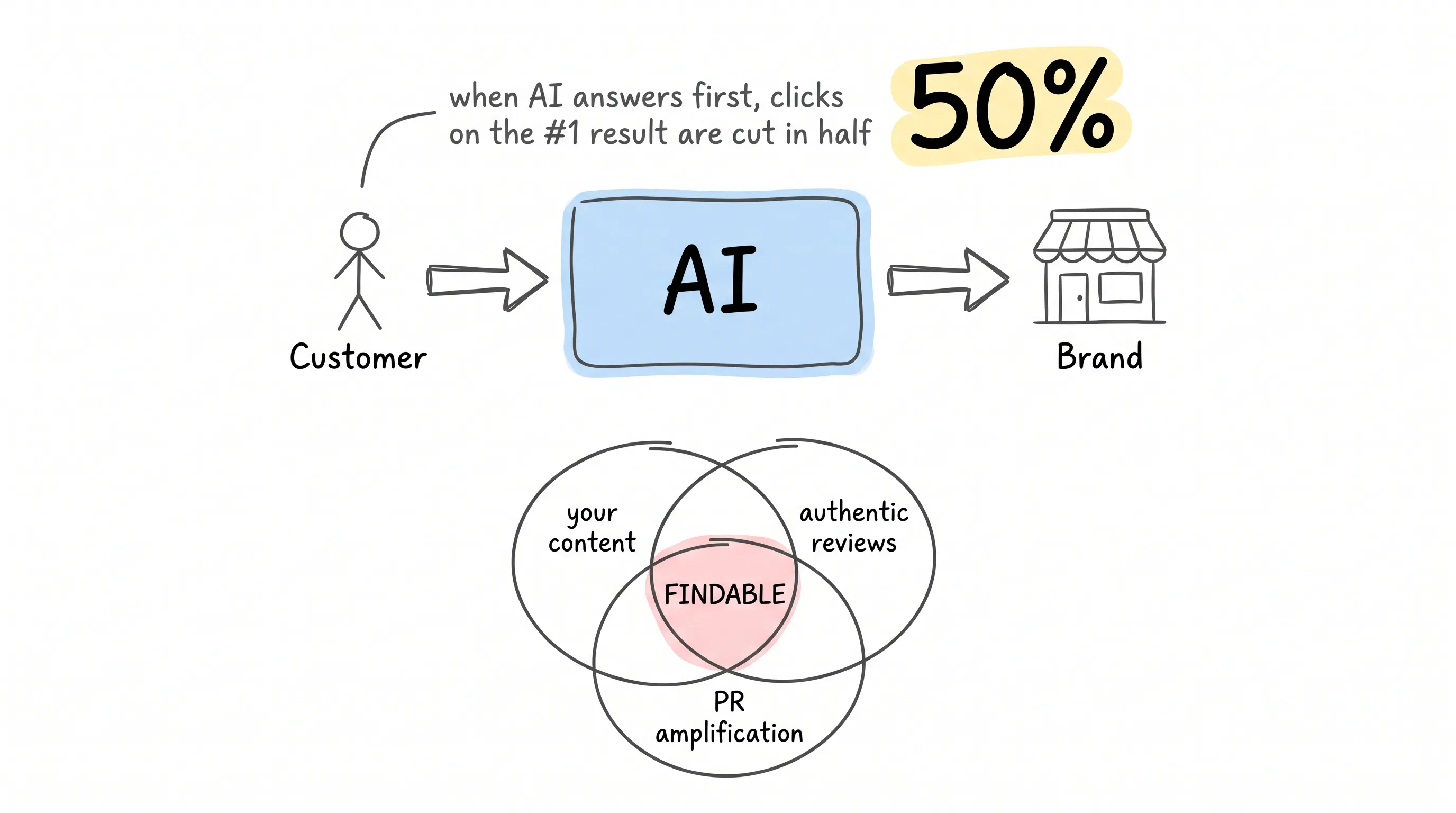
See it now? AI sits between you and your customers.
That's not my hunch — there's data. Drawing on data from Google's search backend, Ahrefs analyzed roughly 300,000 keywords and found: when Google places an AI Overview at the top of the results page, clicks on the number-one organic result (the non-ad listing) were cut in half.
Half.
Meaning: if AI doesn't recommend you, customers never even reach your door.
So what do you do? There's only one thing that works, and it's unglamorous legwork: give Google and the AI a perfectly clear picture of you — who you are, what you sell, whom you serve, and why you count as the expert in your category. If you can't state it clearly, and the web shows no consistent account of you, the AI will never treat you as "that black dress worth recommending."
And there's one more thing that used to be internal reference material and is now an external lifeline: customer reviews. I know several CEOs whose first act on waking each morning isn't checking sales — it's scrolling their own negative reviews. I used to admire that as real care for the customer; now I see it clearly: those reviews are also what AI feeds on. Whether your product is good or not, AI learns that from these authentic voices.
So being findable today takes roughly the intersection of three things: content you keep publishing yourself that hits exactly the right note; authentic reviews customers leave of their own accord; plus amplifying moves like PR. Where the three circles overlap in the middle — that's the spot where you get found. As for old-school keyword SEO? It still works, but it stopped being the main course long ago.
Next, Retention
Being found is pure serendipity. Now that they're here — can you actually catch them?
A friend once told me a story from her own life.
In Marin County, California, there's a boutique she'd patronized for 20 years. Expensive, but she'd made her peace with it. A few days ago she brought a friend along and bought two pairs of jeans and several tops. At home she showed off her haul to another friend, who took one look and said: same jeans — I paid $40 less than you. She checked: the store's price tag sat $40 above the manufacturer's suggested retail price.
She wrote the owner a letter. The owner knew her — a customer of 20 years — and she politely asked the store to make it right with a price-difference voucher. To this day: silence.
Unbelievable. Twenty years of loyalty, forty dollars, one reply letter — three small things, and none of them bought a single "sorry, we'll fix this right away."
Do you think she'll keep going back? Probably not. And even if she does, the first thing she'll do walking in the door is pull out her phone and compare prices.
Finding customers is luck. Keeping customers is skill.
Retention has one more layer: belonging. Yeti is a master of this: documentaries, short films, turning a crowd of insulated-tumbler buyers into a tribe — people who buy it feel like they're in the gang. Quince does it cleverly too, inviting customers to post their outfits, with people of every body type and every age on camera. Have you noticed? What people follow is that feeling of "these are our people."
Finally, Memorability
This one is short, but it's the most valuable.
As being findable gets harder, being remembered by customers — recalled, sought out by name, bypassing every search — becomes the strongest moat. And every drop of water in that moat comes from the first two: first be found, then be kept — and only then do you deserve to be remembered.
The Prescription: One Checkup a Year
By now you might be asking: I get the logic — what do I actually do?
In one sentence: one checkup a year, not one big overhaul every ten years.
Once a year, sit down and take the brand from head to toe: Is the message still right? Does the face still hold up? Are the channels you shout through still the right ones? Is the customer sitting across the table still the same crowd as always?
Think of it as a physical. If the readings are all good, go back to flying and keep fine-tuning. If one number runs a little high — cholesterol up a touch, say — then cut back on red meat. That's an adjustment — nowhere near an overhaul.
Some years, changing one thing is enough. Some years, you need a whole new playbook. What to fix — listen to the diagnosis, not the gut call. And if you don't run this annual diagnosis at all? Then you're right back where we started: driving drunk.
Someone will ask: if you've already been drifting for years, is it too late?
There are miracles, too. Marvel went bankrupt in 1996. After bankruptcy it figured out one thing: no more scattering bets — focus on the film studio, focus on those few core characters. Just last month, Spider-Man's global box office topped $2.1 billion — one of the brightest showings in film history.
But on the same map there's also Sears: bankruptcy — and then, no "then." And no one today would bet confidently on Saks Fifth Avenue's prospects. Retail is a gladiator's arena; drift too deep and try to turn back, and the ticket back is terrifyingly expensive.
So while it's still only a small lump, go see the doctor. Don't wait until you're headed for the operating room to remember that checkups exist.
One last reminder — about another man-made cause of drift.
A senior-executive friend who spent four or five years at Saks Fifth Avenue told me she went through three CEOs there. Each one arrived carrying a brand-new brand strategy.
A new leader wanting to stamp a personal seal on the brand is only human. But mature managers know what weighs more: first look at where the brand stands right now, where the market is heading, and whether an adjustment is needed; "I want to stamp my seal here" comes after.
Seeing clearly where the brand is matters far more than where I want the brand to be.
Remember the restaurant from the beginning, the one that changed its logo? It switched back within days — quick brakes, credit where due. But the real exam question was never that one logo. It's whether, in every year to come, you sit down and seriously ask yourself:
Has my brand drifted again this year?
May you never need the major surgery of a complete teardown and rebuild.
Continue reading
Related articles

Cross-Border Business: Time to Upgrade Your AI Toolbox
A learn article explaining how AI tools help cross-border e-commerce sellers clear five hurdles: language, regulation, logistics, payments, and fraud. It outlines a five-compartment toolbox, a five-step adoption path, and metrics such as conversion rate and CLV, while cautioning against over-reliance on AI.

AI Is Taking Over the Dirty Work of Social Media Marketing, One Task at a Time
This learn article outlines four social media marketing tasks AI can handle — audience analytics, content drafting and design, ad targeting and creative testing, and spam moderation — and cautions that taste, judgment, and data security remain human responsibilities.

AI Is Already This Good — Why Is Your Social Media Marketing Still Pure Manpower?
An overview of 18 AI tools for social media marketing, organized into six categories covering audience research, content creation, scheduling, comment and DM handling, ad management, and visual production, plus notes on personalization, prediction, and emerging trends.