
Before You Run Marketing on AI, Learn to Read Two Bills
A learn article explaining the legal and privacy obligations behind AI-powered marketing, covering data protection rules, contract terms, AI-generated claims, and six practical compliance steps.
A while back, a friend of mine who runs a consumer brand invited me to dinner. We were barely a few bites in when he unloaded a pile of frustrations.
One of the agencies he works with has suddenly started delivering copy at breakneck speed. It used to take them a week to grind out a single piece; now they turn in three drafts a day. At first he was delighted — until his legal team reviewed the contract and tossed back one line: it stipulates that all content must be original, and must be tailor-made for our users.
The agency was using AI.
So he asked me: is that a breach?
I told him: don't rush to dig out the contract. Behind that question sits a much bigger bill — one you may have never added up.
You've Been Using AI All Along
You may be thinking: I never went out and bought any AI products, so this doesn't concern me.
Really? Think about it for a second.
The CRM you use drafts follow-up emails for you automatically. The platforms you buy ads on automatically build audience segments and generate several versions of copy. The tools you use to make images and videos hand you ten variations with one click.
You didn't start using AI on the day you "decided to use AI." You've been inside AI all along.
So legal and privacy issues are not some multiple-choice question that only turns up on a whim someday. They're a fait accompli, and you have to face them now.
This bill splits in two.
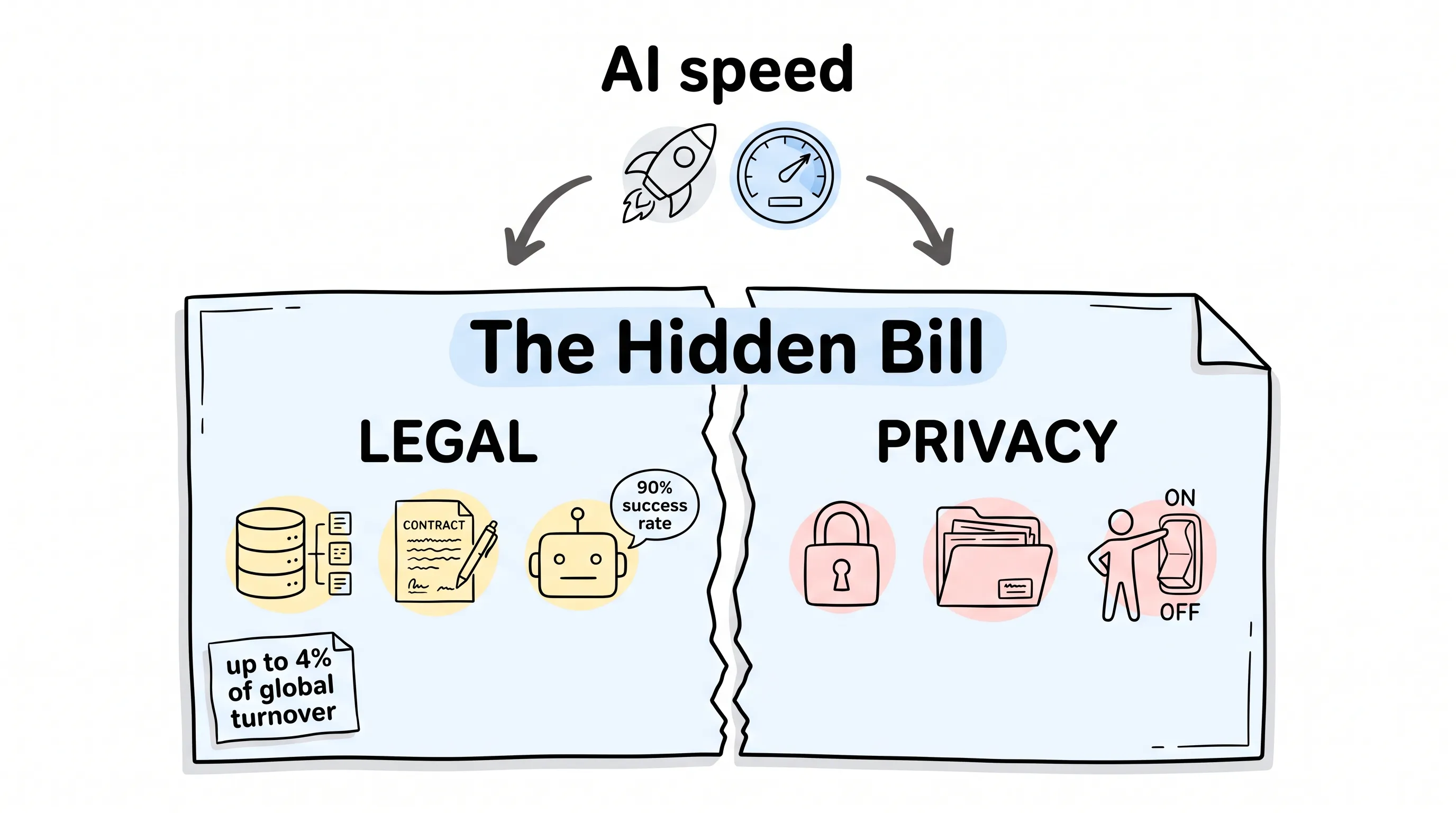
The First Bill: Legal
On the legal bill, let me count out three charges for you.
The first: data.
For AI tools to run, they have to feed on data. Whose data? Your customers'. Names, email addresses, purchase histories, browsing trails — all of it goes in. Could that data be misused? Could it end up in hands where it doesn't belong? Can you answer that?
Regulation today has teeth. The EU's GDPR took effect back in 2018, and violations can be fined up to 4% of global turnover. China's Personal Information Protection Law (PIPL) landed in 2021, and it bites just as hard.
Do the math yourself. For a company with 1 billion in annual revenue, 4% is 40 million. Can the meager labor costs AI saves you fill a hole that size?
The data belongs to your customers. You're only the custodian — and a custodian who loses the goods has to pay.
The second: contracts.
Back to my friend's story. He demanded "original, tailor-made" work; the agency produced it in one click with AI. Does that count as fulfilling the contract? Nobody can say for sure. And when nobody can say for sure, the landmine is already planted.
There are subtler traps, too. When the agency uses AI to serve personalized recommendations to your customers — did you ask those customers? Did they consent? Can they switch it off with one click? Is any of it written into your terms?
Whether it's in writing makes an enormous difference. In writing, you have a way out. Without it, when trouble hits, all you can do is watch — helpless.
Oh, and some industries come with a strict rulebook all their own. Finance, healthcare, anything aimed at children — layers upon layers. Whichever step your AI touches, that step's rules apply.
The third — and the one most easily overlooked: AI lies with a perfectly straight face.
This isn't a new flaw. Back when GPT-3 first appeared in 2020, people tried writing articles with it, and on reading the output they found: the sentences were truly beautiful, and the facts came with truly no guarantee. Fluent and accurate are two different things.
And marketing copy happens to be fact-dense territory. Efficacy claims, statistics, comparisons, partners — every sentence is a statement you bear legal responsibility for. If AI casually invents a line like "experiments prove a 90% success rate" and it goes out the door, who takes the blame?
AI will never stand trial. You will.
The Second Bill: Privacy
Privacy is actually tucked inside the legal bill, but it deserves to be pulled out and examined on its own.
You collect, you store, you analyze — every extra step spreads the risk a little wider. The smarter the tools, the more openings for something to go wrong.
So what do you do? Governance. Which steps use AI, who has the authority to make the call, who covers the damage when things break — these can't rest on unspoken understanding; it takes designated people and written rules. The most critical link is data governance: where data comes from, where it goes, who may touch it — written down, item by item.
It sounds tedious. But the moment something really goes wrong, that stack of paper is your life ring.
Six Pieces of Unglamorous Legwork
How do you actually put this into practice? Here are six.
- Be a student first. Go through the regulations and industry rules around marketing AI yourself; you need a map in your head. China already has dedicated regulations governing generative AI, and in 2024 the EU passed legislation specifically for AI — the EU AI Act. And that map gets updated fast.
- Put legal up front. How data is collected, how it's stored, how long it's kept — build the compliance process first, then talk about adding new tools.
- Hand the choice back to users. Let them know how their data is being used; let them opt out of personalized recommendations and targeted advertising.
- Bind your partners to the same boat. Set data governance down in black and white with your agencies and suppliers — don't rely on the phrase "pleasant cooperation."
- Get regular checkups. Audit your AI systems every so often: has anyone accessed data beyond their authorization? Has any data been diverted to other uses?
- Keep your ears open. Regulations shift, and so does user sentiment. What's compliant today is not guaranteed to be compliant tomorrow.
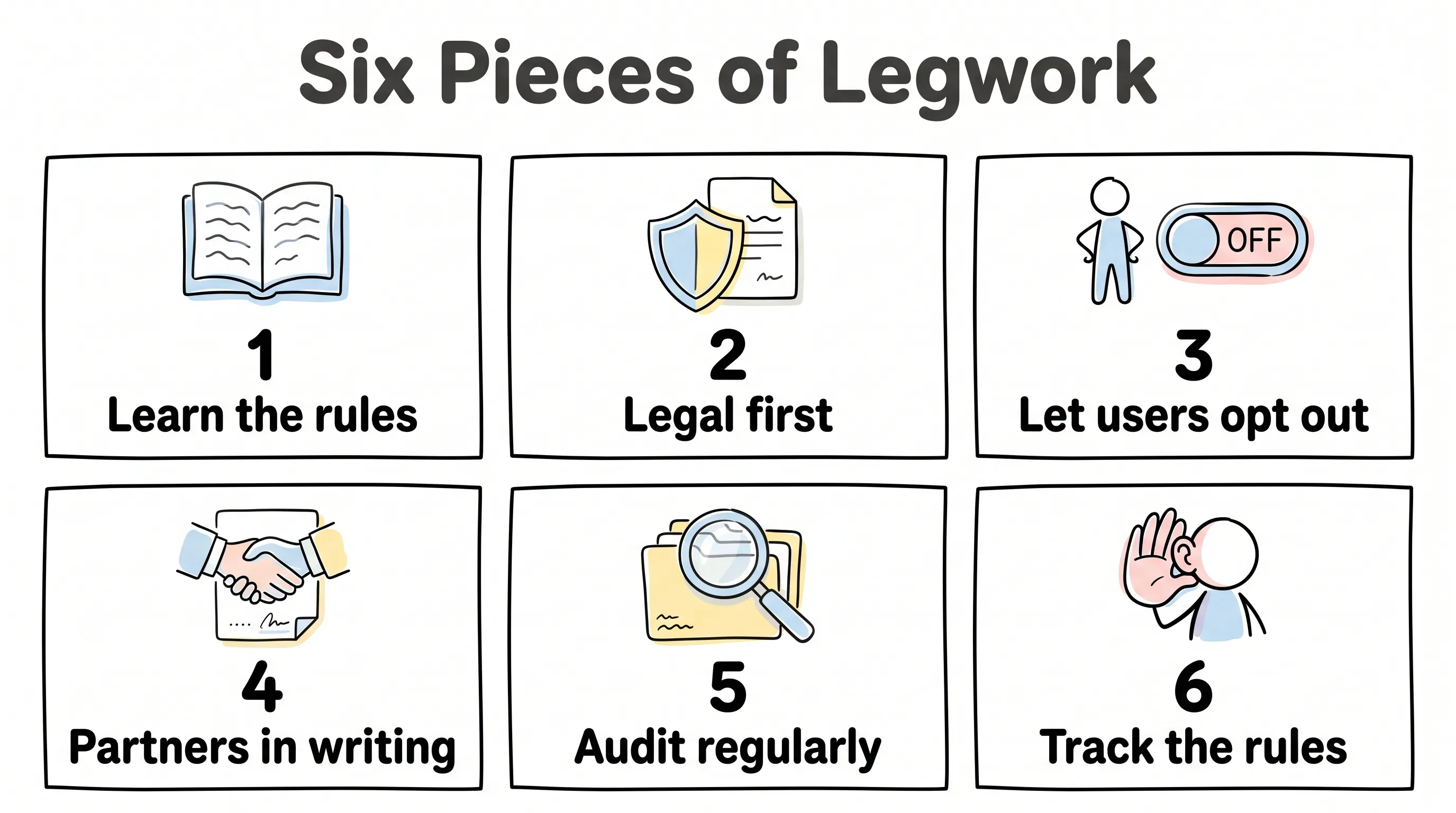
None of these six is a clever hack. All of them are unglamorous legwork.
But that's how business works: cleverness decides how fast you run; legwork decides how long.
Back to That Dinner
In 2023, OpenAI's CEO walked into the US Congress in person and volunteered to the government: come regulate us.
Good grief! The people building the engine are asking for the brakes themselves.
Sit with that a second. Even the people who understand this technology best know that the steering wheel of such a force can't be left to technological enthusiasm alone.
So what happened to my friend in the end? He didn't blow up the relationship with the agency. He added a page of "AI Usage Terms" to every partner agreement: AI may be used; customer data is off-limits; before anything goes out, a human must review the facts.
These days, he sleeps just fine.
The efficiency AI brings to marketing is real. So is the bill hiding behind that efficiency.
Read the bill before you hit the gas — only then can you run fast and last long.
Here's wishing you every bit of AI's dividend — and never once having to clean up its mess.
Continue reading
Related articles

Cross-Border Business: Time to Upgrade Your AI Toolbox
A learn article explaining how AI tools help cross-border e-commerce sellers clear five hurdles: language, regulation, logistics, payments, and fraud. It outlines a five-compartment toolbox, a five-step adoption path, and metrics such as conversion rate and CLV, while cautioning against over-reliance on AI.

AI Is Taking Over the Dirty Work of Social Media Marketing, One Task at a Time
This learn article outlines four social media marketing tasks AI can handle — audience analytics, content drafting and design, ad targeting and creative testing, and spam moderation — and cautions that taste, judgment, and data security remain human responsibilities.

AI Is Already This Good — Why Is Your Social Media Marketing Still Pure Manpower?
An overview of 18 AI tools for social media marketing, organized into six categories covering audience research, content creation, scheduling, comment and DM handling, ad management, and visual production, plus notes on personalization, prediction, and emerging trends.