
Before You Buy a B2B Marketing Automation Platform, Run the Numbers — All Five of Them
A bilingual guide that walks B2B buyers through five checks before choosing a marketing automation platform, covering lead scoring approaches, ABM fit, attribution and finance alignment, implementation timelines and first-year costs, plus AI search visibility and AI citation rate.
A few days ago, a friend of mine who runs a B2B SaaS company invited me to dinner. Halfway through the meal, he pulled out his phone to show me: his company needed to choose a marketing automation platform, and the shortlist ran seven or eight vendors deep — HubSpot, Marketo Engage, Pardot... Every one of their websites promised "AI-powered," "omnichannel," "intelligent growth."
He asked me: which one should I pick?
I said: put the phone away first. This isn't a "which one" question. It's an accounting problem.
Choosing a platform isn't picking flowers. It's settling accounts.
At that dinner table, I ran five accounts for him. Today, I'll run the same five for you.
The First Account: Before You Trust a Score, Ask How It's Made
What is lead scoring?
A lead comes in, the system scores it, and tells sales: talk to this one first.
Sounds simple. But there's one thing you need to figure out first: how is that score actually produced?
The old way: rule-based. You configure rules by hand in the back end — the prospect opened the pricing page, add 10 points; the job title is VP, add 20 points. The logic is fully transparent, and you can tune it however you like.
The new way: AI predictive. The machine learns on its own, blending the lead's engagement behavior, identity data, and buying intent into a single conversion probability. 6sense analyzes buyer behavior signals to predict which account is about to place an order; Salesforce's Einstein uses the historical data in your CRM to score and rank leads.
Which is better? My call: rule-based gives you a sense of control; AI gives you accuracy. Rich data, plenty of signals — go AI. Data still thin — stick with honest, rule-based scoring.
But what matters more than scoring is the next link in the chain — closed-loop attribution. In plain terms: can you account for how much real revenue marketing actually brought in?
Guess how long that takes?
Established platforms like HubSpot, Marketo Engage, and Pardot need 60 to 120 days from launch before they can produce credible closed-loop revenue attribution.
Why so slow? Because there's a pile of dirty work in front of it: the data in your CRM has to be cleaned, and the scope of integrations has to be defined. Dirty data is one of the top killers of automation projects — one industry statistic ties 42% of failed projects to it. If your data is really dirty, add another 2 to 4 weeks of cleanup.
Plenty of buyers stumble right here: they assume go-live means instant results — then two quarters pass, and they still can't produce a single pipeline-contribution report their CFO would accept.
Going live isn't the finish line. Clean data is the starting line.
The Second Account: Do You Need ABM? Check Your Annual Revenue First
What is ABM?
Account-based marketing. Don't cast a wide net for small fish — drop a single, precise line at the big ones.
Is this capability expensive? It depends.
If your annual revenue is under $5 million, hear me out: don't buy a dedicated ABM platform. Why? The math makes it obvious.
Take 6sense: plans start at $5,000 a month, which is $60,000-plus a year. For that money to be worth it, you need three things: a clearly defined list of ideal customers, a sales team that can act on intent signals the moment they arrive, and a deal size big enough to justify it. All three present, the spend works. Missing one, and you're just paying for vanity.
How do mid-size teams usually solve it? With the add-on modules the platform already ships. HubSpot's ABM tools, for instance, can do account-level scoring and company-level targeting without signing a separate intent-data contract. It's lighter, but for most mid-size teams, it's enough.
Then when do you bring in the heavy artillery? When three conditions stack up: your CRM is Salesforce, your deal size is big enough to cover the intent-data investment, and your sales process is mature enough to act on signals immediately. That's when you look at an AI-native ABM platform like 6sense — identifying which anonymous visits belong to which accounts, supplying intent data, and coordinating LinkedIn and Google ad campaigns — plugged in as a data layer on top of Salesforce, HubSpot, or Marketo.
One warning, though: no matter how much you spend on the platform, if sales can't act on the signal, everything is zero. The intent signal says "this account is looking at competitors." If sales follows up two weeks later, the fish has long since swum away.
The Third Account: Will Finance Sign Off on Your Attribution Model?
This is the area where marketing automation platforms get hyped the loudest and deliver the worst.
Here's a number: 67% of B2B marketing teams, to this day, still use "last touch" for attribution.
What does that mean? A customer goes from hearing a podcast, to joining a Slack community, to DMing a friend about you, to finally filling out a form — months and a dozen-plus touchpoints in between. Last-touch attribution only sees that final touch; every undercurrent before it counts as zero.
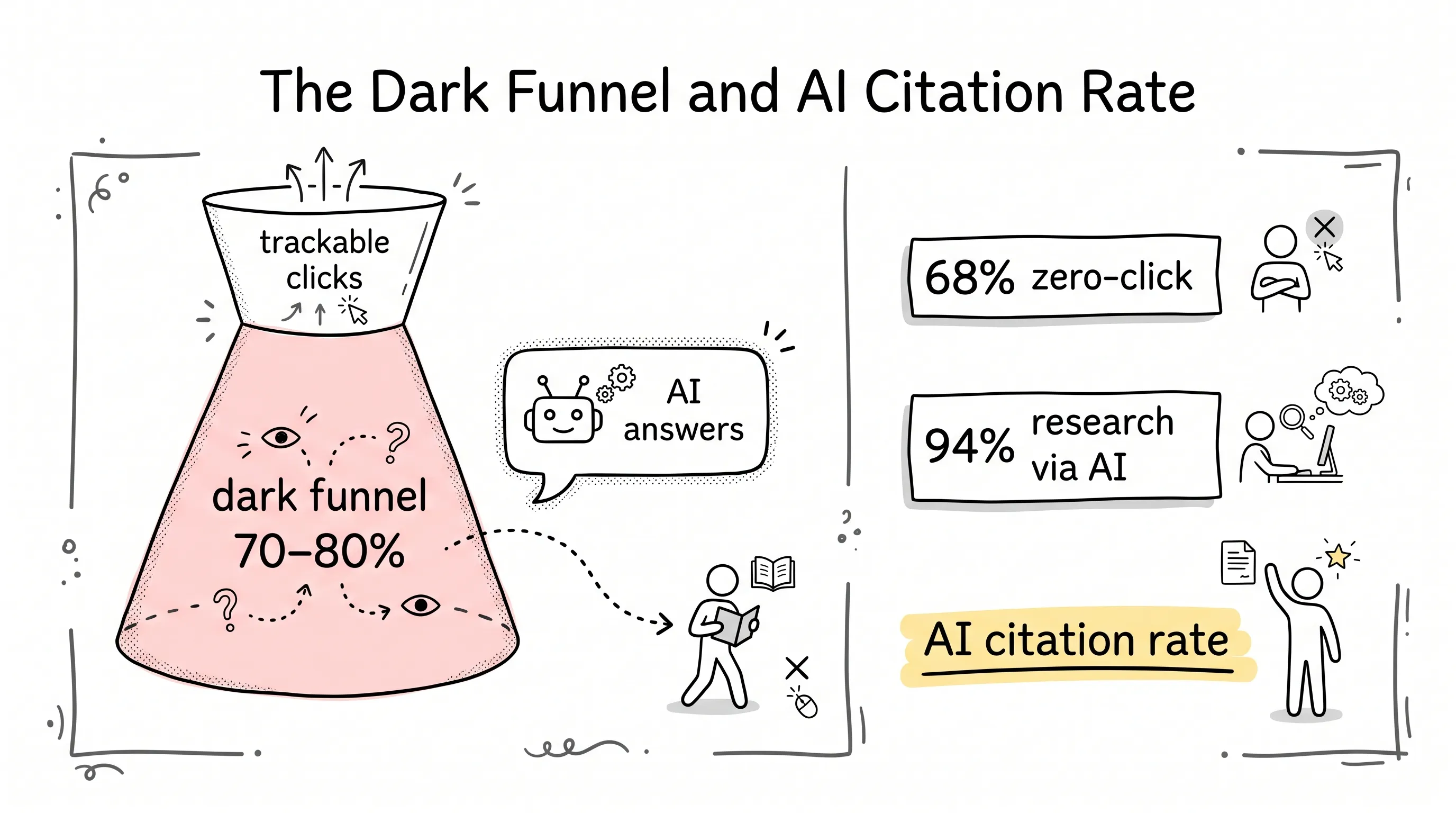
This is the so-called dark funnel. The common industry read is that 70% to 80% of the B2B buying journey happens in channels that can't produce a trackable click at all: podcasts, private communities, one-on-one DMs. A customer tells you outright, "that podcast influenced my decision" — and your attribution tool still can't connect it to a single dollar of revenue.
Worse, AI just added another layer to the dark funnel. A 2025 survey found that 94% of B2B buyers had used large language models to research purchases. Here's the problem: the buyer asks a round of questions in an AI conversation, never clicks a link, and when they finally land on your website, the analytics tool logs them as "direct traffic."
Which means: content just did you a huge favor inside AI answers, and your reports show you did nothing at all.
What do you do? Here's an old-fashioned trick — unfashionable, but it works like a charm: before go-live, reconcile your marketing data against your finance data.
One marketing agency, The Starr Conspiracy, has a hard rule: a new platform's attribution model must be checked against finance's revenue-recognition figures, and only when the deviation is within 5% is it allowed to run formal campaigns.
Plenty of buyers skip this step, and only after launch discover their reports can't get past the CFO and the board. This is also one of the top reasons platforms get replaced.
The Fourth Account: Implementation Timeline, and What Year One Really Costs
Timeline first.
Mid-size company, CRM already in place, sales process running, list reasonably clean: 8 to 12 weeks to go live, including auditing and modeling, building and testing, and embedding at launch.
Rolling out Marketing Cloud Account Engagement (Salesforce's marketing automation product, formerly Pardot) in the Salesforce ecosystem takes 16 to 24 weeks.
And enterprise grade? Multiple regions, multiple product lines, running Marketo or Eloqua — the median, 18 months. Selection, procurement, data migration, training and optimization, all counted.
Eighteen months. Can your market afford to wait that long?
Now the money. Here's a blind spot nearly every buyer has:
License fees are only about one third of first-year total cost.
The common industry guidance is to budget 2 to 3 times the license fee for year one: implementation services, training, integration development, content migration — all of it in there.
An example. A mid-size buyer picks HubSpot Marketing Hub Professional plus Sales Hub Professional. The licenses are cheap, but implementation services cost extra, and an agency's annual retainer hangs off the back end. Marketo Engage? The floor price is high to begin with — add implementation and a certified Marketo administrator on top, and for comparable capability, total cost usually runs 2 to 3 times HubSpot's.
And there's one line item that's easiest to miss: integrations.
For many enterprise projects, connecting the CRM alone isn't enough — you also have to connect the data warehouse, BI tools, event platforms, and product analytics systems. Every additional custom integration adds development time and a long-term maintenance burden. Teams that wrote only licenses and standard CRM connectors into their business case all discover, by the end of year one, that the real cost runs a fair bit higher than the number on the spreadsheet.
That's why so many platforms on the market get replaced within 24 months of going live. It's not that the platforms are bad; it's that the original math was never done in full.
The Fifth Account: The One Everyone Misses — AI Search
The first four accounts are about the platform itself. The fifth sits outside the platform — but you have to run it now.
Start with a few numbers.
In the first four months of 2026, 68% of Google searches in the US were zero-click — users found the answer on the results page without clicking a single link. Google's AI Overviews, by mid-2026, had appeared in 43% of search results. A year earlier, that figure was 15%.
What does that mean?
It means your buyers, before they ever open your website, have already finished drawing up the shortlist inside chat windows like ChatGPT, Perplexity, and Google AI Mode.
Which gives us a new metric every marketer should start watching: AI citation rate. The odds that your brand shows up in an AI answer.
Two things make it painful.
First, no marketing automation platform natively produces or measures this metric. The AI-visibility monitoring tools on the market can tell you "you didn't appear in ChatGPT's answer," but monitoring is not production. It only reports your absence; it won't write the content that gets you cited.
Second, the traffic AI sends you is invisible in your reports. As covered earlier, AI research shows up as "direct traffic." Yet in that 2025 survey, only 16% of brands were systematically tracking their AI search performance. And here's the interesting part: AI-referred sessions often convert into sales leads at a higher rate than paid social or organic search — those buyers have done their homework and already reached the second half of the evaluation.
So how do you raise your AI citation rate? Research from Princeton University and the Indian Institute of Technology Delhi has pointed in one direction: structured content, with entity relationships and verified primary sources, can lift visibility in generative engines by as much as 40%.
Some players are already filling this gap. A company called AI Growth Agent, for example, builds content engines: it helps brands map out the full set of "what will buyers ask," then produces articles with schema and source verification — content AI is willing to cite. By their own published figures, clients average 12,000-plus additional AI citations and mentions, 100,000-plus crawler visits, and a 20%-plus lift in exposure in the first twelve weeks. Take the numbers with a grain of salt if you like — but remember the direction: the battle for AI citations is won by content production, not by monitoring dashboards.
A Word at the End
Back to my friend at the beginning.
After the five accounts were settled that day, he asked: so which one do I actually pick?
I said: match the platform to your size first. Under $5 million in annual revenue — HubSpot's Starter or Professional, one system running everything end to end, don't overengineer. $5 million to $100 million with Salesforce as your CRM — pick Pardot or HubSpot, depending on whether you want to swap out the CRM while you're at it. Enterprises with multiple business lines, complex scoring, an Adobe tech stack — look hard at Marketo Engage. The Starr Conspiracy once weighted the criteria for enterprise buyers: CRM integration depth 25%, reporting attribution 20%, ABM support 15%, three-year total cost 15%. Notice what ranks first.
But as we were parting, I told him something more important:
Choosing a platform is a procurement decision — it answers "how do we run operations." AI visibility is a narrative decision — it decides "can buyers find you." These two questions run in parallel; solving one does nothing for the other.
And the second question? The AI models are buzzing in first. The moment your buyer asks the next question, whether the answer contains you — the model has already decided.
This is my read. It may not be right. But if you happen to be picking a platform this year too: run the five numbers first. Buy second.
May the platform you choose be worthy of your budget — and may your brand show up in the answer to your buyer's next conversation.
Continue reading
Related articles

Cross-Border Business: Time to Upgrade Your AI Toolbox
A learn article explaining how AI tools help cross-border e-commerce sellers clear five hurdles: language, regulation, logistics, payments, and fraud. It outlines a five-compartment toolbox, a five-step adoption path, and metrics such as conversion rate and CLV, while cautioning against over-reliance on AI.

AI Is Taking Over the Dirty Work of Social Media Marketing, One Task at a Time
This learn article outlines four social media marketing tasks AI can handle — audience analytics, content drafting and design, ad targeting and creative testing, and spam moderation — and cautions that taste, judgment, and data security remain human responsibilities.

AI Is Already This Good — Why Is Your Social Media Marketing Still Pure Manpower?
An overview of 18 AI tools for social media marketing, organized into six categories covering audience research, content creation, scheduling, comment and DM handling, ad management, and visual production, plus notes on personalization, prediction, and emerging trends.