
Before You Buy a B2B Marketing Automation Platform, Answer These Three Questions
A guide to choosing a B2B marketing automation platform built around three questions: company size, CRM ecosystem, and staffing. It compares HubSpot, ActiveCampaign, Pardot, Marketo, Salesforce Marketing Cloud, Klaviyo, Braze, and Abmatic AI, with pre-purchase and post-launch checklists.
A while back, an old friend of mine who works in enterprise software invited me to dinner.
His company has about eighty people, and business is good. Last year they bit the bullet and bought a marketing automation platform — high five figures a year. I asked him how it was going.
He scratched his head: "The main thing we use it for... is blasting emails."
The food was excellent, but I left with mixed feelings. The money was spent; the automation never happened.
Ever since that dinner, one question has been on my mind: with so many platforms on the market — from HubSpot to Marketo, from Pardot to ActiveCampaign — how do you actually choose?
Today I'm laying it all out for you.
First, Get Clear on What These Tools Actually Do for You
What is marketing automation, exactly?
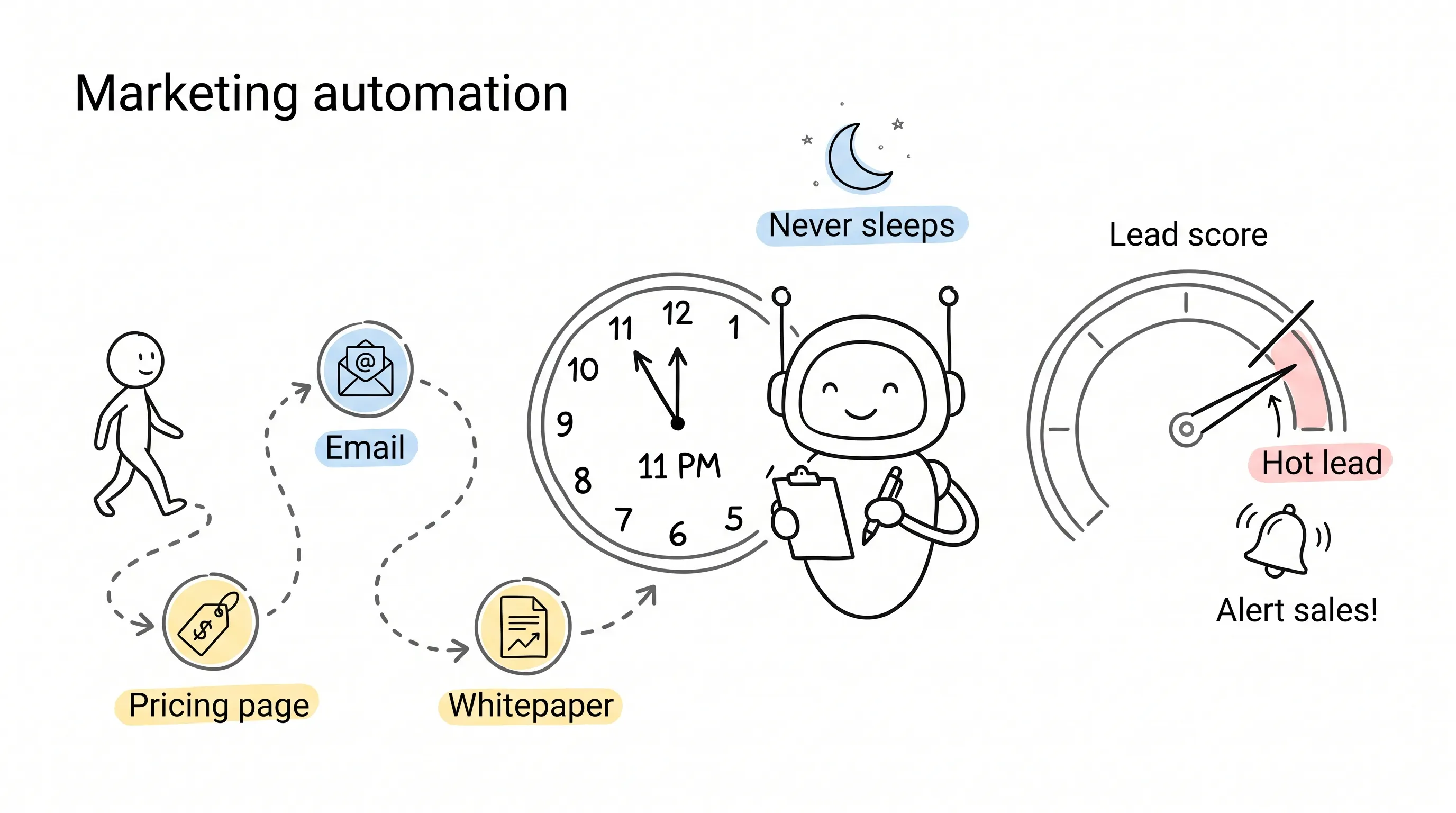
Put simply: you hire your marketing team an assistant who never sleeps.
Think about it. A prospect opens your pricing page at eleven at night. The next morning, they open a case-study email. The day after that, they download your whitepaper.
Your assistant logs all three, and racks up points for this person. Once the score crosses the threshold, sales gets an automatic alert: this one's a hot lead — go work it.
That's marketing automation.
Break it down, and it does six things:
- Nurture leads. Based on each person's behavior and profile, it sends the right content to the right person at the right time, warming prospects up along the way.
- Score them. What they viewed, what they did, how big their company is — it all turns into points. Only the high scorers get handed to sales.
- Orchestrate campaigns. Email, display ads, social media — several fronts firing at once, and in tight formation.
- Run ABM (account-based marketing). Anyone in enterprise sales knows: rather than casting a wide net, you circle your target accounts and go deep on them. Account-level scoring, targeted ads — the tool orchestrates it for you.
- Connect your systems. CRM, analytics, ad platforms — it has to plug into all of them.
- Do the math. How many opportunities and how much revenue did marketing's spend actually bring in? Reporting and attribution should give you the answer.
One more thing that's easy to overlook: compliance. Regulations like GDPR and CCPA, security certifications like SOC 2 — if you do B2B business overseas, you can't dodge a single one.
Every vendor's capability list looks roughly the same. What really separates them comes down to the next three questions.
Question 1: How Big Is Your Operation
Before you pick a platform, don't look at the feature grid yet. The first thing to look at is your company's size.
Small companies, under 50 people. Your marketing team is two or three people, nobody has time to babysit a system, and what you need is something that works out of the box. HubSpot's Marketing Hub, or ActiveCampaign — either path works, and a small team can get it running on their own.
Mid-size companies, 50 to 500 people. Those same two are still the mainstream picks; if you run deep on Salesforce CRM, pull Pardot in for comparison. A word of caution: platforms like HubSpot climb the pricing ladder as you add feature modules and contacts — run the numbers before you renew.
Large enterprises, 500-plus people, go for the heavyweights: Marketo, Salesforce Marketing Cloud, and — if you're on Salesforce — Pardot. But there's a precondition: you have to be able to afford dedicated people to run it. More on that shortly.
That's right: size sets the tier. A small company driving a heavy tank is asking for punishment; a large enterprise taking a toy gun to battle is gambling with the business.
Question 2: Whose Ecosystem Are You Tied To
When buying a marketing tool, why ask what CRM you use? It has everything to do with it.
If your company is deeply bound to Salesforce, Pardot is almost the natural answer. It grew up inside the Salesforce ecosystem: email automation, scoring, forms, ABM — everything plugs in. It walks the line between power and usability nicely, and when your company outgrows it, the upgrade path is clear.
Salesforce Marketing Cloud works the same way. It's built directly on the Salesforce platform, and Journey Builder — its visual workflow designer — is genuinely beautiful. Reporting and dashboards are strengths too.
But — note this but.
Once these two leave Salesforce territory, they can barely flex. If your CRM is anyone else's, don't even look at them. HubSpot, ActiveCampaign, Klaviyo — any one of them beats a forced fit.
Marketo, on the other hand, is the exception. Adobe owns it, yet it doesn't care which CRM you run, it meshes tightly with Adobe Experience Cloud, and its APIs are rock-solid — customize it any way you like.
Question 3: Can You Afford to Keep a Driver
However good the car, someone still has to know how to drive it.
Marketo is the most feature-complete and flexible platform on the market. Complex multi-channel campaigns, granular lead scoring, unlimited workflows — there's almost nothing it can't handle. That's its strength, and its barrier: a steep learning curve, and implementation that's slow and expensive.
In one sentence: if you don't have at least two dedicated marketing operations specialists on staff, don't touch it. And here's the kicker: the combined salary of two senior marketing ops specialists may well be higher than the software bill.
So the real multiple-choice question for large enterprises is this: either pay to staff up and go heavy, or step down a tier and pick something easier to drive.
While we're here, three crossover players.
Klaviyo comes from e-commerce. Behavioral segmentation and personalized email are a genuine forte, and its reporting is clean. It's now pushing into B2B, playing catch-up on CRM capabilities and automation breadth. But B2B sales cycles are long and buying committees are complex — it's not quite a fit yet, and its integration ecosystem runs a size smaller than HubSpot's or Salesforce's.
Braze builds customer engagement. Email, app push, web, ads — its multi-channel journey orchestration is top-tier, personalization is beautiful, and its APIs are strong, which makes it a great fit for deep customization. That said, it shines at post-purchase customer engagement; pre-sale lead nurturing isn't its home turf. And to squeeze everything out of it, your technical and data foundations need to be built thick first.
Then there's a new species: Abmatic AI. AI-native, with a playbook completely different from its elders: it compresses a typical nine-piece ABM toolkit into a single system. Agentic workflows, agentic outreach, agentic sessions, de-anonymizing anonymous visitors into contacts and companies, website personalization, ad orchestration, first-party intent data — all handled from a single login. Pricing starts at $36,000 a year, aimed at mid-size and larger teams. It's a newcomer with a young track record and ecosystem — but this one-system-does-the-work-of-nine playbook is worth watching.
Find Your Seat
Ask the three questions, and the answer mostly surfaces on its own.
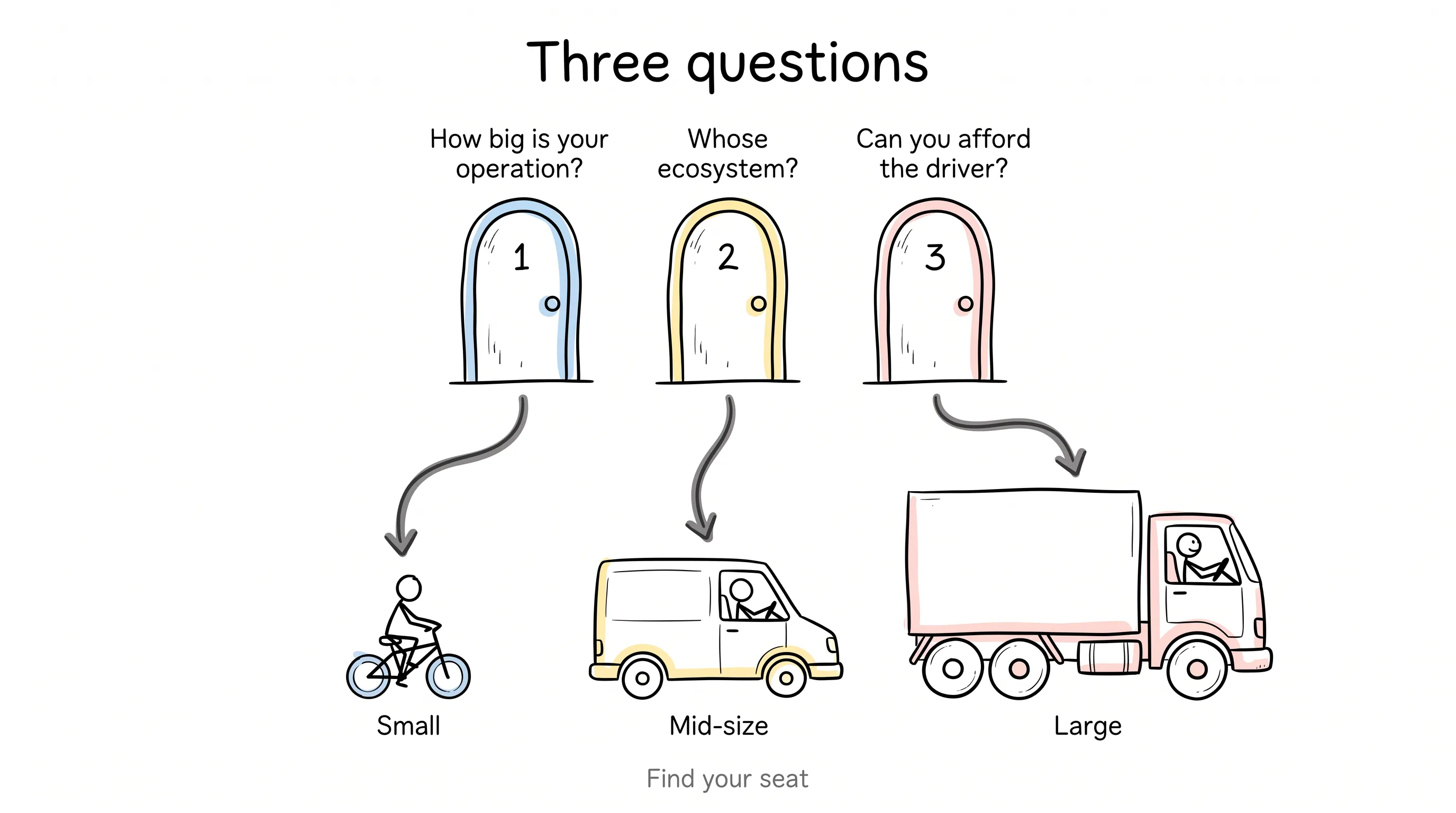
Small company: HubSpot or ActiveCampaign.
Mid-size: still those two; add Pardot if you're on Salesforce.
Large enterprise: Marketo, Salesforce Marketing Cloud, or Pardot.
Deeply bound to Salesforce: look at Pardot first; only when it truly can't keep up, move on to Marketo or Marketing Cloud.
Not on Salesforce: cross Pardot and Marketing Cloud off right away — don't torture yourself. HubSpot, ActiveCampaign, and Klaviyo are all good ways out.
Before You Sign, Do Five Things
First, clean your data. Garbage in, garbage out. If the contact data in your CRM is dirty and messy, automation will only help you produce garbage at scale. Before launch, scrub everything: duplicates, expired records, missing fields.
Second, audit your integrations. CRM, analytics tools, ad platforms, data warehouses — list every system you need to connect, and confirm each one with the platform. Don't discover the gaps after you've bought.
Third, weigh your workflows. A few simple nurture emails, or multi-touch campaigns with conditional branches? Your choice has to carry the complexity you'll grow into.
Fourth, take an honest look at your people. Does your team have the chops to run a complex system? If not, either pick something easy to use, or budget for implementation support up front.
Fifth, look three to five years out. Your company will grow and your needs will change. Pick one that can grow with you — don't get forced to move two years from now. Anyone who has been through a move knows exactly how that feels.
After Launch, Four Rules of Engagement
One: start simple. Don't try to automate everything on day one. Get your core email nurturing and scoring running first, then add complexity layer by layer.
Two: get sales using it. With automation, half the battle is won or lost on the sales side. They have to actually use the system, and come back and tell you whether lead quality holds up. With no feedback, the scoring model keeps guessing blind forever.
Three: watch the metrics, and test. Open rates, click rates, lead quality, conversion rates — review them one by one. Subject lines, copy, send times — A/B test them one by one. Let the data speak, not your gut.
Four: segment, don't blast. Throwing the same email at everyone is the same as not sending it. Segment by behavior, tier by account, and put the right content in front of the right people.
Finally
Back to that friend from the beginning. He never switched platforms — he just did two things: cleaned the data, and got sales using the system. Three months later, the first thing his salespeople did every morning at the office was open the system to check the hot leads that had surfaced that day.
Same system, two different worlds.
Tools are never a silver bullet. Automation is an amplifier: with a clear strategy, clean data, and sales and marketing pulling in the same direction, it amplifies growth; miss any of those, and it amplifies chaos.
Choosing a platform is, in the end, choosing a lever that matches your size, your ecosystem, and your team.
Here's wishing that the one you buy is a lever — not an ornament.
Continue reading
Related articles

Cross-Border Business: Time to Upgrade Your AI Toolbox
A learn article explaining how AI tools help cross-border e-commerce sellers clear five hurdles: language, regulation, logistics, payments, and fraud. It outlines a five-compartment toolbox, a five-step adoption path, and metrics such as conversion rate and CLV, while cautioning against over-reliance on AI.

AI Is Taking Over the Dirty Work of Social Media Marketing, One Task at a Time
This learn article outlines four social media marketing tasks AI can handle — audience analytics, content drafting and design, ad targeting and creative testing, and spam moderation — and cautions that taste, judgment, and data security remain human responsibilities.

AI Is Already This Good — Why Is Your Social Media Marketing Still Pure Manpower?
An overview of 18 AI tools for social media marketing, organized into six categories covering audience research, content creation, scheduling, comment and DM handling, ad management, and visual production, plus notes on personalization, prediction, and emerging trends.