
B2B Marketing Automation Is Shifting from Building Workflows to Deploying Agents
An analysis of how B2B marketing automation is shifting from pre-built workflows to goal-driven AI agents, comparing traditional platforms with AI-native alternatives and outlining steps for adopting automation channel by channel.
A while back, a friend of mine who runs an enterprise software company asked me out for coffee.
His company is around 200 people, selling classic B2B software: sales cycles running the better part of six months, average deal size of a few hundred thousand yuan, a few dozen new clients signed a year — and it does just fine for itself.
He sat down and, before saying a word about business, sighed.
"I've been hijacked by marketing tools. I keep buying more of them, hiring more people, everyone's busier — but if you ask me how many customers all this spending has brought in, I can't answer."
I told him plenty of B2B companies have run that same math. But over the past couple of years, the equation has changed. So today, let's get to the bottom of it.
What Is Marketing Automation?
What exactly is marketing automation?
In plain terms: hand all the repetitive chores in marketing over to software. A prospect opens an email, and three days later a follow-up goes out on its own. Someone fills in a form, sales gets notified automatically. Month's end, reports generate themselves.
The idea isn't new. Marketo, Pardot, and HubSpot spent the past decade perfecting it. That's exactly the kind of tool my friend bought.
But these platforms are products of a previous era. They were designed on an assumption: that you have a pile of emails to blast and a pile of leads to score against a rubric.
That assumption is collapsing.
Why the Old Automation Math Keeps Getting Worse
My friend's grievances boiled down to three words: expensive, rigid, scattered.
Start with expensive.
The expense isn't the subscription — it's getting the system up and running.
With a platform like Marketo, expect 3 to 6 months of configuration before you can use it properly, plus a dedicated marketing operations hire at $80,000 to $120,000 a year. The subscription isn't cheap either: the entry tier starts at $1,000 a month, and with every feature switched on it climbs toward $5,000.
For a B2B company with annual revenue under $50 million, that investment makes no sense however you run the numbers.
Then there's rigid.
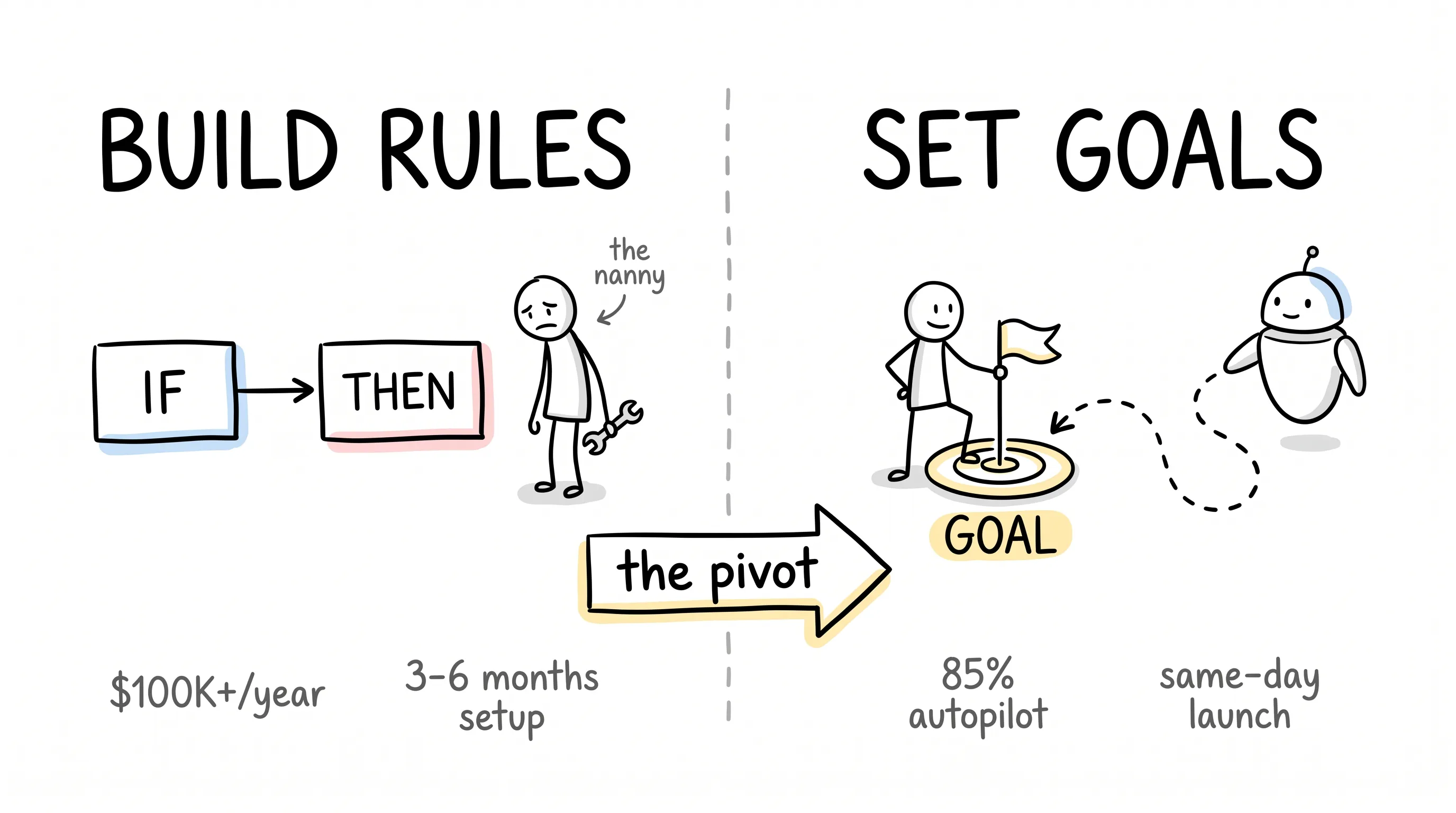
Traditional automation runs on if/then logic: every rule written in advance, hard-coded. When the market shifts, it doesn't. When campaign performance dips, someone has to sit down, diagnose the problem, rebuild the workflow, and redeploy it.
The human becomes the system's nanny.
Finally, scattered.
These platforms excel at email and landing pages. SEO? Weak. Content? Weak. Paid ads? Weak too. So B2B companies end up duct-taping four or five tools together, each minding its own silo, with data that never talks across tools.
More tools, busier people. That is the paradox of last-generation automation.
The Pivot: From Building Rules to Setting Goals
So what exactly does AI change when it walks in?
In one sentence: you used to build rules; now you set goals.
In the old workflow, you had to map out every path in advance. AI-native automation flips it: you supply the goal and the guardrails; it predicts which actions will produce revenue, then executes them directly.
Think about how big that difference is.
Nurturing leads no longer means emailing on a fixed schedule. It means watching what the prospect actually does — how many pages of your site they've read through, whether they've studied the pricing page — and then deciding whether and how to follow up.
Producing content no longer means marching through a quarterly editorial calendar. It means following real-time search demand: whatever people are searching for right now, that's what gets made.
Running Google Ads no longer means a weekly review meeting. Bids, audiences, creative — adjusted every single day.
Doing SEO no longer means waiting for the annual audit. The moment an opportunity pops up, you grab it.
For the first time, marketing automation has gone from "you write the script and it performs" to "you set the target and it finds the way."
This isn't a tune-up. It's a new engine.
Three Calculations I Re-ran for My Friend
That day over coffee, we ran three calculations on the spot.
First, the all-in cost of the old route.
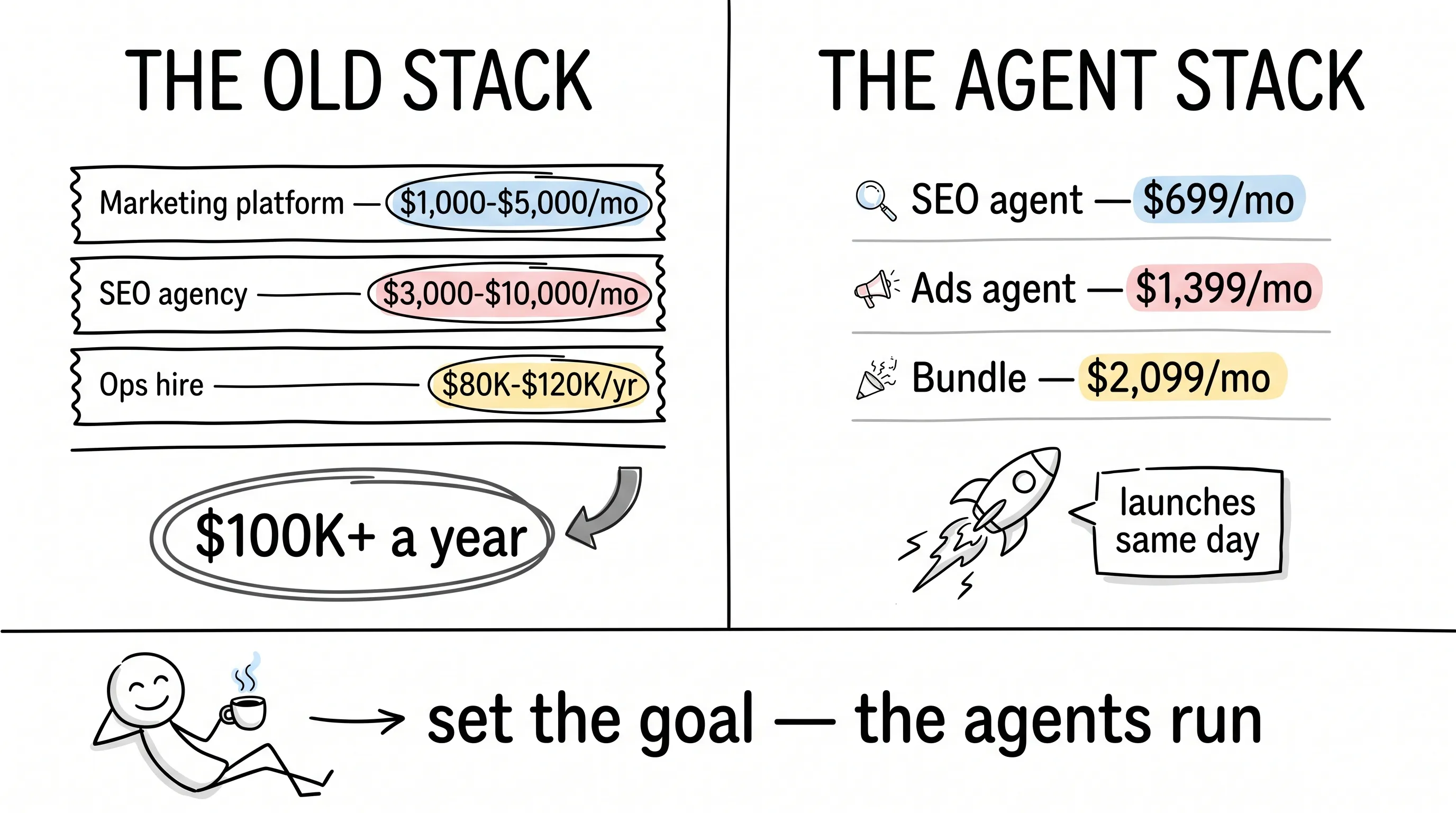
A mid-size B2B company: Marketo subscription, $1,000 to $5,000 a month; an outsourced SEO agency, $3,000 to $10,000 a month; plus a dedicated marketing ops hire to service the system, $80,000 to $120,000 a year. Add it up and you're past $100,000 a year, minimum. And that's before you count the ad spend itself.
Now the new route.
Take an AI-native platform like MEGA: the SEO agent is $699 a month, the ads agent $1,399, both together $2,099 as a bundle. Time to launch? Same day.
Read that again.
Finally, the "people" math.
Marketo demands a dedicated administrator. HubSpot's Professional tier, at $890 a month, is far friendlier — but someone still has to manage campaigns by hand. Agents like MEGA, by the company's own account, run 85% on autopilot; humans handle the remaining 15%: set the direction, guard the quality.
Agents, of course, aren't magic. They can't set your strategy, and they can't understand your customers for you. But at the execution layer, they have essentially taken over the business of "servicing the tools."
So Are Marketo and HubSpot Still Worth Buying?
Let's be clear up front: Marketo, Pardot, and HubSpot are all good products.
Marketo is Adobe's, an enterprise standard with deep Salesforce integration. Big companies can afford it, and can afford the dedicated team to run it. Pardot — now called MCAE (Marketing Cloud Account Engagement) — was always the path-of-least-resistance choice for enterprises already living inside the Salesforce ecosystem. If you already live in Salesforce, why move out?
HubSpot is the friendliest to mid-size companies: free CRM to start, Pro tier at $890 a month, features that hold up fine.
But you need to see what they fundamentally are:
What Marketo and HubSpot sell you is a fully fitted kitchen. Pots, pans, everything's there — but you still have to hire the chef, buy the groceries, and work the stove.
What AI agents like MEGA hand you is the finished dish. All you do is taste and season.
So there's only one criterion for choosing: look at your team.
With a marketing team of five or more, someone dedicated to marketing ops, the kitchen is an asset. If you have a single marketing lead and expect SEO and paid ads to fire on both fronts at once, letting agents do the work directly is probably the smarter call.
If It Were You, Where Would You Start?
At the end, my friend asked me: OK, I want to act. Where do I start?
I said: four steps. One at a time, and don't skip.
Step one: take inventory.
List every cent you spend on marketing: CRM, email tools, SEO tools, ad platforms, analytics, plus the headcount allocated to marketing ops. Almost every company gets a shock when they finish: the money is scattered across a pile of tools that don't talk to each other, and the biggest time hogs turn out to be the pure manual work — content, reports, and campaign management.
While you're at it, sketch a map: from a customer's first contact to the final close, where do they leak out? The worst leak is exactly where automation is worth the most.
Step two: rank channels by their contribution to revenue.
Not all channels deserve equal treatment.
SEO and content are compounding. Slow — 3 to 6 months before results show — but worth more the further you go. What they demand most is an early start. Start a month late, and what you lose isn't that month. It's all the compounding that would have grown out of it, forever.
Paid ads are cash flow. Spend this month, see leads this month — the right tool for propping up the pipeline first.
Email nurturing is a fundamentals play. But it feeds on two things: good content, and a lead list that keeps growing. Until both are in place, don't expect it to deliver.
Step three: turn on one channel at a time.
Don't automate everything on day one. Pick the one that hurts most: need leads urgently, automate ads first; playing the long game, start with SEO; sitting on a stockpile of mediocre old content, do content optimization first.
Once one channel produces results, expand sideways. That's the beauty of these platforms: add an agent, gain a channel — no need to tear down the whole stack and start over.
Step four: watch the right metrics.
The thing to fear in B2B marketing is vanity metrics. Follower counts, pageviews, click-through rates — all nice to look at, none of them cut you a paycheck. The five numbers that matter:
One, customer acquisition cost (CAC). Money spent, divided by qualified leads won.
Two, marketing-influenced pipeline. Of the deals that eventually close, how many did marketing touch and nurture? B2B cycles are long; this number is where the real skill shows.
Three, month-over-month growth in organic traffic. For a new SEO program, the healthy line is roughly 10% to 20% a month. Below it, either the method is wrong or the effort isn't enough.
Four, return on ad spend. For every dollar of ad spend, how many dollars of revenue come back?
Five, content velocity. How many pieces you publish a month, and how fast they get indexed and start ranking.
The Three Most Expensive Traps
Last, three traps — all paid for in hard cash.
Trap one: turning automation into "sending more email."
B2B buyers already live in a flood of automated email. If your strategy is "send one more," you're just another body in an already crowded room. Email deserves a seat, but don't bet all your chips on it. SEO, content, ads — they all need to be at the table.
Trap two: skipping SEO because it's "slow."
This may be the most expensive mistake in B2B marketing. SEO is compounding, and compounding's only cost is time. Companies that start late look back a year later and find the gap has already opened wide.
Trap three: choosing a platform by brand fame.
Marketo and HubSpot are the two biggest names in the room. But a famous name doesn't solve your problem; your team size and your budget do. A small company paying enterprise prices for an enterprise platform, then hiring someone full-time to service it — that trade loses money no matter how you run the numbers.
Oh, and half a trap more: not being able to state your return by channel. If you don't know how much revenue each channel brings, optimization is out of the question. Attribution, too, is a job to hand the tools — let them do it automatically.
Back to That Cup of Coffee
When the coffee was done, my friend went back and took inventory first: every line of tool and headcount spending, listed one by one. Then he re-prioritized SEO and ads. Then he started running SEO with AI agents.
Last month he messaged me: he's got a team of five, and for the first time, someone actually has the time to sit down with customers and hear what they need — instead of sitting in the backend tweaking automation workflows.
I was genuinely happy for him.
The whole point of better tools is to pull people out of the process, so they can do the things only people can do: understand customers, and tell your story well.
May your marketing team soon be free of "servicing the tools."
And may every one of your channels know exactly how much money it earns back.
Continue reading
Related articles

Cross-Border Business: Time to Upgrade Your AI Toolbox
A learn article explaining how AI tools help cross-border e-commerce sellers clear five hurdles: language, regulation, logistics, payments, and fraud. It outlines a five-compartment toolbox, a five-step adoption path, and metrics such as conversion rate and CLV, while cautioning against over-reliance on AI.

AI Is Taking Over the Dirty Work of Social Media Marketing, One Task at a Time
This learn article outlines four social media marketing tasks AI can handle — audience analytics, content drafting and design, ad targeting and creative testing, and spam moderation — and cautions that taste, judgment, and data security remain human responsibilities.

AI Is Already This Good — Why Is Your Social Media Marketing Still Pure Manpower?
An overview of 18 AI tools for social media marketing, organized into six categories covering audience research, content creation, scheduling, comment and DM handling, ad management, and visual production, plus notes on personalization, prediction, and emerging trends.