
Are Your Career Skills Rented — or Owned?
This learn article applies tech-stack design principles—replaceability, data ownership, and positive friction—to marketing careers, explaining antifragility, rented versus owned skills and influence, and five actions for staying resilient as AI agents take on configuration work.
A while back, I had dinner with a friend who has spent more than a decade in marketing technology.
Halfway through the meal, he sighed: his company had replaced the marketing cloud they'd used for eight years. Nobody asked him to sit in on the selection of the new platform. Ten years of journeys, audience segments, and reports built up inside the old platform — wiped out overnight.
The part that stung even more was what his boss added: from now on, for this kind of configuration work, let AI agents try first.
He asked me: "So what were those ten years of mine, then?"
I said, don't be too hard on yourself yet. I'd actually worked through this question a long time ago — let me walk you through it today.
First, a Counterintuitive Answer
When something like this happens, most people's first reaction is: fine, I'll just go learn another new tool.
Wrong.
Learning a new tool means betting your career security on the next platform all over again. Platforms get swapped, AI keeps evolving, and your anxiety doesn't shrink one bit — it just finds a new address.
Here's the interesting part. The antidote isn't in career-planning books. It's in something marketers touch every single day yet almost never think to apply to themselves — the tech stack.
What is a tech stack? It's a company's entire set of marketing systems — CRM, customer data platform (CDP), automation tools, analytics tools — the network they form when connected.
A well-designed tech stack doesn't fear change. Components can be swapped at any time, the data stays in your own hands, and the architecture grows stronger with every revision.
I've translated this design wisdom into career language — three principles in all. Before the three, one foundational concept first.
What Is "Antifragility"?
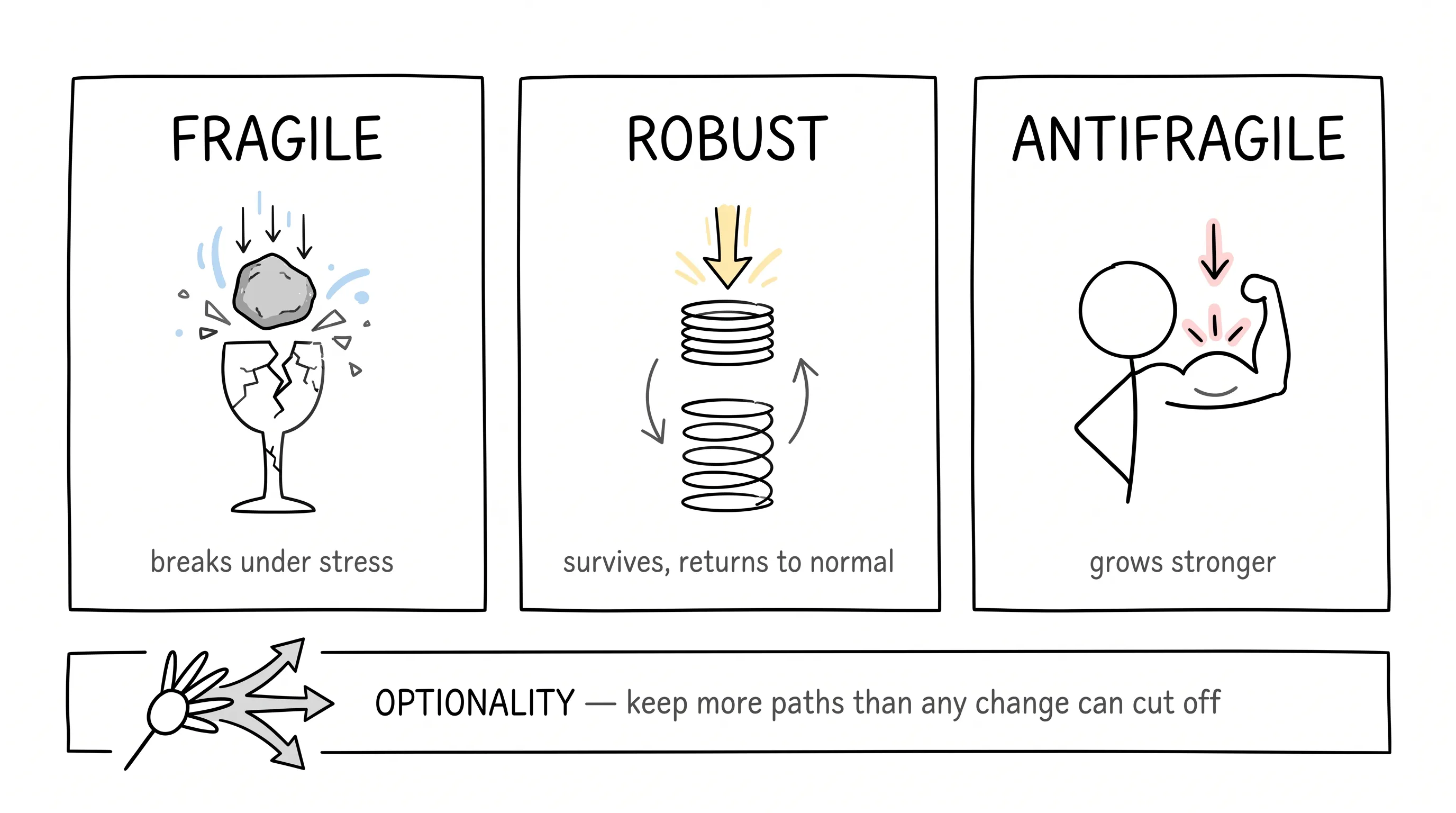
Nassim Taleb divides systems into three kinds.
The first is fragile. When stress arrives, it shatters. A tech stack deeply bound to one vendor collapses entirely the moment that vendor changes an interface.
The second is robust. It takes the hit, holds up, and returns to its original state. There are backups, contingency plans, and outages get repaired.
The third is antifragile. When stress arrives, not only does it not break — it gets stronger. Like a muscle: train it once, and it grows.
Honestly, the third kind is irresistible. Who wouldn't want a career like that — every time the industry has an earthquake, others take the damage and you get upgraded?
The key is the mechanism. The underlying mechanism of antifragility is what Taleb calls "optionality." Put plainly, you keep more paths in hand than any single change can cut off.
Applied to a career: every shake-up lets you walk away with a new capability. Because your foundation is something no single point of change can take from you.
That foundation rests on three pillars. Let's take them one at a time.
Pillar One: Can You Take Your Skills With You?
When evaluating marketing tools, what do insiders look at?
No exaggeration: replaceability should weigh more than the feature list. Are the interfaces open? Are the data formats standard? Can the data be moved out? Pass those three, and you can replace any component today with the system still running tomorrow. Flip it around, and no matter how complete the features, once you're locked in, the deeper you go, the more it hurts to leave.
Gartner has a prediction: organizations adopting composable architecture will ship new features 80% faster than their competitors. That effectively puts a price tag on "replaceability": 80%.
A marketer's capabilities split exactly the same way, into two kinds.
One kind is tied to a specific product. How to configure one vendor's journey builder, how to tune one vendor's audience tool, how to pull one vendor's reports. The moment the company switches platforms, those skills depreciate instantly.
The other kind describes the system itself. How should customer data be modeled? What decision logic still holds after switching platforms? How does user consent flow through the entire chain? That knowledge stays true no matter which vendor you're with.
Think about it: what have AI agents gotten better and better at over the past two years? Configuration, clicking buttons — execution-level work done at lightning speed. What they can't replace is the judgment behind the operations: what counts as a good result? Which data are we allowed to use? Which red lines can never be crossed?
That judgment lives at the system level, not inside any one tool.
So here's a test — the one I use myself when sizing up platforms: could you move this capability of yours to another vendor within one quarter?
If yes, congratulations — that capability will appreciate with every round of platform reshuffling.
If no, it most likely belongs to the vendor. You're only renting.
Pillar Two: Whose Servers Hold Your Influence?
The second design principle of a tech stack is data ownership.
When customer data sits in an ad platform's database and the platform changes its terms, all you can do is watch helplessly. When data lives in systems you control, you can invest in this channel today and that channel tomorrow, and a platform changing its mind is just a temporary headache.
The career version of first-party data is the influence you directly command.
Influence also comes in two kinds.
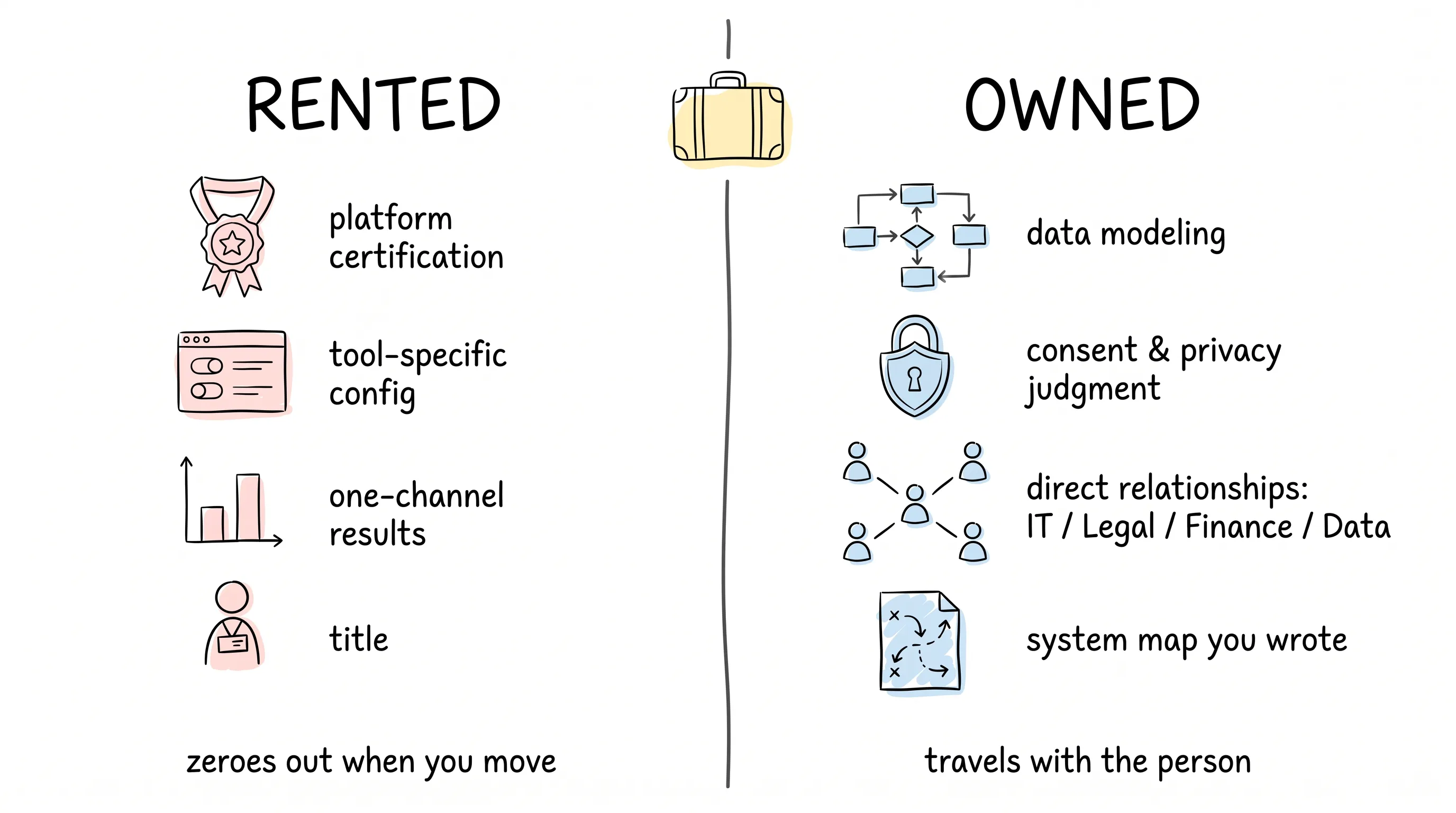
Rented: your position, your title, a platform certification, the boss who speaks for you in meeting rooms. The moment the position moves, it all zeroes out.
Owned: your direct relationships with IT, legal, finance, and the data team. No marketing system rollout can get around these four groups. Plus the shared language you've worn smooth with them, and the documents you've written that people consult every day.
The documentation deserves a word of its own. It is severely undervalued.
Across a marketing system — which systems store customer data, who connects to whom, where consent and identity flow — draw it as one diagram and write it down. Most teams never do.
Whoever holds that diagram becomes the reference point for every add-remove-replace decision. Vendor switch? You need to be in the room. Reorg? You need to be in the room. Because that diagram has nothing to do with reporting lines.
Rented influence zeroes out the day you resign. Owned influence travels with the person.
Pillar Three: Treat Constraints as Tonic
The third design principle I call "positive friction."
When a constraint arrives — new privacy rules, platform restrictions, budget cut in half — human instinct is to route around it.
But think back: has privacy regulation actually destroyed anyone? No. It simply split companies into two kinds: those who genuinely understand customers, and those who only know how to track customers. The gap was always there; the regulation only made it visible.
Constraints don't create weaknesses. Constraints expose weaknesses.
The same goes for people. Every organization-level constraint is a pop quiz for every marketer inside it. The hottest exam paper right now is the "AI for everyone" mandate that management is handing down everywhere.
Once they've got the exam, one kind of person waits for vendors to publish tutorials explaining what this mandate actually means.
The other kind takes it apart themselves, in five steps:
- What exactly can no longer be done, from this point on?
- Of the practices now banned, which should have been thrown out long ago?
- What is it forcing the team to prioritize?
- Whoever adapts first — what do they walk away with?
- Does it point toward a more sustainable way of working, even after this wave passes?
The person who has cracked that AI mandate wide open — the next time the organization hits a constraint, who does the boss look for first?
Constraints hit everyone equally hard, but only those who step onto the field early get to walk away with new capabilities.
This Quarter, Do Five Things
Enough theory — here come the actions. Each one applies one of the principles above back onto yourself.
First, run the replaceability test on yourself. List the capabilities currently propping up your position, and label each one: portable, or vendor-bound. Then throw all your hours at the portable column.
Second, copy how smart teams allocate time. Marketing teams that run ahead of change set aside 5% to 10% of employees' time for what's important but not yet urgent. Do the same for yourself. Invest in what? Data modeling, consent and privacy architecture, and judging whether an AI output can be taken straight into execution. These three are valuable at any company.
Third, if nobody has written the system map, you write it. A few weeks of effort, not a cent of budget, no approval from anyone. Once it's done, every discussion of "build it or not, swap it or not" has a seat for you at the table.
Fourth, place a small bet. Taleb's barbell strategy: the big chunk sits on what holds value in almost any future; the small chunk bets on a big win in one specific future. Your big chunk is those portable capabilities above. Your small bet might be personally building an end-to-end workflow with AI agents, with your own acceptance criteria attached. By the time the organization actually demands this, you'll already have hands-on experience.
Fifth, detox. Taleb calls this "via negativa": proactively cut the dependencies that would fail across multiple futures. Four addictions are especially common:
- Treating one vendor's certification as the center of your professional identity;
- Treating results in a single channel as your entire track record;
- Treating the platform's attribution data as the only evidence your work works;
- Treating annual planning as the only moment for retrospective learning.
One more, to close: the next time a constraint comes crashing down — new privacy rules, a budget review, an AI mandate — don't wait to be assigned. Raise your hand and host the retrospective. The retrospective is where capability grows. Whoever hosts it, benefits.
Change Is the Thing That Never Changes
That friend from the beginning of this article — what happened to him?
He spent one quarter turning the new platform's selection process into a system map for the whole company. Now, every meeting that touches data or tools has a chair for him.
You see? The very same shock — he trained it into muscle.
The marketing organizations that will still be standing ten years from now are the systems that change has ground against — and only made stronger. Marketers are no different: the ones who profit from this great AI migration are people whose capabilities and relationships travel with them, and people who proactively run a retrospective every time a constraint appears.
None of this requires you to guess which platform wins, which regulation lands, or which model becomes king.
You use the tools every day, and you build the systems every day. Only, starting today, turn that craft on yourself.
Here's to never fearing a platform switch again.
Continue reading
Related articles

Cross-Border Business: Time to Upgrade Your AI Toolbox
A learn article explaining how AI tools help cross-border e-commerce sellers clear five hurdles: language, regulation, logistics, payments, and fraud. It outlines a five-compartment toolbox, a five-step adoption path, and metrics such as conversion rate and CLV, while cautioning against over-reliance on AI.

AI Is Taking Over the Dirty Work of Social Media Marketing, One Task at a Time
This learn article outlines four social media marketing tasks AI can handle — audience analytics, content drafting and design, ad targeting and creative testing, and spam moderation — and cautions that taste, judgment, and data security remain human responsibilities.

AI Is Already This Good — Why Is Your Social Media Marketing Still Pure Manpower?
An overview of 18 AI tools for social media marketing, organized into six categories covering audience research, content creation, scheduling, comment and DM handling, ad management, and visual production, plus notes on personalization, prediction, and emerging trends.