
Are You on AI's Recommendation List?
A learn article explaining how businesses can appear in AI recommendations, covering fan-out queries, originality and chunking filters, repeated citations, and technical checks like robots.txt and sitemaps.
A while back, I asked AI to plan a quick three-day getaway for me.
Around noon on the first day, it steered me into a beef noodle shop way off the beaten path. Not a chain. Plain decor. No decent sign above the door. But that bowl of noodles? Genuinely delicious.
On the way back, I kept turning it over in my head: how did this place make it onto AI's list? The owner probably couldn't even explain what AI is.
And yet his shop had already been recommended by AI to one traveler after another — people just like me.
Now flip it around. How many business owners spend every day obsessing over traffic and pouring money into ads, unaware of one thing: your customers, when they hit a problem now, often don't search anymore. They ask AI.
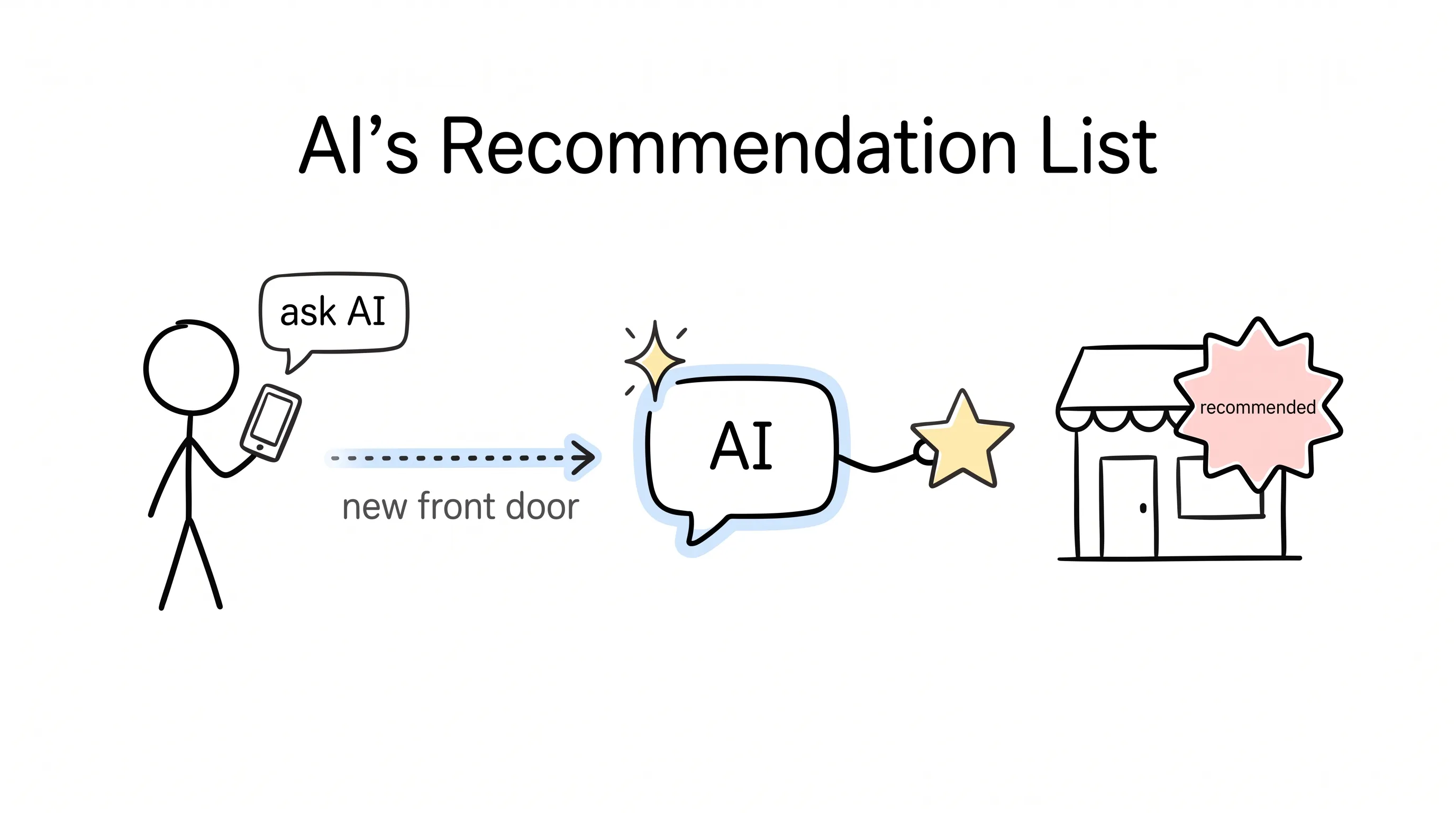
You ask AI, AI recommends. Whoever gets recommended gains a new front door for their business. If AI can't see you, you're invisible at that new front door.
I'm not making this up. Later on, I sat down with a friend who studies AI visibility, and he handed me a few numbers plus a playbook. Once I'd digested it, I knew I had to write this for you.
He led with a number: today, roughly 68% of Google searches end in zero clicks. Users get their answer right on the results page without visiting a single website.
Doing your homework used to mean opening 29 browser tabs in one go — checking attractions, comparing prices, combing through reviews, taking notes. Now you toss your request to ChatGPT, Claude, or Perplexity, and one conversation settles it.
AI has become "that friend who actually knows the scene" for a lot of people. Ask it to plan an itinerary, and it already knows you can't stand cilantro, how old your kids are, what your budget is. If it recommends a place, odds are you'll go.
My friend says it's a dead ringer for the Yellow Pages era. Back then, lots of companies named themselves "AAA Locksmith" just to land on the first page of the phone book. Then people stopped flipping through the Yellow Pages and switched to Google, and those companies had to relearn how to be found. Some figured it out and did just fine. Others clung to the old ways and disappeared.
Every time the gateway shifts, the deck gets reshuffled.
Now it's AI's turn. If you're not at the table, no one deals you in.
I've taken my friend's playbook, added my own interpretation, and shaped it into four questions. Answer them one at a time, and by the end, AI's recommendation list should have your name on it.
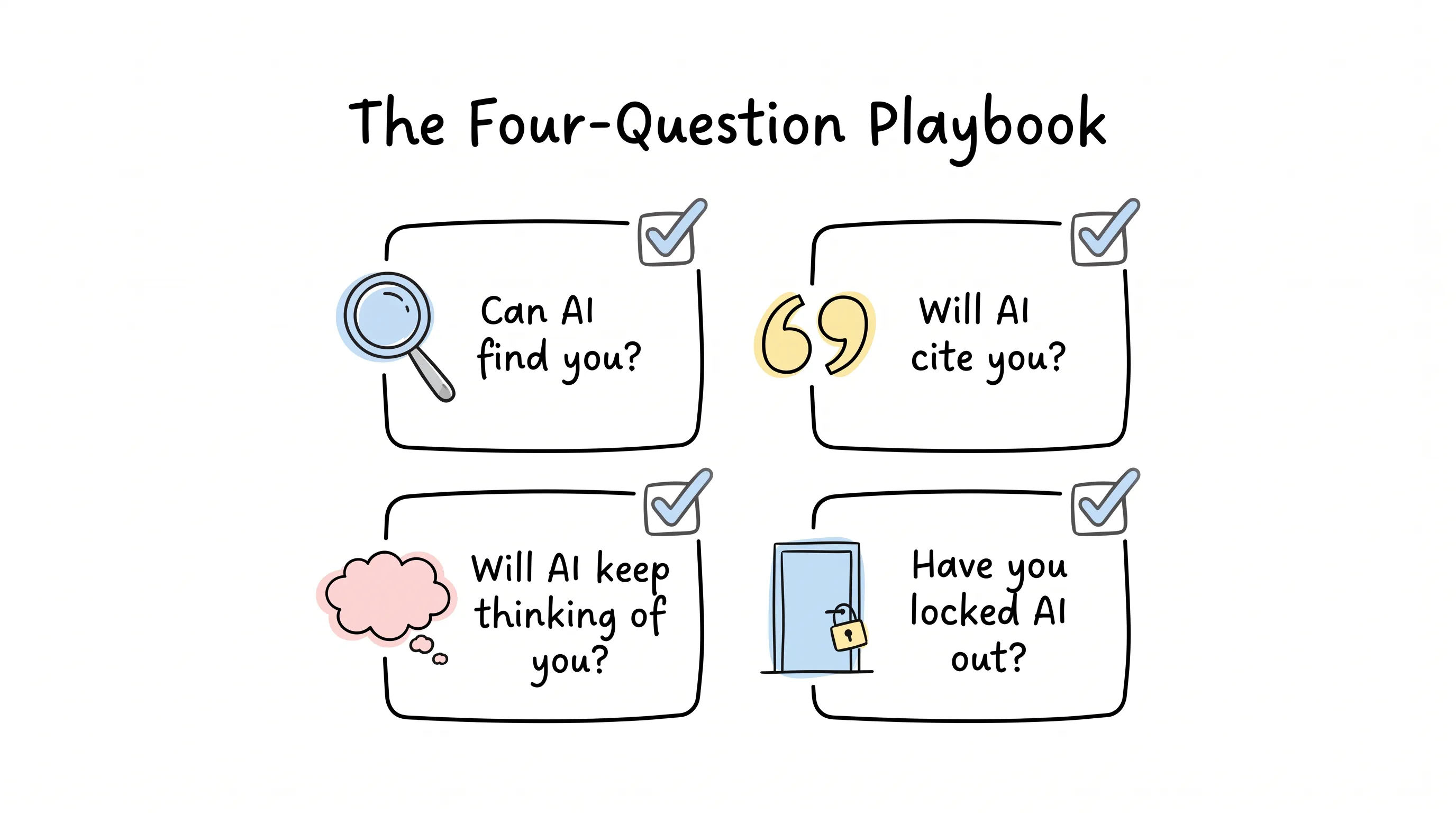
Question 1: Can AI Find You?
Many people assume AI reads articles the way humans do — straight through from start to finish, not skipping a single word.
It's the exact opposite.
When AI receives your question, the first thing it does is spin up dozens of related searches off the back of it and run them all at once. The jargon is fan-out queries. What does that mean? AI takes its best guess at the intent behind your question and asks the surrounding questions on your behalf. Ask it how to do a competitive analysis, and it will also pull market size, pricing, tool comparisons, and industry reports.
So in AI's eyes, one "epic flagship post" doesn't necessarily beat a pile of small pieces that each answer a specific question.
Where do those small pieces come from? My friend says the most wasted treasure of all is the newsletter.
The vast majority of newsletters die the moment they're sent. They sit in the inbox and never get opened again. But what you poured your heart into writing is actually a gem. His approach has three steps:
Step one: once the newsletter has gone out and proven itself, move the original article onto your website, where AI can crawl it and index it.
Step two: then build an "AI version" — same content, new headline, new keywords, new layout, reorganized specifically to suit a machine's taste.
Step three: put both versions under the same domain. One for humans to read, one for machines to read.
Is all that hassle worth it? Take a consulting firm that couldn't match its bigger rivals' ad budgets. Advertising, at its core, is renting traffic: stop paying and the people leave. So they switched tactics. They dug out years of newsletter archives, picked the top performers based on reader engagement, moved them onto the website, then produced a fresh batch of content remade to suit AI's taste.
Three weeks.
Three weeks later, 72% of the AI recommendation slots in their category went to them. When I saw that number, I stared at it for a good while. Rivals had been publishing content for years, had more followers, bigger budgets. Didn't matter.
The gap isn't money. It's understanding the new reader.
Question 2: Will AI Cite You?
AI finding you doesn't mean AI will recommend you. It's holding billions of pages — why should it use yours?
AI runs content through two filters.
Filter one: originality. Here's the interesting part — AI can tell which content was written by AI itself. If a piece is something AI could churn out on its own, why would it cite that? It'll just generate its own version.
How do you test for it? Here's a brutal one: swap the company names in your article for a competitor's name and read it again. Still reads fine? Then the article is fluff.
Harsh, right? But the logic holds.
"10 Retirement Money Tips" — anyone can write that, and AI can write a hundred of them in a second. But a financial advisor writing "how one of my clients restructured her assets during the last market downturn" — that, AI cannot invent.
Because it wasn't in the room.
What AI wants is the stuff it can't generate itself: first-person stories, proprietary data, concrete results, firsthand experience.
The same goes for event organizers. "Ten must-see attractions in this city" means nothing. "How many people filled the room at last year's dinner" or "that little restaurant we stumbled on by accident" — that means something. Details can't be faked.
Can you still use AI? Of course — and you should. Drafting with it is fine. But once the draft is done, you have to stuff in the things only you have: your stories, your numbers, your mistakes, the things your clients said. Leave them out, and what you've produced is just another "a hundred a second" piece.
Filter two: chunks.
What's a chunk? AI doesn't hand users your whole article. It pulls out exactly the two or three sentences that answer the question, serves them straight to the user, and tacks a citation link on the end — pointing at you. The jargon is chunking.
That means every section of your article has to stand on its own: lifted out, no surrounding context, it still makes sense, is still accurate, is still useful.
After you finish a section, ask yourself one thing: if those two or three sentences got extracted on their own, would they still hold up?
Question 3: Will AI Keep Thinking of You?
Getting cited once is luck. Getting cited every time is an asset.
What happens when a user sees the same company again and again across different answers? They start to trust you. It's like a friend who recommends the same restaurant every time you all go out to eat. After the third recommendation, you're definitely going.
That's compound interest. Every time AI cites you, another deposit goes into your trust account.
So how do you raise your odds of being cited? Funnily enough, the answer is the old classic: know your users. What keeps them up at night worrying? What has them confused? Which things do they need to nail down before they make a decision?
You don't have to guess — the answers are sitting in your own data. Support tickets hide your users' real struggles. The questions that come up over and over on sales calls are exactly what you should write about. There's an old rule of thumb from college classrooms: the question one person raises a hand to ask stands in for the dozens who were too embarrassed to raise theirs.
One more thing a lot of people get dead wrong: they fixate on the final step.
A real-estate agent serving first-time homebuyers in Phoenix can't just write "how to buy a house." The questions buyers ask AI are way upstream by then: Is Phoenix safe? How are the school districts? What do the HOA rules say? How high are property taxes?
Every question is a piece of content. Answer every stage, and your authority blankets the entire decision journey.
Don't just wait for customers at the register. Be there while they're still hesitating at the door.
Question 4: Have You Locked AI Out?
Everything so far has been content. This last one is technical — and it's the most unjust layer of all: plenty of owners aren't failing at content. They shut the door themselves and don't even know it.
Five things to check, one by one.
First, structure your content as Q&As. One section answers one specific question, with the answer in the first 100 words. When AI comes slicing, it extracts cleanly every time — and what gets pulled out reads like it was written straight to the person asking.
Second, go dig through your site's robots.txt (a file that tells crawlers which parts of a site they may access). It's an old file, and it may still hold a setting from years ago that blocks AI crawlers entirely. When my friend helps companies investigate "why are AI recommendations never showing up," the trail so often ends at this one line.
Third, Cloudflare has an AI-blocking toggle. It should be off by default, but my friend has seen several sites where it was mysteriously switched on. Check the dashboard — a two-minute job.
Fourth, cut back on dynamic pages that only load content after scrolling or clicking. AI reads static HTML with the least effort.
Fifth, sitemaps. Have the XML one, then build an HTML one too — give AI two entrances. By the way, pages don't all have to squeeze into the navigation menu; as long as they're in the sitemap, AI can still crawl them. If you're on WordPress, put your content into "Pages" — the whole newsletter archive can live there. Site stays clean, nothing gets lost.
One more piece of advice: keep doing structured data like FAQ schema. None of the old SEO homework gets dropped.
SEO isn't dead. Your list of readers just gained a crowd of machines.
Back to That Bowl of Beef Noodles
Now think about that noodle shop again.
Its owner did absolutely nothing, so how did it make AI's list? My guess: some traveler took the time to write a thorough, detailed review on a review site — which day they went, what they ordered, how much they paid. One authentic, detail-rich, firsthand record.
That's the stuff AI loves to eat.
One little shop getting lucky is luck. If you want your business to show up reliably in AI's recommendations, you can't count on luck. Answer all four questions: make sure AI can find you, wants to cite you, and keeps thinking of you — and whatever you do, don't lock the door.
The gateway has shifted again. The Yellow Pages gave way to search, and search is now giving way to questions and answers.
Last time the gateway shifted, "AAA" got companies onto the first page of the phone book. This time, the top spot goes to whoever AI trusts most.
Here's to your business making it onto AI's recommendation list soon.
Continue reading
Related articles

Cross-Border Business: Time to Upgrade Your AI Toolbox
A learn article explaining how AI tools help cross-border e-commerce sellers clear five hurdles: language, regulation, logistics, payments, and fraud. It outlines a five-compartment toolbox, a five-step adoption path, and metrics such as conversion rate and CLV, while cautioning against over-reliance on AI.

AI Is Taking Over the Dirty Work of Social Media Marketing, One Task at a Time
This learn article outlines four social media marketing tasks AI can handle — audience analytics, content drafting and design, ad targeting and creative testing, and spam moderation — and cautions that taste, judgment, and data security remain human responsibilities.

AI Is Already This Good — Why Is Your Social Media Marketing Still Pure Manpower?
An overview of 18 AI tools for social media marketing, organized into six categories covering audience research, content creation, scheduling, comment and DM handling, ad management, and visual production, plus notes on personalization, prediction, and emerging trends.