
Are Rankings Dead? AI Bots Are Now "Copying" Your Answers
A learn article explaining generative engine optimization (GEO): how AI search engines retrieve, rerank, and cite sources, how GEO differs from SEO, and practical steps for making brand content easier for AI answers to cite, along with suggested metrics for tracking AI visibility.
A few days ago, a friend of mine who runs an e-commerce business invited me out for tea. He'd barely sat down before he let out a sigh.
"Man," he said, "my SEO is in great shape — keywords, backlinks, original content, I haven't skipped a single one. But lately, looking at our internal data, we've noticed a lot of customers simply don't click search results anymore. They go ask ChatGPT, ask Perplexity, ask Gemini. The AI instantly hands back one answer — the user reads it, and they're gone."
Then he asked: "So does all the hard work we put into ranking first still mean anything?"
I said: yes, but it's no longer enough.
Because the rules of the game have changed. SEO competes for rankings; GEO competes for citations.
What Exactly Is GEO?
GEO — Generative Engine Optimization.
Put simply, it means getting your content "picked up" by AI search engines like ChatGPT, so that when they generate an answer, they write you into it.
Note: written into the answer itself.
Think about it. What was the goal when we did SEO in the past? Climbing to the top of Google's results page. Among the ten blue links (the classic page of ten organic search results), you sat at the top, and users clicked you.
And now? A user asks ChatGPT: "What are some good CRMs for a small company?"
The AI won't give you ten links. It writes a paragraph directly — synthesizing what it memorized during training with information it just fetched from the web — and hands you a "standard answer."
If your brand isn't in that paragraph, the user never sees you.
Even ranking first on Google is useless, because the user never opened the search results page at all.
The battlefield used to be rankings. Now the battlefield is the answer itself.
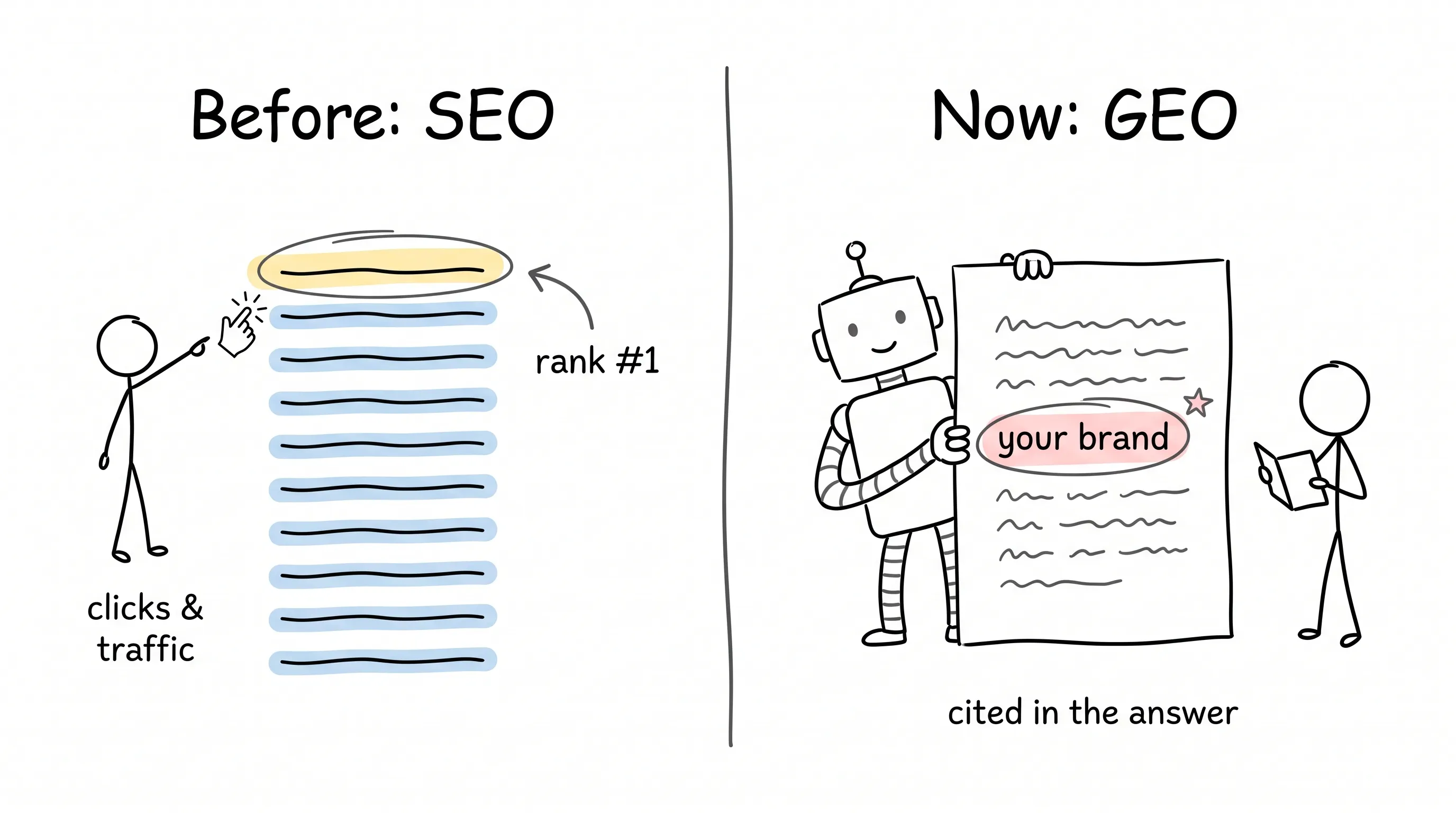
That's GEO. Not a hype term — a genuinely new layer of competition.
How Does AI "Pick" Its Sources?
Some of you may ask: what makes the AI cite one company and not another?
First you need to understand how AI search works. When it answers a question, it roughly goes through four steps:
Step one, retrieval. It digs up relevant material from the web and from its own training data.
Step two, reranking. It lines up that material by authority, freshness, and relevance.
Step three, synthesis. It kneads the top-ranked information into one coherent answer.
Step four, citation. It marks the sources.
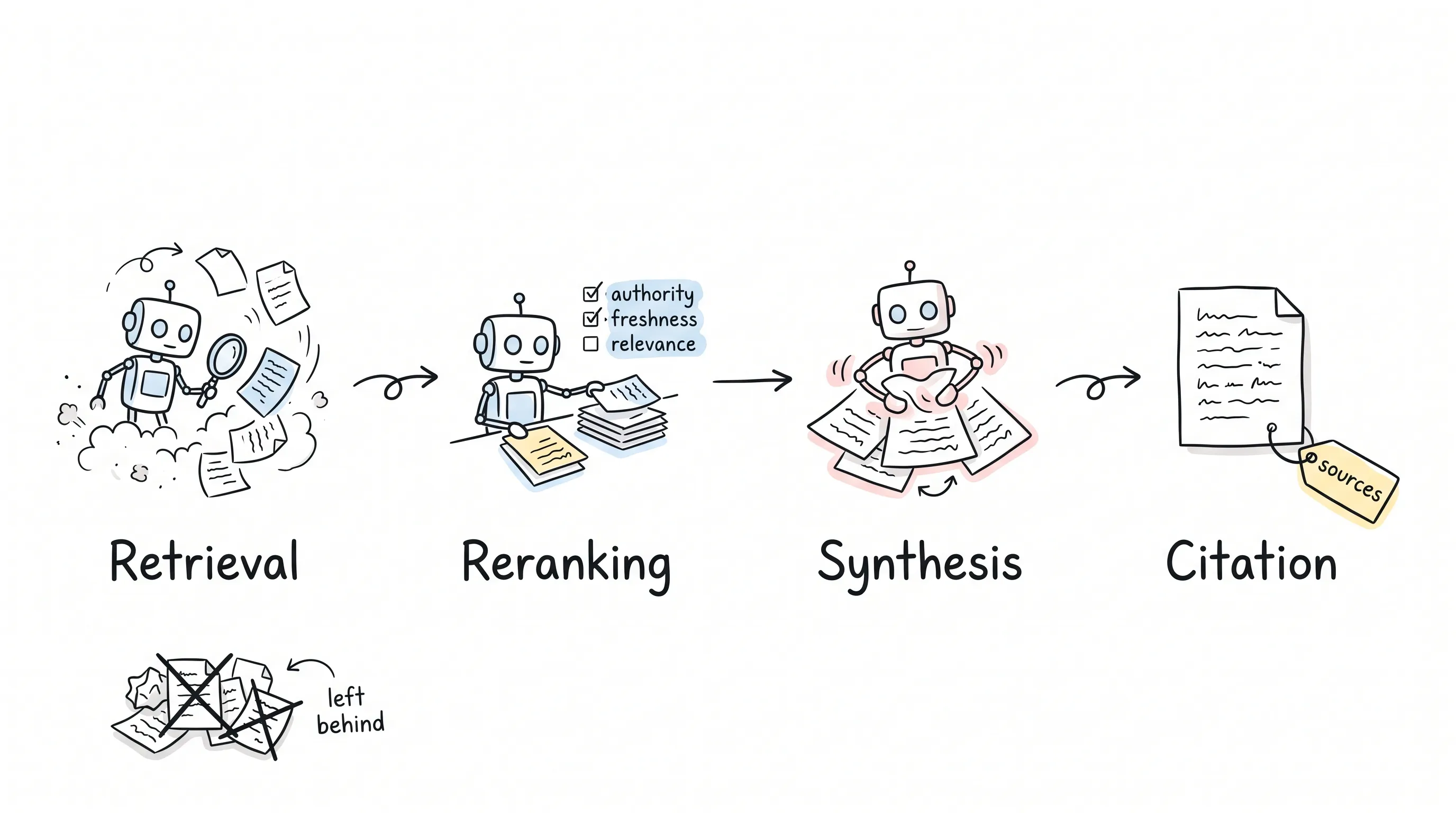
See it now? For your content to survive, it has to get past the first three gates and squeeze into the handful that makes it into the synthesized answer.
This brings a fundamental shift. A traditional search engine is like a librarian: you catalog your book and stick on the labels, and it shelves it for you. AI is more like a researcher: it doesn't look at your labels; it looks at whether you explain things clearly, whether you're credible, and whether you're worth quoting.
Stop thinking about being indexed. Start thinking about being understood.
A site whose content is vague and structurally chaotic is unreadable to AI, so naturally it won't be cited. Write clearly, and the AI will actually be willing to quote you.
What Happened in 2025?
Why is this suddenly urgent? Looking back at 2025, several signals are already very clear.
Apple added AI search capabilities to Safari. ChatGPT, Claude, and Perplexity have taken a large share of the questions that used to belong to Google. And the way users ask has changed too — people used to type four words; now they type a whole sentence. The average query length has grown from 4 words to more than 20.
Four words and twenty words are two entirely different kinds of search.
Four words is "heat pump price." Twenty words is "My house is up north — how much would I save on heating bills in a year with a heat pump, and is it more cost-effective than running a boiler?"
Long questions like this are exactly what AI search is best at.
So the old playbook — piling up short keywords for rankings and gaming authority with backlinks — is running out of steam. When AI bots evaluate content, they look at three things: is it explained clearly, is it authoritative enough, and does it have context. Formats that human readers love — bullet points, Q&A style, mini-summaries — AI loves too, because they're easier to "copy."
SEO isn't dead. But if SEO is all you do, you'll fall behind.
Want to Get Cited by AI? Do These Five Things
Enough theory. Let's get practical. How do you actually do it?
First, say things clearly.
AI likes content humans can read. Cut the jargon, keep paragraphs short, state your points directly. Sentences like "To summarize" or "In one sentence" may sound unglamorous, but don't dismiss them — AI picks up on them especially well.
Second, go deep, not wide.
Take an example. Say you sell heat pumps. Don't just write one product page. Write all of it — "how heat pumps cut your heating bill," "heat pump vs. boiler," "how to claim government subsidies" — and connect the pieces into one body of work. When the AI sees that one brand has covered this topic inside and out, it naturally takes you more seriously. This is called weaving a web of content: let the model recognize your expertise.
Third, make good use of structured data.
Don't be lazy with schema markup (structured-data tags that tell machines what your content is). Mark up your company info, articles, FAQs, and products — clearly. Mark up the credentials in your author bios, too. AI reads structured data far faster, and far more accurately, than it reads articles.
Fourth, get other places talking about you.
This is the one most people miss. Google and OpenAI have both licensed Reddit's data — which means a casual mention of you in some forum thread can shape how the AI sees you. Citations on Zhihu (China's largest Q&A community), in industry forums, and in podcast interviews all feed the AI the signal that "this brand is credible." A marketing agency called Brandcamp Digital has observed that even one unremarkable Reddit discussion can influence a brand's visibility in AI search.
Fifth, keep your content fresh.
It takes time for AI models to learn something new. The newer your content and the fresher your data, the better your odds of being scooped up in the next round of training and crawling. Old content just sitting there, hoping one optimization feeds you for a decade? Doesn't happen.
One Table to See the Difference Between SEO and GEO
Some people like side-by-side comparisons, so here's a rough version:
- Goal: SEO fights for rankings; GEO fights to be cited by AI.
- Core signals: SEO looks at keywords and backlinks; GEO looks at clarity, authority, and citation trust.
- How you write: SEO writes for crawlers; GEO writes for humans — and makes it easy for AI to excerpt.
- Success metrics: SEO counts clicks and traffic; GEO counts "how many times you appear in AI answers."
- User experience: SEO hands over a list of links; GEO hands over an answer.
In one sentence: SEO is about studying the algorithm. GEO is about studying the language model.
Note that the two don't conflict. Keywords, backlinks, technical optimization — keep doing all of it. GEO is a new floor built on top of the old foundation.
The New Report Card: Five New Metrics
So once you've started GEO, how do you measure it? The old tools can't see this. You need new metrics.
Citation share: of the answers AI generates, what fraction cites you?
Visibility frequency: how often your brand gets mentioned across the major AI platforms.
Sentiment: when AI describes your brand, is it praising you, staying neutral, or putting you down?
AI-driven visitors: how much traffic is arriving from ChatGPT, Perplexity, and the like.
Answer attribution: how many AI summaries draw primarily on your content.
Tools are already tracking these numbers — Ahrefs' Brand Radar, for instance, and Profound. This space is still young, but before long it will become as standard in a marketer's dashboard as Google Analytics.
Move first, get data first, iterate first.
Don't Stare Only at Your Own Website
This point deserves to be pulled out on its own.
SEO people have a habit: pour all your effort into your own site. GEO doesn't work that way, because AI gathers material from everywhere — articles, reviews, forum posts, social media, all of it counts.
To be remembered by AI, your brand has to live in multiple ecosystems.
Show up in communities like Reddit and Quora and genuinely take part in industry discussions — no spam, no drive-by self-promotion. Write your industry observations on LinkedIn; AI frequently cites that kind of content. Podcast interviews work too — publish the transcripts, because speech is becoming searchable. Detailed customer cases and testimonials are the "evidence" AI loves to cite most.
In one sentence: your website is your home base, but beyond the home base, everywhere is a battlefield.
So What Should You Do Next?
Here's a concrete action list.
- Don't throw away your old SEO — fold the keyword and backlink work into long-form content that AI can understand.
- Do original research. Models love fresh data most, and your own surveys and reports have the highest odds of being cited.
- Build your own "knowledge base." Use your own words to explain the key concepts in your industry clearly. When AI composes summaries, it especially loves citing this kind of definitional content.
- Once a month, manually search for yourself in ChatGPT and Perplexity and see how the AI introduces you. If it gets something wrong, fix it fast.
- Watch schema and APIs. Going forward, structured data interfaces may well become the new "backlinks."
- Put engineering and marketing at the same table. GEO is half content, half data engineering — you can't do without either.
Will GEO Replace SEO?
A frequently asked question, and my judgment is: no, but it will redefine it.
Traditional search still handles billions of queries a day; for looking things up and shopping, people still habitually turn to Google. So the old trade is still alive.
But attention is migrating. Wherever attention goes, exposure follows.
It's like the companies that jumped on SEO early, back in 2005 — by 2010, they had left the latecomers far behind. Today, whoever feeds their content into the AI's "memory" first will, five years from now, be standing inside the answers.
SEO makes you visible to people. GEO makes you trusted by AI.
Looking One Layer Further
Looking further out: generative engines are becoming agents (AI assistants that act on your behalf) — they don't just find answers; they make decisions for people.
Comparing products, placing orders, booking meeting rooms, hiring service providers — one day these may all be handled by an AI assistant on the user's behalf.
At that point, being remembered by AI no longer just brings traffic — it brings orders directly.
Imagine it: a user's AI assistant is asked to "recommend a reliable design agency," and its first thought is you. What's that position worth?
So in the end, GEO isn't a shouting contest. It rewards whoever explains things most clearly and is most worth trusting — speaking to humans, and to machines.
We used to learn how to talk to Google.
Now we have to learn how to talk to AI.
Whoever learns first, benefits first. It's that simple.
Continue reading
Related articles

Cross-Border Business: Time to Upgrade Your AI Toolbox
A learn article explaining how AI tools help cross-border e-commerce sellers clear five hurdles: language, regulation, logistics, payments, and fraud. It outlines a five-compartment toolbox, a five-step adoption path, and metrics such as conversion rate and CLV, while cautioning against over-reliance on AI.

AI Is Taking Over the Dirty Work of Social Media Marketing, One Task at a Time
This learn article outlines four social media marketing tasks AI can handle — audience analytics, content drafting and design, ad targeting and creative testing, and spam moderation — and cautions that taste, judgment, and data security remain human responsibilities.

AI Is Already This Good — Why Is Your Social Media Marketing Still Pure Manpower?
An overview of 18 AI tools for social media marketing, organized into six categories covering audience research, content creation, scheduling, comment and DM handling, ad management, and visual production, plus notes on personalization, prediction, and emerging trends.