
An Influencer With No Heartbeat — Why Would You Buy What She's Selling?
An explainer on virtual influencers: what computer-generated personas are, why brands use them, and the risks involved. It cites a 2025 Newcastle University study linking marketing effectiveness to social signals, with interactivity driving short-term conversion and credibility sustaining long-term trust.
The other night, deep into a late-night scroll, I came across a fashion model.
She was shooting editorials alongside real celebrities, promoting luxury brands, releasing new songs, chatting with fans in the comments. Millions of followers, and a comment section full of "She's so gorgeous."
Then I saw a message that stopped me cold: this model isn't human.
She's computer-generated. My God.
There are hundreds of "people" like her today, scattered across Instagram, TikTok, and YouTube. The industry calls them virtual influencers.
So What Exactly Is a Virtual Influencer?
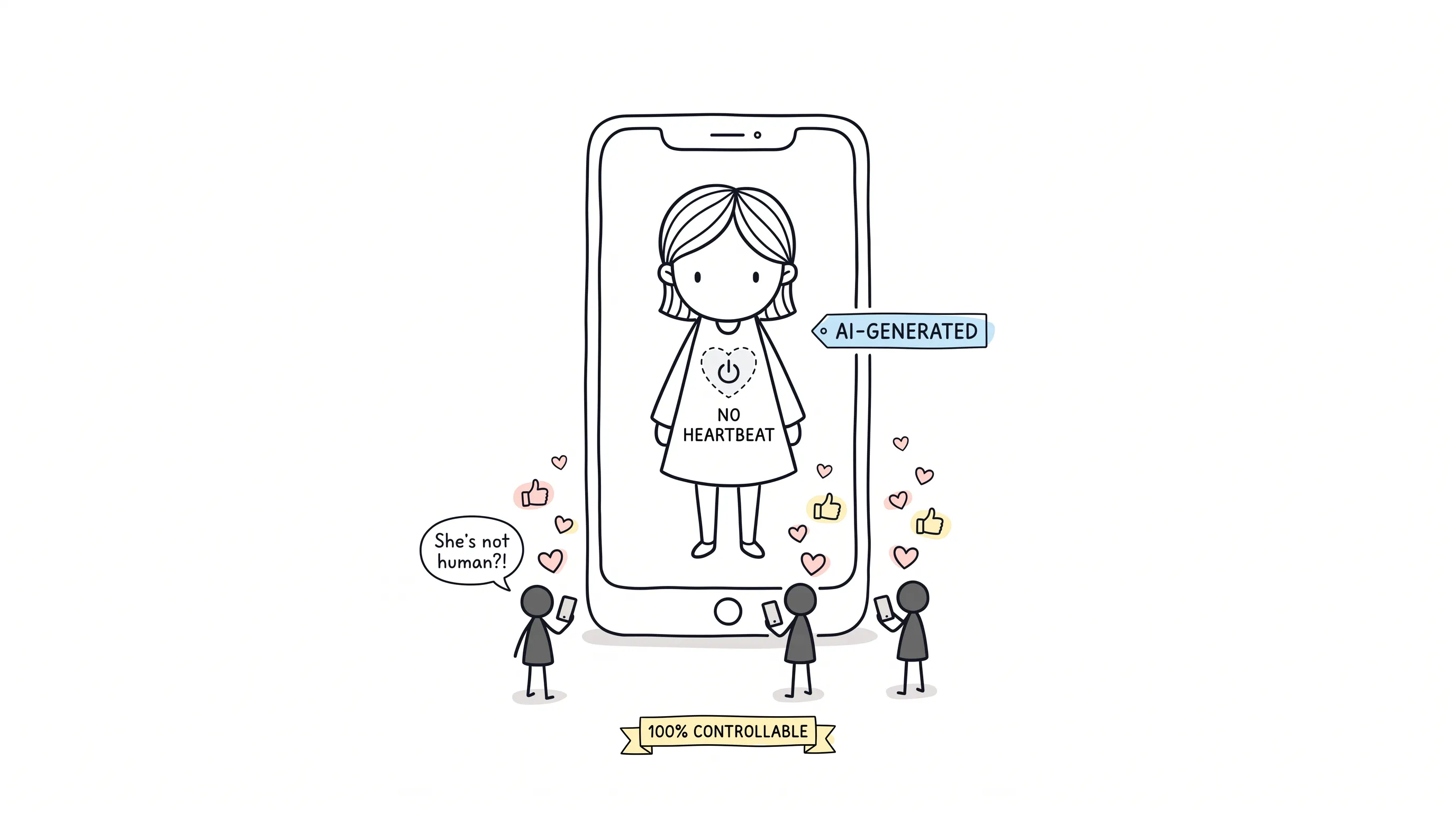
A virtual influencer is an "influencer" made entirely by computer. She posts content, takes sponsorships, and manages her fan base just like a human influencer — the only difference is that she has no body, no heartbeat, and no such thing as clocking out.
These hundreds of virtual influencers differ in personality, looks, persona, and lane. Some are fashion darlings; some are musicians. And don't mistake this for coincidence — it's design. Developers and brands mix and match these traits the way a bartender blends a drink, precisely targeting different fan bases and industries.
They partner with brands in a few different ways, too.
The first is the independent artist. She's an IP (intellectual property) in her own right, negotiating deals with brands and collecting appearance fees. The most famous is Lil Miquela, who debuted in 2016 as fashion model, singer, and performer all at once. Prada, Samsung, and Calvin Klein have all cast her in campaigns, and she's collaborated with plenty of real celebrities too. In August 2025, she even posted to mark the eighth anniversary of her first single.
The second is the brand mascot. She is a brand's dedicated "face," and her whole reason for existing is to make that brand feel like a living person.
The third is pure entertainment. No sponsorships — just fun, musical, or artistic content that quietly builds a following. And once the following is big enough, the brands come knocking.
On the surface, the business seems to be thriving, right?
So here's the question: why are they so popular?
Three Forces Pushing Them Into the Spotlight
The first force is technology.
AI, AR, and VR have advanced by leaps and bounds in recent years. Creating a virtual human indistinguishable from the real thing costs less and looks better every year. These virtual beings don't just live on traditional social platforms — they can move into immersive virtual spaces.
The second force is us.
Have you noticed that when you talk to Siri, argue with a customer-service bot, or name your game character, you're treating it like a person?
That's the key. Spend enough days interacting with chatbots and avatars, and without realizing it you start transferring the rules of human interaction onto machines: expecting reciprocity, expecting empathy, expecting honesty. To put it bluntly, machines, used long enough, get treated as people.
The ones making this shift most completely are digital natives — Gen Z and Gen Alpha, raised from childhood inside screens, plus younger millennials. To them, making friends and building personas in virtual worlds is as routine as eating and drinking. A virtual character recommending a product? They don't find it fake — they find it normal.
The third force is the brand's math.
Think about what a top-tier human influencer means: hard-to-book schedules, travel expenses to reimburse, a persona that can crack at any moment — and possibly a 3 a.m. meltdown that torpedoes your entire campaign. A virtual influencer? Image, persona, and messaging, 100% controllable. No ten-hour flights for a shoot, no limits from the physical world; today you want her in Tokyo, she's in Tokyo.
Controllable, flexible, cheap. Any brand's CFO does that math in seconds.
But There's Always a Flip Side.
The virtual influencer's greatest weakness is hiding in plain sight, in her very nature: she has never lived.
She recommends that face cream, but she has never known the sting of washing off makeup at midnight. She recommends that restaurant, but she can't actually taste the food. Not one of her recommendations comes from real experience — she is simply a megaphone for brand intent.
Once the novelty wears off, this becomes the biggest problem of all. Consumers can accept an idol without a heartbeat, but it's much harder to trust a salesperson who has never used the product.
And when things blow up, virtual personas are no gentler than human ones.
In 2022, a virtual rapper named Fn Meka signed with the record label Capitol Records, becoming the first "non-human artist" signed to a major label. After signing, he posted a celebration — his songs had racked up over a million streams. Pretty glorious, right?
The glory didn't last. Internet users dug up his appearance and behavior, finding them full of racial stereotypes and suspected cultural appropriation, and the backlash drowned him. Capitol Records had no choice but to apologize and drop him, and the project was essentially declared dead.
You see, being virtual or not is secondary. If the social signals your audience perceives are wrong, you die all the same.
So how exactly do you design those social signals? That brings us to a study.
Short-Term: Interactivity. Long-Term: Credibility.
A research team at Newcastle University Business School studies the persuasiveness of virtual influencers. Their 2025 study delivered a refreshingly practical conclusion: a virtual influencer's marketing effectiveness depends on the social signals she sends to her audience.
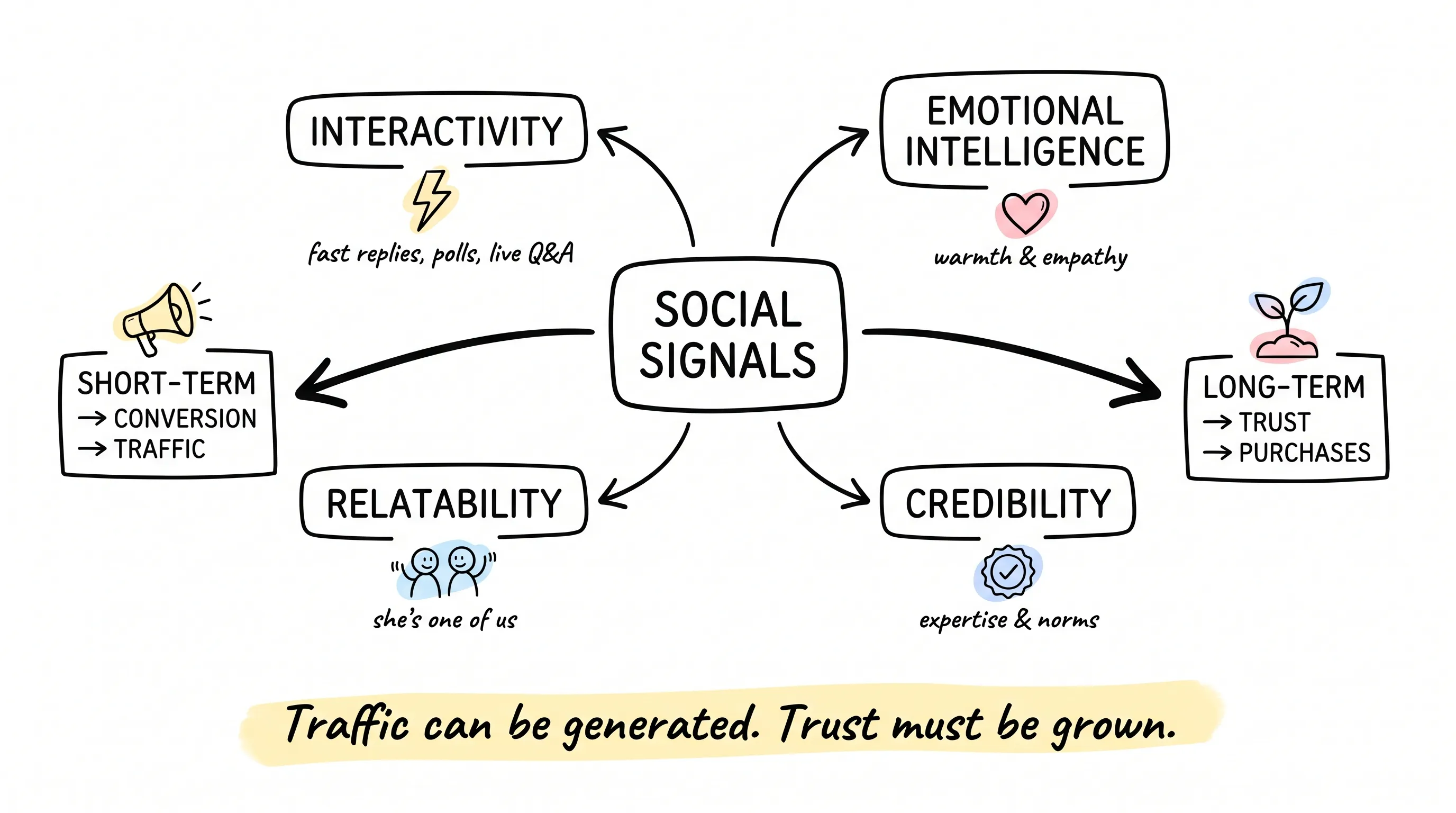
What are social signals? Everything she says and does that makes followers sense "what kind of person she is."
The main ones:
Interactivity: how fast she replies, how much she engages, how active she is. GenAI now lets virtual influencers read context and make every reply feel customized — and this is still improving.
Relatability: how strongly followers feel "she's one of us." Whether what she says, does, and wears lines up with the values you believe in.
Emotional intelligence: whether she has warmth. Does she care about people? Does she speak kindly? Virtual humans can convey empathy too — through copywriting and persona design.
Credibility and expertise: does she actually "know what she's talking about," and does her behavior conform to accepted norms?
Here's the interesting part: how you use these signals depends on what you want.
If your goal is short-term conversion — limited-time deals, product launches, driving traffic to an event — then hammer interactivity. Instant replies, polls, interactive stories, live Q&As. First, crank up the volume of instant responses.
If your goal is a long-term brand relationship, interactivity alone won't cut it. You need consistent output that is professional, credible, and within the norms, plus a deep understanding of your audience — so her language, style, and cultural references feel native to your audience's tastes.
And there's one more piece of math many brands get wrong.
Likes, shares, and comments are "low-effort actions" — fast interaction can buy them. But getting someone to pull out their wallet is a different matter. Purchases come from long-term relationships. And long-term relationships aren't built overnight by one viral hit; they're built over time: a continuous story, values aligned again and again, and a symbolic bond with fans.
In one sentence: traffic can be generated. Trust can only be grown.
Finally, Back to That Model I Scrolled Past
It's late at night, and she's still posting, still replying to comments. She doesn't need sleep, doesn't need conditioner, and will never go out of style.
But what she needs is the same thing you need: to be genuinely believed.
Technology will only get cheaper. Building a virtual influencer will soon be as easy as spinning up a newsletter or a social account. But no amount of money can buy one thing: the moment a follower feels "she gets me."
So if your brand wants to create one of these "hers," don't rush to ask your tech team how human they can make her look.
Ask yourself first: what truth do you want her to speak for you?
Continue reading
Related articles

Cross-Border Business: Time to Upgrade Your AI Toolbox
A learn article explaining how AI tools help cross-border e-commerce sellers clear five hurdles: language, regulation, logistics, payments, and fraud. It outlines a five-compartment toolbox, a five-step adoption path, and metrics such as conversion rate and CLV, while cautioning against over-reliance on AI.

AI Is Taking Over the Dirty Work of Social Media Marketing, One Task at a Time
This learn article outlines four social media marketing tasks AI can handle — audience analytics, content drafting and design, ad targeting and creative testing, and spam moderation — and cautions that taste, judgment, and data security remain human responsibilities.

AI Is Already This Good — Why Is Your Social Media Marketing Still Pure Manpower?
An overview of 18 AI tools for social media marketing, organized into six categories covering audience research, content creation, scheduling, comment and DM handling, ad management, and visual production, plus notes on personalization, prediction, and emerging trends.