
Amazon's Customer Service, Coca-Cola's Copy: Where Do Big Companies Actually Use AI?
A learn article surveying how companies including Amazon, Coca-Cola, JPMorgan Chase, Netflix, Spotify, The New York Times, and IBM apply AI in customer service, copywriting, document review, recommendations, advertising, and healthcare support, with a plain-language breakdown of the underlying technology.
A while back, a friend of mine in consumer goods invited me out for tea.
He sat down and opened with: "These large models — besides helping everyone write their weekly status reports, what can they actually do?"
I said, easy. Asking about concepts gets you nowhere; you have to look at actions.
Whose actions? The big companies'. They have the most people, the most money, the most data — and the highest cost of trial and error — so their moves are the most honest. Where they sink real money is, basically, where this technology is most valuable today.
Over the past few years I've gone through the public playbooks of quite a few companies: Amazon, Coca-Cola, JPMorgan Chase, Netflix, Spotify, The New York Times, and IBM. The more I read, the more interesting it got. So today I'm taking you on a stroll through them.
By the end of the stroll, you'll see: LLMs aren't mystical. They are a handful of very concrete jobs.
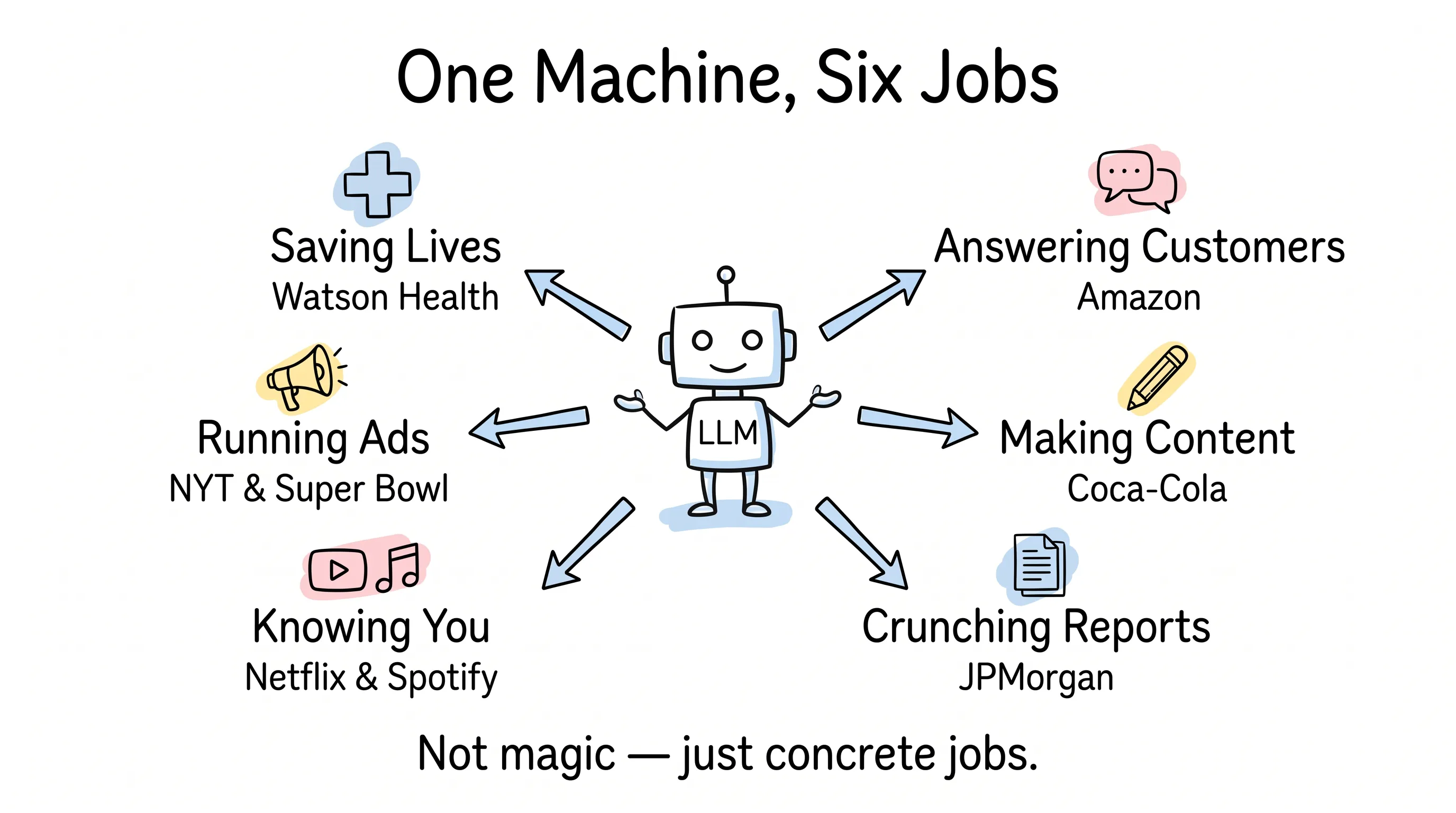
Job 1: Answering Customers
Start with the one closest to you: customer service.
Have you noticed that asking an e-commerce platform a question gets you a faster reply these days? You used to queue for a human agent; now many questions get answered in seconds.
What makes good customer service? Put plainly, two things: fast, and right.
The first one, machines are born good at. Amazon plugged large language models into its chat system early on, powered by its own Amazon Lex. It understands the problem you describe in plain language and comes back with a solid answer. Questions get understood, problems get solved faster, satisfaction climbs on its own.
But the move I find truly valuable is the next one.
Amazon didn't hand customer service entirely over to machines. Complicated questions, long-winded disputes, complaints with emotions attached — those still go to humans.
Why? Because machines can catch routine questions, but not human hearts. Order lookups, shipping nudges, returns and exchanges — that's the bulk of the volume, and machines answer fast and steady. The ones you can't explain in one sentence still need a person.
AI handles the fast; humans handle the hard. That setup is far smarter than "replace it all with AI."
That's the first lesson.
Job 2: Making Content
Now, Coca-Cola.
One of this brand's most valuable assets is its voice. Warm and joyful, and it hasn't lost its flavor in over a hundred years. That voice has lasted this long because countless lines of copy, posters, and posts stacked it up day after day.
Now they've pulled OpenAI's GPT-4 into the content pipeline.
The first use is easy to grasp: writing. Social posts, marketing copy, informational content — high volume, and it all has to taste like Coca-Cola. GPT-4's output has one distinctive quality: it sounds human. Which means no matter which platform it lands on, the brand's voice holds together.
The second use is more interesting: run it in reverse. Set it loose on mountains of consumer data and market information, and have it spit out patterns and reports — what are people into lately? Which way are consumption habits drifting?
Outbound, it's the brand's mouth. Inbound, it's the brand's eyes.
One model — one end for talking, the other for listening.
Job 3: Crunching Reports
The third company, JPMorgan Chase. Its work isn't glamorous, but it's the heavy lifting.
What does a bank face every day? Stacks of legal documents and financial reports — all unstructured text, all jargon. One person reading one document takes ages, and a tired reader misses things.
JPMorgan uses IBM's Watson for this job. Using natural language processing, Watson can chew through massive amounts of unstructured text quickly, and with high accuracy. Work that used to burn through piles of person-days gets compressed into a few machine-minutes.
Saving time is the visible benefit. The hidden one is worth more: machines don't tire, and they won't skip a line because they've been staring at documents for eight hours. Error rates drop, results turn reliable, and the service quality clients feel on their end climbs with it.
Watson works a second job too: catching the bad guys. Machine learning models watch the transaction streams nonstop. Any transaction whose pattern looks off gets flagged immediately. What human eyes could never keep up with, it watches for you.
Job 4: Knowing You
The next two companies you most likely use every single day: Netflix and Spotify.
I'm putting them together because they do the same thing: guessing what you'll like.
Netflix looks at your viewing history, every click and every pause, and slowly assembles a portrait of your taste, then recommends shows you're likely to love. Spotify looks at your listening habits, the playlists you build, the songs you put on repeat, and predicts the next song you'll fall for.
Put simply, Spotify is a private DJ who gets you: before you've said a word, he already knows what you want to hear.
Oh, and in both companies' recommendation systems, you'll find the fingerprints of language models like BERT. Every click you make is a sentence. A machine is reading your diary, word by word.
Every swipe is a vote. They win — by knowing you better than you know yourself.
Job 5: Running Ads
Advertising has been rebuilt too.
One player is The New York Times. They use OpenAI's GPT-3 to do two things for advertisers: recommend better placements based on the ad's content, and find niche audiences that were previously out of reach. Targeting got sharper, and advertisers' money went further.
Another group: the Super Bowl. More than a hundred million people watch this game every year — a gold mine of data. Generative AI chews up the viewer data, sorts people by preference and behavior, and shows different ads to different people.
The same 30-second ad went from one message for everyone to a different message for every viewer.
Job 6: Saving Lives
The last one is what I most want to tell you. Because lives hang on it.
What IBM's Watson Health does in medicine is called clinical decision support. Simply put: while a doctor is seeing a patient, it combs through vast medical literature and patient data alongside them, offering diagnoses and treatment suggestions backed by evidence.
Doctors are human too, and human reading has a ceiling — while the medical literature grows every day. With an assistant at your side who has read "all the literature," your diagnosis rests on one more layer of evidence, and the process moves a notch faster. It can also spot early signs of disease outbreaks in the data, helping with early detection and prevention.
This use of the technology is genuinely good. A lot more real than writing poems and painting pictures.
Underneath, the Same Machine
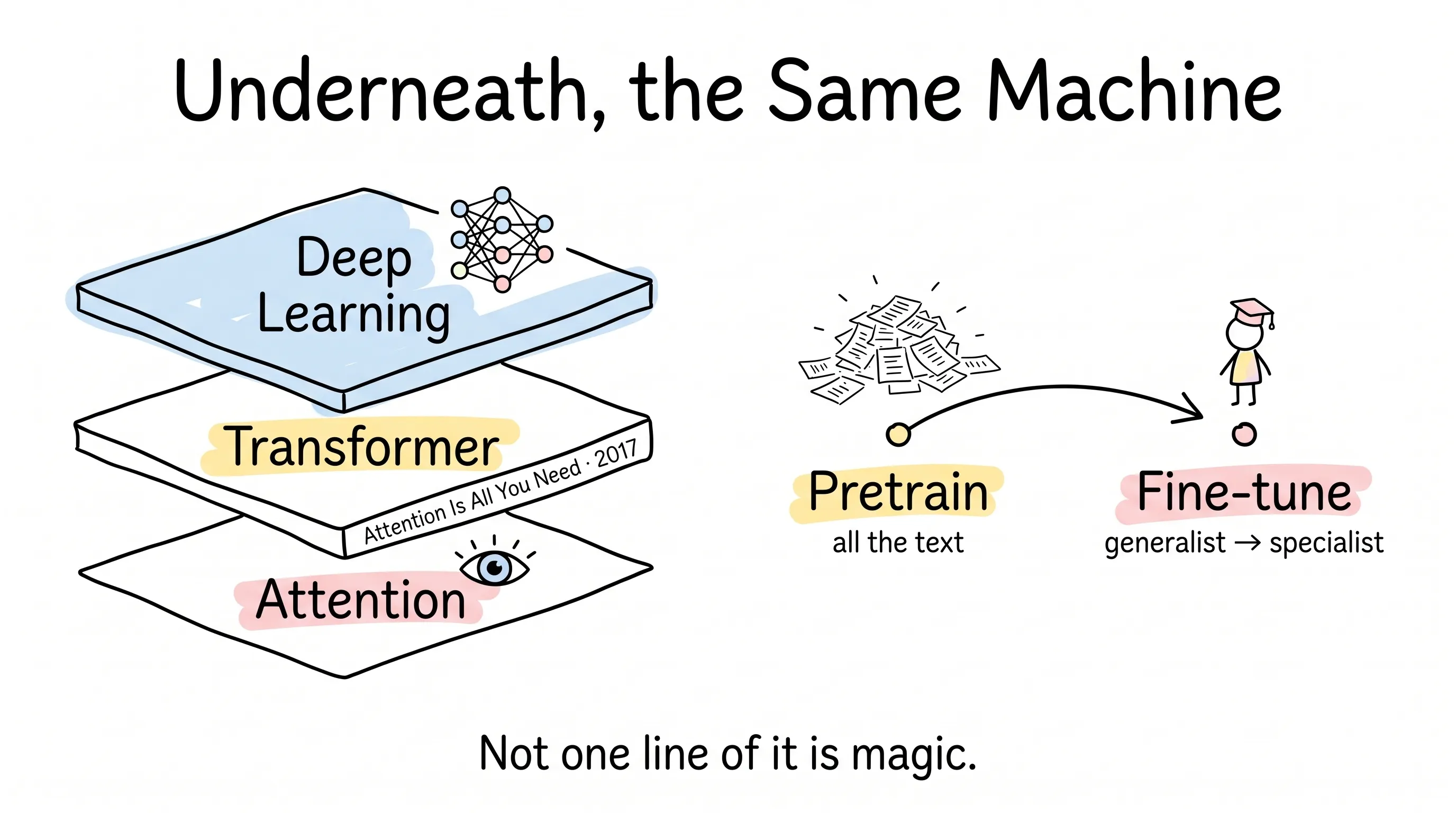
Six jobs, done. You might ask: customer service, copywriting, risk control, recommendations, advertising, healthcare — six fields with nothing to do with each other. Is it really the same technology underneath?
Yes. And the machine underneath, taken apart, isn't that mysterious.
First layer, deep learning. A neural network with many layers, working the text one layer at a time.
Second layer, the Transformer. In 2017 a paper called Attention Is All You Need proposed this architecture, and it is the foundation of most large models today. Its trick is handling connections between words that sit far apart in the text.
Third layer, the attention mechanism. It lets the model know, as it generates each word, which words in the input to focus on. It's how you automatically catch the gist when someone's talking to you.
Then the training method: pretrain first — learn the general rules of language from astronomical amounts of text; then fine-tune — use specialized data to turn a generalist into a specialist.
There's also tokenization, chopping your input into small pieces called tokens; the model only knows tokens. And how to grade a model (metrics like perplexity and BLEU), and how to rein it in with safety and ethics guardrails.
That's the whole list. Not one line of it is magic.
Back to That Cup of Tea
At the tea table that day, I ended by telling my friend: you're asking the question backwards.
The question to ask is: in your business, which task is high-volume, pattern-rich, and especially labor-hungry? That's the task worth handing to it first.
Customer service works that way, and so does copywriting. Reading reports, making recommendations, running ads, assisting diagnosis — all the same. From Amazon's customer service to Coca-Cola's copywriting, to JPMorgan's risk control and Salesforce's automated reporting — this is the judgment big companies are buying.
Whether you call the thing AI or not doesn't matter.
I later heard that the first thing my friend did back at the office was pull all three months of his team's customer service chat logs and count them up: which questions made up 80 percent?
See? Now that's the right move.
And here's to you finding your own "high-volume, pattern-rich, labor-hungry" task — soon.
Continue reading
Related articles

Cross-Border Business: Time to Upgrade Your AI Toolbox
A learn article explaining how AI tools help cross-border e-commerce sellers clear five hurdles: language, regulation, logistics, payments, and fraud. It outlines a five-compartment toolbox, a five-step adoption path, and metrics such as conversion rate and CLV, while cautioning against over-reliance on AI.

AI Is Taking Over the Dirty Work of Social Media Marketing, One Task at a Time
This learn article outlines four social media marketing tasks AI can handle — audience analytics, content drafting and design, ad targeting and creative testing, and spam moderation — and cautions that taste, judgment, and data security remain human responsibilities.

AI Is Already This Good — Why Is Your Social Media Marketing Still Pure Manpower?
An overview of 18 AI tools for social media marketing, organized into six categories covering audience research, content creation, scheduling, comment and DM handling, ad management, and visual production, plus notes on personalization, prediction, and emerging trends.