
AI Writes Your Drafts — But Who Checks Them?
A learn article describing a five-step workflow in which parallel AI agents fact-check and proofread editorial briefings against source materials, cross-check each other's flags, and return a tiered report, while noting that agents can share the same errors and humans retain final judgment.
A while back, my team ran into a real headache.
Every week, we put out an audio show. Before each episode, we have to assemble a briefing — stitched together from dozens of source materials: news stories, research reports, announcements, transcripts. It's dense. Really dense. Every fact and every number that goes into the show has to have a source, and it has to be correct.
Before recording, someone has to check the entire briefing from top to bottom.
Who used to do that? One person. Read the whole document, dig back through the source materials, check line by line, fix typos along the way. Thorough? Extremely. Fast? Not even slightly. Tedious? Ask anyone who's done it.
Then we handed the job to AI agents.
Efficiency went through the roof.
Today I'll walk you through the whole approach. There's nothing mysterious about it — you can start using it tomorrow.
What exactly is an AI agent?
First, let's get one concept straight.
Many people assume that working with AI means opening a chat window: you ask one question, it gives one answer.
An AI agent is different.
What is an agent? An agent is AI you can hand an entire task to — it breaks the job into steps, runs them, finishes the work, and hands it back to you, all on its own. You don't have to babysit it. Once it takes the task, it goes off to find the materials, run the comparisons, and write the report by itself.
In one sentence: A chatbot waits for your questions; an agent does your work.
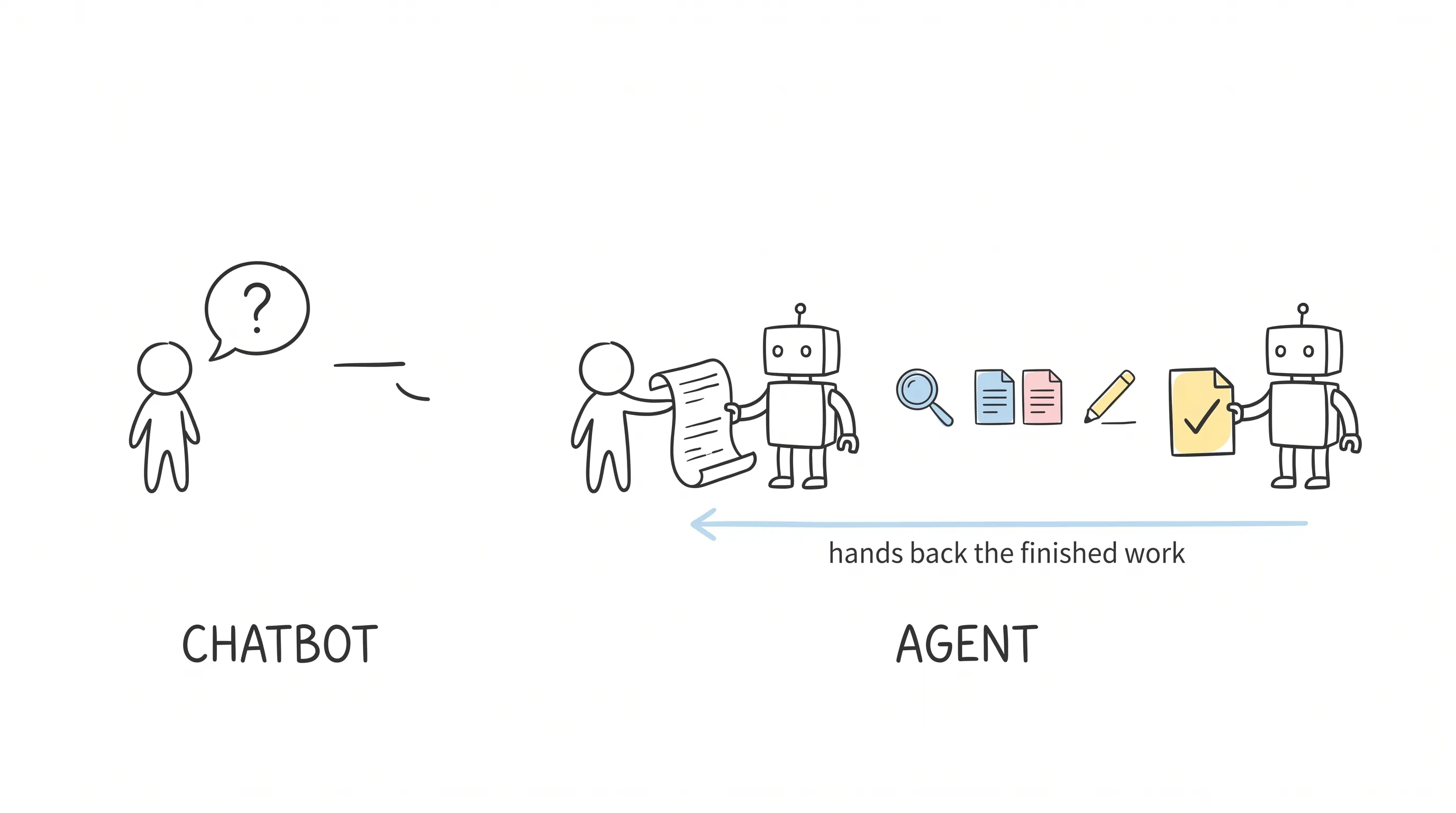
Once that clicks, everything that follows makes sense.
How do we actually do it?
Back to that briefing.
Our approach has five steps.
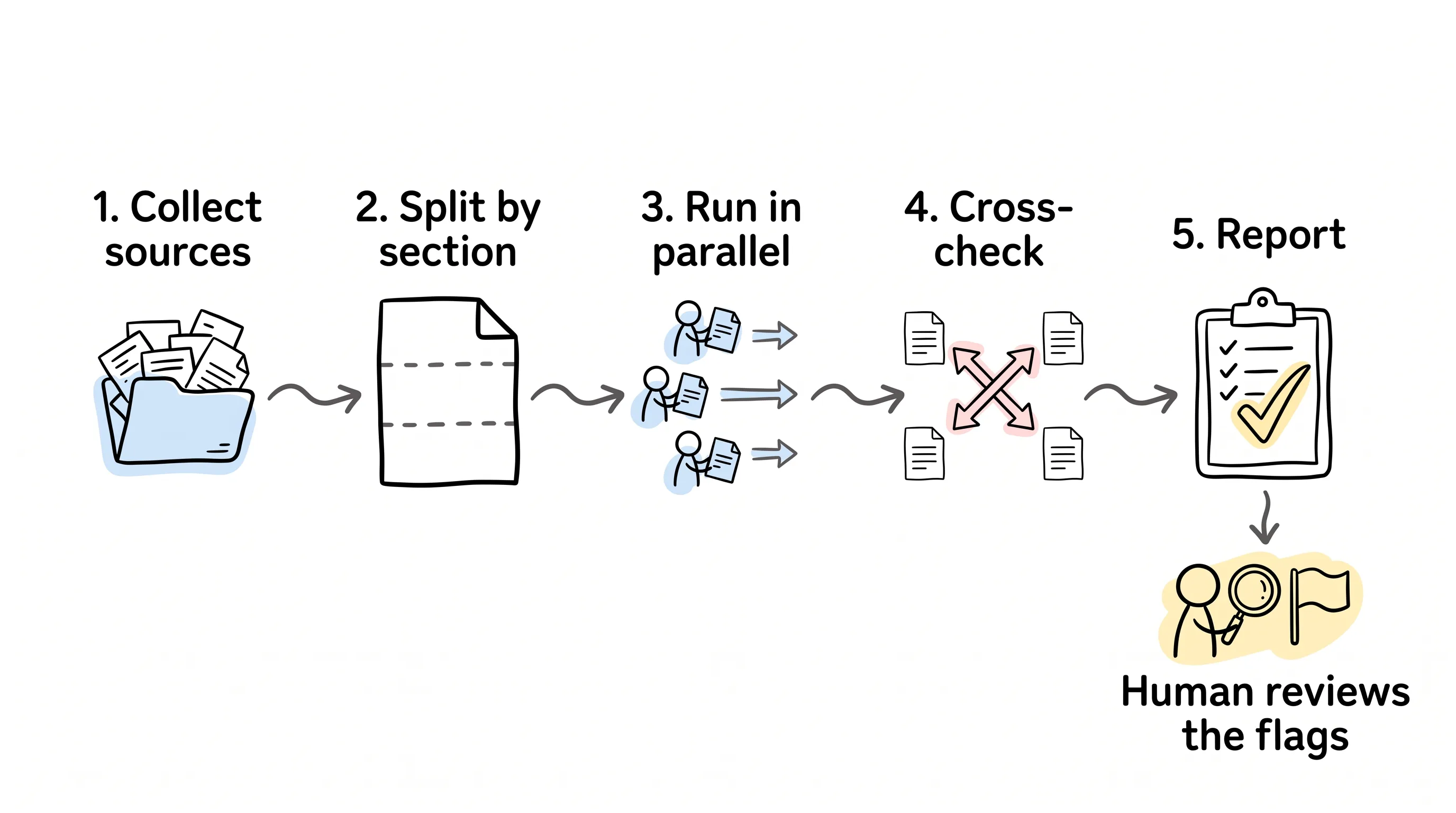
Step one: gather the source materials. Every article, research report, and transcript the briefing was built from — collect it all in one place. These are the "answer key." What the agents check is whether the briefing lines up with them.
Step two: split up the briefing. Don't expect a single agent to check everything. Divide it by topic — one agent per section, each with its own assignment.
Step three: run them in parallel. Use Codex, Claude, or any platform that supports agents, and let them work at the same time. What used to take a human reviewer an hour now gets covered in minutes.
Step four: cross-check. Once the first round finishes, send in another agent whose only job is to re-examine the first round's flags: Did anything slip through the net? And are there "corrections" that were flagged but whose evidence doesn't actually hold up?
This step is brilliant. Agents picking at each other's mistakes means extra pairs of eyes, essentially for free.
Step five: collect the report. What lands back in your hands is a clean, crisp list: which facts were flagged, what changes are suggested, where the source links are, and which typos you can approve with a single glance.
After those five steps, the human steps back in.
And note: we haven't tossed the source materials aside. The people making the show still read the primary materials in full. What the agents do is turn "hunting for a needle in a haystack" into "here's the needle, laid out in front of you."
The machine's job is to pick out the needles. The human's job is to check that each one is stuck in the right place.
What's truly valuable is how it hands the work back to you
In this workflow, what surprised me most wasn't how accurately the agents check.
It's the way they hand in their homework.
Think about it: if an agent throws a long document back at you and you still have to read it from the beginning, you haven't saved any time.
But what it hands back is a crystal-clear ledger: issues grouped by section; every question carrying a link to the underlying source; and sorted into two tiers. Typos and wrong numbers are high-confidence — one glance and you can confirm them. For anything that needs human judgment, it tells you plainly: this one, I'm not sure.
And so your work changes.
From "read everything" to "review only what's flagged."
Those are two completely different kinds of editing. The first trades on time; the second trades on judgment.
But there's a trap you must know about
AI agents get things wrong.
That's not surprising. What's surprising is this: several agents can be wrong together — in exactly the same way.
Picture it: three agents cross-check each other and reach the same conclusion. You'd feel reassured, wouldn't you?
Don't be.
They may simply have read the same material, the same wrong way.
So that fact-check report is not a get-out-of-inspection-free pass. Your confidence should come from the evidence it dug up, and from the parts you've read yourself — not from "the AI said it was all checked."
Put simply, this workflow is, at its core, an attention allocator.
Where does the machine get the final say? Typos, formatting, obvious numerical errors. Those you can verify at a glance, and the time they free up is worth real money.
Where does the human have the final say? Every sentence you're going to publish and stand behind.
Where should you start?
You don't need to build anything complicated on day one. Start small, and work up in four steps.
First: proofreading. Have one AI run a checklist over your draft: typos, grammar, inconsistent formatting, obvious factual errors. This is the easiest work to verify — and the most instantly satisfying.
Next: source verification. Hand the document, together with the source materials behind it, to the AI, and have it flag every sentence the sources can't support.
Then, once your documents get longer and your sources multiply, bring in parallel agents. Split by topic — Codex, Claude, whichever you prefer — and run them all at once.
Finally, apply it first to the content where mistakes hurt most. Client reports, research memos, outbound emails, presentations on their way out the door — these are the danger zones. Wherever errors cost the most is where this workflow pays for itself fastest.
A final word
Our show's briefing is still one document a week, and still just as dense.
What's different is that before recording, the agents have already picked the needles out one by one and laid them in front of the editor. The editor's time is saved, and their judgment is spent exactly where it counts.
AI agents won't turn you into a better editor.
But they will drive your attention to the one place only you can stand.
If you're still fact-checking everything by hand, I'd suggest you try it once today. Keep it simple — start with the typos.
In this era of more content than anyone can read, trust is the most valuable traffic.
May every word you publish withstand scrutiny.
Continue reading
Related articles

Cross-Border Business: Time to Upgrade Your AI Toolbox
A learn article explaining how AI tools help cross-border e-commerce sellers clear five hurdles: language, regulation, logistics, payments, and fraud. It outlines a five-compartment toolbox, a five-step adoption path, and metrics such as conversion rate and CLV, while cautioning against over-reliance on AI.

AI Is Taking Over the Dirty Work of Social Media Marketing, One Task at a Time
This learn article outlines four social media marketing tasks AI can handle — audience analytics, content drafting and design, ad targeting and creative testing, and spam moderation — and cautions that taste, judgment, and data security remain human responsibilities.

AI Is Already This Good — Why Is Your Social Media Marketing Still Pure Manpower?
An overview of 18 AI tools for social media marketing, organized into six categories covering audience research, content creation, scheduling, comment and DM handling, ad management, and visual production, plus notes on personalization, prediction, and emerging trends.