
AI Writes Your Copy, but the Bill Still Comes to You
A bilingual learn article examines whether time saved by AI copywriting is real, weighing drafting speed against editing, accuracy, copyright, and data-leak risks for marketers.
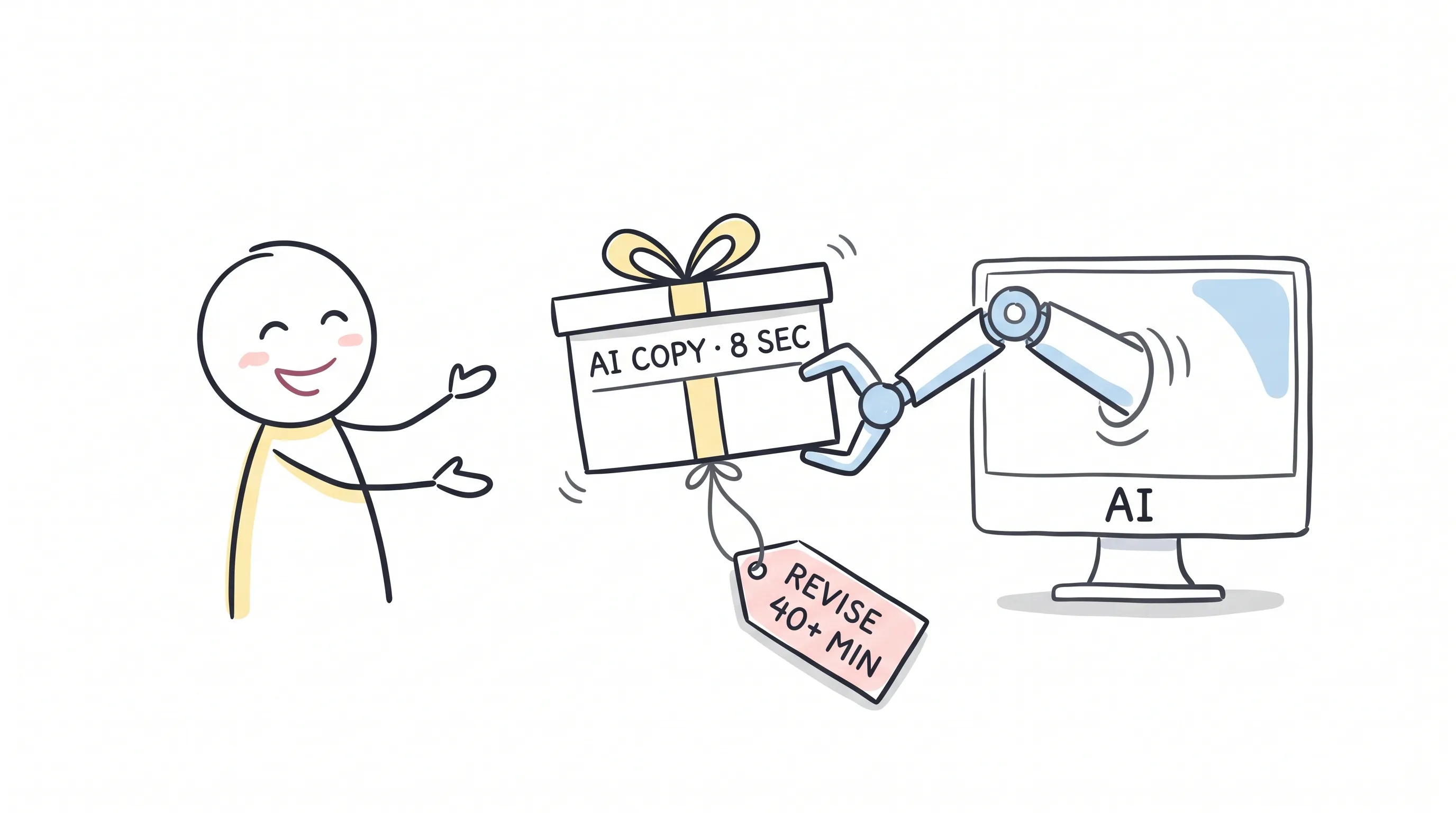
A few days ago, I asked ChatGPT to write an event opening for me.
Eight seconds.
Eight seconds, and it handed back a passage—smooth, coherent, plus two angles I hadn't thought of. I stared at the screen, a little dazed. Before, a piece like that cost me at least an hour of grinding.
It felt great. But once the buzz wore off, a question surfaced: the time it saved me—was it really mine?
Today, let's settle this account once and for all.
Why Marketing Pounced First
Some background first. At the end of 2022, ChatGPT launched. Within two months, it had 100 million users.
What is generative AI? Simply put, it's a bunch of things called large language models (LLMs) doing the work: you give them a sentence, they hand you back whole pages. They can write copy, write code, draw images—even write song lyrics.
And marketing, as an industry, was born a content factory. Ad copy, headlines, hashtags, blogs, posts, white papers, case studies... all year round, it churns out words and images.
Which is exactly what generative AI is best at: producing words and images.
So it surprised no one that in 2023 marketers were the first to pounce: ChatGPT, Bard, and Jasper for writing, Midjourney for images—nobody wielded them with more fluency.
Is the Time You Save Real?
In 2023, one survey of marketers worldwide found that 73% of respondents were already using generative AI on the job. Among these adopters, three-quarters were small-business owners and independent practitioners. Why? Because the decision was theirs to make—if they wanted to use it, they could start on the spot.
The benefits they listed were strikingly consistent: time saved, faster output, lower cost, higher volume.
Eugene Cheng, a strategy consulting partner in Singapore, said AI sped up his workflow by several hours. Ashley McAlpin, a marketing lead in Tennessee, put it more pointedly: her team no longer had to burn time on simple content and outlines; the hours saved went toward writing pieces with a real point of view. David Gómez-Rosado, who runs a design studio in the San Francisco Bay Area, did his own math: drafts no longer needed to be written by hand, and for non-creative work he didn't even need to keep a staff copywriter.
Pretty impressive, right?
But every coin has a flip side.
The people who pounced first turned out to be the loudest complainers. In the survey, three entries on the ledger kept coming up.
First entry: accuracy. AI will talk nonsense with a perfectly straight face—"hallucination," in the trade's lingo. It has invented titles for articles that never existed and pinned them on real reporters. Why? Because ChatGPT at the time was trained on data only up to September 2021. It knew nothing about anything that has happened in the world since. But it won't say "I don't know"—it just keeps making things up.
Second entry: can you publish it as-is? Nearly everyone who received copy from AI still had to run it through another round of human editing. Many had assumed that once AI wrote it, you could hit publish. The result? The time saved on drafting went straight back into editing. It's like buying a dishwasher and still having to rinse every dish first.
Third entry: do you dare sign your own name to it? AI's training data is stuffed with text and images taken without the authors' permission—and without payment. So is what it spits out plagiarism? Nobody will vouch for you. You have to run the generated content through search engines yourself and check it paragraph by paragraph. One respondent put it bluntly: AI is trampling other people's copyrights, and I don't want to support that.
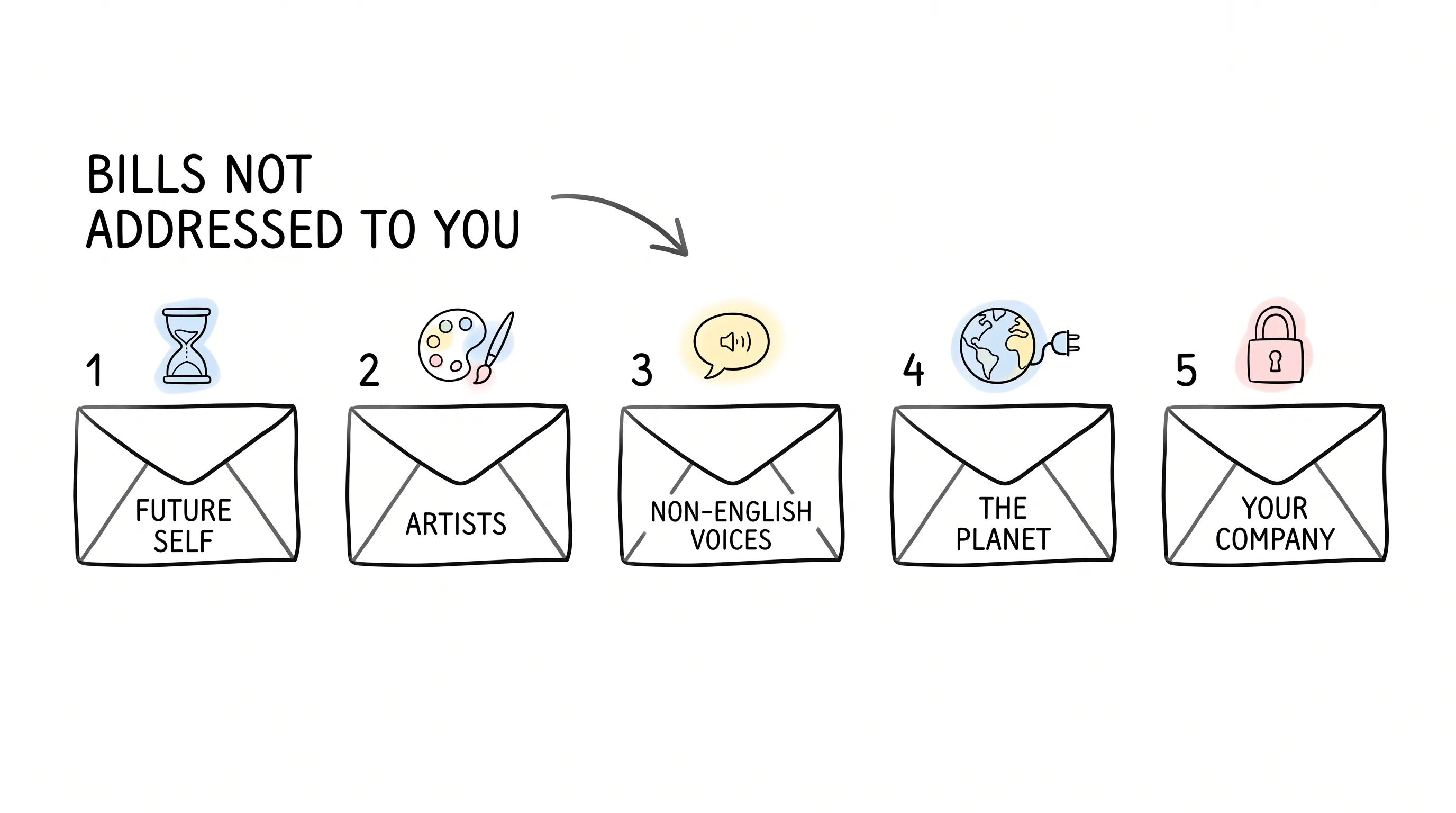
Marketers can see these three entries for themselves. But dig a little deeper, and there are more bills—bills not addressed to you, but to someone else.
A Few Bills That Don't Come to You
The first bill goes to your future self.
Youssef Hani, a tech marketer in Cairo, said something that stuck with me: what's scary isn't that AI writes poorly—it's that we can now produce first and never ask whether the content deserves to exist. If management chases nothing but immediate speed, what gets sacrificed is quality, and genuine thought.
It boils down to one question: Is AI a tool, or a crutch?
Muscles you don't use atrophy. So does creativity.
The second bill goes to the people whose craft was "learned" right out of their hands.
In San Diego there's a Don Litzenberg whose job title is fractional CRO (Chief Revenue Officer)—one person serving as an executive for several companies at once, renting out experience by the day. His worry: artists fed the models and didn't get paid a single cent.
There's a line to draw here. If you're a solo owner who can't afford a designer, AI doing the work for you is a good deal. But if you're at a big company, don't rush to cut the design team. The eye and experience of real people are still beyond AI—for now.
The third bill goes to the people whose voices were never loud to begin with.
What content were the models mostly trained on? English. Western. What they spit out is a copy of that same pile. Over time, content from the non-English world will sink bit by bit into the digital background. The digital divide was already there; now it stands to be stretched exponentially wider.
The fourth bill goes to the planet.
We've been down this road with cryptocurrency: in a single year, its mining devoured more electricity than the entire nation of Ireland. AI drinks power too. Bloomberg cited a 2021 study: training GPT-3 once consumed 1.287 gigawatt-hours. How much is that? The annual electricity use of 120 American households. Oh, and it emitted 502 tons of carbon in the process.
The fifth bill is the one that stings most, delivered straight to your company's front door: leaks.
OpenAI's terms of use state that content entered outside the API may be used to improve the models. What does that mean? Every line you paste into ChatGPT is not guaranteed to stay inside your company. In 2023, Samsung learned this the hard way: employees pasted in confidential source code.
And what passes through a marketer's hands every day? Client data, media plans, campaigns that haven't launched. This last one may be the real Achilles' heel.
So, Who's Accountable?
If an AI-written piece goes out and gets something wrong, does the bylined person bear the responsibility?
AI expert and Rebooting AI author Gary Marcus answered without pulling any punches: yes, they must. Marketers have to resist the temptation to use large language models to mass-produce garbage that no one stands behind.
Katrina Ingram, CEO of Ethically Aligned AI, added another layer: clients have the right to know how much AI went into the delivered work. And she pointed out that the mechanisms were laid on the table long ago—marketers have professional standards, media platforms have legal and ethical obligations, and ad copy itself has always had to answer to the laws of every category. AI is just the new guest; the rules are old.
Regulators haven't been sitting still, either. Back in 2023, US Senate Majority Leader Chuck Schumer was leading the push for AI legislation, the EU was laying the groundwork for what became its AI Act, and China had already put out a draft regulation.
The tools will keep evolving; people will keep using them—and keep misusing them. This push and pull, I'm afraid, still has many years to run.
Now, back to those eight seconds at the start.
That piece of copy from the other day—I ended up spending more than forty minutes revising it before I dared to use it. So did AI actually save me time? It did. And where did the saved time go? Into making sure the AI wasn't talking nonsense.
Here is the true ledger of the AI era:
Every bargain it hands you comes with a price tag attached. It's just that some tags face up, and others are pressed flat at the very bottom of the box.
May you snag the bargains—and never lose sight of the price tag.
Continue reading
Related articles

Cross-Border Business: Time to Upgrade Your AI Toolbox
A learn article explaining how AI tools help cross-border e-commerce sellers clear five hurdles: language, regulation, logistics, payments, and fraud. It outlines a five-compartment toolbox, a five-step adoption path, and metrics such as conversion rate and CLV, while cautioning against over-reliance on AI.

AI Is Taking Over the Dirty Work of Social Media Marketing, One Task at a Time
This learn article outlines four social media marketing tasks AI can handle — audience analytics, content drafting and design, ad targeting and creative testing, and spam moderation — and cautions that taste, judgment, and data security remain human responsibilities.

AI Is Already This Good — Why Is Your Social Media Marketing Still Pure Manpower?
An overview of 18 AI tools for social media marketing, organized into six categories covering audience research, content creation, scheduling, comment and DM handling, ad management, and visual production, plus notes on personalization, prediction, and emerging trends.