
AI Will Take Over 36% of Marketing. Your Opportunity Is Sitting in the Welcome Email
A data-heavy essay for e-commerce marketers arguing that AI adoption in marketing is certain but uneven, so teams should first complete core email automation flows such as welcome and cart abandonment, clean their data, and pilot AI agents with human oversight.
Last month, an old friend who runs a cross-border e-commerce business invited me to dinner. We had barely sat down when he pushed his phone across the table.
On the screen was a quote from a platform sales rep, with a headline built to impress and intimidate: "Agent-First Marketing Platform. A 2026 Must-Have."
He asked me: this thing — do we need to buy it?
I said, don't reach for your wallet yet. Let me run three numbers for you. When I'm done, you'll be able to answer yourself.
The First Number: Direction and Pace Are Two Different Things
In 2026, the marketing world has two kinds of numbers fighting each other.
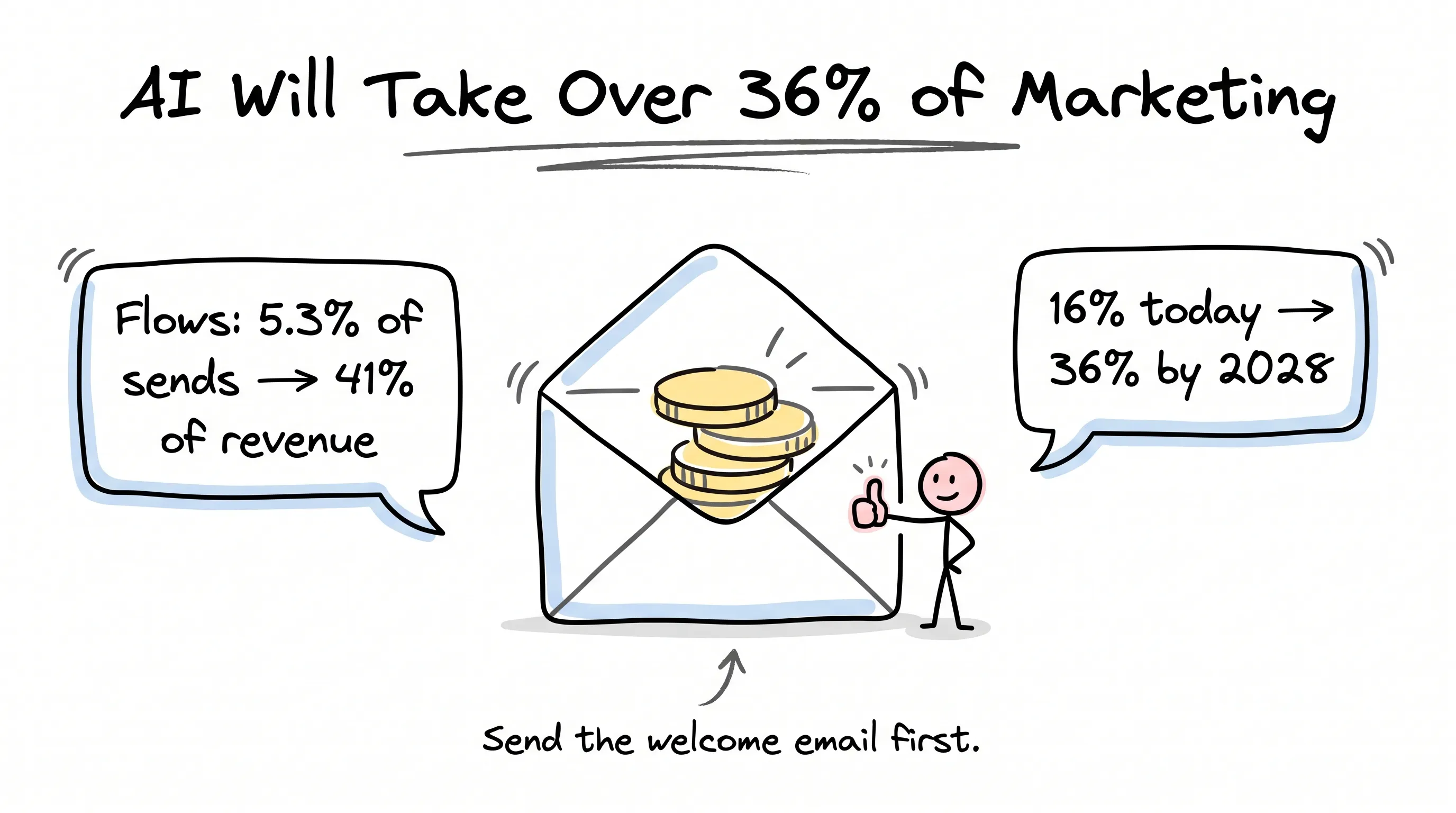
One kind is exhilarating. A Gartner survey released this May says that by 2028, AI will take over 36% of marketing work. What's the share today? 16%. Twenty percentage points in thirty months. Gartner has another prediction too: by 2028, 60% of brands will use AI agents to deliver one-to-one personalized outreach.
What's an agent? Think of it as an AI employee that does the work on its own, without you hovering over it every second.
The other kind of number is far more sober. Another Gartner survey: only 17% of enterprises actually run agents in production, and 42% are still stuck at "planning." Gartner also predicts that more than 40% of agent projects will be killed off before 2027. The causes of death aren't complicated: ROI they can't calculate, costs they can't contain, risk controls that never caught up.
You see it: the direction is certain. The pace is chaos.
Plan for the future. Budget for reality.
So my first answer to my friend: don't switch platforms. The cost of switching will likely exceed everything you'd save over the next eighteen months — in enterprise procurement, the sticker price often covers only about 30% of the true cost; the bulk hides in the fine print of implementation, storage, and support.
The Second Number: The Money Is Hiding in 5.3% of Your Sends
So where exactly is the money?
First, a concept. What is a flow? It's a pre-built sequence of automated touches: a customer does something — signs up, places an order, leaves the cart sitting there — and the system automatically fires off a series of emails or texts, pulling them back step by step.
The first time I saw Klaviyo's 2026 benchmarks, I paused: flows account for only 5.3% of email volume, yet generate nearly 41% of email revenue.
SMS is even more extreme. Flows make up 7.6% of send volume and drive 45.2% of revenue. Click-through rates on SMS flows hit around 10%, roughly twice an ordinary campaign, with top performers exceeding 16%. And 64.4% of SMS flow revenue comes from new customers — for a team living off repeat purchases, it's the handiest new-customer weapon there is.
The per-email math is even more brutal. Omnisend's data: an automated email earns $3.41 per send, a batch campaign just $0.155 — 22x. Conversion rate: 19x. Overall, marketing automation returns $5.44 for every dollar invested within three years, and 76% of companies break even in the first year.
Automated email isn't a time-saver. It's a money printer.
But hold on — don't rush off to research new tools. The real opportunity is here:
The three most valuable flows — welcome, cart abandonment, browse abandonment — account for 87% of all automated email orders. Yet it's 2026, and only 57.7% of brands send a welcome email at all. Of those that do, 41% have let it slip past 48 hours before sending.
So how good is a welcome email, really? A 35.53% average open rate and 2.11% conversion rate, far ahead of batch sends. A three-email welcome series brings in about 90% more orders than a single email. And if all four core flows (welcome, cart abandonment, browse abandonment, win-back) are fully in place, revenue per email can run up to 320% higher.
See it? The biggest automation dividend of 2026 isn't buying new tools. It's finishing what you started.
The Third Number: What Goes to AI, What Stays Human
My friend asked again: so what can AI actually do for me?
On the sales side, 87% of sales organizations are already using AI, and 54% of salespeople have personally used an agent. On the marketing side, Customer.io's data shows the most common uses are writing copy (68%) and drafting headlines (65%), saving an average of 6.1 hours a week. Meanwhile BCG's research offers a caution: 38% of AI-assisted campaigns still need rework on tone.
Here's a contrast I especially love: 87% of marketers use generative AI in at least one fixed workflow, but campaigns that are genuinely AI-driven account for only 15%. The gap between those two numbers is your space. By Gartner's projection, it will double by 2028.
My rule for dividing the work comes down to three sentences.
Sentence one: automate the reactions, humanize the decisions. Triggering, routing, scoring, surveying, timing — all reactions; hand them to the machine without worry. Pricing, launches, key-account conversations — all decisions; a human must be in the room. Michael Pattison, Klaviyo's head of digital strategy, put it plainly: being relevant across the entire journey matters more than forcing "personalization at scale" on every single channel.
Sentence two: manage send frequency like a compliance problem. 40% of SMS unsubscribes are the result of being bombarded. On email, keep complaint rates under 0.10% (the Google and Yahoo bulk-sender rules that took effect in 2024 set the ceiling at 0.30%), and let unsubscribes happen in one click. One more reminder: the EU AI Act's transparency obligations took effect this August — if you send AI-generated content at scale, you have to label it, or face fines up to €15 million or 3% of global revenue.
Sentence three: put a living person between the agent and the customer. HubSpot's service agents resolve 70% of conversations on average; top teams reach 90%. Great numbers. But the 40% of projects Gartner says will get killed? Most of them are missing exactly this layer of quality control. Ben Zettler, a veteran email marketer, said it well: no matter how fast the technology runs, someone has to be there to stop the things that should never go out.
The Foundation: Dirty Data Can't Produce Clean Growth
At this point my friend was getting restless. I told him there was one more number — the one that stings the most.
Automation is, at its core, an amplifier. If your CRM is dirty, your flows will show it to you: same dirt, higher frequency, amplified.
Migration data from 2026: 67% of enterprises discover serious data-quality issues mid-migration, 54% get delayed, and 43% drag their mess past the six-month mark after go-live. Earlier Gartner research put a price on it: poor data quality burns an average of about $12.9 million per organization per year.
There's one more layer many people can't untangle: CRM versus CDP. Simply put: CRM manages the relationship and interactions with customers; CDP collects, unifies, and activates customer data from everywhere. But Gartner predicted back in 2025 that by the end of 2026, more than 70% of enterprise CRMs would have CDP capabilities built in. Most of the time, you won't need to buy it separately.
For most teams, the automation bottleneck isn't the tool. It's the data table.
The Only Criterion for Picking a Platform
If the day comes when you really must pick a platform, forget the feature checklist. Ask one question: what actually triggers your revenue?
If cart events trigger it, go with e-commerce flow platforms like Klaviyo or Omnisend. If the sales cycle drives it, go with CRM-native platforms like HubSpot or Salesforce — the former's agent matrix revolves around CRM data; the latter spreads agents across the entire customer lifecycle. And for small teams that want AI embedded in a lean sales process, Zoho or Pipedrive will do fine.
One more reality check: the average marketing tech stack swaps out roughly a third of its tools every year. So don't bet "forever" on any single vendor. Data must be able to leave. Agents must not die the moment a vendor swaps models. Get both written into the contract before you sign.
So How Do You Spend the 90 Days?
Finally, I drew my friend a 90-day roadmap. Don't underestimate that length — it's long enough to ship something real, and short enough to kill a bad idea before it burns a full quarter.
Days 1–10: diagnose, then map. Lay out the customer lifecycle as a table: for every stage, what triggers it, what flows run, which channels are used, which KPI you watch. McKinsey's research says organizations that seriously analyze the customer journey are 30% to 40% better at predicting satisfaction and churn.
Days 11–30: clean the data. Align SPF, DKIM, and DMARC; get deduplication, consent, and syncing on your core tables fully working. Compliant senders see roughly 89% inbox placement; non-compliant ones watch 22% to 34% of their email drop straight into spam.
Days 31–60: launch the four core flows — welcome, nurture, cart abandonment, onboarding. The welcome email must fly out within a week, and flow revenue share should climb toward that 41% benchmark.
Days 61–90: pilot one agent, limited to 10% to 20% of conversation volume, measured against customer satisfaction and the human baseline. Working? Scale it. Not? Kill it.
When the 90 days end, hold a culling meeting: everything the data can't support gets taken offline. And while you're at it, upgrade your measurement: multi-touch attribution adoption hit 47% in 2026, essentially tied with last-touch; teams that can compute attribution clearly spend 23% more of their martech budget yet generate 1.6x the pipeline. You can't decide where the money goes until you can see it.
Gartner's "40% of projects will be killed" line? I don't think it's a tragedy. If you can kill things, your system is working.
Oh, and one last reminder: the technology is the easy half. Organizations with strong change management reach 90%+ adoption within 30 days; without it, only 40% to 50%, followed by a long, painful climb. Reserve 15% to 20% of your resources for training and hand-holding — no feature comparison table will spend that money for you.
Back to That Dinner
The math done, I tossed the question back to my friend: AI will take over 36% of marketing sooner or later — but did you send your welcome email correctly today?
He thought about it and smiled. That same week, the welcome series went live. The platform? Unchanged.
That's my answer for you. The age of agents really is on its way, but this moment isn't theirs to star in. First, launch all four flows. Clean your data. Assign AI a quality-control supervisor. Then, when 2028 arrives and it really does take over 36%, what you catch is the dividend — not the mess.
Here's to your welcome email flying out within five minutes.
Continue reading
Related articles

Cross-Border Business: Time to Upgrade Your AI Toolbox
A learn article explaining how AI tools help cross-border e-commerce sellers clear five hurdles: language, regulation, logistics, payments, and fraud. It outlines a five-compartment toolbox, a five-step adoption path, and metrics such as conversion rate and CLV, while cautioning against over-reliance on AI.

AI Is Taking Over the Dirty Work of Social Media Marketing, One Task at a Time
This learn article outlines four social media marketing tasks AI can handle — audience analytics, content drafting and design, ad targeting and creative testing, and spam moderation — and cautions that taste, judgment, and data security remain human responsibilities.

AI Is Already This Good — Why Is Your Social Media Marketing Still Pure Manpower?
An overview of 18 AI tools for social media marketing, organized into six categories covering audience research, content creation, scheduling, comment and DM handling, ad management, and visual production, plus notes on personalization, prediction, and emerging trends.