
AI Will Recommend You—and Also Talk Consumers Out of Buying: The Math Most Brands Haven't Done
An analysis of how AI chatbots shape shopping decisions: citing survey findings, the article argues chatbot answers can both recommend and talk consumers out of a purchase, and advises brands to address negative reviews since AI responses draw on publicly available feedback.
A while back, a friend of mine who runs an e-commerce business invited me out for tea.
He let out a sigh the moment he sat down: something strange was going on with his business. His ad campaigns hadn't changed, he'd reworked his product pages draft after draft, his store ratings were solid—and yet his orders were quietly slipping.
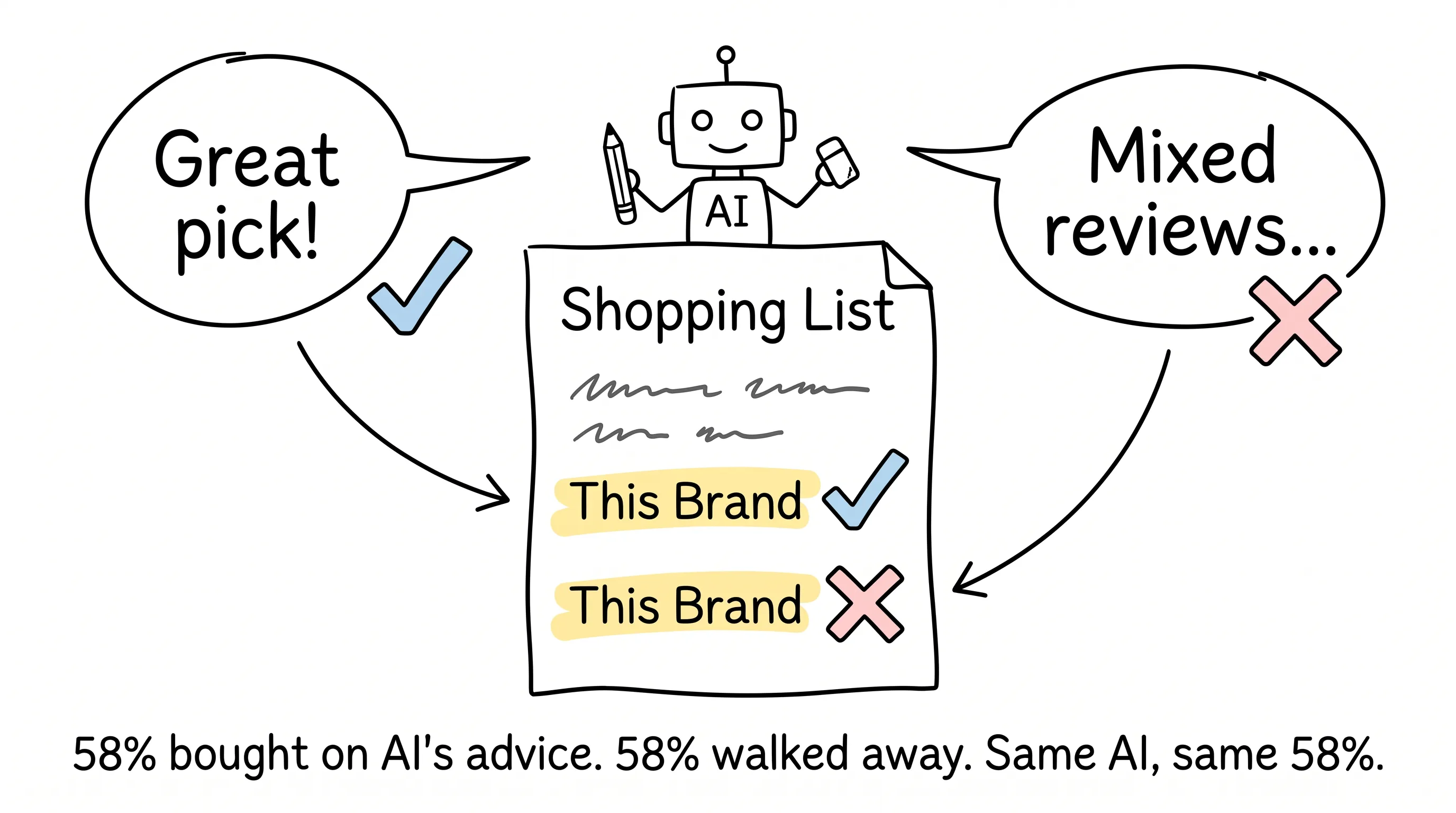
After ruling everything else out, he found a clue in his customer group. One customer said that right before placing an order, she had idly opened ChatGPT and asked: "What's this brand like—is it worth it?" The AI came back with a paragraph noting that the brand had gotten mixed reviews.
The customer decided: never mind, not buying it for now.
When I heard that, my stomach dropped.
Plenty of brands today are busy figuring out how to get AI to recommend them, without realizing the other side of the coin: AI will also talk people out of buying from you.
First, Look at the Numbers
Don't assume my friend is an isolated case. Semrush recently ran a survey of 2,338 U.S. adults, looking specifically at how consumers use AI for shopping.
Two numbers in the results left me speechless for a long while.
First: among consumers who have used AI, more than half have abandoned a purchase based on the information a chatbot gave them.
Second: among people who habitually shop with chatbots, that figure approaches 81%. In other words, of every 100 people who treat AI as their shopping advisor, roughly 81 of them have put an item they were about to buy right back on the shelf—all because of one remark from AI.
Let that sink in.
Every time we've talked about AI's impact on marketing, the conversation has been "how do I get AI to mention me?" and "how do I squeeze into AI's answers?" That's the right direction—but only half right.
AI isn't just another exposure channel. What it holds is the power to recommend—and the power to veto.
What Does the Power to Veto Look Like?
Let me break down a few numbers for you.
Start with the recommendation side. 58% of AI users have bought something a chatbot recommended. And the more often they use it, the more they take its advice: among people who use AI several times a week, more than 80% have spent real money on products AI recommended.
Now the veto side. An identical 58% of AI users have walked away from a purchase because of the information a chatbot gave them. One side pushes hard; the other side blocks hard—and the ratios on both sides are exactly the same.
Think about what that means.
You probably know people like this: they used to ask friends and coworkers before buying; now they just ask AI. If AI says it's good, they place the order. If AI says the reviews are full of complaints, they close the tab.
And AI undercuts you in the most painful way possible: it digs up the reviews and serves them to you on a platter.
More than 74% of consumers say that if a chatbot mentions in its answer that a product's reviews are mixed or mostly negative, their willingness to buy drops immediately. Among AI users, that number tops 85%.
Before, negative reviews were buried on page two of the review section, and shoppers couldn't be bothered to dig. Now AI has dug them up on the shopper's behalf—and highlighted the key points.
Of course, flipped around, the opportunity is just as real. Nearly 59% of AI users have discovered new brands and new products through chatbot recommendations. And 71% of them believe chatbots can recommend the best brands and products.
So it can write your name onto the shopping list—and then turn around and cross it off. And both of these things can happen within the same conversation.
So, Is Nobody Using Google Anymore?
At this point you might be thinking: that's it—everyone's off asking AI now, search is doomed?
I thought so too, at first. Then I read the data and found otherwise.
Across all consumers, only 29% use AI chatbots to do their shopping homework. For all the noise around AI, most ordinary people still buy things the old way.
But among people who use AI every week, that number jumps to 55%. And when this group researches purchases, they reach for chatbots more often than they ask friends and family, scroll social media, browse retail sites, or watch YouTube. Only search engines and reviews still rank ahead of it.
What's more, 65% of AI users admit that chatbots have already taken over some of the shopping searches they once would have run on Google.
Sounds scary, right? Yet in the same survey, nearly half of respondents said that over the past year, the total amount of shopping research they do on Google hasn't really changed.
So what does this tell us?
AI hasn't taken over anyone's territory. It's a new neighbor who just moved in.
The consumer decision journey always had several stages: run a search, skim some reviews, drop by the official site, ask a friend. Now there's one more gate on that path. The same shopper could easily, within a single purchase, search Google first, then flip through reviews, and casually ask AI along the way.
A longer chain means more checkpoints where a brand can lose points. It used to be enough to guard your search rankings and your reputation. Now, every AI conversation is a fresh round of vetting.
So Can I Just Buy an Ad in There?
Many people's first reaction: just run ads inside AI—problem solved?
Not that simple. The math has to be done in two steps.
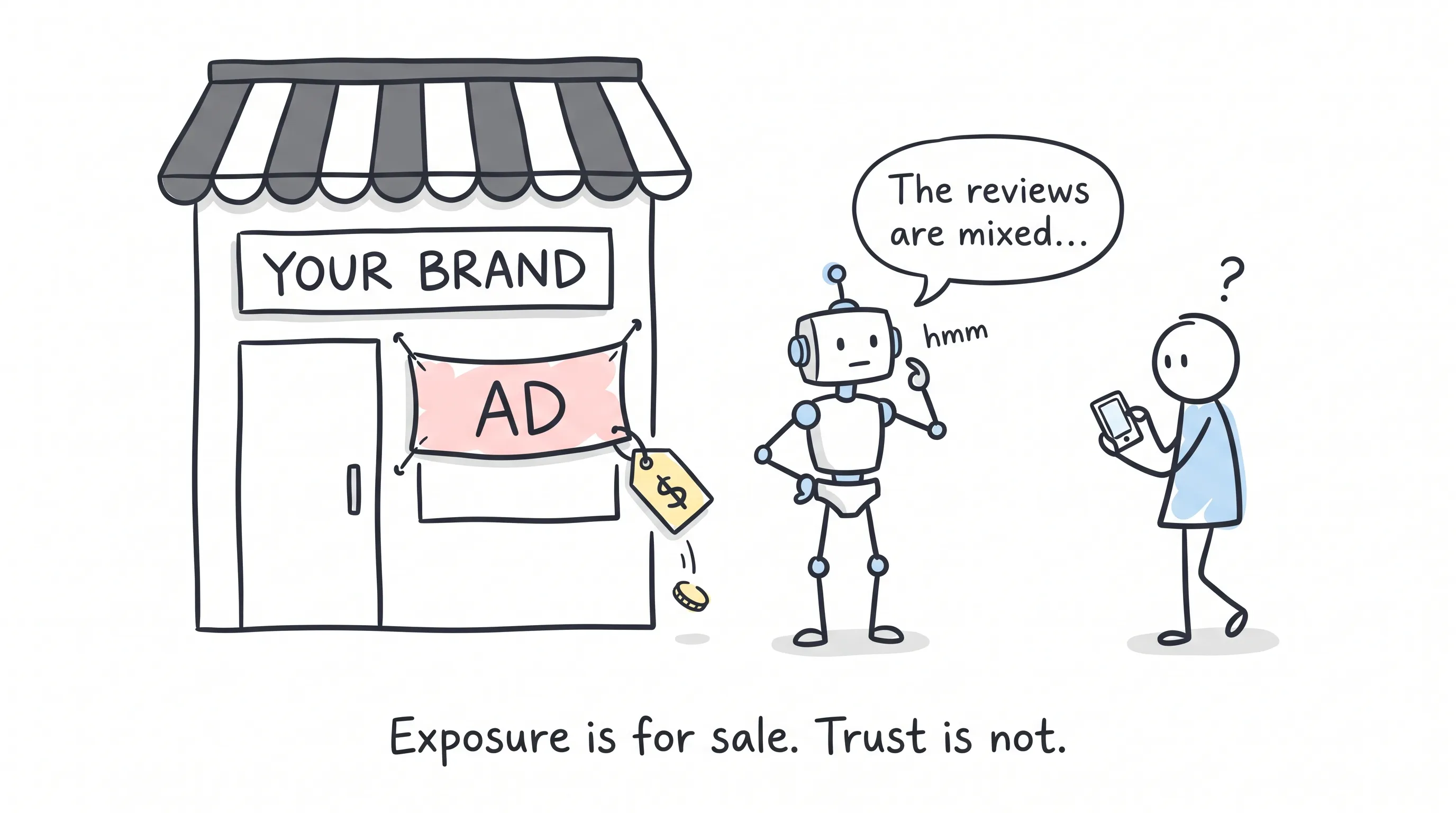
Step one: exposure. Ads really can put your brand right in front of users' eyes. That part, money can take care of.
Step two: the answer. After seeing the ad, the user will most likely follow up with: "So how good is this product, actually? Compared with the other one, which should I pick? Has anyone complained about it? Is it worth the price?"
And what the AI says at that moment is beyond any ad placement's control.
You can buy the banner over its door, but you can't buy the words out of its mouth.
And that money has side effects, too. In the survey, 42% of consumers said they dislike chatbot ads, only 20% like them, and the remaining 38% feel nothing either way. The real trouble is with the people who dislike them: 66% of them said that seeing ads inserted into a chatbot makes them start to question whether the AI's answers are fair at all.
Play this move clumsily, and even your otherwise spotless organic recommendations get dragged down with it.
Paying gets you the stage; it doesn't buy the applause. Exposure is something you can buy. Trust isn't.
Finally, Back to My Friend
Later, I told him: stop fixating on how to get AI to mention you. Go back, pull up your store's negative reviews one by one, list out the points users complain about most, and deal with them one at a time.
Because the questions consumers bring to AI changed a long time ago.
It used to be: "Which brands make good stuff?"
Now they also ask: "Is this brand reliable?" "Are those bad reviews real?" "Might the other one be better?"
You can't control how AI answers. But where its material comes from—that's up to you.
Your product, your reviews, every word you leave on the internet—that's the confidence AI draws on the next time it opens its mouth.
Here's to holding up when AI gets asked about you.
Continue reading
Related articles

Cross-Border Business: Time to Upgrade Your AI Toolbox
A learn article explaining how AI tools help cross-border e-commerce sellers clear five hurdles: language, regulation, logistics, payments, and fraud. It outlines a five-compartment toolbox, a five-step adoption path, and metrics such as conversion rate and CLV, while cautioning against over-reliance on AI.

AI Is Taking Over the Dirty Work of Social Media Marketing, One Task at a Time
This learn article outlines four social media marketing tasks AI can handle — audience analytics, content drafting and design, ad targeting and creative testing, and spam moderation — and cautions that taste, judgment, and data security remain human responsibilities.

AI Is Already This Good — Why Is Your Social Media Marketing Still Pure Manpower?
An overview of 18 AI tools for social media marketing, organized into six categories covering audience research, content creation, scheduling, comment and DM handling, ad management, and visual production, plus notes on personalization, prediction, and emerging trends.