
AI Spoiled Your Customers. Now It Can't Deliver.
A commentary on Alchemer's 2026 AI and Customer Expectations Survey, arguing that AI raises customer expectations faster than it improves experience. It highlights the top complaint of not reaching a human when needed and suggests tracking repeat contacts, reopen rates, and true resolution time.
A few days ago, Alchemer released a report, the 2026 AI and Customer Expectations Survey. They asked roughly two thousand American consumers a refreshingly simple question: knowing that a company uses AI, what would you think?
The results caught me off guard.
Nearly sixty percent said that if they know you use AI, they simply assume you must respond faster. At the same time, 89% said AI has botched their experience in at least one instance.
What does that mean?
AI raises customer expectations faster than it improves their experience.
You use AI to make your back office fast and smooth, and customers won't think you've improved. They will just decide that fast is what you owe them. Next time, they want it faster still.
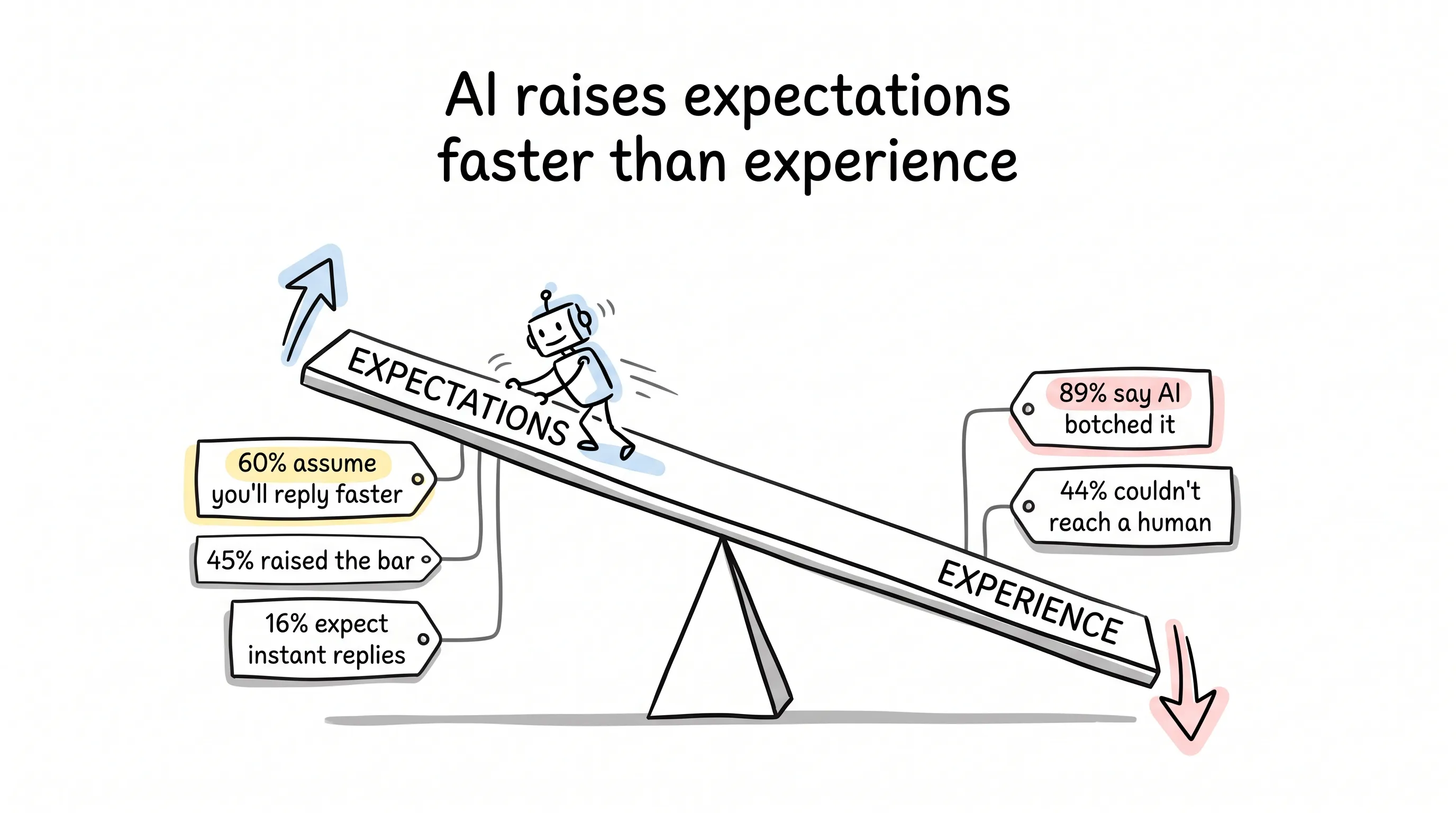
45% of people said AI's advances have raised their overall expectations of every company. Nearly 30% expect their feedback to be acknowledged within 24 hours. 16% go further: immediately.
And that's just expectations. What if those expectations can't be met?
The Biggest Pain Point? Not Privacy
You would assume the anger about AI customer service centers on privacy, wrong answers, or unreliable recommendations.
The survey says none of the above.
The number-one complaint, at 44%, is not being able to reach a human when you need one.
Good grief. Think about it: why did we adopt AI in the first place? To cut costs. And how do you cut costs? By using fewer people. Yet the customer's biggest grievance is precisely "I want to reach a person, and you just won't give me one." Every dollar of labor cost you save is being logged on the customer's side as resentment.
And the sting cuts deeper.
Fast Isn't Enough
Customers do want AI to speed things up: 38% want their problems resolved faster — the loudest ask of all; 34% want faster replies.
But one in five says that with AI, their problems actually took longer to solve. And 30% say they were forced to submit the same information over and over again.
This slams one question onto the table: how you measure automation determines how good you think you are.
Many teams watch just two numbers: first response time and resolution rate. Both look great. The bot replies in seconds; the ticket gets marked "resolved."
And then? The customer comes back on another channel — still chasing the same unresolved problem. Neither of those two numbers can see that happening.
So what should you watch? Repeat contacts, reopen rates, and how long a problem truly takes to resolve from start to finish. Those numbers are ugly. But they're real.
What Matters More Than Personalization? Being Understood
There's another set of numbers in the survey I stared at for a long time.
37% received an AI reply that completely failed to understand their question. 26% got wrong information. 19% got irrelevant recommendations.
So 29% say they want AI to understand their needs better; 24% want the experience to be more relevant and personalized.
Notice: "understand me" ranks ahead of "personalize for me."
Customers don't want you to know them. They want you to understand them.
A system can hoard ten thousand tags about you, but as long as it hasn't figured out "what does this person actually want right now," it will still miss the point entirely. AI missing the subtext and misreading the context is a stubborn old problem. Adding another thousand attributes to the user profile won't cure it.
So what do you do? Take your customer-service AI and test one thing: whether it actually understands what the customer is trying to accomplish. Whether its answers are correct is a separate matter. Then set confidence thresholds — when the system isn't sure, make it go get a human, no pretending.
There's no shame in that.
The Most AI-Savvy Users Are the Hardest to Please
And here's a particularly interesting pattern.
The more people use AI, the pickier they get.
Among daily AI users, 40% find AI service cold and impersonal; among occasional users, only 22% feel that way. Heavy users are also more worried about AI reaching conclusions with nothing to back them up.
The more you see, the higher your standards. You can fool someone meeting AI for the first time. You cannot fool the crowd that lives inside it every day.
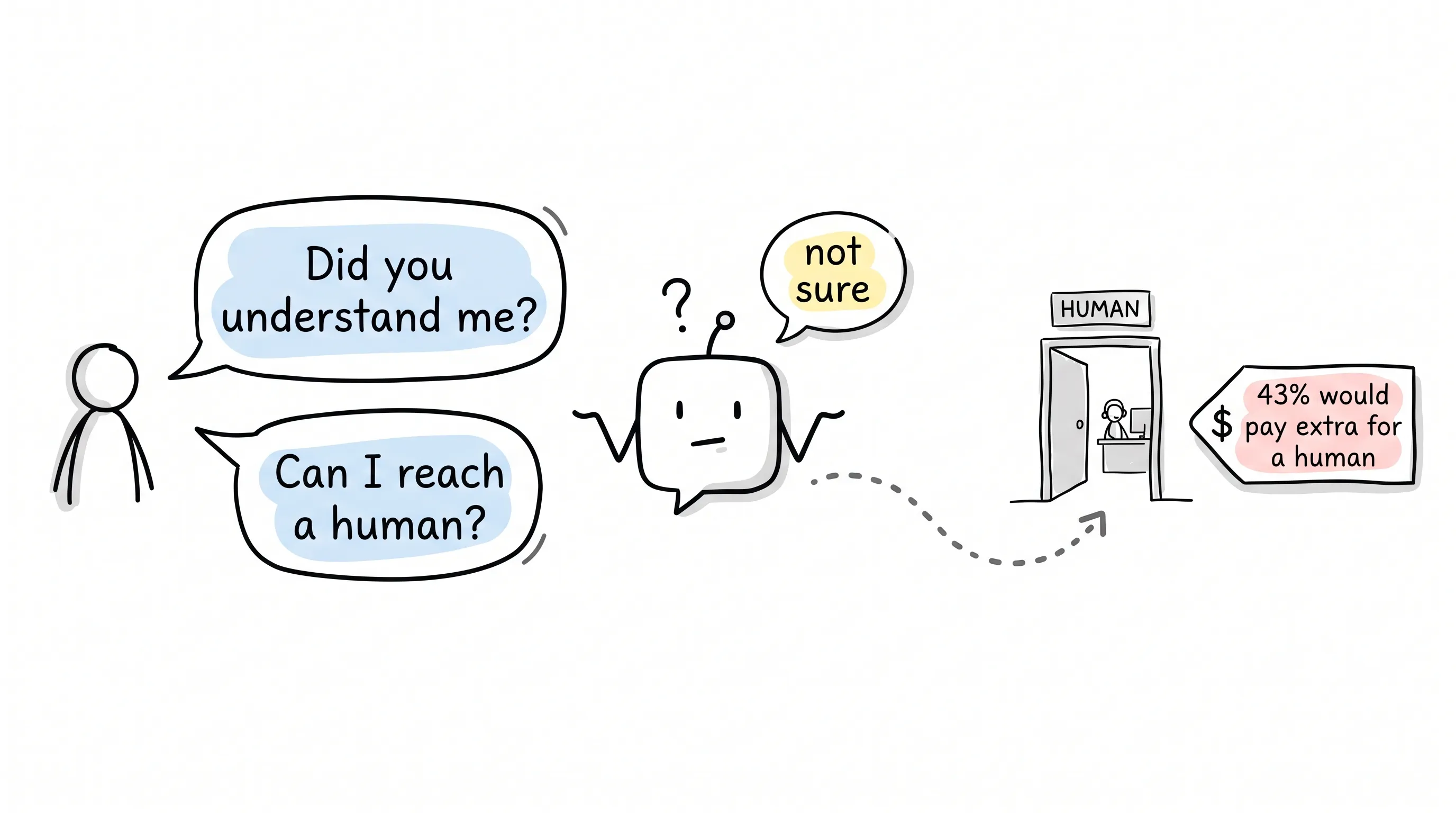
And these picky people are willing to pay. 27% of daily AI users say they would pay extra for a guarantee of reaching a human. Among low-frequency users, that figure is only 10%. Across everyone, 43% of consumers would pay more for a product or service that guarantees a human.
Customers paying for something that used to be free is obviously a plus on the books.
But put yourself in the customer's shoes: who is happy about paying again for something that should have been there all along?
Is this good news? Yes — and no.
One way or another, next time, your customer won't ask you "do you use AI?" They will ask only two things: Did you understand what I said? When I need a person, are you there?
Here's hoping your AI can always handle those two questions.
Continue reading
Related articles

Cross-Border Business: Time to Upgrade Your AI Toolbox
A learn article explaining how AI tools help cross-border e-commerce sellers clear five hurdles: language, regulation, logistics, payments, and fraud. It outlines a five-compartment toolbox, a five-step adoption path, and metrics such as conversion rate and CLV, while cautioning against over-reliance on AI.

AI Is Taking Over the Dirty Work of Social Media Marketing, One Task at a Time
This learn article outlines four social media marketing tasks AI can handle — audience analytics, content drafting and design, ad targeting and creative testing, and spam moderation — and cautions that taste, judgment, and data security remain human responsibilities.

AI Is Already This Good — Why Is Your Social Media Marketing Still Pure Manpower?
An overview of 18 AI tools for social media marketing, organized into six categories covering audience research, content creation, scheduling, comment and DM handling, ad management, and visual production, plus notes on personalization, prediction, and emerging trends.