
AI Slashed Content Costs — but You Can't Settle This Ledger Halfway
This article examines how AI content marketing saves time and cost while creating hidden risks such as flattened brand voice, unverified facts, and skill atrophy. It outlines a three-layer human review process and four starting scenarios including SEO content and product descriptions.
Last week, a friend of mine who runs a small-appliance brand showed me their content dashboard.
One product write-up: AI drafts it in about fifteen minutes. A month's output: several hundred pieces. He was proud of it — content costs, cut by two-thirds.
I asked, casually: has any of this AI copy ever blown up on you?
He paused.
Turns out it had. Last month, one product promo post went out with specs the AI had made up. Customers got their orders, found the numbers didn't match, and complained all the way to the store. PR spent two days smoothing it over before it died down.
I told him: that wasn't bad luck. You've simply booked half the bill in a place you can't see it yet.
Over the past couple of years, using AI for content has become routine for marketing teams. Blogs, emails, product descriptions, ad copy — text models like ChatGPT and image models like DALL·E all get a hand in. Fast, cheap, and the output volume is staggering. But most teams do the accounting the way my friend did at first: they count what's saved, not what comes due later.
Today, let me run you through the whole ledger.
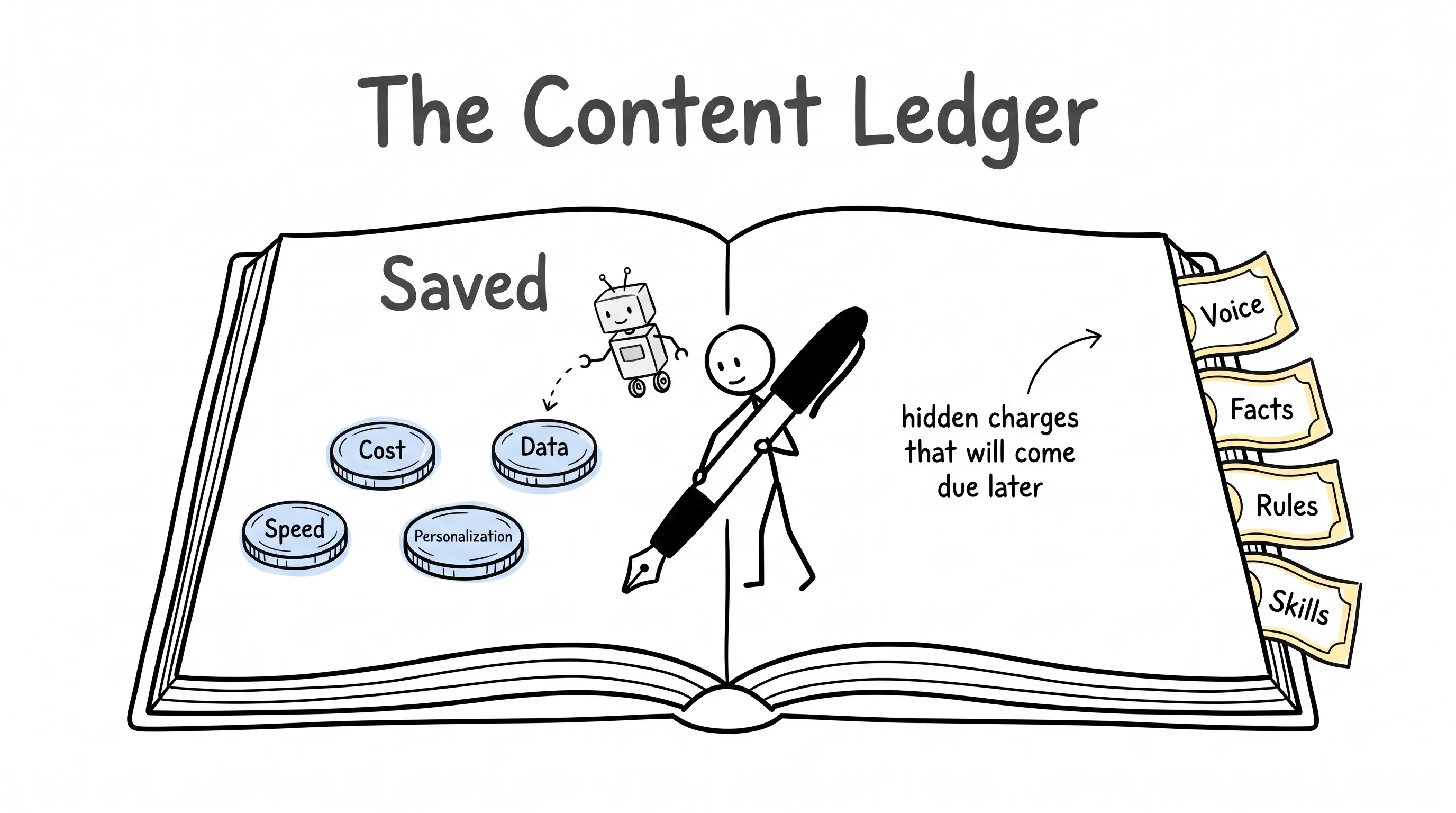
First, What Exactly Is AI Saving You?
What is AI content marketing? Simply put: the machine does the first pass, the human does the last.
Writing one blog post used to mean topic selection, digging up sources, a first draft, two rounds of edits — at least a full day gone for a copywriter. Now you toss your keywords and requirements to ChatGPT, and fifteen minutes later a draft that looks the part is on your screen. Your job is to edit.
Run the numbers — what a deal that is.
An e-commerce brand with 2,000 SKUs of product descriptions once had to keep a small team writing for two months. Now AI generates every entry, people spot-check and revise, and the job wraps in two weeks. Recruiting costs, management overhead, turnover risk — all gone.
Small teams can finally match the big players on output. They never could before — ten copywriters on their side, one on yours. In front of the machine, everyone's capacity sits in the same order of magnitude. Game changer.
And it's not just the savings.
Personalization opened up too. One email used to go to every customer; now you split by segment — a familiar tone for loyal customers, a hook for new ones, a win-back message for the dormant — each with its own language. Open rates and conversion rates genuinely climb.
Topic selection sped up as well. Plug the tools into the data, and within minutes they'll lay out which topics are climbing and which keywords still have an opening. An argument that used to consume an entire editorial afternoon now takes a coffee break.
Efficiency, cost, personalization, data — all four gains are real. I've watched plenty of teams get giddy at this stage.
But everything has a flip side.
The Money You Save Gets Charged Back in Four Places
Let me count them off, bill by bill, ordered by how often I've seen each one blow up.
The first bill, and the most common: your voice gets sanded flat.
AI writes like the average of everything out there. It has read the entire internet, so what it produces is the least-bad version — and the dullest one.
What is brand voice? It's when readers know it's you with their eyes closed. Some brands, one glance at the copy and you know who wrote it. Other brands, you couldn't pick them out without the logo.
Let the machine write everything, and within three months your WeChat account looks about the same as any other AI-powered brand's. Correct. Fluent. Boring.
That's how a brand writes itself out of existence.
The second bill, the deadliest: factual blowups.
That complaint my friend ran into? This is the bill it came from.
Here's a baseline fact to internalize: AI completes patterns; it does not verify. It has read oceans of product copy, so it knows what specs "usually look like" — and then it fills in the most plausible-sounding one for you.
Note the wording: plausible-sounding, not true.
ChatGPT will invent a feature that doesn't exist; product images from an image model may not match the real thing in the details. It doesn't fact-check; it fills in the blank. So every number, every spec, every date that comes out of AI has to be treated as unverified before it ships. No exceptions.
The third bill comes from outside: the rules are tightening.
Copyright, data provenance, the legality of training data — none of these disputes are settled yet. But one thing is already clear: consumers have started to care.
"Was this written by a person or a machine?" Nobody used to ask. More and more people ask now. Legally, disclosure isn't always mandatory; on the trust ledger, hiding it is always a deduction.
My call: transparency is shifting from a bonus to the passing grade. Say it early, say it up front — there's no shame in it.
The fourth bill is the best hidden: people get lazy.
It's also the one I worry about most.
Once the machine handles the first draft, people should move up to the work that's worth more: strategy, insight, story. Yet plenty of teams outsource the thinking too — AI proposes the topics, AI invents the takes, AI even makes the calls.
A year on, the output is still there, but the team's craft is gone. And the day you need a piece that truly carries the brand, you discover nobody knows how to write it anymore.
AI's job is to pull people out of the grunt work. Not to think for them.
So What Do You Do? Three Layers of Defense — Skip None of Them
Here's the plan I later gave that friend.
Layer one: humans set the direction. AI can write ten thousand words, but "who we are, who we're talking to, and what we say" is not its call. Positioning, audience, the brand's attitude — a person has the final say. However strong the machine gets, it doesn't know where your business is headed.
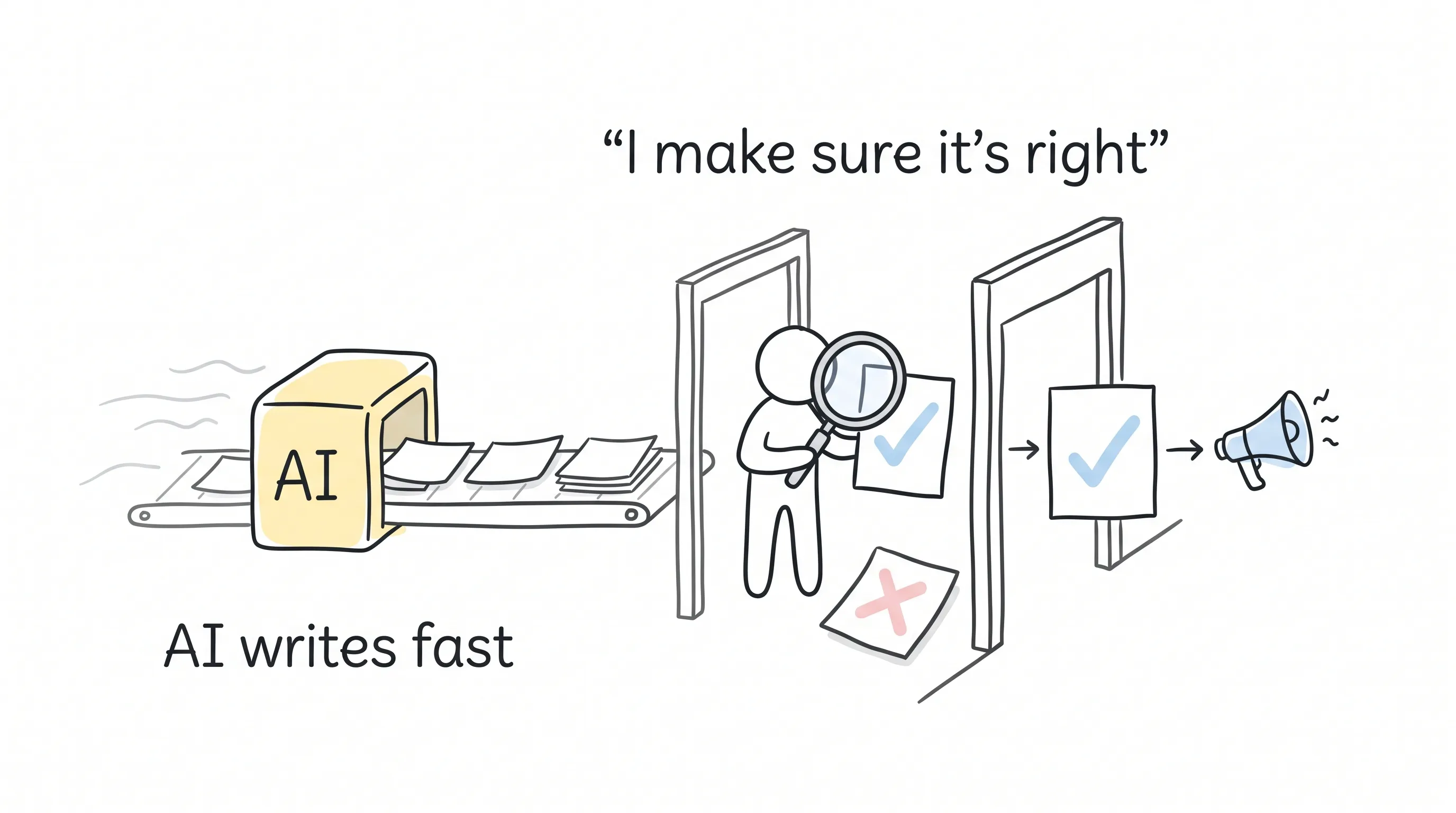
Layer two: humans hold the final gate. Every AI draft passes through a person before it ships — verify the facts, check the tone, cut the correct-sounding fluff that says nothing. The cost of this step is non-negotiable. Every cent you shave off it, the brand absorbs as risk. My friend's spec incident was exactly this gate left unguarded.
Layer three: the team keeps learning. This field changes every few months; each model upgrade rewrites the playbook. Set a rule: every quarter, the team reviews the tools' new capabilities and the industry's latest blowups. There's a tenfold gap in output between people who know how to use these tools and people who only know where the generate button is.
Where to Start? Four Scenarios to Run First
Don't start by asking AI to write your brand manifesto — that's throwing your softest punch at the hardest wall. Put it on repetitive work first.
One: SEO content. Have it produce structured outlines with keywords already placed; you fill in the opinions and the examples. The volume builds and the publishing rhythm settles.
Two: product descriptions. Hundreds or thousands of SKUs — no human can write them all. AI drafts every entry, people spot-check a sample. This is its highest-ROI use.
Three: ad and social variants. For one product, have it write ten headlines, throw them out there, and let the data tell you which one works. This is what it's best at.
Four: email segmentation. Adjust subject lines and phrasing by segment — one master message split into eight versions.
These four scenarios share three traits: high volume, high tolerance for error, and results you can verify with data. Check all three boxes before you move toward core content. Don't get the order backwards.
Looking Ahead, the Dividing Line Only Gets Sharper
Voice search optimization, predictive content generation, AI-assisted video production — all of these are heating up, and whoever gets there early keeps collecting the dividends.
But the other end is shifting too: readers' expectations of authenticity are rising right alongside output.
The more content the machines mass-produce, the scarcer content with human warmth becomes. And scarce things command a premium.
So my conclusion has always been clear: don't treat AI as a shortcut. It's an amplifier. When your strategy is sharp, it amplifies your efficiency; when your team is coasting, it amplifies your mediocrity.
Back to That Friend
Last month he had me out to dinner again and walked me through the new process: AI drafts, a human verifies every spec and offer detail one by one, the copy lead gives the final sign-off; the brand's messaging habits and its list of off-limits claims go straight into the prompts.
Output didn't drop. Complaints disappeared.
He said something I think everyone in this business should tape to the wall: "AI writes fast. I make sure it's right."
The AI content marketing contest was never about who produces the fastest. It's about who dares to stand behind the machine and guard the gate.
Here's hoping every dollar you save is a dollar you never repay — double — somewhere else.
Continue reading
Related articles

Cross-Border Business: Time to Upgrade Your AI Toolbox
A learn article explaining how AI tools help cross-border e-commerce sellers clear five hurdles: language, regulation, logistics, payments, and fraud. It outlines a five-compartment toolbox, a five-step adoption path, and metrics such as conversion rate and CLV, while cautioning against over-reliance on AI.

AI Is Taking Over the Dirty Work of Social Media Marketing, One Task at a Time
This learn article outlines four social media marketing tasks AI can handle — audience analytics, content drafting and design, ad targeting and creative testing, and spam moderation — and cautions that taste, judgment, and data security remain human responsibilities.

AI Is Already This Good — Why Is Your Social Media Marketing Still Pure Manpower?
An overview of 18 AI tools for social media marketing, organized into six categories covering audience research, content creation, scheduling, comment and DM handling, ad management, and visual production, plus notes on personalization, prediction, and emerging trends.