
AI Quintupled the Output — So Why Is His Team More Exhausted Than Ever?
An essay on why AI-boosted content output can leave marketing teams more exhausted: production speeds up while review and approval bottlenecks remain. Citing Adobe and McKinsey research, it advises fixing one workflow end to end, trimming approvals, and testing one variable at a time.
A few days ago, I had dinner with a friend who runs a consumer brand.
His marketing department brought in AI this year. Copy, posters, short-video scripts — you hand over a brief, and in less than half a day, a dozen-odd versions are sitting there, all neat and ready. Output capacity quintupled.
I asked him: so things must be a lot easier now?
He said: quite the opposite. The team is more exhausted than before.
Why?
Because all the work piled up in the back half of the process.
So today, let's break this thing open. In all my years of consulting, this is the first time I've been this eager to tell people: do less.
What Do I Mean by "Indigestion"?
What AI solved was the speed of production.
But between the moment a piece of content is made and the moment it goes out, there's still a long chain of things: someone has to review it, someone has to verify the claims, someone has to confirm the messaging hasn't drifted, the assets don't infringe on anything, and the brand hasn't lost its shape.
AI hasn't spared you a single one of those tasks.
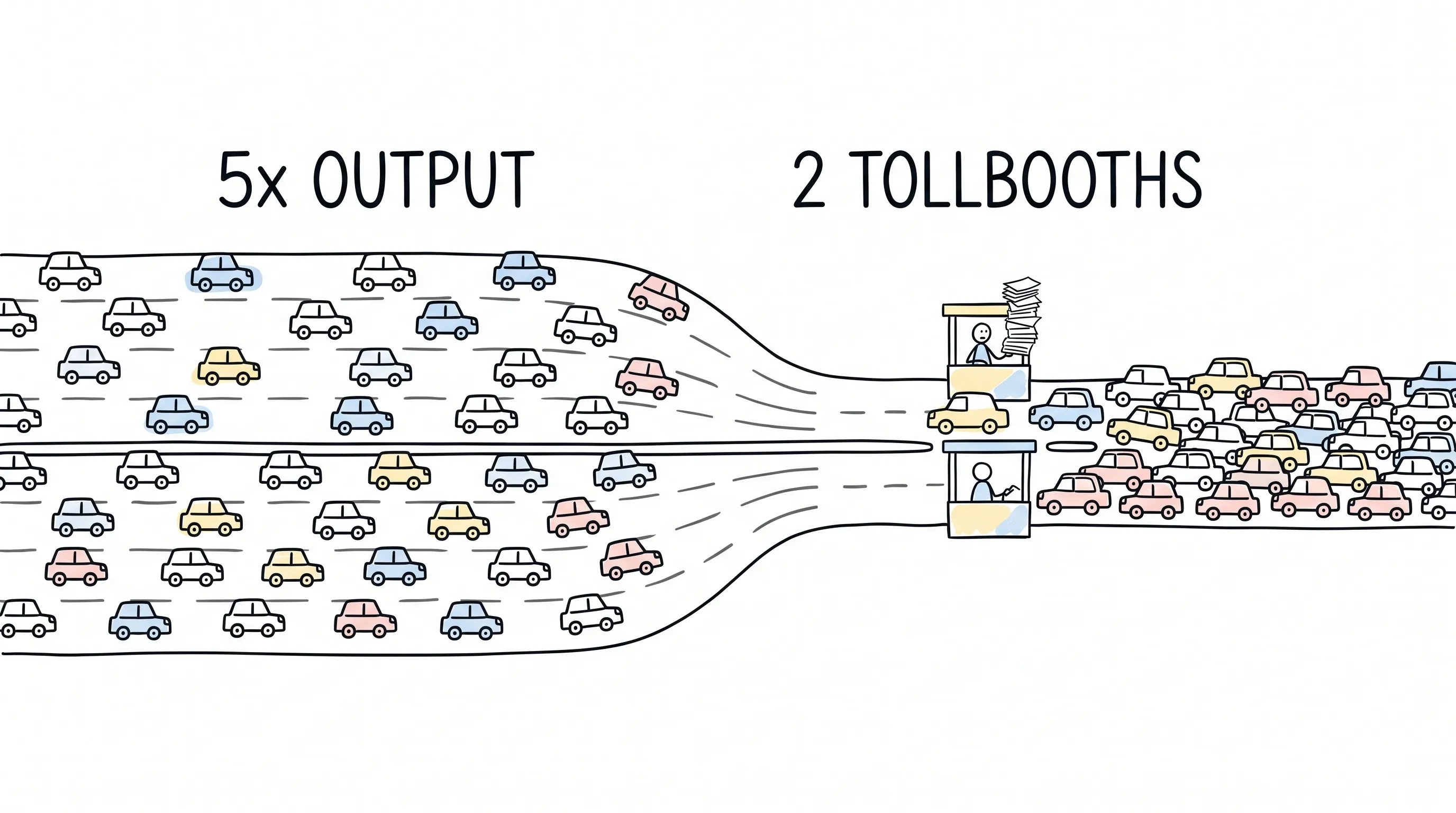
The result: the production highway widened from two lanes to eight, while the approval road still squeezes through the same two tollbooths as before.
The more cars, the worse the jam.
Where does it jam? Think back to your own company — where does content usually get stuck?
Is it that the first draft never gets written?
Occasionally. More often, it's that the brief itself was never clear, or three people handed down three sets of conflicting feedback, or there's a decision that nobody actually has the authority to make.
Throw forty new versions at these bottlenecks and not one of them gets solved. You just get more work, and shorter tempers.
Let's Run the Numbers
In 2025, Adobe ran a survey of more than 1,600 marketers. 89% said a piece of content passes through at least three approvals between creation and publication. 58% said they spend over 40% of their time managing reviews and approvals.
Forty percent. Good grief.
Work five days a week, spend two of them reviewing. Only in the remaining three days do strategy and game plans get a turn. That's how so many managers' calendars fill up.
Let's keep going. Suppose a piece of content goes through three approvals at half an hour each — a hundred pieces comes to 150 hours. What does that mean? Nearly a month of one person's work.
Back when it was twenty pieces a week, approvals burned an hour at a time, and you could bear it.
What about a hundred pieces a week now?
You have only two options: turn yourself into a full-time reviewer, or hire someone whose whole job is reviewing.
Whichever you pick, the money AI saved gets spent somewhere else.
So don't just ask how much AI can help us produce. The more important question is: how much can our organization digest?
No matter how brilliant the chef, the guest has only one stomach. Creative, legal, brand, media, data analytics — each link in the chain can only push so much through in a day.
This is a stomach problem, not a cooking problem.
That said, AI has done one enormous favor that most people haven't spotted: it has shone a light on every bottleneck in the process.
Back when volume was small, the bottlenecks stayed tucked away. Now that output has grown fivefold, exactly where it jams — and for how long — is plain at a glance.
Tasting a Dish and Putting It on the Menu Are Two Different Things
So should you scale output up or not?
Scale it up. More ideas are always a good thing — they let you see plays you would never have thought of otherwise.
But not every idea deserves a trip through the approval queue.
Here's an analogy I like. Every good restaurant has a test-kitchen stage in the back. In the test kitchen, anything goes — the stranger, the better. But before a dish makes it onto the official menu, it has to clear a different gate: Is it reliable? Is it affordable? Will guests actually order it?
Tastings: the more, the merrier. Menu items: be choosy.
Applied to content, before anything enters the approval queue, it should clear three questions: Who is this piece for? What is it meant to achieve? What makes it better than the one you already have?
If you can't answer, don't get in line yet.
Some people say that pouring out more content always buys growth — nudge the click-through rate up 0.1%, multiply it across a big enough base, and that adds up to real money.
Maybe. But time and again, the ideas that truly move people beat the ones that have been optimized until they're rigid. Piling the approval queue high won't buy you a single good idea.
Testing is the same.
A lot of teams "test" like this: swap the headline, swap the image, swap the offer, swap the audience too. And the results did get better.
And then?
And then you have no idea who to thank.
Move four variables at once and the team wins the game — does the credit go to the coach, the tactics, or the players? Nobody can say. Next time you want to win, all you can do is move all four again and roll the dice.
A real test moves one variable at a time. Validate headlines this month, creative next month, stacking up little by little. AI can help here: gathering the historical conclusions scattered across cloud drives and asset libraries into a team memory that grows richer the more you use it.
But there's one thing it can't help with: honest interpretation.
If the test says it works, say it works. If it's unclear, admit "we don't know yet."
I would rather hear "we don't know yet" in a meeting than watch a vague, non-committal result travel all the way up the chain until, at the executive briefing, it has been polished into an ironclad conclusion.
Don't Copy the Structure — Copy the Questions
The direction is clear — but the moment it hits the ground, people get stuck.
At some companies, one person manages content, customer systems, and data reporting all alone. At others, those three areas belong to several different teams, plus two agencies on top of that. And here's the most infuriating part: two companies whose org charts look exactly alike may make decisions in completely different ways.
So how do you standardize? Copy someone else's process?
No.
Don't copy the structure. Copy the questions.
Every company's content process has to pass through the same X-ray of questions:
What are we actually trying to achieve?
Who has the authority to make this call?
Which information can we trust?
Where does work usually sit waiting for someone? When opinions clash, whose word wins?
The answers to these five questions, pieced together, form your own marketing operating system: how work gets requested, how it gets picked, how it gets approved, how it gets distributed, and how the lessons get banked.
Within that system, AI's role is the butler. It keeps approved messaging a glance away, lets the team know what content already exists, and remembers the lessons from the last battle.
Sometimes AI's biggest value is disarmingly plain: just before you're about to spend money on another new piece of content, it reminds you — you did this just last month. Don't do it again.
There's corroboration for this. McKinsey's State of AI research, released in March 2025, examined 25 factors tied to AI's returns — and the one most strongly linked to how well the work went was whether the workflow had been redesigned.
Correlation isn't causation, of course. But it points in a direction:
Before you buy the next tool, look at how the work actually flows.
Fix One Thing First — Don't Try to Renovate Overnight
It sounds like a tangle of threads. Where do you start?
Pick one recurring task and follow it end to end.
A single lifecycle email is enough — the kind that gets sent to customers automatically based on the stage they're at.
Pull in everyone who touches it and reconstruct how it actually travels: Is that approval buried in some chat group? Did someone rewrite the brief halfway through, with nobody the wiser? Tally it from the beginning: how much time went into making it, how much into waiting, how much into redoing it.
Then fix the problem you found.
If assets can't be found, fix the search. If the brief is missing information, fix the intake. If nobody makes the call, hand the authority to one specific person.
AI can lend a hand with the first two. The third is beyond it. Making the call has always been a human's job.
After the fix, let it run a few full cycles. Watch total turnaround time — remember to count the time spent checking AI's output; watch how much content actually reaches customers; watch whether any test genuinely informed a decision. Keep an eye, too, on lead quality, complaints, and unsubscribes.
A faster process that leaves customers annoyed is nothing to celebrate.
Finally, keep the accounting honest.
Twenty minutes saved on drafting can turn into an extra hour spent reviewing before you know it. System integrations, software licenses, actual implementation — all of it costs money. The time saved is real money, but only once you decide what to spend it on does it count as a return.
The day you walk into the CFO's office with your AI investment, you need a story like this: sales are up, lead quality is better, actual costs are down — or we cut spending that never should have happened.
If all you can say is, we produced 1,000 more assets this year —
your CFO will start to have doubts — either about your motives, or about your ability.
Back to That Dinner
Near the end of that dinner, I asked my friend what he did next.
He said he did one small thing: cut the approvals from five to three, and set a rule that anything entering approvals must first state who it's for, what it aims to achieve, and why it's better than what already exists. Output didn't drop — and the team could finally breathe.
If he'd known earlier, he said, he would have done this before AI ever went live.
I wrote that down. And I'm passing it on to you:
AI decides how much you can produce. Process decides how much you can digest.
Fix the process first. Then scale the output.
Here's wishing that your output always stays within your capacity to digest.
Continue reading
Related articles

Cross-Border Business: Time to Upgrade Your AI Toolbox
A learn article explaining how AI tools help cross-border e-commerce sellers clear five hurdles: language, regulation, logistics, payments, and fraud. It outlines a five-compartment toolbox, a five-step adoption path, and metrics such as conversion rate and CLV, while cautioning against over-reliance on AI.

AI Is Taking Over the Dirty Work of Social Media Marketing, One Task at a Time
This learn article outlines four social media marketing tasks AI can handle — audience analytics, content drafting and design, ad targeting and creative testing, and spam moderation — and cautions that taste, judgment, and data security remain human responsibilities.

AI Is Already This Good — Why Is Your Social Media Marketing Still Pure Manpower?
An overview of 18 AI tools for social media marketing, organized into six categories covering audience research, content creation, scheduling, comment and DM handling, ad management, and visual production, plus notes on personalization, prediction, and emerging trends.