
AI Personalization Is Rewriting the Customer Journey
An explainer on how AI personalization moves marketing from broad segmentation to one-to-one experiences across email, websites, ads, and product recommendations, covering its benefits, privacy and integration pitfalls, and a four-step guide to starting small.
It's 8 p.m. You're curled up on the couch, idly opening a shopping app.
Right in the center of the home screen sits the pair of shoes you looked at this afternoon, hesitated over, and didn't buy. Next to it, a small line of text: an exclusive discount just for you.
Your heart skips a beat: how does it know it's me?
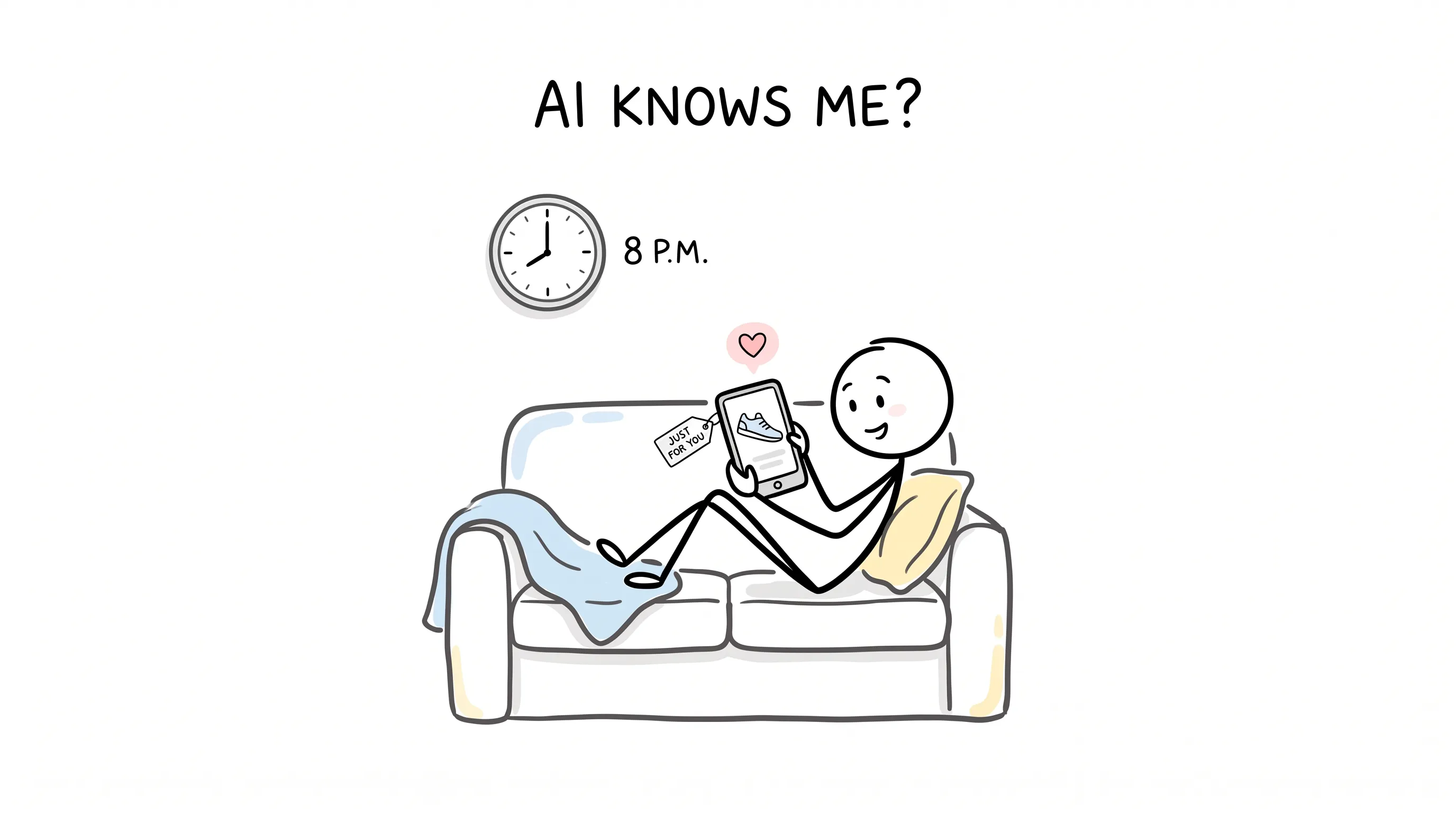
That's AI personalization. And it's no longer some cutting-edge concept — it's a quiet rewrite happening across the marketing world right now. Today, I'm going to take it apart and walk you through it.
What Do We Mean by Personalization?
Let's start with the past.
How did marketing talk to customers back in the day? By sorting people into piles. One pile by age, one by city, another by gender. Then each pile got one generic script.
The industry calls this "segmentation."
But think about it: no matter how finely you divide the piles, the people inside them are still different. In the same pile, some just graduated, some are about to retire; some want to buy today, others are just browsing. Speak one script at the whole pile, and most of the people in it will feel you're talking to someone else.
What AI does, to put it plainly, is one thing: shatter the "pile" until only a single person is left.
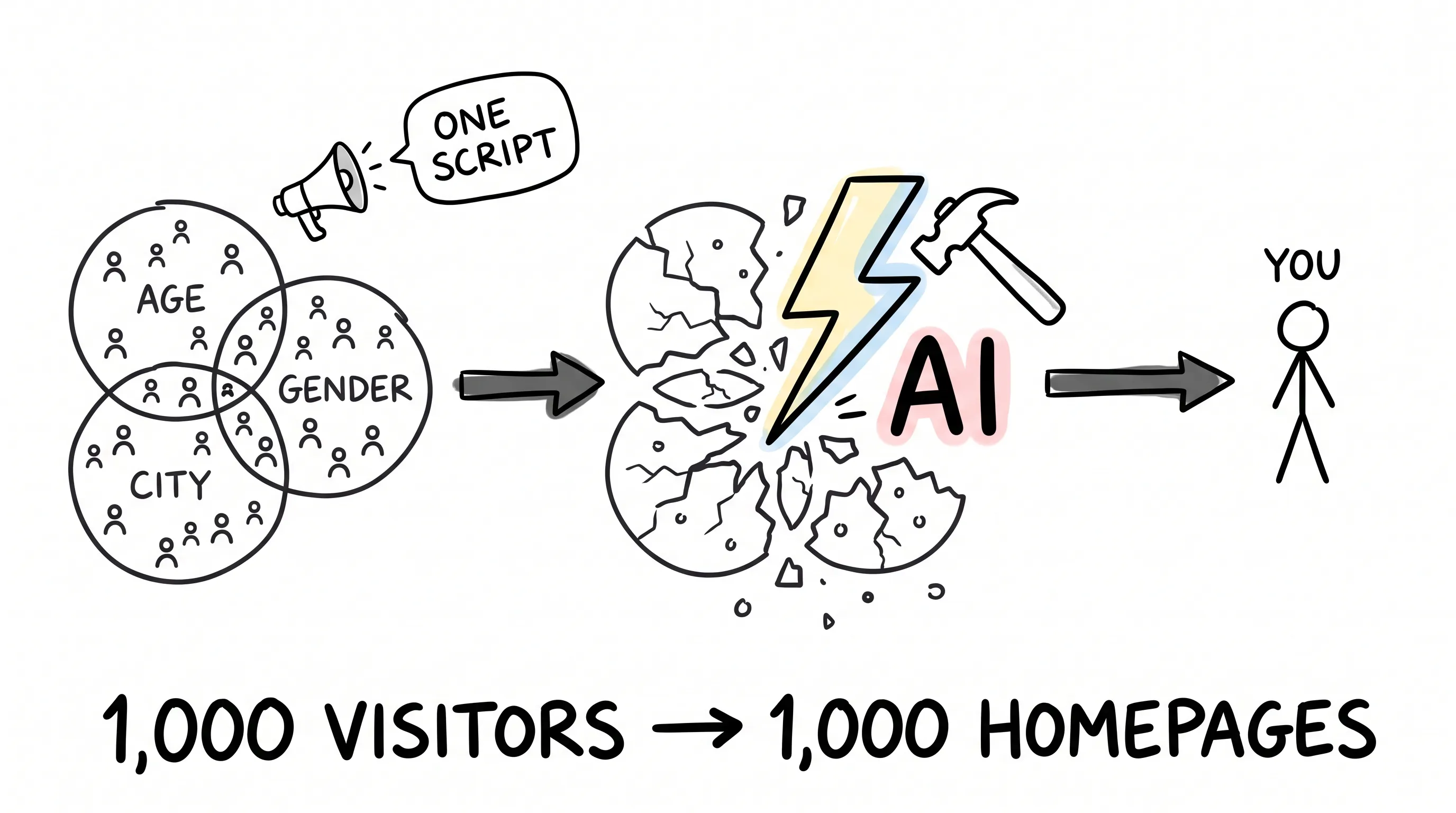
What does it look at? The pages you've opened, the things you've bought, how many seconds you lingered on which product, what device you use, which city you're in right now, what time it is. Pieced together, those fragments make a living, breathing "you." And that profile updates every hour.
That's what one-to-one means.
Take an example. A longtime customer returns to your website on their phone at 8 p.m. The one-size-fits-all approach shows them the standard homepage. The AI-driven approach puts the product they last fell for right in front of them, attaches an exclusive discount, and streamlines mobile checkout while it's at it.
One website. A thousand visitors. A thousand homepages.
A little creepy? A little fascinating, too.
Where Is This Already Happening?
You might ask: it sounds mystical — where is it actually used?
Four places. Let's go through them one by one.
First, email. In the old days of mass sends, ten thousand people got the exact same subject line. Now, tools like Mailchimp AI, ActiveCampaign, and Klaviyo tailor subject lines, content blocks, and product recommendations to each person's behavior — even the send time varies from person to person. Night owl? It arrives at midnight. Morning scroller? It shows up with breakfast.
Second, websites. Tools like Optimizely, Dynamic Yield, and Adobe Target let banners, homepage layouts, and recommendations shift dynamically with each visitor. Crucially, these variants are generated by AI — no hand-building a thousand homepages.
Third, ads. Google Ads, Meta's Advantage+, AdRoll adjust creative, format, and delivery timing based on each user's behavior across platforms. The same ad looks different to different people.
Fourth, product recommendations. "Frequently bought together," "recently viewed" — behind these features sit engines like Amazon Personalize and Salesforce Commerce Cloud. Behavior-based cross-selling beats a salesperson's gut feel, by a wide margin.
What's the Payoff?
Some will ask: all this complexity — for what?
Run a few numbers and it's clear.
Done well, personalization lifts click-through rates, time on site, and conversion. When what people see relates to them, they naturally stick around a little longer.
Same with retention. If someone is consistently well taken care of at your place, why would they ever leave?
Average order value climbs. The better the recommendations, the easier it is for people to add one more item without thinking twice.
And there's a ledger hardly anyone keeps. John Wanamaker, the grand old man of American department stores, famously said: half the money I spend on advertising is wasted; the trouble is, I don't know which half. A big chunk of that ad money sprays onto people who will never buy.
AI personalization is about finding that wasted half.
What you get back is profit.
But There's Always Another Side
Don't get carried away just yet. This thing has three pitfalls, each more painful than the last.
Pitfall one: privacy.
GDPR, CCPA — these are real laws with real teeth, and the fines are real money. If you use customer data for personalization, you must tell them plainly how it's being used. Sneak it, and it will blow up sooner or later.
Pitfall two: too much personalization.
What counts as too far? When users feel tracked.
"I only mentioned it to a friend — why are you showing me this?" The moment that feeling appears, all the trust you've banked drops to zero. So always leave users a door: they can turn personalization off, they can choose another path. Better to not guess at all than to make people feel watched.
Pitfall three: it won't plug in.
Personalization tools don't run the moment you plug them in. They have to connect to your CRM, your CMS, your analytics system. If data doesn't flow, the tool is an island — however smart, it's useless.
Where to Start?
If you want to act, don't aim big. Four steps.
Step one, audit your data. Sort through what you have: is it clean, is the structure clear, is it granular enough to point to a specific person? Data is the foundation of everything.
Step two, pilot small. Start with one personalized email, or a single recommendation slot on the homepage. Don't dream of an all-site overhaul on day one.
Step three, A/B test. Personalized version against generic version — run the numbers, let the data speak, don't rely on gut feelings.
Step four, iterate. Feed users' feedback and behavior back into the model, so its guesses get sharper and sharper.
Finally, Back to Those Shoes
What happens when personalization is taken to its extreme?
Users no longer feel you're selling.
They feel: you get me.
That's the true endgame of AI personalization. The end of marketing isn't making people buy — it's making people trust.
Technology is only a knife. Whoever uses it to save users effort wins the next era; whoever uses it to squeeze users' privacy gets blocked with one click.
Same knife, two ways to use it.
Here's hoping you're the first kind.
Continue reading
Related articles

Cross-Border Business: Time to Upgrade Your AI Toolbox
A learn article explaining how AI tools help cross-border e-commerce sellers clear five hurdles: language, regulation, logistics, payments, and fraud. It outlines a five-compartment toolbox, a five-step adoption path, and metrics such as conversion rate and CLV, while cautioning against over-reliance on AI.

AI Is Taking Over the Dirty Work of Social Media Marketing, One Task at a Time
This learn article outlines four social media marketing tasks AI can handle — audience analytics, content drafting and design, ad targeting and creative testing, and spam moderation — and cautions that taste, judgment, and data security remain human responsibilities.

AI Is Already This Good — Why Is Your Social Media Marketing Still Pure Manpower?
An overview of 18 AI tools for social media marketing, organized into six categories covering audience research, content creation, scheduling, comment and DM handling, ad management, and visual production, plus notes on personalization, prediction, and emerging trends.