
AI Marketing: Why Some Campaigns Go Viral — and Others Get Roasted
A learn article analyzing why some AI marketing campaigns succeed while others backfire, using cases like Nike, Heinz, Spotify, and Coca-Cola to outline patterns in AI placement, data-driven sharing, and emotional positioning.
A few days ago, I watched someone tear into a Christmas ad in a group chat.
It was made by AI. Coca-Cola had used AI to remake its classic 1995 "Holidays Are Coming" truck ad. The result? Faces stiff as wax figures, truck wheels spinning the wrong way. One animator's tweet went viral: "Coca-Cola is red because it's made from the blood of out-of-work artists."
Brutal. Genuinely brutal.
Yet here's the curious part: other brands used AI too. Heinz had AI draw ketchup — and drew 1.15 billion impressions, plus a Cannes Lion. Nutella used an algorithm to generate 7 million one-of-a-kind jar labels and sold out in a month.
Same knife. Some turn out a royal feast with it; others slice their own hand.
So what makes the difference?
I recently dug through every AI marketing case from the past few years I could get my hands on — Netflix, Spotify, Nike, Coca-Cola... The more I read, the clearer the pattern became. Let me walk you through it.
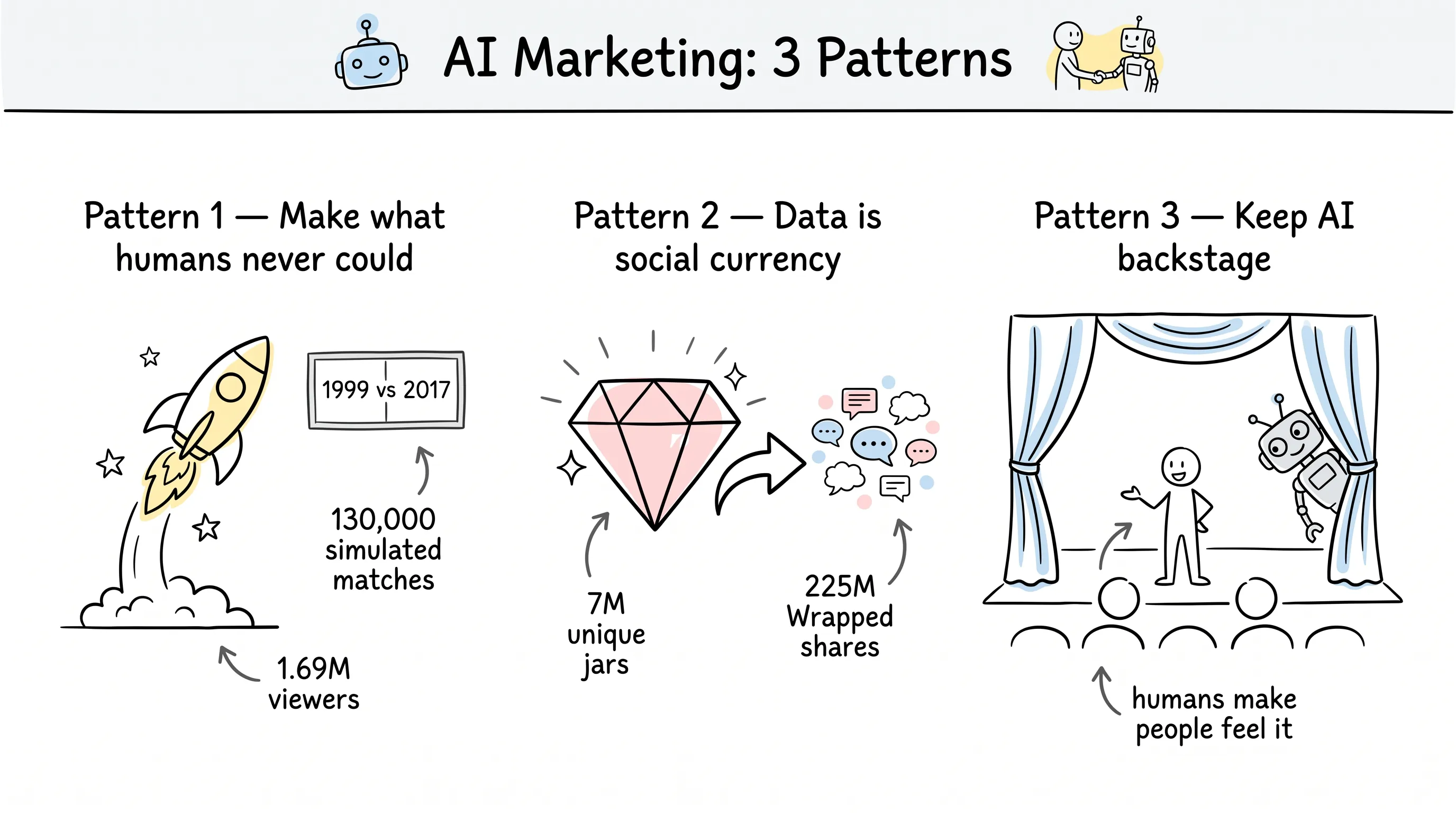
Pattern No. 1: AI's Greatest Value Is Making the Things Humans Could Never Make
Most people turn to AI to save time and money.
Fair — it does. But if saving is all you're chasing, you will never make the thing that makes people go "wow."
Let me tell you a few stories.
When Nike said goodbye to Serena, it did something that had never been possible before: it staged a match between 1999 Serena Williams and 2017 Serena Williams.
How do you stage that?
Together with AKQA, they used machine learning to study Serena's game in both eras — her decisions, her shot selection, her reactions, her recovery, all learned from historical match footage, with the technical backbone of Stanford University's vid2player. Then AI simulated 130,000 matches and 5,000 head-to-heads, picked out one, and livestreamed it on YouTube.
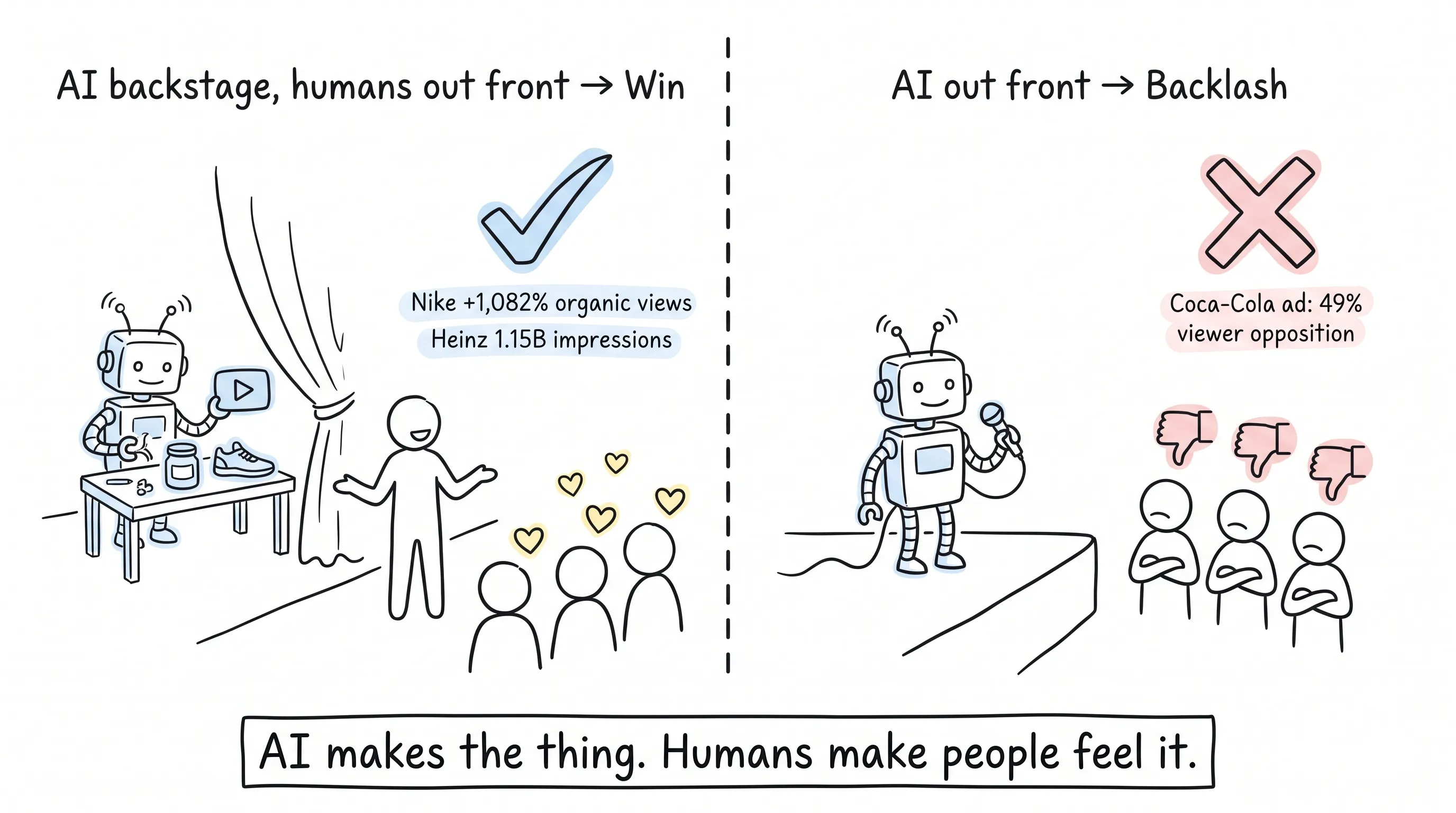
1.69 million people watched Serena say goodbye to herself — across 18 years. Organic traffic ran 1,082% higher than Nike's other content, broke every YouTube record the brand had, and took home the Digital Craft Grand Prix at the 2023 Cannes Lions International Festival of Creativity.
No production budget on earth could have delivered this concept, because there was no way to even define "how do you shoot this." Here, AI is a key that opens a door that never existed before.
Netflix is the same story. At its 2025 Upfront (the annual event where TV networks and streamers pitch advertisers), the company announced modular ads: using AI to "paint" brands into the world of its shows. A bag of Cheetos could be rendered in the gothic gloom of Wednesday; a travel brand could grow straight out of the Paris streets of Emily in Paris.
No reshoots, no set builds — AI composites it on the spot. The ad suite already counts 94 million monthly active users. Netflix's own performance numbers: brand favorability 8x that of ordinary connected-TV ads, sales lift per impression up 162%, purchase intent up 3x.
Think about what that means.
Product placement — something you'd negotiate months in advance and spend serious money on — has been compressed into a single prompt.
If you've ever wondered what it looks like when the rules of the game get rewritten, this is it.
The Heinz story is even better. They asked a remarkably simple question: what does AI draw when you ask it to draw "ketchup"?
Partnering with Rethink Canada, and using DALL-E 2 — back then still closed to the public — they generated "scuba ketchup," "Renaissance ketchup," "space ketchup."
And no matter how they prompted it, every single image came out looking like Heinz.
Unreal. The collective knowledge AI distilled from millions of images had just confirmed, all by itself, that the default ketchup is Heinz.
They turned it into social content and limited-edition bottles, and invited people to submit their own prompts and play along. 1.15 billion impressions, engagement rates 38% above previous campaigns, and a 2,500% ROI.
Notice: Heinz used AI without inventing anything new — and proved it had already won. What the AI painted was never ketchup. It was the reflexive first answer that lives in hundreds of millions of minds.
Pattern No. 2: Data Is the New Social Currency
What is social currency?
It's what someone is really saying when they share your stuff: "Look — this is me."
People don't share ads. People share themselves.
Spotify has taken that idea to its absolute limit. Every December since 2015, Wrapped turns your listening data into a set of gorgeous cards: your artist of the year, your playlist of the year, proof of what a unique listener you are. The 2023 edition drew 225 million participants and more than 2 billion social impressions — which works out to hundreds of millions of dollars in advertising, earned free, every single year.
Why are people so eager to show it off?
Because sharing your playlist is sharing your taste, your identity, your year. Users are using Spotify to curate themselves.
But there's a lesson hiding in here too.
In 2024, Spotify leaned heavily on AI-generated content, including an AI podcast-style year in review. Users weren't buying it — cold, mechanical, no human pulse. Positive sentiment dropped from 50.5% to 41.5%, and negative sentiment nearly doubled.
So they scrambled to course-correct: the design went back to a human touch, and AI was pushed backstage — still generating content from the data, but no longer stepping out front to play the lead.
Sit with that reversal: the same AI, hidden behind the data, is a plus; standing in front of the emotion, it's a minus.
Nutella pushed "unique" to its extreme. Working with Ogilvy Italy, they used an algorithm to permute dozens of patterns and color schemes into 7 million completely different jar labels, each with its own unique ID.
Seven million jars, every one of them one of a kind. All sold out within a month. More than 10,000 users posted their jars unprompted — nobody paid them; the jar itself was reason enough.
Burger King pushed the logic one step further. In February 2024, it ran the "Million Dollar Whopper" contest: users designed their dream Whopper in the app with up to 8 ingredients, an AI named Grilliam generated photorealistic images plus a personalized jingle, and the whole creation could be shared to social media in one tap. The three finalists' burgers got limited runs in stores, and the winner took home $1 million.
3 million people built burgers. 14 million app visits. 1.3 million AI-generated video ads shared. In November 2024, in-store sales hit a record.
Worried that imperfect AI output would get you flamed? Rainbow buns, gummy-bear toppings, ice-cream burgers... not a single person nitpicked. Because the whole thing was play — and nobody audits the AI in something meant to be fun.
Underneath it all sits that 50-year-old Burger King line: Have it your way — your burger, your call. Three generations of technology later, that promise hasn't changed by a single word.
Pattern No. 3: The Higher the Emotional Stakes, the Further Back AI Must Stand
Now, back to that Coca-Cola from the opening.
It's not as if Coca-Cola never tasted the upside. In 2023, the company partnered with OpenAI to build the "Create Real Magic" platform, letting digital artists create freely with DALL-E and GPT-4. It attracted a wave of creators worldwide and cemented Coke's persona as an AI pioneer.
But the 2024 AI Christmas ad crashed. Three AI studios, multiple generative models — and out came stiff faces and wheels spinning backward. Viewer opposition hit 49% in 2024, and was still at 46% in 2025.
Here's what's interesting: on paper, it actually doesn't lose money. Five AI specialists replaced a 50-person production team; 70,000 assets generated in one month (the traditional process took 12 months); production costs estimated down 90%; and revenue is still growing.
So how exactly should you judge this?
My take: what Coca-Cola lost is something no ledger can count. A Christmas ad sells warmth and nostalgia — the feeling of a family gathered around the TV. Content like that ships with a factory default: humanity. When viewers click play, they assume "this was made by people, for people." The moment the AI gets spotted, that default collapses.
Coca-Cola is big enough to absorb the hit. Is your brand?
L'Oréal chose a smarter path. In February 2023, its Maybelline brand introduced a digital human named "May" as the face of a new mascara, sharing the frame with real-life ambassador Gigi Hadid.
Why were they bold enough to try? Not long before, L'Oréal had just weathered a storm: influencer Mikayla Nogueira was accused of wearing false lashes while promoting a mascara. A virtual human gives you fully controlled creative — none of the uncertainty that comes with real people.
And here's the key: May was explicitly virtual from start to finish. Audiences turn out to be remarkably accepting of disclosed synthetic humans: 58% follow at least one virtual influencer, and 35% have bought something one of them recommended. Today, virtual influencers are standard industry practice.
L'Oréal has also wired Google's Imagen 3 and Veo 2 into its in-house CREAITECH lab, compressing content customization across markets from weeks to hours. For a company spanning 150 countries with a portfolio of more than 34 brands, this is control at scale — exactly what it wants.
Notice something? In all of these cases, success or failure had almost nothing to do with whether AI was used — and everything to do with where AI stood.
AI tucked into the execution layer, humans out front telling the story: win.
AI shoved out front, trespassing on human emotional territory: crash — or at least a roasting.
AI makes the thing. Humans make people feel it. That division of labor is non-negotiable.
Finally: Three Takeaways for Anyone Ready to Actually Do Something
First, AI's greatest use is unlocking the ideas that couldn't exist without it. Speed and savings are just the loose change you pick up on the way. Don't ride a rocket like it's a bicycle.
Second, data is your gold mine — but the person doing the showing off has to be the user. Turn data into something users want to represent themselves with, and sharing follows on its own. Of course, clear the compliance gate first.
Third, for emotionally charged content, keep people out front. Where transparency is needed, be generous with it — a virtual human should say it's virtual. When no face needs to be shown, let AI stay quietly backstage.
One more thing to remember: AI fatigue is real. A trick that feels fresh today can read as lazy tomorrow. There is no set-and-forget on this road — only constant experimenting and fast correction.
Back to that roasted Christmas ad from the start.
Honestly, I don't think AI was the culprit. A knife has no allegiance; the chef does.
What audiences resent is never the technology — it's technology displacing the warmth they came for.
In your own product, which parts can you safely hand to AI — and which must stay human?
That question is worth answering now.
Here's to putting AI where the blade actually cuts — and keeping people right where the human heart belongs.
Continue reading
Related articles

Cross-Border Business: Time to Upgrade Your AI Toolbox
A learn article explaining how AI tools help cross-border e-commerce sellers clear five hurdles: language, regulation, logistics, payments, and fraud. It outlines a five-compartment toolbox, a five-step adoption path, and metrics such as conversion rate and CLV, while cautioning against over-reliance on AI.

AI Is Taking Over the Dirty Work of Social Media Marketing, One Task at a Time
This learn article outlines four social media marketing tasks AI can handle — audience analytics, content drafting and design, ad targeting and creative testing, and spam moderation — and cautions that taste, judgment, and data security remain human responsibilities.

AI Is Already This Good — Why Is Your Social Media Marketing Still Pure Manpower?
An overview of 18 AI tools for social media marketing, organized into six categories covering audience research, content creation, scheduling, comment and DM handling, ad management, and visual production, plus notes on personalization, prediction, and emerging trends.