
AI Marketing: The More You Save, the More You Risk
An essay on the trade-offs of using AI in marketing, outlining five common pitfalls such as generic output, weak human touch, brand damage, customer data misuse, and compliance fines, plus five practical rules covering human review, regular audits, and pre-publish red lines.
A few days ago, an old friend of mine who runs a consumer brand invited me out for tea.
Somewhere into the conversation, he pulled out his phone to show me what their WeChat Official Account had published last month.
I scrolled through, post after post. Honestly, none of them were badly written. Tidy headlines, clean structure, all the right points covered.
But by the fifth post, I couldn't scroll any further.
Why? Because all five read like they were written by the same person. No — by the same machine. Every one opened with the same sentence pattern and ended with the same uplifting flourish.
I said: these were written by AI, weren't they?
He froze for a second. How could you tell?
I said: it wasn't me who could tell — your data could. He sighed: you called it. Three months in, followers flat — unfollows up.
I finished my tea, but the story sat with me for days.
Today I want to lay it all out: when you use AI for marketing, how should the books actually be kept?
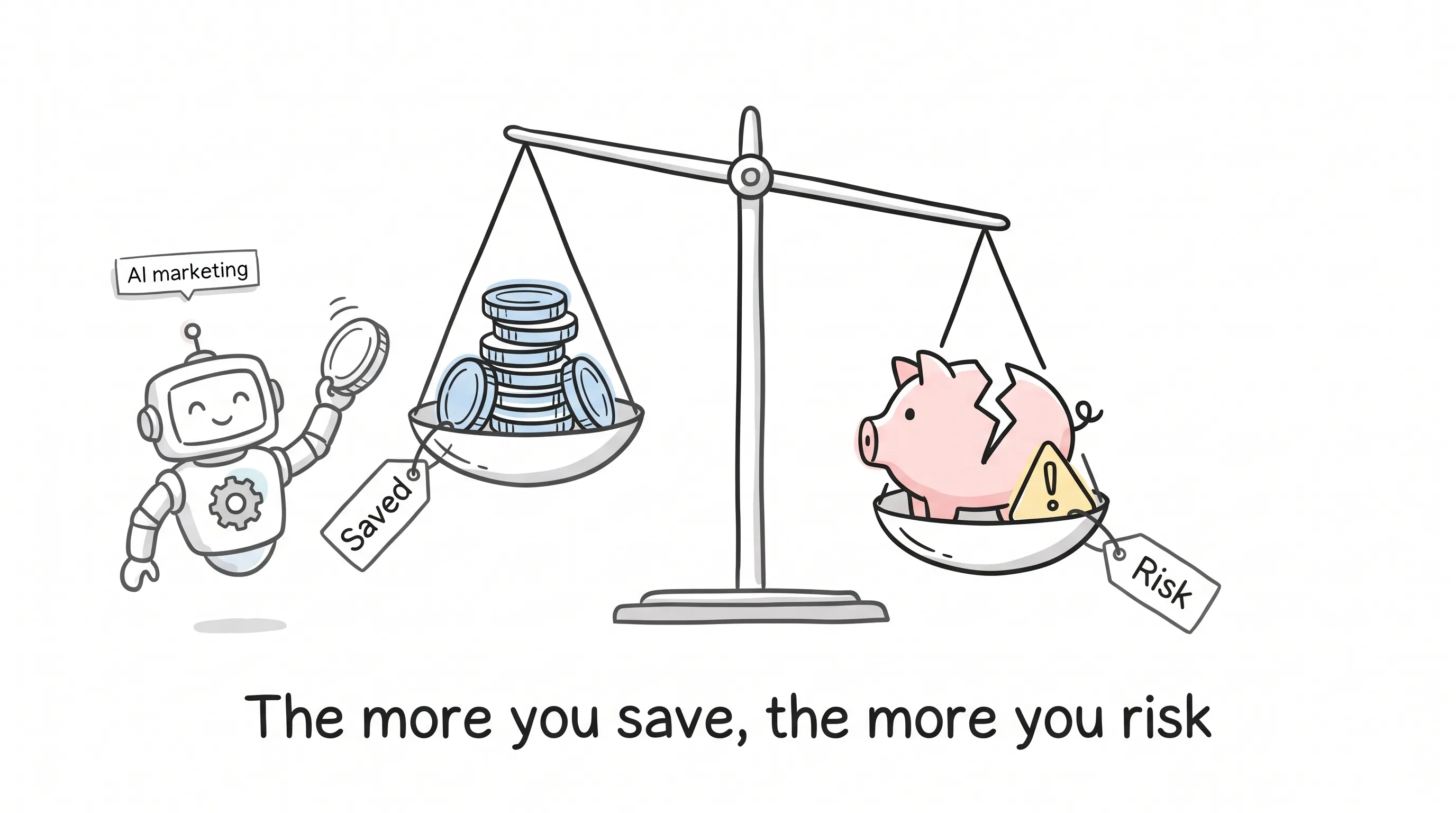
First, Count the Savings
Let me be clear: I'm not here to talk you out of using AI.
Quite the opposite.
A product video used to mean an outsourced shoot — two days minimum and a bill easily in the tens of thousands of yuan. Now? AI hands you 20 versions in ten minutes, pick whichever you like. A post used to leave a copywriter stuck for a whole afternoon. Now you get ten in one go, images included.
What you save is cold, hard cash.
Look around: almost no marketing team is AI-free anymore. If you don't use it, the team next door does — and you can wait to be left in the dust.
But.
With this thing, the more it saves you, the more it puts you at risk.
I'll lay out five traps for you. Then I'll give you five iron rules.
Trap One: Sameness
The first trap is the most common — my friend has already fallen into it.
What do I mean by sameness?
Think about how AI writes: it learns patterns from the data it's fed. Whatever you feed it, that's all it can ever be.
It's like a chef who has spent his whole life cooking in one company cafeteria. Ask him to prepare a banquet fit for an emperor, and out come the same three cafeteria dishes.
Worse, you use AI — and so does the company next door. The whole industry runs on nearly the same large models, writes nearly the same prompts, and copies nearly the same viral hits. In the end, the whole class hands in essays from the same anthology.
Your budget sinks in, and you don't even hear a splash.
Trap Two: No Human Touch
The second trap hides a little deeper.
AI knows how to write the word "moved." It has never been moved.
It has never pulled an all-nighter to finish a proposal, never stood at a shelf agonizing for three minutes over a bottle of soy sauce, and never received a client's 2 a.m. message saying "You've worked hard."
It has no life.
So what it writes is steady and safe — correct on every count, and moving no one.
Think of the ads you actually remember. Was any of them merely "correct on every count"? The ones that stick are a little odd, and honest enough to sting.
What machines do best is precisely sanding off the rough edges.
Trap Three: Wrecking the Brand
The third trap is the most expensive.
What is a brand, really? Strip it down, and a brand is a piggy bank of trust. Ten years' worth of trust, fed in one coin at a time.
AI, meanwhile, is a temp on day one. It doesn't know your brand, doesn't know what can be said — let alone what must never, ever be said. Stop watching, and it will happily speak in your name.
One slip — one line of copy off-brand, one image that blows up. Consumers don't care whether AI made it. All they remember is: something's off with this brand.
The piggy bank — smashed to the floor.
Ten years of trust, emptied in one spill.
Trap Four: Customer Data
The fourth trap waits in the dark.
Why is AI personalization so powerful? Because it has read mountains of customer data: what they've bought, what they've browsed, when they place their orders, what they love most.
But get one thing straight: this data was entrusted to you by your customers, not handed to you for free.
It's like someone lending you their diary for a quick look — that's trust. Photocopy it and send it to the whole world, and that's betrayal.
Once data gets misused, trust resets to zero that same day.
This one comes with no second chance.
Trap Five: Fines
The fifth trap sits right there on the road.
These past two years, governments everywhere have been writing the traffic code for AI: how data may be used, how ads must be labeled, whether generated content may pass itself off as a real person — rule after rule, getting finer all the time.
Skirting the rules used to cost you a few angry comments online. Now it costs you a fine with an official stamp on it.
However fast you drive, if you ignore the lights, an accident or a ticket is waiting for you somewhere down the road.
Five Iron Rules
Reading this far, you might be thinking: with so many traps, maybe it's time to stop using it altogether?
No. A knife can cut your hand, but kitchens don't stop using knives. The key is knowing the rules.
Here are five rules in plain language.
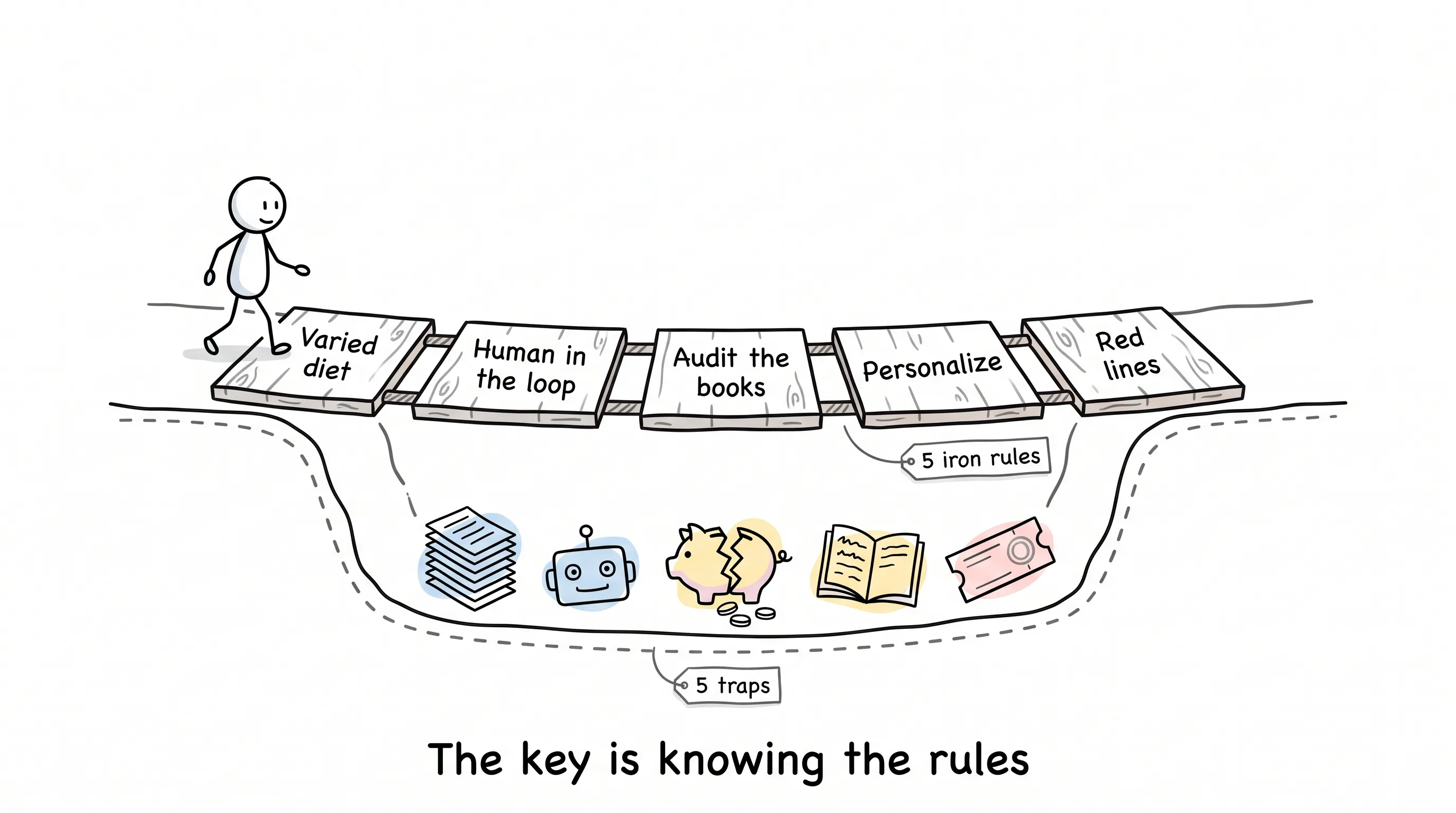
First, feed it a varied diet.
AI's output ceiling is the ceiling of its data. Feed it the same sample essays every day, and it can only answer you in one tone. Put in high-quality, varied material, and it hands you something fresh.
Garbage in, garbage out. In the AI era, this iron rule bites harder, not softer.
Second, keep a human in the loop.
AI drafts, humans give the final review. Keep the brainstorm sessions — creativity is the one thing you can never outsource.
Give the machine the efficiency. Keep the judgment for yourself.
Third, audit the books regularly.
Treat AI like a new hire: check its output every week. Is the tone right? Has the style drifted? If it's off, go back and adjust it — and adjust what you feed it.
Don't let it run loose. Brands that go free-range get burned by the temp sooner or later.
Fourth, play with the settings, and put personalization to full use.
Take one topic, tweak the settings, shift the angles, have it produce ten versions — then pick the best one.
And since AI is so good at reading people, let it speak to each specific person with every piece of content. A thousand distinct faces is exactly the cure for a thousand identical ones.
Fifth, draw the red lines before you publish.
Clear the advertising rules; set your ethical bottom lines. Build the review process before anyone presses publish — not after something goes wrong.
Let anything discriminatory or misleading die before it ever ships.
Back to That Cup of Tea
Last month, I saw that friend again.
He did three things: every AI draft now goes through his editors' hands and gets reworked until it has rough edges again; one fixed hour each week goes to checking the content ledger; and the range of what he feeds the machine has doubled.
Output volume, cut by a third.
The numbers came back.
So you see, the root of the problem isn't whether AI works well. It's what you take it to be. Treat it as an employee who shoulders your workload and can answer for your mistakes, and sooner or later you'll crash. Treat it as a tireless assistant that still needs watching, and it's like giving a tiger wings.
AI can work for you. It cannot answer for you.
The Austrian writer Stefan Zweig once said: all the gifts fate bestows on us have long been secretly marked with a price.
Every minute AI hands you comes with a price tag.
Here's my wish for you: may every cent you save with AI be a cent you never have to pay back twice over.
Continue reading
Related articles

Cross-Border Business: Time to Upgrade Your AI Toolbox
A learn article explaining how AI tools help cross-border e-commerce sellers clear five hurdles: language, regulation, logistics, payments, and fraud. It outlines a five-compartment toolbox, a five-step adoption path, and metrics such as conversion rate and CLV, while cautioning against over-reliance on AI.

AI Is Taking Over the Dirty Work of Social Media Marketing, One Task at a Time
This learn article outlines four social media marketing tasks AI can handle — audience analytics, content drafting and design, ad targeting and creative testing, and spam moderation — and cautions that taste, judgment, and data security remain human responsibilities.

AI Is Already This Good — Why Is Your Social Media Marketing Still Pure Manpower?
An overview of 18 AI tools for social media marketing, organized into six categories covering audience research, content creation, scheduling, comment and DM handling, ad management, and visual production, plus notes on personalization, prediction, and emerging trends.