
AI Marketing: How Many Checkpoints Must You Clear?
An explainer on AI marketing compliance, covering data privacy, ad truthfulness, AI governance rules, and a seven-step checklist for consent, vendor oversight, disclosure, and documentation.
A while back, I had dinner with a friend who runs marketing. He was glowing the moment he sat down: his team now uses AI to write copy, produce creative, and run one-to-one personalized ad targeting — a full campaign can go live in three days.
Impressive, I said.
But near the end of the meal, I asked one question: all that customer data you're feeding the models — has legal taken a look?
He froze.
That frozen moment is what this article is made of.
Regulators Care About What You Do with the Technology
Many marketers wince the moment they hear "compliance" — it sounds like a bridle being strapped onto their work.
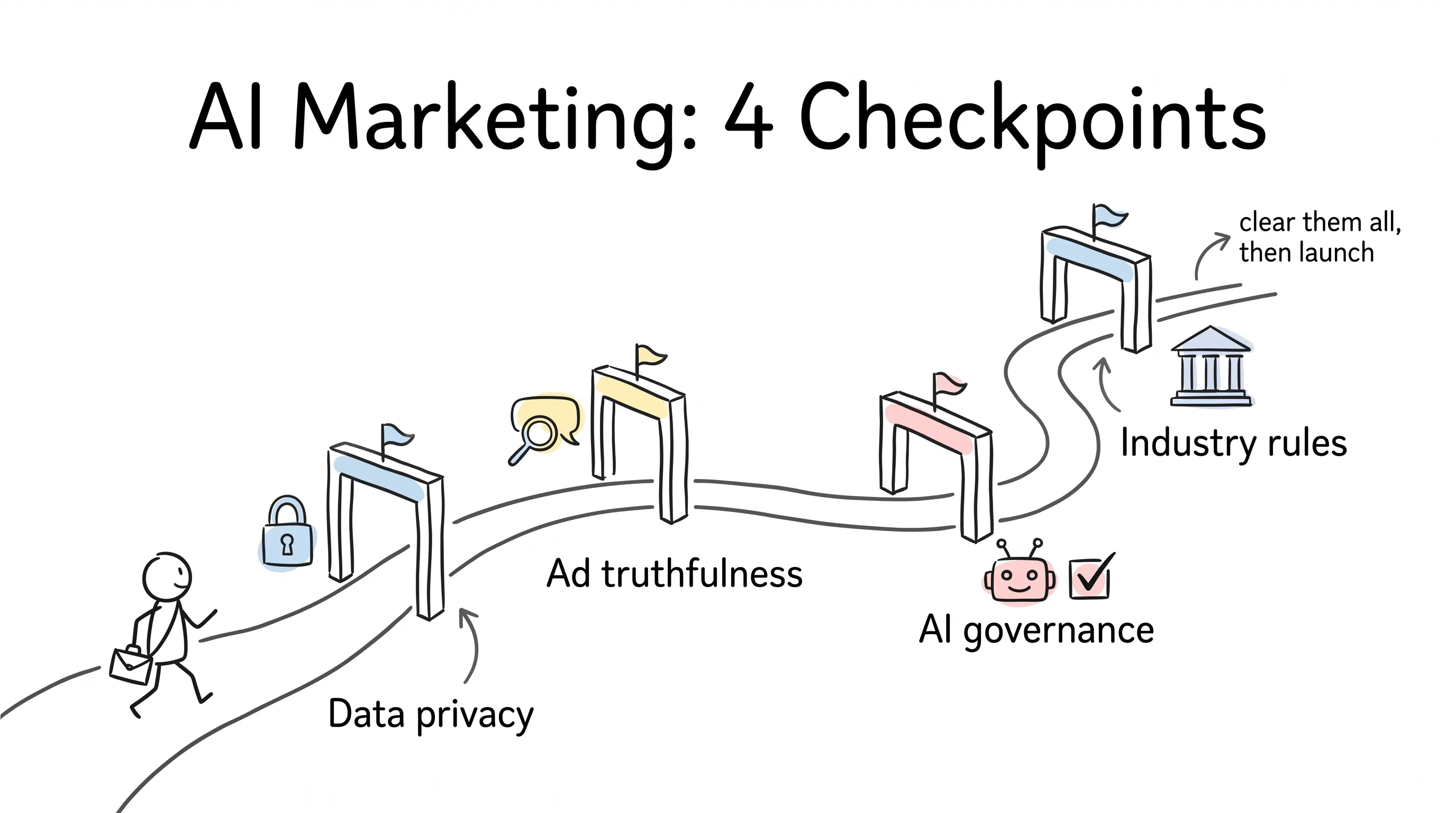
Break it down, though, and it's really just four checkpoints.
What do I mean by four checkpoints? Pretty much every regulation that touches AI marketing, torn apart and examined, lands in one of these four buckets.
Checkpoint one: data privacy. How you collect data, how you use it, who you share it with. Europe's GDPR, in force since 2018, made consent a hard requirement and enshrined data minimization as a core discipline — with fines that can run to 4% of global annual turnover. California's CCPA, tightened up by the CPRA in 2023, goes a step further: consumers have the right to opt out of having their data used for targeted advertising. Now ask yourself: in your ad platform, is that "opt-out" signal actually wired up?
Checkpoint two: advertising truthfulness. In the US, this is the FTC's home turf: performance claims need substantiation, and endorsements and testimonials must be disclosed. AI-generated content is no exception — there's no exemption clause for it anywhere in the rules. In 2024, the FTC cracked down on a batch of companies hyping their AI capabilities into the stratosphere.
Checkpoint three: AI governance. This one has only grown up in the past few years. The EU AI Act passed in 2024 and is phasing in step by step: manipulative practices are flat-out prohibited, with top fines at 7% of global annual turnover. Starting this August, most of its obligations formally took effect — AI-generated content and chatbots have to identify themselves as such. On the US side, Colorado passed the nation's first comprehensive state-level AI law in 2024, aimed at high-risk automated decision-making, and it started taking effect at the end of June this year. The common thread across all of these: transparency, risk control, and documentation.
Checkpoint four: industry- and content-specific rules. Healthcare and finance have their own rulebooks. Marketing to children in the US? COPPA is watching. Touch biometric data and Illinois's BIPA is waiting for you. Texts and emails require consent first. And a newer one: synthetic content realistic enough to pass for the real thing has to be labeled under the rules — and the major platforms have requirements of their own on top.
Four checkpoints in, you might be feeling a little rattled.
Don't be. Regulation has never stood in the way of people doing serious work — it only asks that you do things properly.
How Do You Actually Do It? Think Restaurant
Run a restaurant, and the chef in the back kitchen can flip the wok however he pleases — nobody micromanages the showmanship. But raw and cooked stay separated, samples get retained, records get kept. Why? So guests dare to walk through the door.
AI marketing works the same way. Where to start? Here's my seven-step breakdown.
Step one: take inventory. Map every spot where AI touches your marketing: content writing, targeting, lead scoring, customer chat. Chart where customer data flows in from — one diagram, crystal clear.
Step two: classify your data. What may enter a model, and what can never be touched. Personal information, sensitive categories, children's data, biometrics — draw the red lines first, in writing.
Step three: wire up consent. This is where many teams have a hidden trapdoor: the front end dutifully collects user consent while the back end carries on exactly as before. A user clearly clicked "no targeted advertising," yet they're still sitting in your audience segments. Consent signals must flow into your analytics, your segments, and your ad platform.
Step four: keep your vendors in line. When you use third-party models and services, get clear answers to a few questions: Will you train on my data? Where does it live, and for how long? What terms govern cross-border transfers? How fast will you notify me when something goes wrong?
Step five: watch your mouth. Every performance claim an AI writes needs evidence standing behind it. The thing about AI: the more you praise how clever it is, the bolder it gets about bragging on your behalf.
Step six: disclose. If your chatbot is AI, say so openly. Label synthetic content when it's called for. In your privacy policy, spell out clearly that AI takes part in your processing.
Step seven: leave a paper trail. Data sources, prompt templates, who reviewed what, what got changed, what got checked — all on record.
Set the rules up front. Keep the receipts after the fact.
A Special Word on Feeding Customer Data to Models
People are always asking me: can we use customer data to train or fine-tune a model?
Yes. But treat it as a high-risk operation.
First, the basis: do you have user consent or another lawful basis? Next, the boundaries: can you simply steer clear of sensitive categories altogether? Then, the contract: does your vendor take this data to train anything else? Are the purposes locked down in writing? Is there a retention limit? Are the opt-out options users are entitled to actually in place?
Walk through every item, then act. Do it in reverse order, and you're betting the whole business.
How Do You Know You're Up and Running?
Compare two teams and the difference is obvious.
The team that isn't running scrambles to fight fires after something breaks: which data was used? Nobody can say. Who reviewed it? Cue the chat-log archaeology.
The team that is running opens its data inventory, pulls out the approval records, and hands you a complete evidence chain in ten minutes.
Here's the interesting part: the team that's running actually ships faster. The rules are ready-made, the standard clauses were long since negotiated with vendors, the approval paths are crystal clear — and no experiment requires knocking on legal's door first.
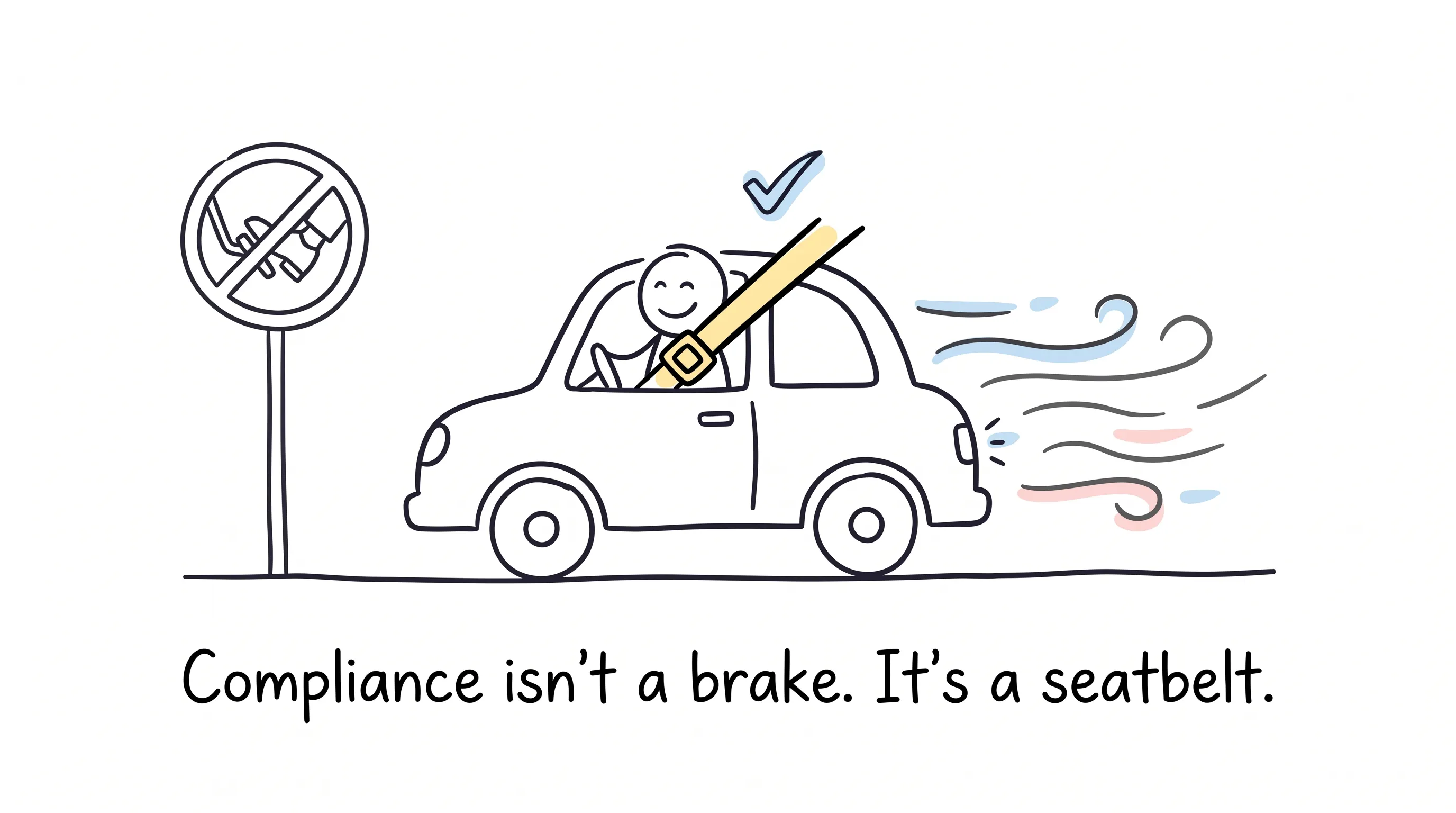
Compliance isn't a brake; it's a seatbelt. You wear it not to drive slower, but so you can dare to drive faster.
If You're Stuck, Start with Five Things
A data inventory, to get a clear picture of everything you hold.
Consent wired into your ad platform, so that "no" actually counts.
A set of standardized vendor terms — stop renegotiating with every single tool.
An AI disclosure rule, saying in black and white when you must state "this is AI."
An approval flow for high-risk campaigns, with someone standing guard before launch.
Five things, and one quarter is plenty to stand them all up.
Back to That Dinner
At the end of that dinner, my friend pulled out his phone and sent a message to his head of legal: "Let's meet next week and go through every place we use AI."
Three months later, he told me that launching an AI campaign now takes them less time than it used to. Because every question worth asking had already been asked.
Oh, and he picked up one new habit: every AI-written performance claim gets checked against the original data first. No data, no publish.
Respect.
Regulation waits for no one. But it has never made life hard for those who are prepared.
Here's to your seatbelt staying fastened — and to driving fast and steady, all the way.
Continue reading
Related articles

Cross-Border Business: Time to Upgrade Your AI Toolbox
A learn article explaining how AI tools help cross-border e-commerce sellers clear five hurdles: language, regulation, logistics, payments, and fraud. It outlines a five-compartment toolbox, a five-step adoption path, and metrics such as conversion rate and CLV, while cautioning against over-reliance on AI.

AI Is Taking Over the Dirty Work of Social Media Marketing, One Task at a Time
This learn article outlines four social media marketing tasks AI can handle — audience analytics, content drafting and design, ad targeting and creative testing, and spam moderation — and cautions that taste, judgment, and data security remain human responsibilities.

AI Is Already This Good — Why Is Your Social Media Marketing Still Pure Manpower?
An overview of 18 AI tools for social media marketing, organized into six categories covering audience research, content creation, scheduling, comment and DM handling, ad management, and visual production, plus notes on personalization, prediction, and emerging trends.