
AI Marketing Enters the Reckoning: A Toothpaste Company Just Won a 44x Bet
A learn article reviewing recent Think with Google case studies, arguing AI marketing has entered an ROI-focused phase. It cites Colgate-Palmolive's reported 44x conversion lift with AI Max search ads, Wayfair and Groupon's AI-first redesigns, and DeepMind's shift from prompting to directing.
A few days ago, I read a recent batch of case studies from Google's "Think with Google" column from start to finish. They share one common theme: AI Excellence — what results has AI-driven marketing actually delivered?
When I finished, I wrote one sentence in my notebook:
The noisy first half of AI marketing is over. Now comes the reckoning.
Why do I say that? Let me tell you a few stories first.
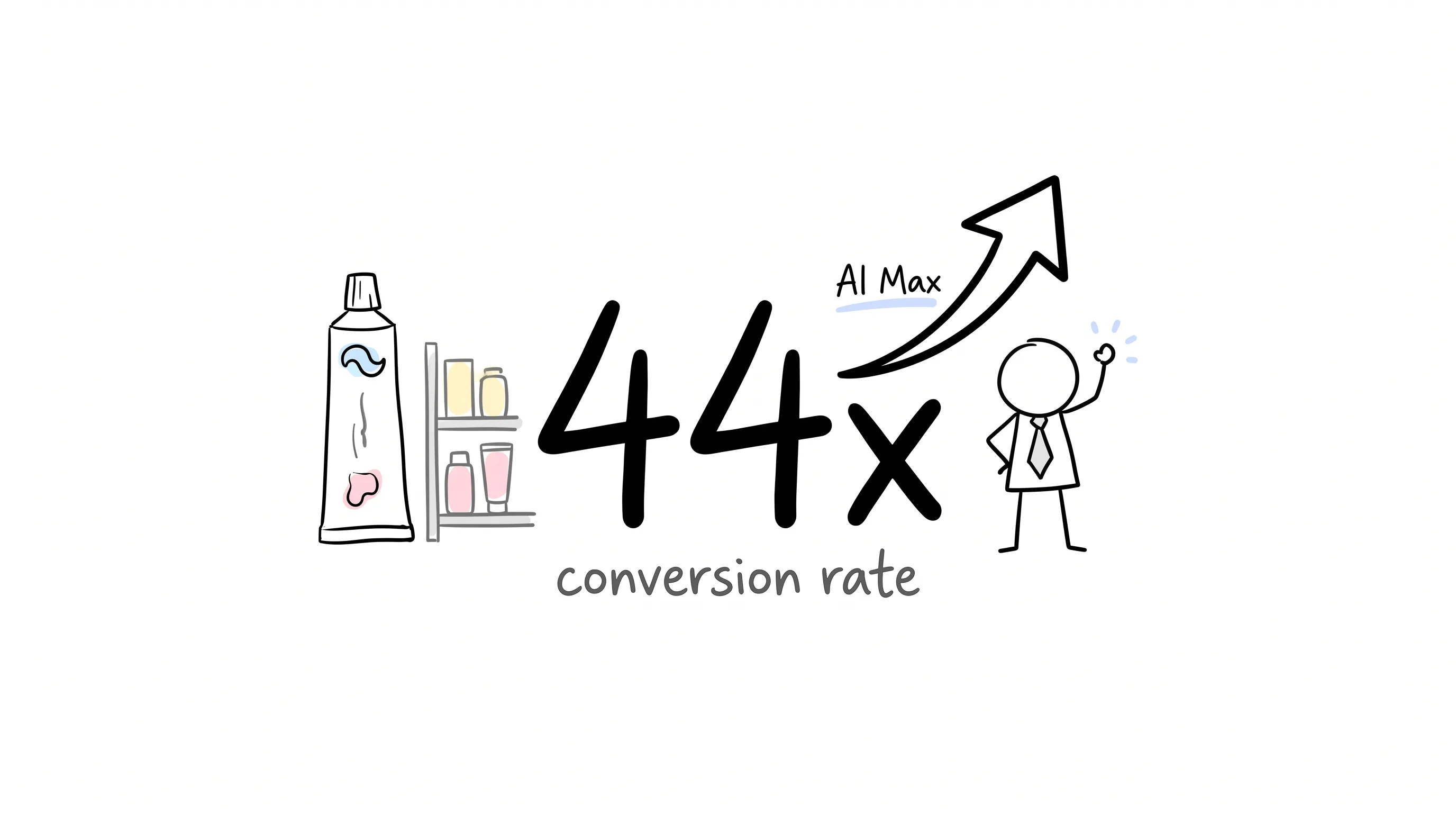
1. A Toothpaste Company Places a Bet
Colgate-Palmolive. The company that makes your toothpaste and your shampoo — you see it on supermarket shelves every day. By all rights, it should sit an entire Pacific Ocean away from the words "cutting-edge technology."
This year, the company placed a bet on AI Max, Google's AI-powered search-ad feature.
The result: a conversion rate 44 times what it was before.
44x. After all my years of business analysis, I've watched teams pop champagne over 20% growth. 44x isn't optimization — it's a different engine.
You might ask: what is AI Max?
Put simply, search advertising used to be humans picking keywords: you guess what users will search for, and you buy those words. What AI Max does is hand the "guessing" to the machine. It figures out users' real intent, then goes and finds people, and makes the match, on its own.
Before, people picked the words. Now, the machine understands the person.
That's the first signal of the reckoning: even the most conservative consumer-goods company dares to bet real money on AI ad placement — and the math works out. This is no longer an experiment.
2. Two Companies Doing the Same Thing
The second signal comes from two e-commerce companies.
One is Wayfair, which sells home goods. In August this year, Google sat down with it for an interview, and the topic came down to a single sentence: how to stand at the very frontier of AI search.
The other is Groupon. A June case study covered how it transformed itself into an AI-first company.
On the surface, one is talking about search and the other about organization. But once I'd read both, I realized they are doing the same thing: redesigning the entire company as an AI company.
That difference is huge. Bolting on tools treats AI as MSG — a flavor enhancer you sprinkle in to perk things up. Redesigning treats AI as the staple food, re-running the entire pipeline from procurement to ad placement around it.
Wayfair and Groupon both chose the latter.
Between a tool mindset and a systems mindset lies an order-of-magnitude difference in returns.
3. From Asking Questions to Directing
The third signal is the most interesting, and it comes from Google DeepMind.
In July this year, DeepMind offered a take I especially like: the future of creation is a shift from prompting to directing.
What does directing mean?
Think about it. In the past, using AI was like asking for directions: you say a sentence, it answers, and if the answer isn't good, you rephrase and try again. And a director? A director holds the script and the storyboard, brings aesthetic standards, conducts an entire crew, and turns the picture in their head into something real.
Your role has changed. You're no longer haggling with AI. You're directing it.
In the same month there was another article, about agentic AI in the finance industry. It contained a line that has stayed with me: every Chief Financial Officer must immediately come to grips with the "three new economies." You see — even finance, the most conservative function in any company, is starting to be rearranged by agents.
And there was the June piece, about how pioneering ad agencies and brands use AI to make "impossible ideas" happen. In the past, you'd say: this creative can't be shot, can't be made. Now, AI has flattened the cost curve.
What limits creativity is less and less the budget. It's imagination.
4. The Reckoning: How Do You Do the Math?
String these stories together, then reread the line Google placed in this collection, and you'll understand its weight:
Gemini's advantage is your ROI advantage.
At first glance, it sounds like an ad slogan. But think about it: Colgate's 44x, Wayfair's head start, Groupon's rebuild, DeepMind teaching people to direct — all of it points to the same thing:
AI's dividend is shifting from "knowing how to use it" to "using it to produce results."
More and more people know how to use AI. Prompts are everywhere; tutorials are everywhere. But people who dare to bet, who can make the math work, and who will rearrange the whole company — those are rare.
So here's my point: the first half was about who got on board first; the second half is about who can do the math. Every dollar of AI investment has to answer the same question: where's the return? If you can't answer, that's not using AI — that's paying tuition to AI.
One Last Thing
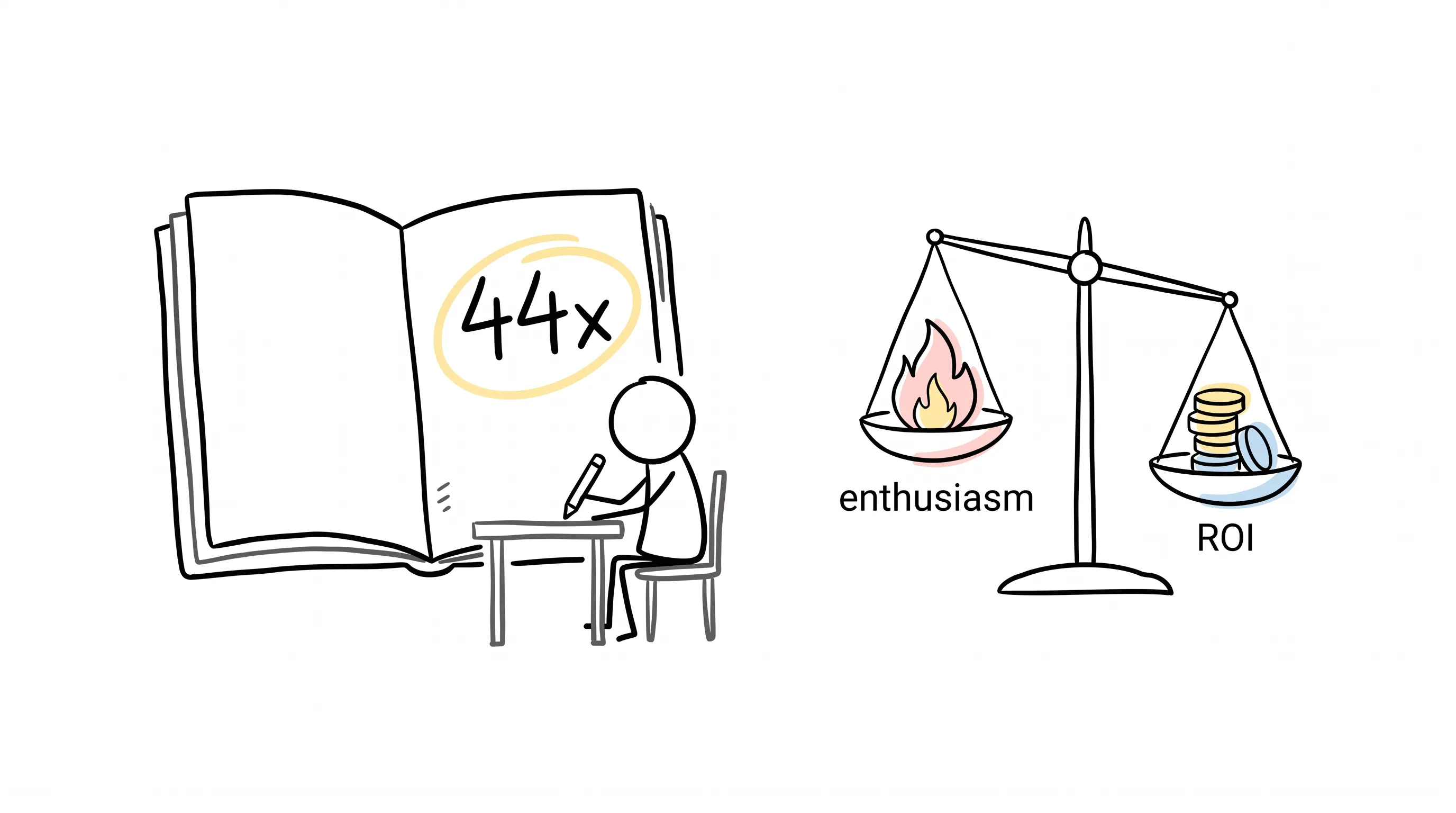
That day, after finishing the case studies, I copied the number "44x" onto a page of its own in my notebook.
Not because it's big. Because it came from a company that sells toothpaste.
The company least expected to be rescued by technology is the one keeping the clearest ledger.
This era doesn't lack enthusiasm for embracing AI. What it lacks is the patience to convert that enthusiasm into ROI.
Here's wishing you're the one who runs the numbers first.
Continue reading
Related articles

Cross-Border Business: Time to Upgrade Your AI Toolbox
A learn article explaining how AI tools help cross-border e-commerce sellers clear five hurdles: language, regulation, logistics, payments, and fraud. It outlines a five-compartment toolbox, a five-step adoption path, and metrics such as conversion rate and CLV, while cautioning against over-reliance on AI.

AI Is Taking Over the Dirty Work of Social Media Marketing, One Task at a Time
This learn article outlines four social media marketing tasks AI can handle — audience analytics, content drafting and design, ad targeting and creative testing, and spam moderation — and cautions that taste, judgment, and data security remain human responsibilities.

AI Is Already This Good — Why Is Your Social Media Marketing Still Pure Manpower?
An overview of 18 AI tools for social media marketing, organized into six categories covering audience research, content creation, scheduling, comment and DM handling, ad management, and visual production, plus notes on personalization, prediction, and emerging trends.