
AI Made Marketing Faster. Then What?
A learn article arguing that AI speeds up marketing production but exposes weak decision-making; it outlines how teams can improve direction-setting, review criteria, and result interpretation around AI-generated content.
A while back, I visited the head of marketing at an e-commerce company.
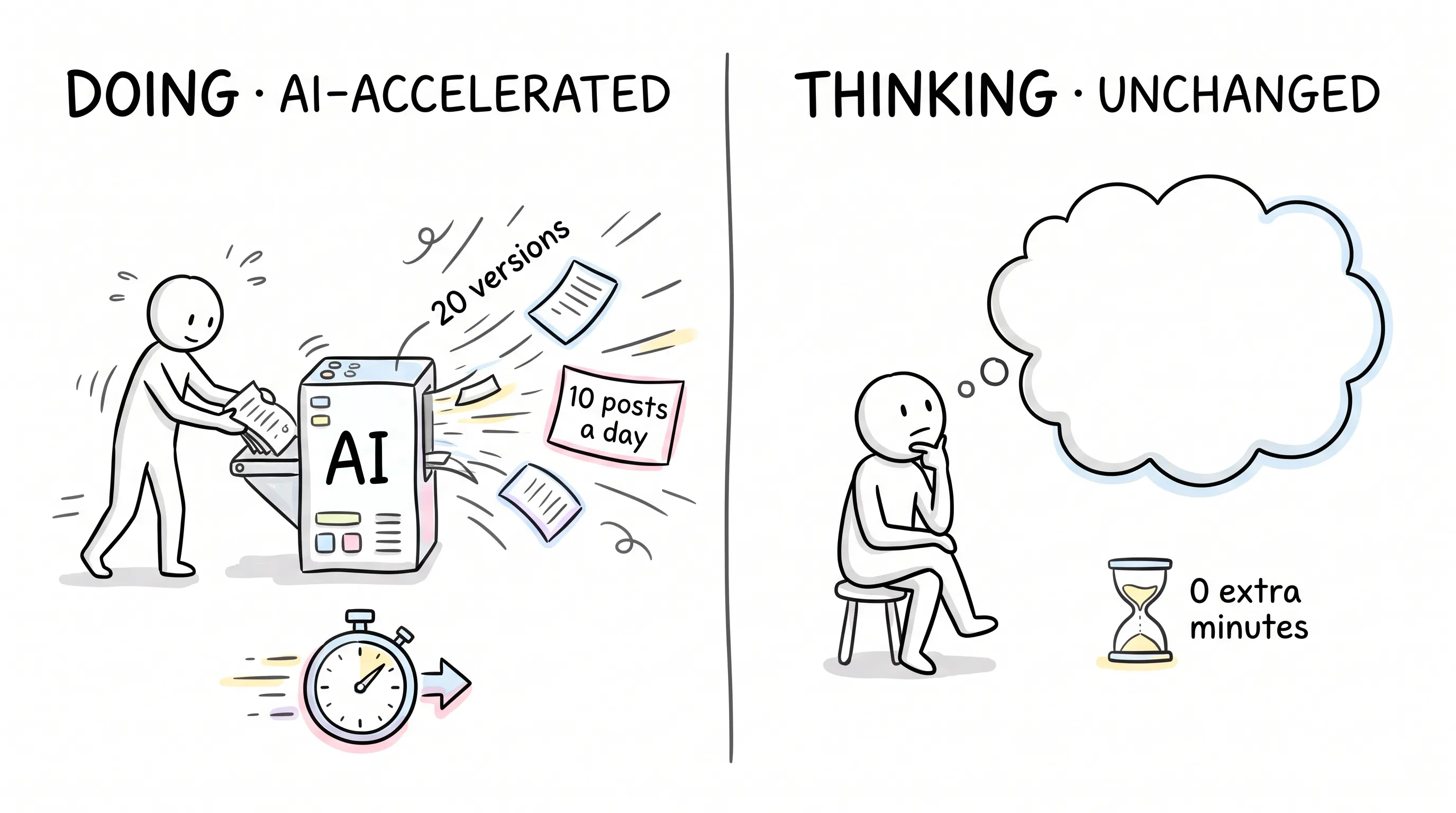
We'd barely sat down before he pulled out his phone to show me: 20 versions of hero-image copy generated by AI in a single afternoon, all lined up neat and tidy.
"Look — this used to take a week with an outside agency. Now? In the time it takes to finish a meal."
I said, nice. So what did you do with all that time you saved?
He froze.
After thinking for a good while, he said: honestly... we just got busier. We used to put out one piece of content a week; now we push out ten a day. Review meetings went from once a week to once a day. There's more copy than ever — and more arguing, too.
Isn't that exactly what the past two years have looked like for a whole lot of marketing teams?
AI sped up the "doing" — but the "thinking" never got a single extra minute.
The Bottleneck Was Never the Writing
Let's start with a question: where is a marketing team's real bottleneck, exactly?
Most people assume the problem is that they can't write.
That used to be true. A copywriter would grind all afternoon, squeeze out three lines, delete them, and grind some more. The designer's calendar was booked three weeks out, and the boss's approval was drifting somewhere at sea — nobody knew which day it would make landfall.
So when generative AI first arrived, everyone figured the savior had come. First drafts in seconds, five variants per draft; social posts, long-form articles, product pages — all revised on the fly. Everyone tacitly accepted the same implication: the time saved could finally go toward strategy, planning, and optimization.
Some of that did happen. First drafts came faster, and you no longer dreaded requests like "give me five versions."
But strangely, no extra time ever materialized.
Why?
Because writing was never the only bottleneck. Reviewing creative briefs, judging the audience, evaluating the offer, designing the journey, interpreting the data, pushing approvals through... AI can't do a single one of those for you.
Worse, the faster you write, the more there is to fight about.
If your approval process was already slow, messy, and seasoned with office politics — congratulations: now you own 20 versions of a plan nobody wants.
Speed amplifies your decision-making problems.
AI Dragged the "Never Thought It Through" Out Into the Sunlight
This is the part that stings most.
In the pre-AI era, a campaign took a long time to go from conception to launch. Drafting, revising, handing off to design, chasing approvals, manually pulling data. Production itself was so slow that it could reliably hide the fact that "the strategy was never really thought through." Everyone was busy. And being busy is the perfect fig leaf.
Now?
AI drafts in half an hour. The fig leaf is gone.
Hand AI a brief full of holes, and it will confidently produce a piece of writing. Note this carefully: it will not tell you what the brief is missing. It will pretend everything is fine.
Got a blank in your own customer insight? No problem — AI will fill it with a pile of generic assumptions. The filler flows so smoothly that you'll mistake it for insight.
The strategy is fuzzy? AI can't clarify it for you — unless you already know which questions to ask.
The measurement plan is a muddled mess? AI can hand you a beautiful summary. But summarizing data and understanding what actually changed are two different things.
So speed only exposes weak thinking faster.
No matter how fast a draft gets generated, it can't substitute for the thinking that should have gestated it. The ceiling on output quality is always the quality of thinking.
More Options, Better Decisions? Not Necessarily
What AI does best is generate options.
Headlines: give me 10. Subject lines: 10. Campaign angles, audience segments, content variants, test plans, journey branches — as many as you want.
Is that useful? It is. But only if the team first knows what "good" means.
Otherwise, more options just means a bigger disaster.
When nobody has defined the criteria, what do decisions rest on? Personal preference. And more often than not, the loudest voice in the room ends up impersonating customer insight.
This is where so many teams get mixed up: they mistake productivity for progress.
Generating 10 options feels like moving forward. But if the standard for judgment is fuzzy, you may not be moving forward at all. You're just moving sideways — and picking up speed.
What's Actually Scarce Is Decision Quality
The quality of marketing comes down to a chain of decisions.
Here are a few — feel the weight of them:
Who are we trying to influence? What behavior do we want to change? Why now? What does the customer believe at this moment? What do they need to understand, feel, and trust before they'll act? What evidence do we actually hold? What risks are we taking? What should never be published at all? How do we judge whether this worked?
Throw these questions at AI and it will hand back a smooth, evenly hedged paragraph of nothing.
These questions can only be answered by a person.
Here's the interesting part: the stronger AI gets, the more valuable these questions become. Because when production turns cheap and fast, the human instinct is to make more. More campaigns, more content, more tests, more personalization, more versions.
But making more isn't making better.
A weak campaign is weak — whether you build it fast or slow.
Stop Telling AI to "Just Write This Better"
So what do you do? Start by changing your commands.
Most people use AI with execution-type commands: write an email. Turn this into a nurture sequence. Summarize the data.
The problem with that approach: the work has already been handed off before anyone got clear on what it's actually for.
Flip the order. Think first; let AI work second.
Before you have AI write the email, decide what role it plays in the journey. Is it meant to create demand, or dissolve hesitation? To educate, to drive repeat purchases, or to win back abandoned carts?
Before you ask AI for headlines, get clear on the recipient's state of mind right now. Curious? Skeptical? Comparison-shopping? Swamped? Or a dormant customer who's already fast asleep?
Before you have AI summarize the data, define success. Is this campaign about immediate revenue, about helping people discover a new product, or about understanding some specific customer behavior?
Before you ask AI for test ideas, answer: what do we want to learn?
A test with no learning objective is usually just two guesses slugging it out.
Use AI this way, and what you're improving is the decisions that guide the execution — not just the speed of execution.
Incomplete Decisions Always Come Back to Collect
Have you ever seen a team like this: goals unclear, audience defined in broad strokes, message priorities never ranked, selling points that can't articulate the differentiation, the offer still under debate, data incomplete, stakeholders each with their own opinion, and a measurement plan remembered the night before launch.
AI can paper over those cracks for a while. Because what it produces looks finished.
Looking finished is the most dangerous illusion of all.
Then the bill arrives.
The brief wasn't written clearly, so the copy gets rewritten. No one ever signed off on the concept, so the creative gets redone. The approval chain was unrealistic from day one, so the launch slips. Success was never defined, so the report turns painful to write.
All that creation time you saved gets spent redoing the decisions that were never thought through.
And there you have the answer to why so many teams complain: AI is this powerful — how do I still have no time?
Because AI solves production. Your problem is decisions.
Your Value Is Migrating to Both Ends
If AI can handle first drafts, variants, summaries, and ideas, where does the marketer's remaining value live?
At both ends.
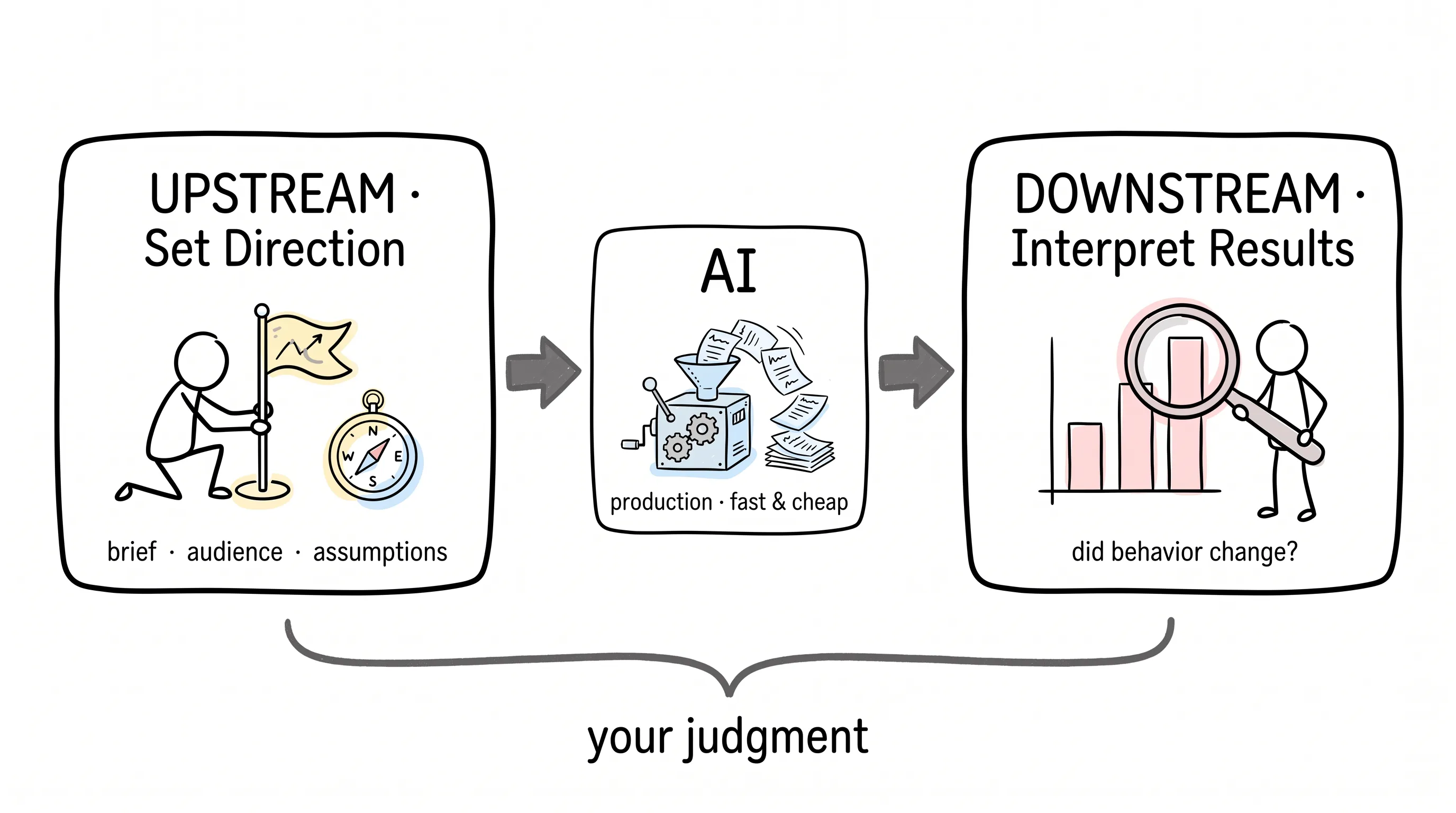
Upstream: set direction. Define the problem, understand the customer, write a clear brief, decide what this campaign is actually meant to change, pick the right audience, challenge the assumptions nobody dares to challenge.
Downstream: interpret the results. Copying numbers into a weekly report is easy; the hard part is answering: did this campaign truly create demand, or did it just use a discount to pull forward purchases that would have happened anyway? Did this test uncover a real behavioral pattern, or a passing whim? Did this automation improve the experience, or manufacture new noise?
AI can help you summarize patterns, spot anomalies, and propose hypotheses. But the final call is always yours.
Judgment is your trump card.
One More Painful Truth: AI Is Best at Amplifying Mediocrity
A lot of people worry AI will take marketers' jobs.
I'd argue the bigger risk is another one: AI will let weak marketing scale.
Templated content, surface-level personalization, tests run for testing's sake, box-checking analysis. It used to be that output was limited, so the damage was limited too. Now? One click and it flies.
Which creates a particularly ironic mismatch.
On your side of the screen: productivity boost! Efficiency soaring!
On the customer's side: yet another message not worth opening. Yet another "personalization" pretending to know me. Yet another automated journey with machine written all over it.
What you're celebrating is exactly what they're enduring.
Direction First, Then Speed
Of course, the answer isn't to retreat to the hand-crafted era and go back to squeezing out those three lines.
Speed is a real need, and the speed AI gives you is every bit as good as promised. But the order can't be reversed: direction first, speed second.
Before you let AI produce more stuff, let it help you think the thing through first.
For example, toss your brief to AI and have it play your pickiest, most demanding customer: what assumptions is this brief built on? Which customer questions have we simply not answered? If this message goes out, will it come across as irrelevant, intrusive, or spectacularly mediocre? What behavior will it change — and what won't it?
Or, have it hunt for counterexamples to your strategy: what evidence supports it, and what undermines it?
See the difference? Same AI — but now you're clearing the mines from the road ahead.
One Last Thing
Back to that friend from the beginning.
Last time we met, he told me the team had set a new rule: any AI-generated content has to clear three questions at the review meeting first. Whose behavior does this piece of content want to change — and into what? On what grounds do we believe it can? How do we count it as a win?
Only after the questions get answered does anyone make the call. If you can't call it, don't ship it.
That crude little method took their review meetings from every day back to twice a week.
I firmly believe one thing: the winners of the next phase of AI marketing won't be the teams with the highest content output, but the teams with the highest decision quality. They know which work is worth doing, which campaigns shouldn't be sent, which audiences deserve different treatment, which tests are worth running, which metrics are the real metrics — and which AI outputs merely sound sensible.
AI can shorten production time.
But it can't shorten the time that thinking deserves.
Marketing won't get better because we can do more.
Marketing only gets better because we think more clearly about what's worth doing.
Here's my wish for you: always think it through first — then press the generate button.
Continue reading
Related articles

Cross-Border Business: Time to Upgrade Your AI Toolbox
A learn article explaining how AI tools help cross-border e-commerce sellers clear five hurdles: language, regulation, logistics, payments, and fraud. It outlines a five-compartment toolbox, a five-step adoption path, and metrics such as conversion rate and CLV, while cautioning against over-reliance on AI.

AI Is Taking Over the Dirty Work of Social Media Marketing, One Task at a Time
This learn article outlines four social media marketing tasks AI can handle — audience analytics, content drafting and design, ad targeting and creative testing, and spam moderation — and cautions that taste, judgment, and data security remain human responsibilities.

AI Is Already This Good — Why Is Your Social Media Marketing Still Pure Manpower?
An overview of 18 AI tools for social media marketing, organized into six categories covering audience research, content creation, scheduling, comment and DM handling, ad management, and visual production, plus notes on personalization, prediction, and emerging trends.