
AI-Made Ads You Can't Tell Apart. But Your Wallet Can.
An analysis of an Ipsos study comparing human-made and AI-made video ads, covering where AI creative underperforms, how briefs shape AI output, and the need for measurement discipline and AI transparency.
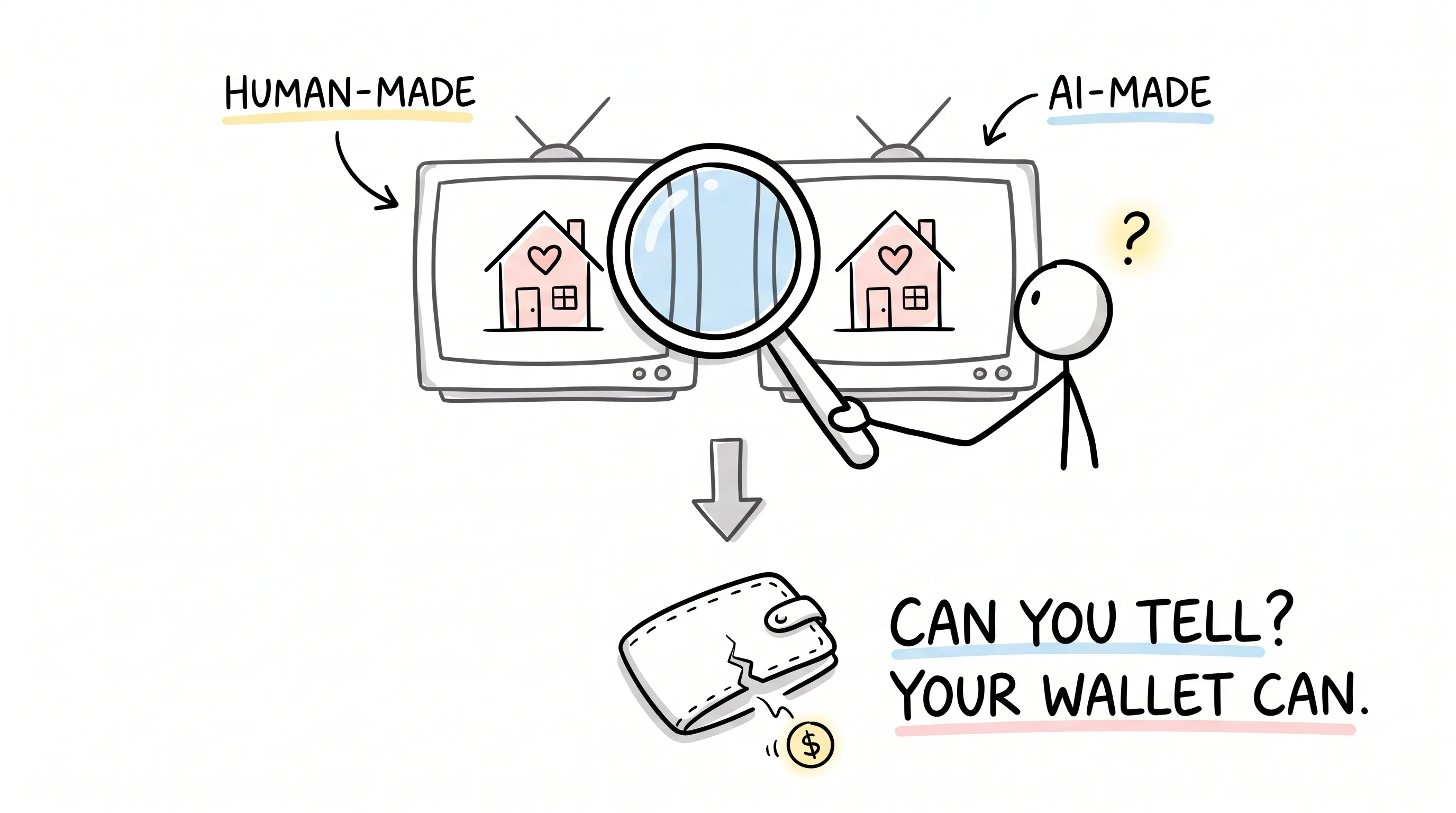
Recently I came across a study, and the more I think about it, the more it sends a chill down my spine.
Ipsos, the well-known research firm, ran an experiment alongside a few researchers. They recruited 3,000 American consumers to watch 20 video ads, all from brands everyone knows. Half of the 20 were made by human teams. The other half, from concept to post-production, were made entirely by AI. The AI got exactly the same assignment as the humans: the same creative brief, the same marketing strategy, the same starting line.
Guess what happened?
Consumers couldn't tell them apart. They really couldn't. Dropped into a real ad break, nothing about the AI ads felt out of place. People watched them and assumed humans made them.
But the business results were a different story entirely.
On average, the AI ads' short-term sales potential was 14% lower than the human ads'. Their long-term brand equity was 17% lower.
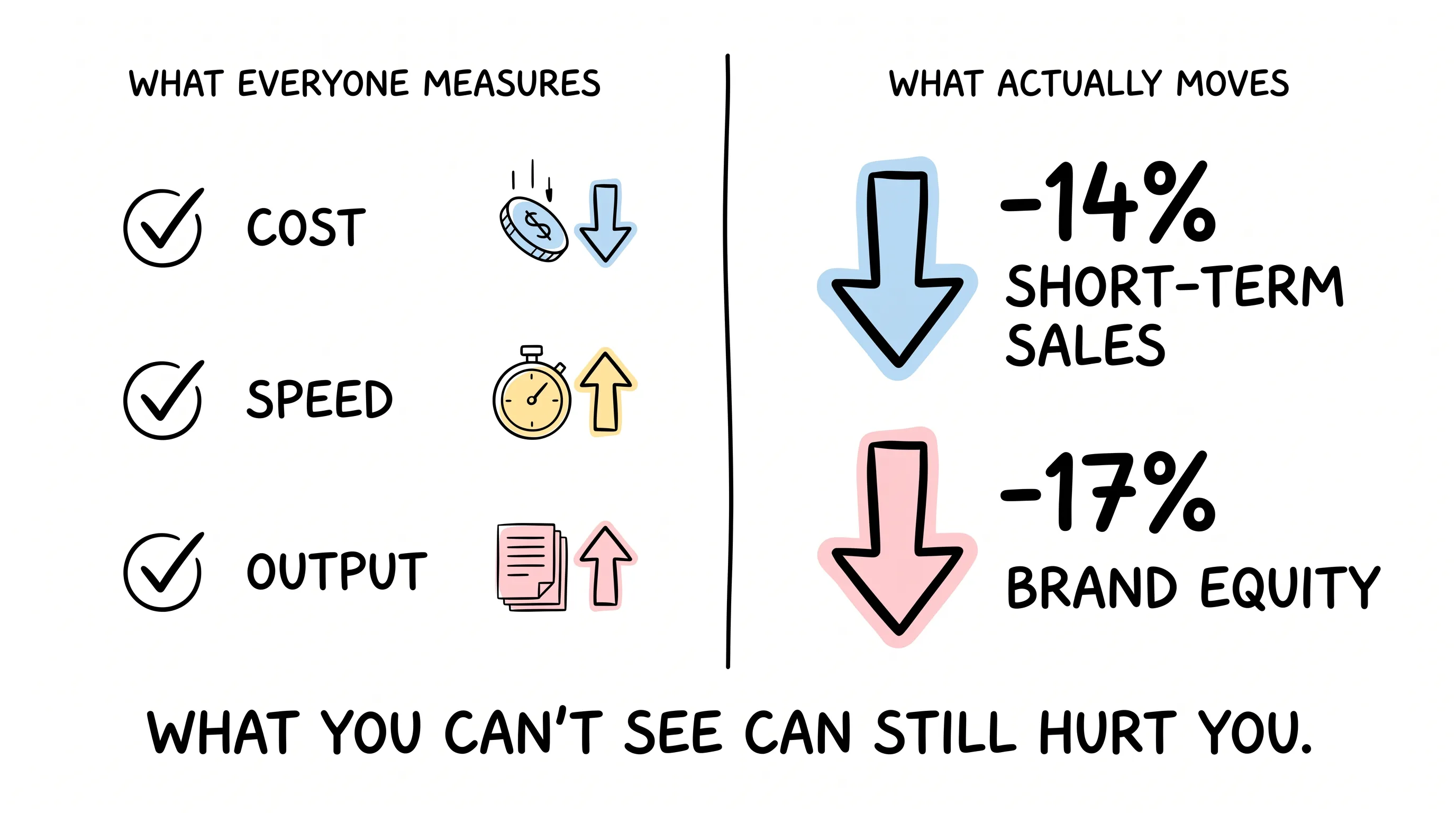
What does 14% and 17% mean? Say you spend 100 million a year on advertising and switch it all to AI production. Sure, you save money — but quietly off the books, you could be losing tens of millions in sales power, plus the thicker layer of brand equity you could have been building. That money never shows up on any report.
You might now ask: if consumers can't even tell the difference, isn't that enough?
That's exactly where this study cuts deepest. It tells you: what you can't see can still hurt you.
What does that harm look like? Think about it: ads aren't shot for the boss; they're shot for the market. What a great ad really does is make people remember the brand, trust the brand, and give it an extra glance next time they're in the supermarket. The problem with AI ads isn't that they flop. A flop you can spot in one look — kill it and reshoot. The problem is: they look completely passable while quietly losing points.
Let me give you a concrete example.
The study included a Chewy Christmas ad. Chewy is an American pet-supplies retailer. The human version follows a golden retriever from puppyhood into old age. There's a shot where the owner pulls a little sweater over the puppy, and by the time it comes off again, the dog is old. One single gesture, and it says everything about how the years with a dog slip by — faster than you think. When it's over, you want to go hug your own dog.
The AI version? Same "puppy to old dog" idea, but what comes out is a family gathered around a Christmas tree with a dog milling about nearby. By the end, you're not even sure whether the puppy and the old dog are the same dog.
Was the AI ad bad? No. It was a perfectly average ad. But the human one was the kind you remember for years. The gap between adequate and moving is one AI can't cross.
What makes this trickier is that when it happens, everyone in the company thinks it's good news.
The CFO sees production costs falling. The CMO sees faster campaign cycles. The CEO sees the company embracing AI. All three are looking at green numbers. So an unspoken consensus forms: produce more, produce faster, produce everywhere. Little by little, "passing approval" becomes the new bar, and the system starts rewarding output and speed instead of moving people.
Then one day sales quietly slip, and you can't find on any report the day it started. Because every single day looked perfectly normal.
So what do you do? Change the yardstick.
When measuring AI-made creative, the last things to look at are per-unit production cost, production time, and content output. Those are the easiest numbers to grab — and the easiest to be fooled by. What you should actually measure: given the same brief, which version — AI or human — delivers more attention, more persuasion, deeper memory, better conversion, thicker brand equity?
If the AI version performs just as well or better, use it freely. If it doesn't, kill it and don't get sentimental about the production budget you saved. Media spend is the real money; a dead ad saves pennies and burns fortunes.
And there's one crucial finding: the quality of the brief directly sets AI's ceiling.
In the study, both Cheerios ads ranked near the top of the entire test. The human version: a little girl asks her mom whether the cereal is good for the heart. Hearing that it is, she quietly pours a pile of Cheerios onto her sleeping father's chest — using the most direct way she can think of to help Dad's heart. The AI version: same insight, executed as a more conventional family-dinner-table scene, tying heart health to "the people waiting for you at home." Both were good. Why? Because the brief was rooted in a human insight simple enough: the meaning of heart health is getting to keep showing up for the people who need you.
With a solid foundation, AI can build a decent house. With a rotten one, all AI can do is build more neatly on top of it.
So what is AI actually good at? Let me lay it out. Two kinds of work.
The first: formulaic work. The study found the highest-scoring AI ads all look basically alike: product-driven, straight to the point — pose a problem, offer a solution, give you a reason to believe. Why? Because AI's strength is recognizing patterns and recombining them. The AI ad for fabric refresher Febreze is a clean demo: spray it on fabrics all over the house, and everything looks refreshed. The AI ad for shampoo Herbal Essences is a woman showing off her hair, intercut with beauty shots of the shampoo surrounded by flowers and natural ingredients. Both matched the human versions on short-term sales potential. Because this kind of ad needs no point of view — only flawless execution.
The second: grunt work and chores — resizing, versioning, localization, internal mockups, first-draft copy, product demos. It's also excellent at rapidly fanning out creative directions during the exploratory phase.
So what can't AI do?
Delicate work. When the brief is vague, it struggles. Anything that depends on emotional precision, cultural timing, narrative tension, or a sense of humor — it struggles.
The study's most typical blowup was a Fiat car ad. The brief called for: energetic, untamed, playful, rebellious. The AI version dutifully executed the letter: dark tones, cinematic, neon-lit streets, the car looking like a lab specimen under test. It looked cool. The result: one of the lowest emotional-impact scores in the entire set. How did the humans shoot it? Same "testing" concept — engineers in white coats staging the car being smashed by an angry partner. See the difference? Same pitch of toughness, but they turned the product's selling point into a story that makes you laugh. AI copied the look of rebelliousness. It never copied the soul.
One more thing that deserves its own mention: transparency.
In the study, more than half of respondents said a brand using AI in its ads wouldn't change how they see the brand. But at the same time, the overwhelming majority said: you have to tell me.
Consumers can accept you using AI. They can't accept you hiding it.
And this stopped being a style question long ago. The EU's AI Act, as of August this year, already requires transparency for certain AI-generated or synthetic content. New York State already requires disclosure of AI-synthetic actors in ads. The Interactive Advertising Bureau (IAB) has published an AI transparency framework too. Keeping records of AI usage, deciding when to disclose, setting rules for synthetic faces and synthetic voices, making agencies and suppliers play by the same rulebook — these are becoming the basic hygiene of brand governance.
Heinz once gave a beautiful demonstration. Its "AI ketchup" campaign used AI for every image: the team simply asked the model "what does ketchup look like," showed the generation process openly, and invited consumers to submit their own prompts. Disclosure became the creative itself.
By now you probably think I'm about to talk you out of using AI. Quite the opposite.
This study's conclusion has nothing to do with whether to use AI. Use it boldly. What needs adding is discipline: knowing clearly where it creates value, and where it has buried landmines you can't see.
AI is great at exploration and execution: concept development, competitive analysis, creative prototypes, rapid iteration, plus resizing, versioning, localization, first drafts. But brand strategy, briefs rooted in fresh insight, emotional connection, cultural interpretation, which concept finally ships, whether to bet big on a major brand campaign — those calls still belong to humans. Because humans define the problem, humans interpret the users, and humans judge whether the work deserves real money.
In the end, it comes down to one sentence:
AI owns "can be done." Humans own "should be done." Every cent of production cost you save has to pass one test first — "is it actually working?" — before it gets to be spent.
The future of advertising won't be won by who produces the most. It'll be won by who judges the best.
Here's to using AI fast and cheap — and selling more, and better.
Continue reading
Related articles

Cross-Border Business: Time to Upgrade Your AI Toolbox
A learn article explaining how AI tools help cross-border e-commerce sellers clear five hurdles: language, regulation, logistics, payments, and fraud. It outlines a five-compartment toolbox, a five-step adoption path, and metrics such as conversion rate and CLV, while cautioning against over-reliance on AI.

AI Is Taking Over the Dirty Work of Social Media Marketing, One Task at a Time
This learn article outlines four social media marketing tasks AI can handle — audience analytics, content drafting and design, ad targeting and creative testing, and spam moderation — and cautions that taste, judgment, and data security remain human responsibilities.

AI Is Already This Good — Why Is Your Social Media Marketing Still Pure Manpower?
An overview of 18 AI tools for social media marketing, organized into six categories covering audience research, content creation, scheduling, comment and DM handling, ad management, and visual production, plus notes on personalization, prediction, and emerging trends.