
AI Just Re-Tilled the Field of Traffic
A learn-style roundup on how AI answers are reshaping web traffic: brand visibility in AI citations, changes to search and ad platforms, agents, and regulation. It frames a shift from fighting for rankings to being cited in AI responses.
Not long ago, while sorting through research material, one number stopped me cold.
60%.
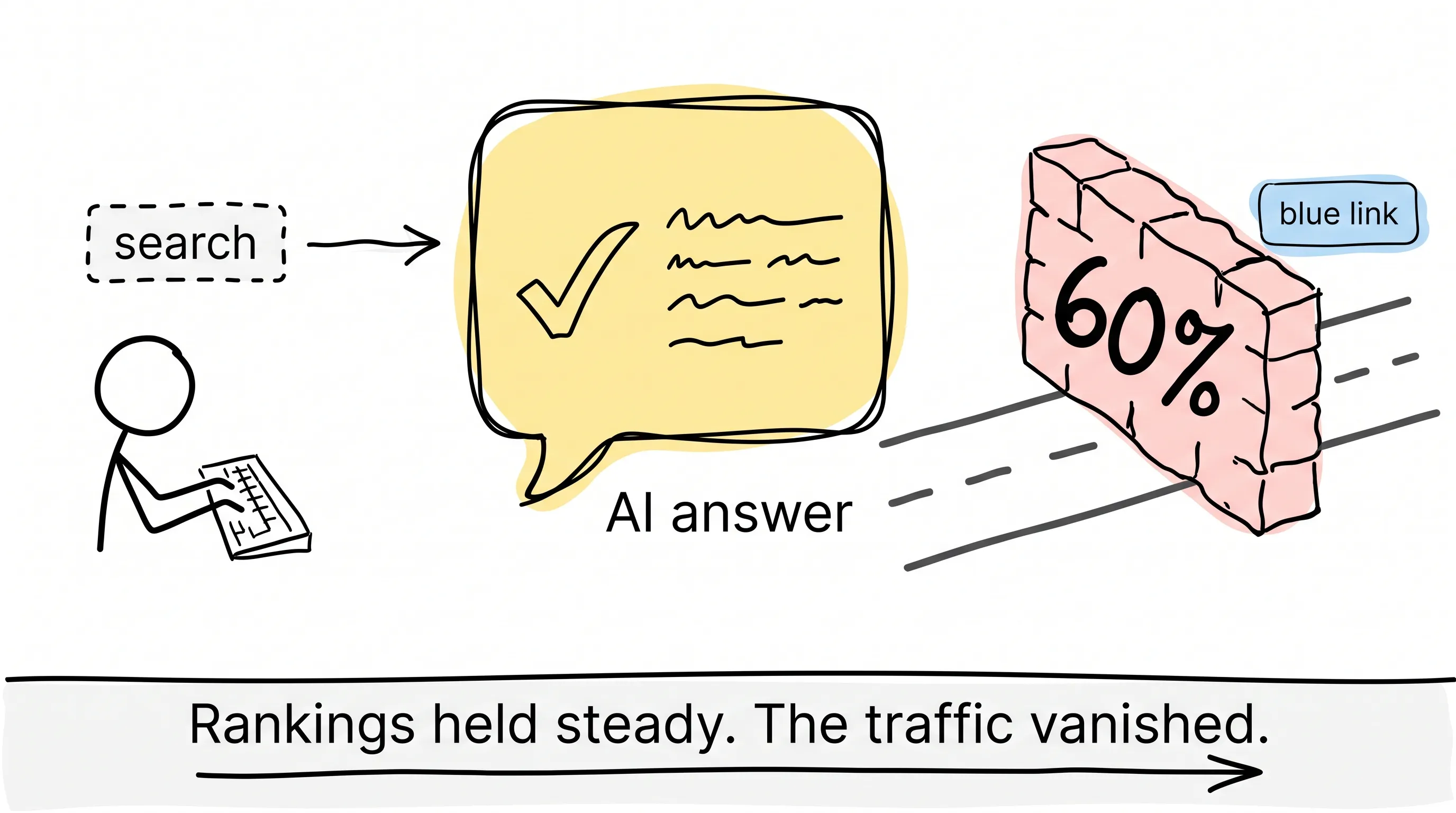
In late February, LinkedIn published a set of figures: the slice of B2B traffic that carries no brand terms — pure awareness traffic — fell by as much as sixty percent at its worst.
Here's the interesting part: the rankings didn't drop.
Rankings held steady. The traffic vanished.
Where did it go? It was intercepted by AI answers. Users search, AI finishes the answer, and nobody clicks the blue link anymore.
And this is only the beginning. Keep following the thread — advertising, models, agents, regulation — and you find layer after layer being re-tilled. Let me walk you through everything I've gathered these past few months, from the top.
1. Traffic first: rankings remain, clicks are gone
LinkedIn admitted it first. The company has abandoned traditional SEO metrics and now watches a different set of signals: how often your brand gets mentioned in AI answers, how often it gets cited, whether it has any presence at all. It even assembled a cross-functional team to work out optimization methods for generative-engine environments.
From fighting for rankings to fighting for citations — the very foundation of discovery has changed.
One analysis covered 76,000 websites: ChatGPT handles questions measured in the billions every day — no small number — yet the referral traffic it sends to websites isn't even in the same league as Google's.
Why? The business models are different.
Google is a shopping mall — it walks you in, then lets you wander back out, and the business happens out there. ChatGPT is a concierge who gets everything done for you — the errands are finished inside, and you never need to step out.
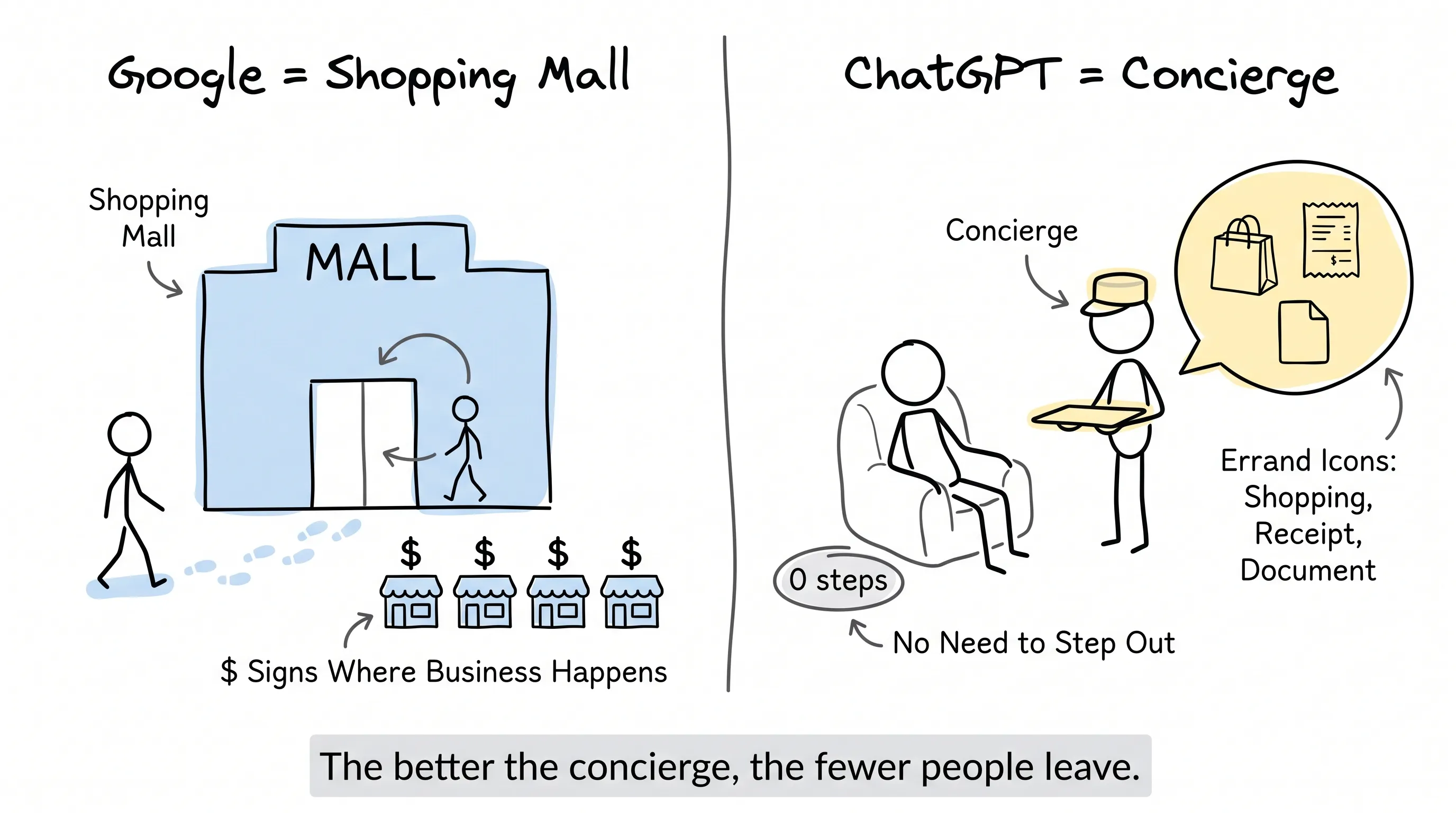
The better the concierge, the fewer people leave. That's how website owners lost their traffic.
So how do you make AI notice you? Microsoft's advertising team published a guide that breaks AI-driven brand selection into three steps: first, the data a model absorbed during training provides the base layer; then, web content retrieved in real time calibrates it; finally, first-party structured data makes precision corrections. The old game was keyword matching. The new game is entity clarity, contextual relevance, and how structured your signals are. Bing, Edge, Copilot — the logic is the same at every entry point.
Google is moving too. In AI Overviews and AI Mode, links now come with hover cards — summaries, images — making it easier for users to click back to the web.
Why the sudden concern for links? Because publishers have been howling daily that AI summaries are eating their lunch, and regulators in the UK and the EU are watching closely. Google wants to build a switch that lets publishers opt out of AI summaries without hurting their visibility in traditional search. A senior engineer put it bluntly: hard, and a lot of engineering. Negotiating content licensing on one side, fielding regulator questions on the other — Google is still searching for the balance.
In the traffic era, you fought for rankings. In the AI era, you fight to be cited.
2. Advertising: some rush in, some pull out
First, the ones rushing in.
Google's AI Mode has already passed 75 million daily users. Google is stuffing shopping ads straight into the conversation: as the user chats about a product, the product appears mid-answer. And the longer the conversation runs, the richer the intent signals, the sharper the targeting. Behind it sits an entire pipeline: Gemini-powered ad tools, on-site checkout through Universal Commerce Protocol, pushing steadily toward agentic commerce.
Users stopped typing queries and started chatting. So Google moved the ads into the chat. In effect, it rewrote the rules of search monetization.
Now OpenAI. Its commercialization lead has publicly sketched this future: a business tells ChatGPT its goals in one sentence, and the system builds the campaigns itself, tests the bidding, splits the budget, tunes the strategy. Trials start with free and entry-tier users in the US. Small and mid-sized owners won't need to keep an ad-ops team on payroll, nor an agency.
A chill ran through the ad world. AI can replace campaign execution — but can it take over strategic judgment and cultural instinct? Plenty of practitioners have their doubts.
Some are doing the opposite. Perplexity announced it will phase out advertising and lean on subscriptions and enterprise customers instead. The reasoning is a single line: stuff ads into a chat answer, and users start suspecting your answers aren't clean. Executives say ads may return someday, but for now, the company will fund itself with business customers' money.
Same intersection. Some hit the accelerator on ads, some pull them. Everyone is betting on the same thing: whether users trust you.
3. Engines: capability rises, prices don't
Beneath the foundation sits another layer: the models. And at this layer, a price war is on.
Alibaba's Qwen 3.5: open weights, Apache 2.0 license, sparse Mixture-of-Experts (MoE) architecture (a design where many specialist sub-models share the workload), a one-million-token context window, support for 201 languages, decoding 19 times faster than the previous generation, and lower token pricing to boot. Performance, it claims, matches America's top closed-source models. Open models are pressing hard against closed ones, and the moat that closed-source vendors dug with pricing is visibly being filled in.
Google's Gemini 3.1 Pro: reasoning performance on ARC-AGI-2 more than doubles the previous generation, coding, multimodal, and science benchmarks all pushing forward, and enterprise partners report reliability is up too. The most critical line: prices unchanged. Capability doubles, price stays flat — reasoning at half the effective price. The model ships through Vertex AI and the Gemini API, aimed at developers building agents and enterprise applications.
Anthropic set Claude Sonnet 4.6 as its new default model. Coding, long-context reasoning, and the ability to operate software interfaces like a human all improved — and on some real office tasks it even beat the company's own flagship, Opus 4.6. A cheaper model beating the flagship: you wouldn't have dared imagine that before.
Now let me do the math for you. Two years ago, Anthropic had barely a dozen customers paying over a million dollars a year. Today, more than five hundred. Two years. More than a fortyfold increase.
Capability is rising. Prices are not. This battle is being fought on the cost line.
4. Agents: AI starts doing the work itself
One layer deeper is the busiest layer of the stack this year: agents.
xAI launched Grok 4.2 in public beta. The architecture is four specialized agents: divide the work, debate, synthesize — only then hand you the answer. Hallucination rate is down 65% from the previous generation, the model iterates weekly, and user feedback flows straight into the next version. Doing this with a native multi-agent architecture inside a mass consumer product puts Grok in the first wave.
OpenAI went more direct, hiring OpenClaw's founder Peter Steinberger to lead personal AI agents. OpenClaw will convert into an open-source project backed by OpenAI, with community governance intact. The intent is unmistakable: AI's next stop isn't just answering questions — it's doing your work for you.
E-commerce is moving too. Google joined hands with Southeast Asia's Sea to pilot an agentic shopping prototype inside Shopee, and to spread AI across game development at Garena. In this market — one that commands a huge share of Southeast Asian e-commerce — buying things is shifting from "a person asks the AI" to "the AI buys for the person."
Academia is running forward as well. UC Santa Barbara built a Group-Evolving Agents framework: a swarm of agents shares experience and evolves together, matching and sometimes beating human-designed frameworks on coding and software engineering benchmarks — with no rise in inference cost. The results even transfer across different underlying models, which makes them flexible for enterprises.
On the hardware front, Apple is cooking up a set of devices: AI smart glasses targeted at 2027; a pendant the size of an AirTag with a camera that's always on; plus upgraded AirPods with a camera. None of them has a display; the compute leans mainly on the iPhone. In essence, it's giving Siri eyes — reading the scene around you, then triggering whatever needs to happen. The benchmark is Meta's glasses ecosystem.
For all the excitement, UC Berkeley researchers poured cold water first. They published a 67-page set of agent risk-management standards, extending NIST's AI risk-management framework to a class of new risks: reward hacking (agents gaming the metrics they're judged by), deceptive alignment, chained intrusions, self-replication. The rationale is simple: agents are already at work on ad platforms and enterprise systems with little oversight, while governance thinking is still stuck at "manage one model." It isn't enough.
Agents will no longer wait for your nod at every step.
5. The way people work is changing too
IBM announced it will triple entry-level hiring this year. Yes — tripling, the opposite direction. It redesigned its junior roles: less repetitive code, more customer visits and product work, with the repetitive parts handed to AI. The executives' math is clear: hiring young people on the cheap and developing them beats paying a premium to poach mid-level talent. In surveys, plenty of financial-services CEOs likewise expect AI spending to grow headcount, not shrink it.
The talent pipeline is lengthening too. An online AI film school called Curious Refuge has taught more than 10,000 students across 170 countries; last year it was acquired by the AI entertainment studio Promise, becoming a talent reservoir for Hollywood's generative era. Some people fear losing their jobs to this; others see new creative roles. Tuition and technical barriers are both falling — I'm betting on the latter.
The tools have climbed into our hands as well. WordPress built an AI assistant straight into the site editor: rewrite copy, generate images, build pages, adjust layout — just by saying the word, with image generation powered by Google's Nano Banana model. Figma opened the road from Claude Code to the design canvas: a live interface in production becomes an editable Figma file, letting design and development run back and forth. And Google put Lyria 3, its music-generation model, into the Gemini app: a 30-second song, cover art auto-generated, available worldwide to anyone 18 and up — built for original expression, explicitly not for imitating any particular singer.
The barrier has collapsed. The people who know how to ask are the ones who are now valuable.
6. The rules can't keep up
Start with something strange. Microsoft's security team discovered a new attack: inside a fake "summarize with AI" link lurk invisible instructions that can rewrite a chatbot's memory, so that from then on it quietly speaks favorably about certain topics. Across finance, healthcare, legal, and SaaS, more than 30 organizations were observed testing these tricks. Microsoft calls it "memory poisoning." Copilot has shipped mitigations, but detection depends on scanning for suspicious prompt patterns, and that doesn't come cheap.
Answers can be bought; recommendations are no longer clean. Sit with what that means for the marketing industry.
The regulators, meanwhile, are in disarray. California's attorney general Rob Bonta, on one hand, sent a cease-and-desist letter to xAI over Grok generating non-consensual explicit images; on the other, he stood up a state-level AI oversight team. The federal level is stalled, so the states move first.
The UK is pushing a social media ban for under-16s, and wants to close a loophole: one-on-one AI chats currently escape the existing safety law, and it wants them brought inside — with data-preservation orders from a child-death inquiry attached. Across Europe, more countries aren't waiting: Spain, Ireland, France, Greece, Denmark, Slovenia, and Czechia are each investigating platforms and AI pornography, some pushing teen bans outright. Patience with the EU's enforcement pace on the Digital Services Act has run out. Washington has threatened trade retaliation, and the two sides are locking horns.
Stranger still is another report: the White House, reportedly, has been pressuring Utah to let a state AI transparency bill die. That bill would require frontier AI companies to disclose their safety and child-protection plans, and it protects whistleblowers. Blocking a bill in a fellow Republican's own state — the states-versus-Washington fight looks set to run for a while.
Academia is in an awkward spot too. One study evaluated AI health advice and AI psychological counseling — but before the paper was even published, the models being tested had already been upgraded and replaced. Peer review can't outrun the launch events. Independent evaluation matters more than ever, and is harder to do than ever.
Models update weekly. Institutions meet yearly. The gap between them gets filled with risk.
7. Another table: Hollywood, China, India
ByteDance's Seedance 2.0 video model generates lifelike clips from a single prompt — so lifelike that stars and copyrighted characters are recognizable. Star Wars and Marvel characters, "played" without authorization. Disney's and Paramount's cease-and-desist letters arrived directly, with Hollywood's unions and industry bodies piling on. ByteDance says it will strengthen safeguards; details weren't given.
What's really keeping Hollywood up at night is something else: Chinese open-source models are eating up global usage share — cheap, fast, low barrier to entry. Whose tool becomes the industry default will very likely decide whose logic the copyright rules of the future are written in.
In its home market, ByteDance released Doubao 2.0, built for the agent era: it takes on complex multi-step tasks, not just Q&A, and the Pro version claims parity with America's top models in reasoning and task execution, at a steeply cut cost. Doubao runs 155 million weekly active users and sits at the top of China's chatbot leaderboard, with DeepSeek and Qwen pressing close behind.
New Delhi hosted a five-day AI summit, billed as the first for the Global South. India wants to be the bridge — one end touching the advanced economies, the other the developing world, with its digital public infrastructure of identity and payment systems laid across the middle. No binding agreement came out of it, but governance, safety, jobs, and defense were all discussed. The geopolitical weight of AI is visibly stacking up.
Back to That 60%
Back to the number we started with.
The traffic that dropped didn't disappear. It just no longer passes through the crossing called "one click." It became a mention in an AI answer, a citation, a landing point inside a hover card.
The intersection moved. The people are still on the road.
A road missing from the old map isn't a road that's gone. It means you need a new map.
May the new map in your hands be drawn a little earlier than your competitors'.
Continue reading
Related articles

Cross-Border Business: Time to Upgrade Your AI Toolbox
A learn article explaining how AI tools help cross-border e-commerce sellers clear five hurdles: language, regulation, logistics, payments, and fraud. It outlines a five-compartment toolbox, a five-step adoption path, and metrics such as conversion rate and CLV, while cautioning against over-reliance on AI.

AI Is Taking Over the Dirty Work of Social Media Marketing, One Task at a Time
This learn article outlines four social media marketing tasks AI can handle — audience analytics, content drafting and design, ad targeting and creative testing, and spam moderation — and cautions that taste, judgment, and data security remain human responsibilities.

AI Is Already This Good — Why Is Your Social Media Marketing Still Pure Manpower?
An overview of 18 AI tools for social media marketing, organized into six categories covering audience research, content creation, scheduling, comment and DM handling, ad management, and visual production, plus notes on personalization, prediction, and emerging trends.