
AI Just Filled In the Multiple-Choice for Consumers — Is Your Brand on the Shortlist?
A learn article on how AI answers are reshaping the first step of consumer decisions, shifting from active search to recommendation. It covers generative engine optimization, why partner and creator content gets cited by AI, attribution and metric pitfalls, and localization lessons for Chinese brands going global.
A couple of days ago, I witnessed a very ordinary scene.
A friend of mine wanted to buy a coffee machine. Not long ago, he would have opened a search box, typed in keywords, waded through ten web pages, compared specs himself, and read the bad reviews. This time? He went straight to AI: "Pick three for me, and tell me why."
The AI gave him three options. He picked one, placed the order, done.
It suddenly hit me: he never even made a choice — the choice had already been made for him.
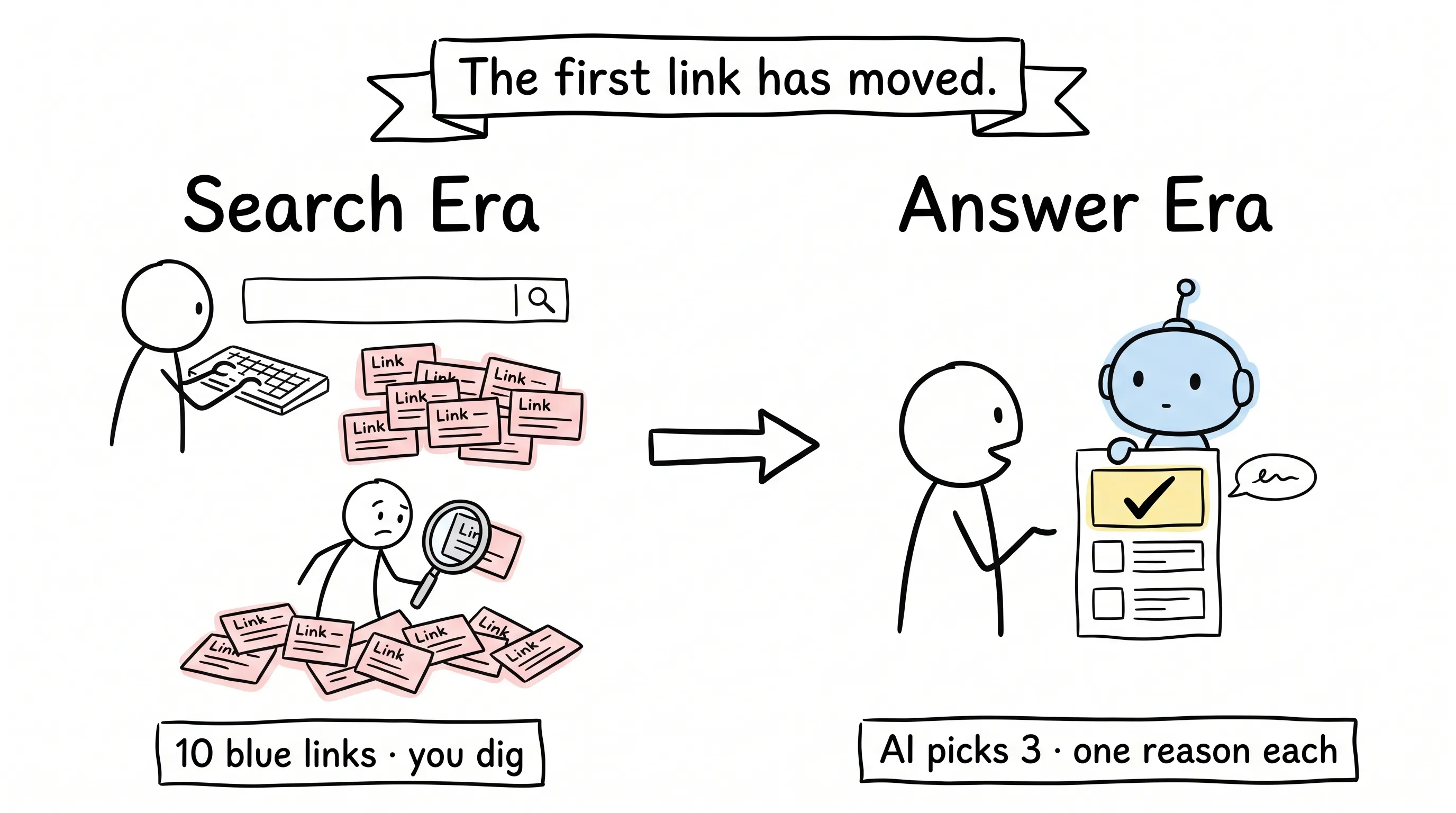
From search to answer, the first link in the consumer decision chain is being rewritten.
And for Chinese companies going global, this could matter far more than anyone imagines.
Why Should Going-Global Companies Be Nervous?
Start with some numbers.
According to China's General Administration of Customs, in the first half of 2026, high-tech product exports grew 39%, and own-brand exports grew 25.4%.
What does that mean? It means Chinese companies are moving from "selling products" to "building brands" on their way overseas.
But don't celebrate yet. Rising exports and stronger products don't mean these brands have made it onto overseas consumers' shortlists.
Think about it: in overseas markets, a Chinese brand has to pass three gates — being seen, being understood, being trusted. Selling the product only gets you past the threshold of the first gate. The other two are the real watershed between "cross-border selling" and "global operations."
And the spread of AI has just added a new variable at exactly this point.
In early September, impact.com held a cross-border marketing summit in Shenzhen (iPX 2026) and summed the whole thing up in one sentence: from the "Search Era" to the "Answer Era."
After the event, its Global Chief Revenue Officer Justin Morrison and President of Greater China Jennifer Zhang talked at length. I've distilled their judgments, together with data I've seen myself, into this piece for you.
So What Is the Answer Era?
First, let's be clear: what is the "Answer Era"?
In the past, when consumers shopped, they did "active search": type in a keyword, get ten blue links, dig through them yourself. Now, AI does the filtering first, then places a handful of brands — plus a few reasons why — into a single answer.
Justin Morrison calls it the shift from "active search" to "being recommended."
Think about how lethal this is. The transaction may still happen on search, e-commerce platforms, or brand websites — that road isn't broken. But whether a product ever appears in the candidate pool is decided much earlier, at the step where AI "explains" you.
Your brand can die before the consumer ever asks.
So is search doomed? Hold on — look at the data.
Adobe analyzed over one trillion visits to US retail websites and found that in Q1 2026, traffic from generative AI grew 393% year over year; by March, this traffic converted 42% better than non-AI traffic.
Whoa. 393%. Is AI about to eat search?
Calm down. A big year-over-year jump doesn't mean the total has overtaken mature channels. Look at the other side: Pew Research Center analyzed 68,900 searches and found that when an AI summary appears, only 8% of users click the traditional results; without a summary, the number is 15%. Yet over the same period, Google's search-related revenue in Q2 2026 was still up 17% year over year.
Put the two datasets side by side and the conclusion is clear: AI and search aren't in a replacement relationship — they're stacked. Search isn't dead. There's just a new middleman talking before search does.
Who Holds the Ticket to AI's Recommendations?
The most interesting question here: where do AI's answers come from?
Justin Morrison stressed one point: a substantial share of the content AI cites comes from partners — creators, publishers, user communities. Jennifer Zhang added that tools already exist to trace back which content sources a given AI has actually indexed; follow that thread, and you can identify the partners with real influence.
The partnership between impact.com and Evertune, a generative search optimization firm, follows exactly this route: dig out the creators and publishers most frequently cited by AI, then feed them into partner recruitment and management workflows.
Evertune has run the numbers: among the 10,000 most AI-cited sources it tracks, more than 40% of the content carries affiliate links or sponsorships.
When I saw that figure, my first reaction was: oh? So the product-seeding business (influencer-driven recommendations) is back — just wearing a new outfit.
But pump the brakes here. This data comes from their own research, and it does not follow that "spend money, get recommended by AI." AI answers are swayed by phrasing, region, timing, model versions, and retrieval mechanisms; how often a brand gets mentioned is unstable.
So here's my take: generative search optimization, for now, is less an ad slot you can buy off the shelf and be done with, and more a content and data capability that's still maturing. Whoever starts treating "being cited by AI" as part of partner operations earliest gets an extra ticket.
AI Saves You Time, Not the Cycle
Now that the entry point has changed, the question companies really start to ask is: how do you calculate the return on this AI spend?
Justin Morrison put it plainly: the core of most conversations has shifted from "what pain point does your product solve for me" to "how do you help me seize the opportunity." When executives evaluate vendors, they don't ask what AI features you've bolted on; they ask whether you understand where the industry is heading, where your product is going, and whether your capabilities map onto the metrics they care about most.
Put simply, AI has gone from being a feature to being the yardstick by which companies judge a vendor's long-term capability.
What can AI do? It speeds up finding partners and matching resources. Jennifer Zhang also mentioned that brands use AI to analyze their exposure inside large models' answers. All good — it solves information overload and makes choosing easier.
But here I want to hammer in one nail:
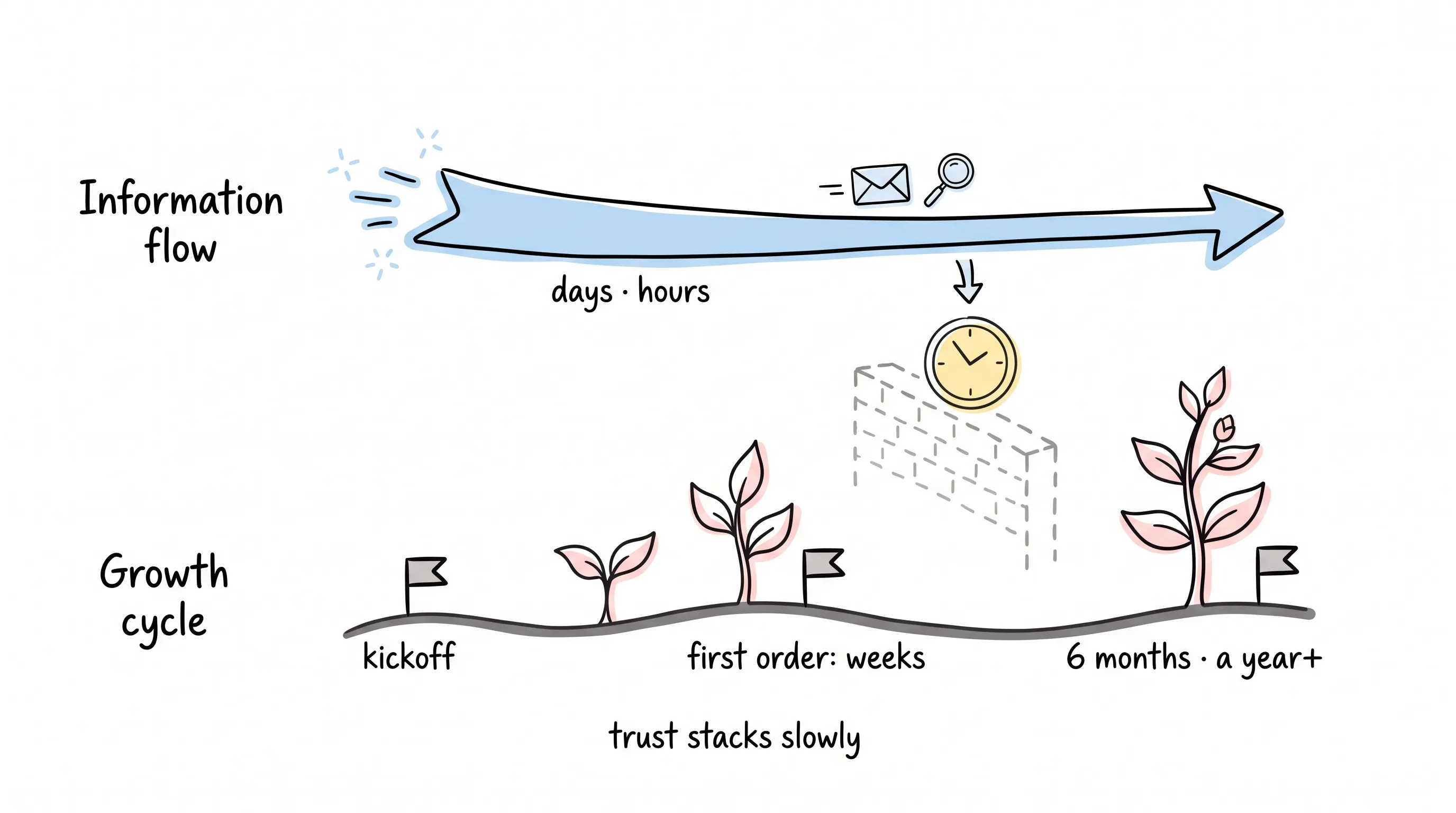
AI raises the speed at which information flows. It cannot compress the cycle it takes for a business to grow.
Why do I say that? Because in a high-cost-of-capital environment where budgets are ruthlessly tied to measurable outcomes, the question a brand ultimately has to answer is: can this partnership build brand awareness and drive revenue conversion at the same time?
AI mention rate, answer ranking, content reach, partner count — these are process metrics. New customers, revenue, customer acquisition cost, retention — those are business metrics. Process metrics cannot substitute for business metrics. Especially when AI answers influence the consumer up front while the transaction happens on your website or an e-commerce platform, that final-touch attribution simply has no room for the credit the front-end content deserves.
There's a subtler trap too: getting the observation window wrong.
Platform integration, partner recruitment, landing the first order, building stable market presence — each phase moves at a completely different speed. Justin Morrison says that from project kickoff to first customer or order, it usually takes weeks, at most a few months. Jennifer Zhang is more granular: big brands with recognition and reputation may see results in one or two months; small brands? Six months, a year, even longer.
Now imagine measuring every phase with the same ruler, boiling technical deployment speed, short-term conversion, and long-term brand building in the same pot. The conclusion you get is almost certainly wrong.
So how should you evaluate AI's return? Short term, watch orders; at the same time, watch whether the partner network and brand awareness keep stacking up. You have to look at both ends.
When Attribution Breaks, the Organization Has to Change With It
One level deeper, the attribution problem becomes an organizational problem.
A single consumer decision is being shaped simultaneously by AI answers, creator content, affiliate links, and user recommendations. So tell me: which team owns that partner? Does their contribution count as brand exposure, content marketing, or sales conversion?
Jennifer Zhang says the boundaries between partner types are blurring. Influencers can run affiliate marketing at the same time; media partners can produce content and manage social accounts too.
And many companies? One team for email, one team for influencers, one team for search — each in its own lane. Some haven't even genuinely started KOC (key opinion consumers) or consumer referral programs. The result: the same partner gets handled over and over by multiple departments, and the data can't be compared on a single standard.
She put it brutally: some companies "build teams for a model, not for an actual outcome."
The direction of adjustment isn't simply merging departments. It's re-cutting your org, your data, and your budget around outcomes — acquisition, retention, revenue growth.
The executive level is no different. Justin Morrison says acquisition traditionally sits with the CMO, while retention and growth sit more with the CRO, depending on each company's business priorities. Jennifer Zhang goes bolder: she predicts that in the next three to five years, some executive roles may merge. If she were CEO, she'd fold the CMO into the CRO, or have the CMO report to the CRO.
When recommendations and clicks mix together, organizations built floor by floor around channels have to be rebuilt around outcomes.
The Road AI Can't Shorten Is Called Trust
Finally, back to Chinese companies themselves.
The customs data at the opening was about exports. But Jennifer Zhang characterizes the current stage as an early, exploratory one: new brands have to build recognition from scratch, and even established companies with decades of supply-chain and manufacturing experience have to recalibrate their brand expression for each target market. Products and playbooks validated at home cannot be copied overseas as-is.
She shared one example I find especially telling.
A company making tattoo equipment entered the US market — and then discovered its target users weren't at traditional industry trade shows at all. They clustered among tattoo artists, at music festivals, in bars, and in street-culture circles.
What makes this case interesting isn't channel-selection tactics. It's the precondition of localization: you first have to understand how users live and how their circles form; only then do you decide whom to partner with and what content to speak with. AI can help you organize information and segment audiences, but the judgment that comes from standing on the ground — it can't replace that.
Localization has another gate, inside the organization.
Jennifer Zhang has observed Chinese companies that hire staff overseas yet rarely promote local talent into core management; others, put off by differences in work rhythm and management culture, simply pulled the business back to domestic teams.
Whether your overseas team can take part in decisions, get resources, and own results directly determines how fast you respond to shifts in the local market. Sprinkling a few locals into the execution layer — that's not localization. That's window dressing.
A Few Last Words
Back to that coffee machine.
What AI has changed is how consumers get information. It makes the information gaps and misreadings of overseas markets more likely to directly decide whether a brand gets recommended.
But stretch the timeline out, and AI has not closed the gap between selling products abroad and building brands abroad. It can compress the time it takes to produce content, analyze information, and match resources. What it cannot compress is cultural understanding, product validation, and user trust.
Product efficiency gets you in the door fast. At scale, what you compete on is brand expression, third-party content, community relationships, and user retention.
The exam question for the next stage is already written: can your supply-chain edge and innovation edge become the stable brand recognition in overseas consumers' minds, plus the local operations capability that puts down roots?
Next time an overseas customer asks an AI "how's this brand?", may the answer it reads out be exactly the line you wanted to say.
Here's wishing you a place in every answer.
Continue reading
Related articles

Cross-Border Business: Time to Upgrade Your AI Toolbox
A learn article explaining how AI tools help cross-border e-commerce sellers clear five hurdles: language, regulation, logistics, payments, and fraud. It outlines a five-compartment toolbox, a five-step adoption path, and metrics such as conversion rate and CLV, while cautioning against over-reliance on AI.

AI Is Taking Over the Dirty Work of Social Media Marketing, One Task at a Time
This learn article outlines four social media marketing tasks AI can handle — audience analytics, content drafting and design, ad targeting and creative testing, and spam moderation — and cautions that taste, judgment, and data security remain human responsibilities.

AI Is Already This Good — Why Is Your Social Media Marketing Still Pure Manpower?
An overview of 18 AI tools for social media marketing, organized into six categories covering audience research, content creation, scheduling, comment and DM handling, ad management, and visual production, plus notes on personalization, prediction, and emerging trends.