
AI Isn't Just Here to Sell Your Stuff Anymore: The 8 E-commerce AI Tools That Popped Up in July, Reviewed One by One
A roundup reviewing eight generative AI e-commerce tools that launched in July, covering AI customer service with Shopify and WhatsApp integration, image generation, browser automation, and open-source video ad creation, with notes on the shift toward agentic AI and data privacy considerations.
A few nights ago, I went through everything that happened in the e-commerce world in July, from top to bottom.
When I finished, I sat in my chair for a good long while.
In just half a month, at least eight generative AI e-commerce tools shipped. AI customer service, browser automation, image generation, video ads — they've touched nearly every part of running an online store.
Taken one at a time, none of them is earth-shattering. But put the eight side by side, and I saw one thing in common. That common thread matters more than any single tool.
What is it?
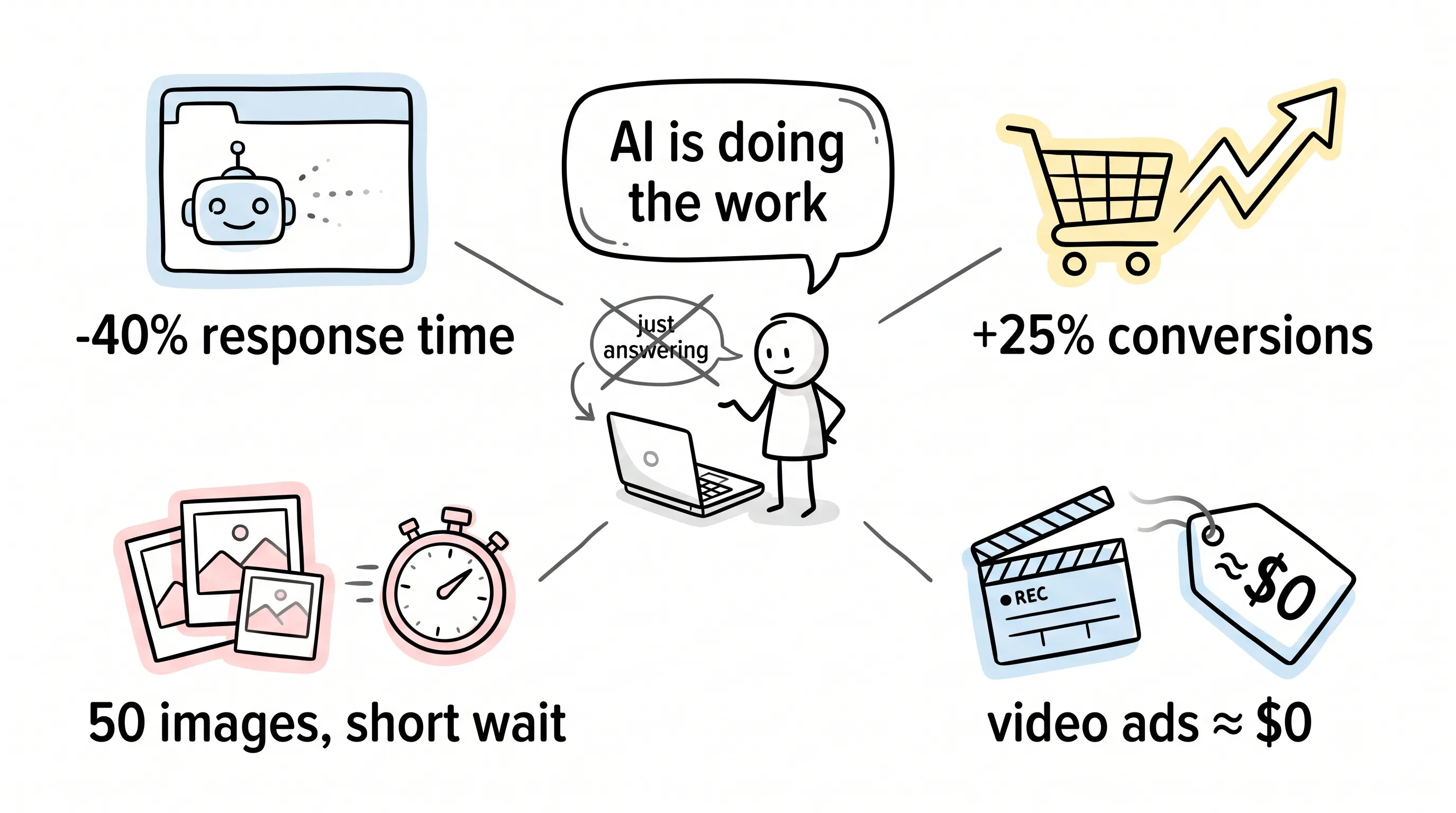
AI has gone from "answering questions" to "doing the work."
First, Customer Service — the #1 Pain Point for Store Owners
What do I mean by AI customer service? Isn't that just a chatbot? We've had those for ages.
True, we have. But this time is different.
Text — the company behind LiveChat, ChatBot, Inbox, and HelpDesk — released a Shopify app that bundles all four tools together and adds a fleet of AI agents into the mix. And it goes further: it plugs straight into the WhatsApp Business inbox. In places like Southeast Asia and Latin America, where business runs on chat apps, owners no longer have to bounce between several windows.
The official line calls it "the AI operations layer of the modern e-commerce tech stack." In plain language: routine questions get answered by AI directly; complex ones get handed off to a human on its own; and it learns from past conversations.
Feedback from merchants who've used it: for high-frequency questions like order status and return policies, response times dropped by as much as 40%.
Forty percent — that's a number measured by merchants in real stores, not a marketing claim.
Now, another one.
Voiceflow, a platform for building AI agents — its early-July changelog reads: native Shopify integration.
What does that mean?
Customer-service AI used to run on static knowledge bases. You fed it your product info once, and the moment it went stale, it started giving wrong answers. This time, the agents read your store's live data directly. Orders, inventory, products — all alive.
Say a customer asks: "Is that blue sweater still in stock in size L?"
The agent checks inventory on the spot. In stock? It drops it into the cart. Out of stock? It recommends two alternatives. The whole thing happens inside the chat window — not a single human agent gets pulled in.
Early testers reported conversion rates up 25%.
What 25% means for a store — anyone who's run one knows.
Next, Content — Small Teams' Achilles' Heel
We've talked a lot about image generation. But this time, one thing deserves its own mention.
PixPix, a platform for AI images and video, has integrated Google's lightweight model Nano Banana 2 Lite.
Why integrate a "Lite"? Aren't big models stronger?
Think about it: when does a store owner need images? At a product launch — 50 images in a single batch. Product shots, lifestyle scenes, ad creatives, thumbnails. On a big model, one image takes several minutes. A lightweight model has low latency, saves compute, and the image quality still holds up.
50 images go from "an overnight wait" to "a short wait."
For small teams without a designer, this might be the difference between shipping new products daily and not.
Then, the One I Find Most Interesting
AllyHub — browser-native AI automation.
What does browser-native mean? No code to write, no APIs to wire up, no software to install. A browser extension is all you need.
You demonstrate the task once: scrape a competitor's prices, write product descriptions in a specified style, fill them into a form. It records that whole sequence of moves, turns it into a reusable asset, and replays it directly next time — the more you use it, the smoother it gets.
Impressive.
Automating a workflow used to mean hiring a developer or buying software. Now, you just demonstrate it once.
Ads — Where Costs Are Collapsing Fastest
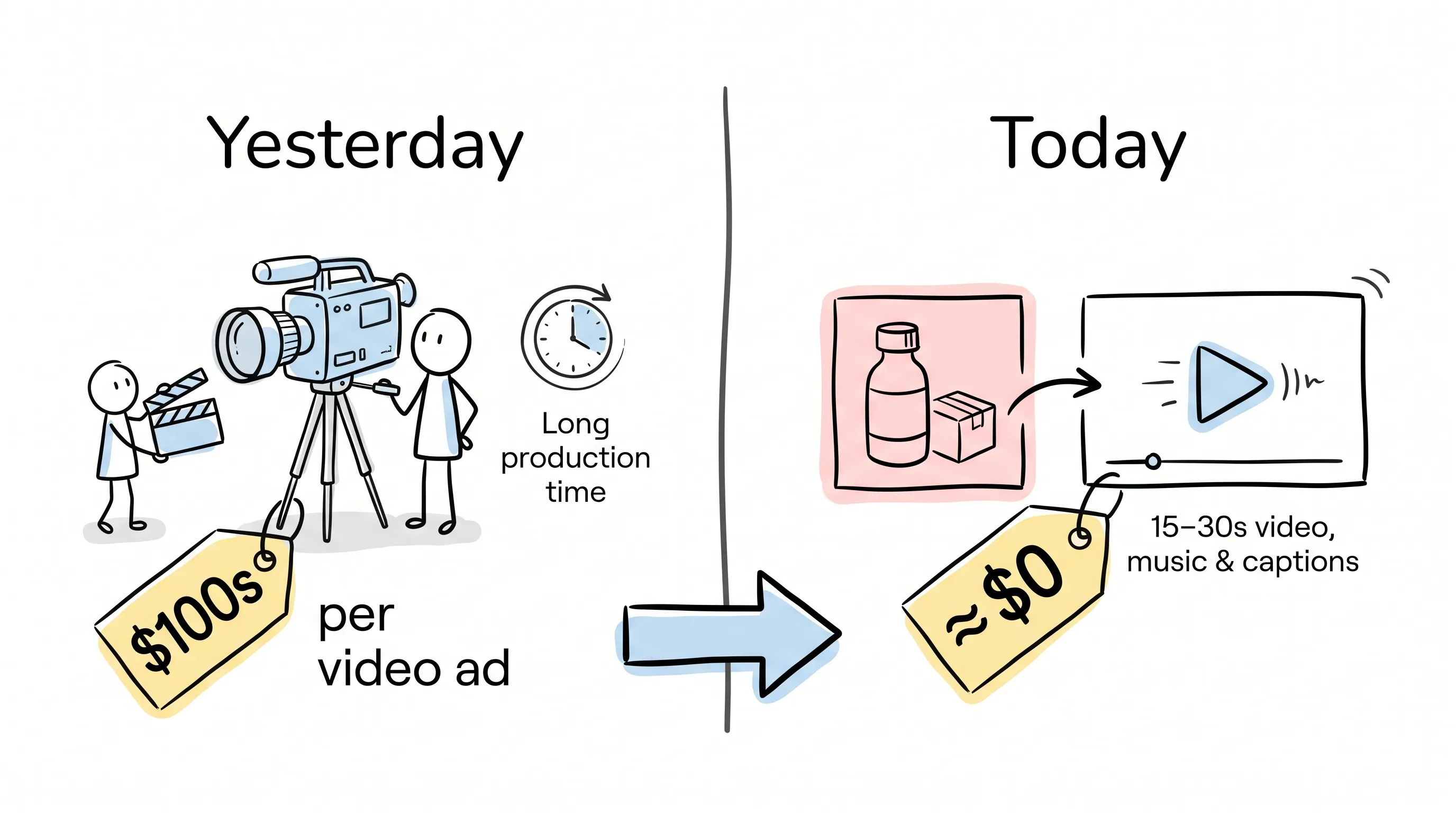
A developer has open-sourced a project: from a single product image, automatically generate a complete e-commerce video ad.
One image in, a 15-to-30-second video out. It generates lifestyle scenes automatically, adds motion effects and captions, and even comes with the background music already scored.
How's the quality? Honestly, it's still a notch below professional teams, with occasional flaws. But the point isn't the flaws — it's the cost: shooting an e-commerce video ad used to start at a few hundred bucks. Now, it's close to zero.
From a few hundred bucks to nearly zero. That's not "cost optimization." That's tearing down an entire industry's barrier to entry.
One More Signal — Don't Ignore It
Optmyzr, a company in ad management, has introduced a new approach it calls "AI Skills." It breaks marketing automation down into individual skills, and the first open-sourced one is a Google Ads audit skill: it analyzes your ad account and gives actionable recommendations directly.
Open source means ad agencies and in-house teams can adapt it to their own industries.
Why does this direction matter? Because the shape of tools is changing.
Before, you needed one all-in-one big tool. Now you can pick and install from a "skills marketplace" — just like installing apps on Shopify today. An audit skill today, bid optimization tomorrow, copy generation the day after.
What Do These Tools Have to Do with You?
A few calls — take them for what they're worth.
If you want to try something new, start with customer service and content. Text or Voiceflow for service; PixPix or AllyHub for content. These two areas pay back fastest and show results you can see.
But one thing you need to think through: agentic AI. The direction of this batch of tools is clear — not just answering, but acting. Checking inventory, changing orders, producing ads. Your tech stack will rely more and more on these agents that can string systems together on their own. And while they save you labor, their permissions keep getting wider. Data privacy — think it through before you turn them loose.
Also, the barriers are collapsing. Open-source options and free versions keep multiplying. Small businesses that could never afford AI automation can now experiment at low cost.
Finally, Back to Going Global
This July, an industry report from South Africa concluded that AI and cross-border trade are reshaping the local e-commerce ecosystem. From product discovery to after-sales support, AI has seeped into the entire chain.
Sounds far away?
Think about Voiceflow's agents, which can answer in multiple languages. Think about PixPix's images, which can localize product pages. Think about Text's WhatsApp integration, built from the start for markets spanning time zones and languages.
For small teams running a going-global business, the biggest costs used to be people and time zones. Now, AI is eating away at both, bit by bit.
At the start of this piece, I said I sat in my chair for a good long while after going through the news. I sat that long thinking about one thing:
Tools get released one after another, and barriers collapse one after another. When they've all collapsed, what's left to compete on? Your understanding of the business.
Whoever figures it out first moves first.
Hope you get moving early, too.
Continue reading
Related articles

Cross-Border Business: Time to Upgrade Your AI Toolbox
A learn article explaining how AI tools help cross-border e-commerce sellers clear five hurdles: language, regulation, logistics, payments, and fraud. It outlines a five-compartment toolbox, a five-step adoption path, and metrics such as conversion rate and CLV, while cautioning against over-reliance on AI.

AI Is Taking Over the Dirty Work of Social Media Marketing, One Task at a Time
This learn article outlines four social media marketing tasks AI can handle — audience analytics, content drafting and design, ad targeting and creative testing, and spam moderation — and cautions that taste, judgment, and data security remain human responsibilities.

AI Is Already This Good — Why Is Your Social Media Marketing Still Pure Manpower?
An overview of 18 AI tools for social media marketing, organized into six categories covering audience research, content creation, scheduling, comment and DM handling, ad management, and visual production, plus notes on personalization, prediction, and emerging trends.