
AI Is Transforming Influencer Marketing — and the Most Expensive Commodity Is a Dose of "Real"
An overview of how AI is reshaping influencer marketing, covering AI-driven creator discovery, automated outreach and campaign management, audience segmentation, fake-follower detection, predictive analytics, and virtual influencers, with a closing argument for keeping authenticity with human creators.
A while back, an old friend of mine who runs a beauty brand invited me to dinner. He'd barely sat down before he let out a sigh.
He told me: last year, when they went looking for creators to seed their product, five people on his team spent all day, every day scrolling Instagram and TikTok — checking who had the biggest following, whose content felt on-brand — until their eyes glazed over. After all that, they managed to shortlist 50 people, sent out 50 DMs... and got fewer than 10 replies.
I said: isn't this exactly the kind of work you should have handed to AI ages ago?
He paused, then shot back: "AI? You mean those fake virtual people posing for photos? Wouldn't that blow up in our face?"
Come on, dinner's on me tonight. I'd just finished going through how AI is actually being used across the influencer marketing industry, end to end.
By the time you finish reading, you'll see that what AI is doing to this business goes far beyond "making a few virtual influencers." It has flipped nearly the entire pipeline upside down.
The Numbers First — So You Know Why This Can't Wait
The 2024 State of Influencer Marketing benchmark report asked a question that cuts straight to the bone: when you run a campaign yourself, what's your biggest pain point?
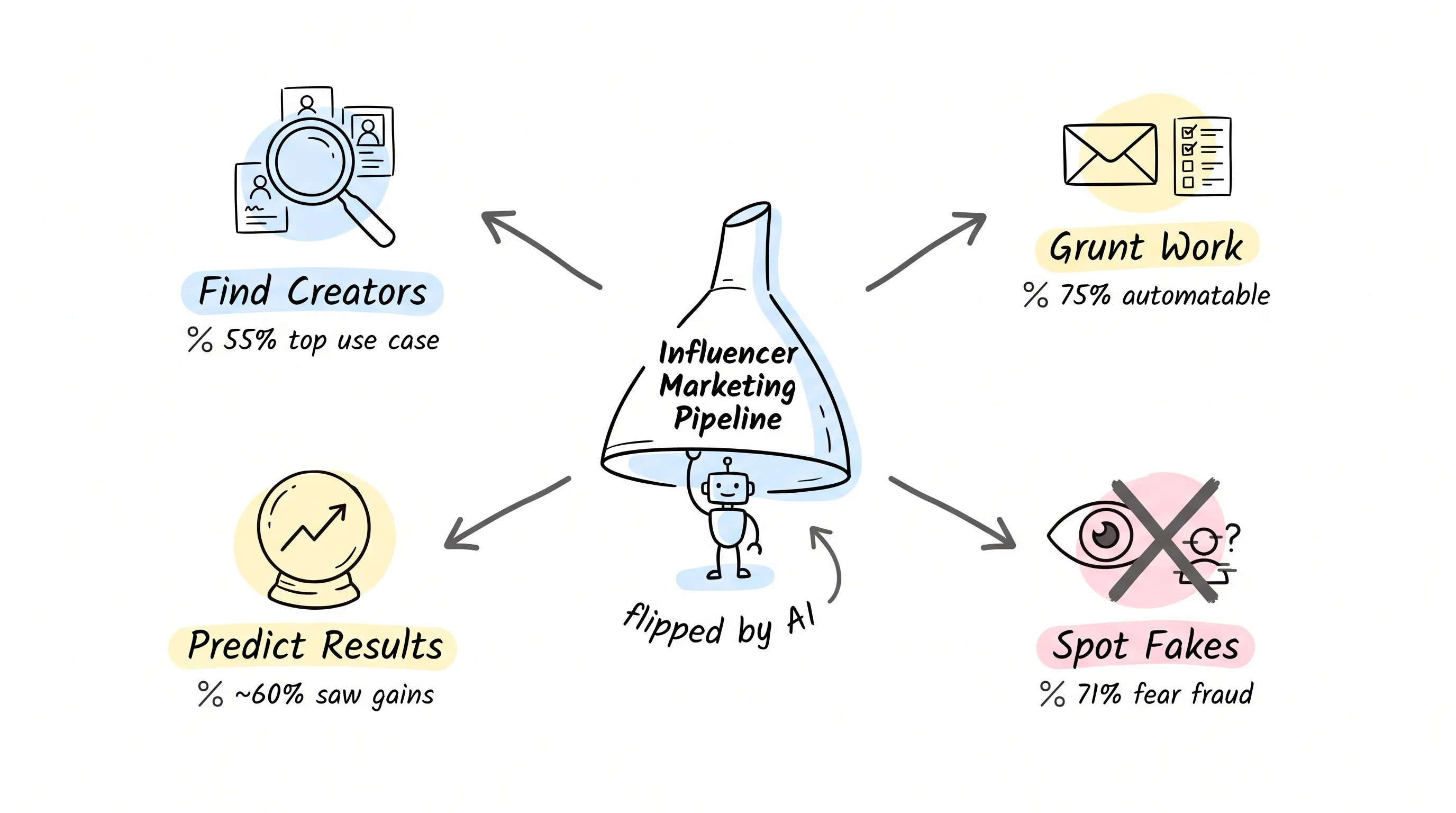
29.8% of marketers picked the same answer: finding the right creators.
Why is it so hard? Follower counts are easy to fake, and whether a creator's persona actually fits your brand is a gut call — the whole process is riddled with traps. Another 14% flagged contracts and deadlines as their headache, and 13.3% put it plainly: not enough hands, not enough hours.
Put bluntly, more than half of this business's manpower used to be burned on grunt work.
And once AI walked in? In that same survey, nearly 75% of respondents believed a substantial chunk of influencer marketing work could be automated. 63% of marketers were already planning to use AI in their campaigns. And among those already using it, nearly 60% said the results genuinely improved.
Think about that: 60% say it works, and 63% are lining up to get in. That's not a trend anymore. That's the new normal.
Finding Creators: This Step Has Changed Completely
First, let's get precise about what "finding creators" really means.
How did it used to work? Two hard criteria: does the category match, and is the following big enough. Selling fitness products? Go find fitness influencers with 500K+ followers and check them one by one.
That approach could pass muster back in the early days. Then it stopped working.
Why? Brands gradually realized that a big following doesn't equal sales. You need creators who genuinely share your values — only then will their audience buy what you're selling. But "value alignment" can't be measured in follower counts; you had to scroll through their content screen by screen. And when exactly did that ever end?
Once AI arrived, this job got done a completely different way.
Algorithms sweep through millions of creators in one go — their content, audience profiles, engagement rates — then use natural language processing (NLP) to parse what topics they talk about and what words they tend to use, and rank the list by how well each one matches your brand's tone. You no longer scroll through content; you go straight to the shortlist.
Even more impressive is LTK's Match.AI. It doesn't just look at what a creator says — it looks at what actually sells. What products this creator has promoted, which categories moved well, how product performance looks in real time — it factors all of that in, then tells you point-blank: pick these people; they convert the hardest.
Modash lets you search by what's in the frame. You don't type in keywords; you let it look at what the content actually shows. Captions can lie. Visuals can't.
Sprout Social has a particularly clever little feature: find similar creators. If you already have one creator who's a perfect fit — say, someone doing outdoor camping content — the platform takes that person's profile and pulls up everyone else talking about the same topics, then lets you filter further by audience size and content category.
And yes — today, the number one reason marketers give for using AI, cited by over 55% of them, is precisely this: finding creators.
Leave the Grunt Work to the Machines
Once you've found your people, the work begins.
Here's an uncomfortable question: are you still typing your creator outreach emails one sentence at a time?
Using AI to pick one creator out of thousands up front, then sending DMs by hand one at a time — that's where your efficiency bottlenecks.
The way it works now: AI writes your personalized outreach, and automatically follows up on who replied and who didn't. Creative briefs are auto-generated to each creator's profile, content queues up for review with AI suggesting edits along the way. Contracts, content licensing, payments — the whole flow runs itself.
Take Skeepers: an entire campaign can essentially run on cruise control — automatic creator matching, automatic outreach, automatic content generation, automatic rights and licensing. And once you have the rights, you can repurpose the creators' content for additional distribution.
Grin keeps its eyes on the money and the results: it automatically tracks the content creators produce, surfaces the best-performing posts for you to reuse, and calculates and settles creator fees on its own.
Upfluence went even more direct: it was the first in the influencer marketing industry to build in a ChatGPT assistant, auto-generating optimized outreach emails while putting budgets, ROI, and workflows on a single dashboard — every negotiation, visible at a glance.
Run the whole pipeline end to end, and humans are left doing exactly one thing: making judgment calls.
Audience Segmentation: How Fine Can It Get?
Audience segmentation used to hit its ceiling at "category."
You sell fitness products, so you find fitness influencers. Want to go finer — powerlifters, marathon runners? Sure, go sift through content by hand. That's why campaigns of the past often looked like "an audience full of fitness people" when in reality yogis, weightlifters, and aerobics fans were all mixed together. Money went out; conversions didn't line up.
AI punched through that ceiling.
It can scan a creator's entire body of content and tell you: this person mainly covers home organization, with a focus on minimalism, and touches on small-apartment makeovers on the side. Note that — this is no longer a "home and lifestyle influencer." This is a channel that precisely reaches "minimalist small-space enthusiasts."
Modash's take: it breaks a creator's audience interests completely apart and lays them out for you, paired with their most-used hashtags and mentions, so you can tell at a glance whether this creator is "precise" enough.
Precision beats size.
Fake Followers? AI Sees Right Through Them
This deserves its own section, because it's getting worse.
There are services out there that sell fake followers and fake engagement, and they can make any creator's numbers look as pretty as you like. Choose creators by numbers alone, and you're handing money straight to the fraudsters.
How many people are worried? In that 2024 benchmark report, over 71% of respondents were concerned about influencer fraud, up from 64% in 2023. And the share who had actually experienced fraud climbed from 31% in 2022 to nearly 60% in 2024.
Nearly doubled in two years. That's not a punchline — that's the industry's baseline.
How painful is manual fraud-checking? You comb through comment sections, pull out follower accounts, and inspect them one by one to tell real humans from bots. Feasible for one creator. What about a hundred?
AI does this at an absurd speed.
Modash flags each creator's fake-follower percentage outright, and it breaks the numbers down in fine detail: real people, other influencers, mass followers, suspicious bulk-follow accounts, bots and fake accounts — laid out layer by layer. Just about every inflation tactic ends up with nowhere to hide.
In industry surveys, using AI to spot fake creators and fake engagement already ranks as the third most common use case.
The Biggest Dividend Is Actually Fortune-Telling
Everything above was about saving time. AI's most valuable capability in this business is making predictions for you.
What does prediction mean? The old way to judge whether a creator would perform was to run one campaign and see. You only learned if it worked after spending. The cost of that trial and error? Your actual, hard-earned budget.
Predictive analytics takes a creator's historical performance patterns, audience data, and content signals to forecast roughly what results they can deliver — before the campaign even launches, you already know the ballpark. And after launch, Linqia's Resonate platform can track audience sentiment in real time, so you adjust while the campaign is running.
That said, the technology isn't mature yet. Surveys show 22.3% of respondents are using predictive analytics — fourth place — while 41% ranked "better performance prediction" as their most anticipated improvement. First place.
Real demand on one side; a technology just getting started on the other.
This is the single biggest opportunity window in influencer marketing's next chapter.
Here's Where It Gets More Interesting: The Influencer Itself Can Be AI
Having covered the whole pipeline, let's talk about the means of production themselves.
There's now a category of influencer called the virtual influencer, or AI influencer. Using tools like Midjourney or Stable Diffusion, you type in text to generate a virtual character, then build a persona around that figure, grow the account, and start taking brand deals.
Real humans get tired, cause scandals, and raise their rates. Virtual humans do exactly as they're told.
Which makes marketers' attitudes toward them quite interesting. One State of AI and Influencer Marketing report found: nearly 60% of marketers are already planning campaigns with AI influencers, and 77% of those believe this type of influencer performs well. Over 56% consider AI influencers more usable and flexible than real ones — after all, a real person can't be custom-built from scratch around your brand story.
Now let's run the numbers. Industry data shows more and more brands keeping per-campaign budgets under ten thousand dollars — yet a big chunk of that still goes to the creator themselves. Switch to an AI influencer, and the biggest cost becomes the AI platform's subscription fee. No creator fees.
Whatever you save is pure profit.
But. There's always a but.
Nearly 50% of respondents are seriously worried about the ethics of AI influencers. It boils down to one thing: did you actually tell consumers this "person" isn't a person? Lack of transparency is deception. There's no gray area here.
And nearly 40% worry about something else: the fake, in the end, lacks that dose of "real." Keep in mind — when consumers choose which creators to trust, authenticity ranks near the top. Real influencers have stories, lived experiences, past wrecks — and that's exactly why fans stand behind them. However polished a virtual persona is, it carries no scars.
That worry has data behind it: a July 2024 survey found 36.7% of marketers concerned that AI influencers lack authenticity, and 19% worried consumers would distrust the brand as a result.
So you see, this isn't one replacing the other. Real humans' strengths are authenticity and empathy; AI's strengths are control and cost. Deploying each where their strengths lie is the right answer. There are real-world precedents already: virtual influencer Lil Miquela has over 2.5 million Instagram followers, collaborates with designer brands, and runs public-interest campaigns on the subject of e-waste.
Oh, and don't forget to tally the legal bill. AI-generated content can step on plagiarism landmines. Efficiency can go to the machines — judgment has to stay with humans.
So, Are Human Influencers Out of a Job?
Back to that friend from the dinner at the start.
My advice to him was one sentence: hand creator discovery to AI, hand campaign management to automation, hand fraud detection to data — but don't outsource the human touch in your content.
AI does all the grunt work, drags every fake into the light, and pre-calculates everything that could go wrong. But the better it performs, the more valuable that real, clumsy, scarred sincerity of human influencers becomes.
Leave efficiency to the machines.
Keep sincerity for the humans.
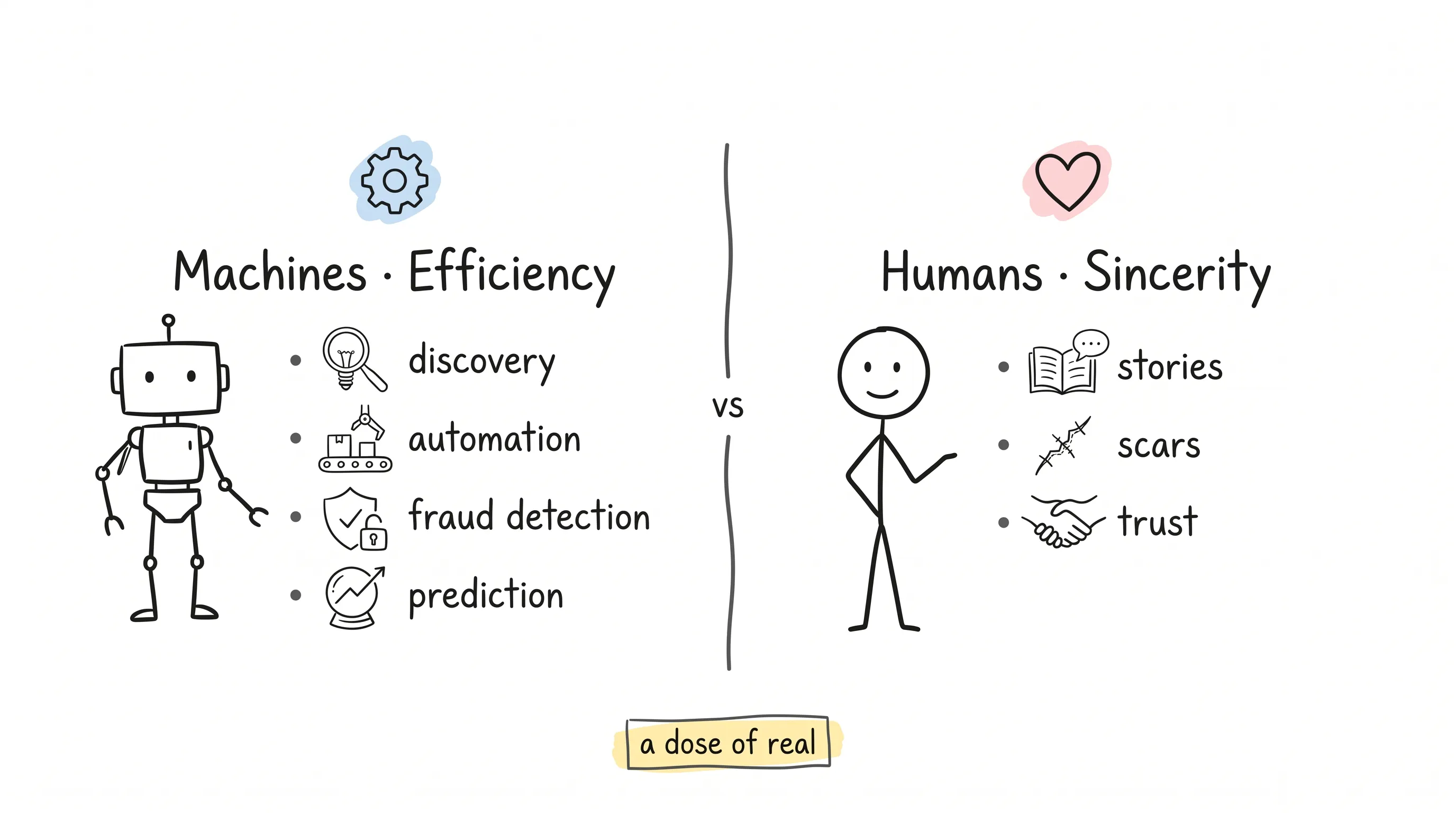
That's the right way to navigate this transformation. Here's wishing you, amid all this change, a firm grip on efficiency — and a firm hold on that dose of real.
Continue reading
Related articles

Cross-Border Business: Time to Upgrade Your AI Toolbox
A learn article explaining how AI tools help cross-border e-commerce sellers clear five hurdles: language, regulation, logistics, payments, and fraud. It outlines a five-compartment toolbox, a five-step adoption path, and metrics such as conversion rate and CLV, while cautioning against over-reliance on AI.

AI Is Taking Over the Dirty Work of Social Media Marketing, One Task at a Time
This learn article outlines four social media marketing tasks AI can handle — audience analytics, content drafting and design, ad targeting and creative testing, and spam moderation — and cautions that taste, judgment, and data security remain human responsibilities.

AI Is Already This Good — Why Is Your Social Media Marketing Still Pure Manpower?
An overview of 18 AI tools for social media marketing, organized into six categories covering audience research, content creation, scheduling, comment and DM handling, ad management, and visual production, plus notes on personalization, prediction, and emerging trends.